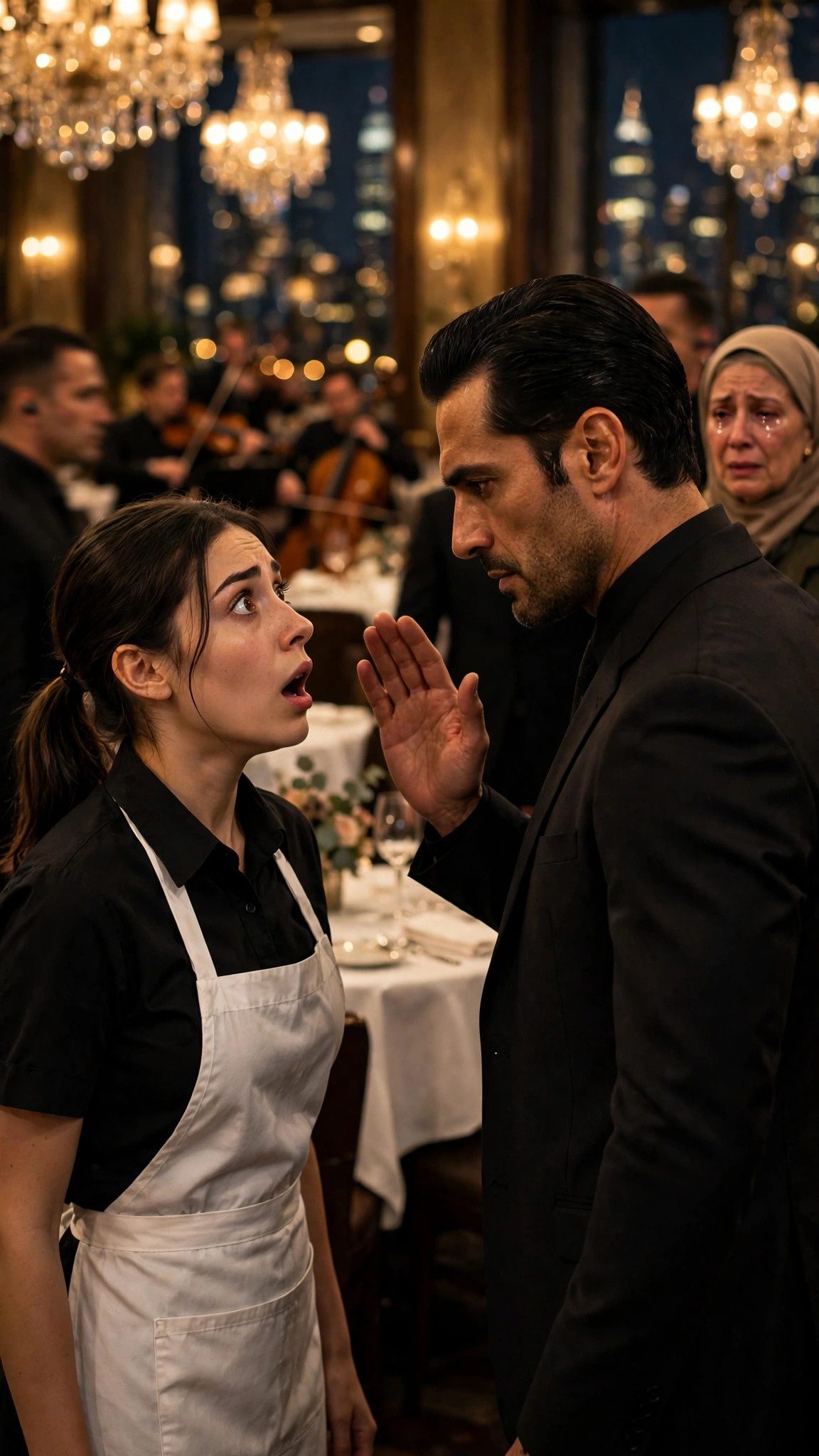
Three months later, on a cold evening in January, I stood in the Bellweather Room in a dress that was not a uniform, and I watched the string quartet tune their instruments in the lobby, and I thought about how strange it was that a room could look exactly the same and feel completely different.
The white tablecloths were the same. The warm light was the same. The vanilla-scented tea was the same. But I was not the same. I was not the waitress with the soft nervous voice and the little notebook in her apron pocket, counting her tips and smiling while a thief stole from her. I was Nia Rahal Brooks, the granddaughter of Amina Rahal, the niece of Kareem Rahal, the daughter of Layla Rahal, and I was standing in the restaurant where my life had changed, and I was about to change it again, for every girl who worked there.
Kareem had bought the Bellweather Room.
He had bought it the week after Marcus Hale left New York, quietly, through a lawyer, for a price that made the previous owner's eyes widen, and he had signed the papers, and he had handed me the keys, and he had said, "It is yours, Nia. Not as a gift. As a trust. You will run it. You will hire the staff. You will set the wages. You will make sure that no waitress in this restaurant ever has to count her tips in a little notebook and wonder where the money went. That is your job now. That is what your mother would have wanted."
I had cried. I had stood in the dining room with the keys in my hand, and I had cried, because nobody had ever trusted me with anything bigger than a tray, and now the most feared man in New York was trusting me with a restaurant on Fifth Avenue, and with the lives of twenty-three people who worked there.
The first thing I did was raise the wages. The second thing I did was abolish the envelope. Tips went directly to the waitress who earned them, in cash, at the end of every shift, counted in front of her, with a witness, and written down in a ledger that anyone could inspect. The third thing I did was hire Rosa as the head waitress, and Mei as the assistant manager, and I gave them both raises, and I told them that the Bellweather Room was their restaurant now, too, and that no one would ever steal from them again, not while I was alive.
The fourth thing I did was invite my father to dinner.
He came on a Friday night, wearing his best suit, the one he had worn to my mother's funeral, and he sat at the table next to the main window, the table where Kareem had sat that October night, and he ordered vanilla-scented tea, and he looked around the dining room, at the white tablecloths and the warm light and the string quartet in the lobby, and he said, "Your mother would have loved this place, Nia. She would have loved to see you here, running it, standing tall in it. She always said you were braver than both of us."
"She was wrong," I said. "I am brave because of both of you. Because she taught me the words, and because you kept the box, and because you loved her enough to let me find my family, even when it frightened you."
He reached across the table, and he took my hand, and he held it, and for the first time in nineteen years, I saw my father smile without sadness behind it.
Kareem came to dinner that night, too. He came with Amina, and with Nabil, and they sat at the table with my father, and they talked, and they laughed, and Amina told stories about my mother as a little girl in Beirut, stories I had never heard, stories about a girl who sang in the kitchen and chased birds on the balcony and laughed like a bell, and my father told stories about my mother in Brooklyn, about the night he heard her laugh in a little club and knew he would love her for the rest of his life, and the stories fit together like two halves of a photograph, and for the first time, I saw my mother whole.
After dinner, Kareem took me aside, into the little office that had once been Marcus Hale's, with its smell of old coffee and cleaning fluid, and he said, "There is something I want to tell you, Nia. Tariq is gone. He left New York the night of the council, and he will never come back. Castellano has gone quiet. His men have stopped watching this restaurant. His men have stopped watching our ships. I think he has understood that the Rahal family is not as easy to break as he thought. And I have made a decision. I am going to turn our business toward the light. The shipping company will become legitimate, all of it, every ship, every route, every dollar accounted for. It will take years. It will cost us money. But it is the right thing to do, and it is what your mother would have wanted, and it is what I want, for the first time in my life."
"Why?" I asked. "Why now?"
"Because of you," he said, simply. "Because you spoke the words, and the words saved a man's life, and they changed my heart, and I do not want to be the man who orders killings in warehouses anymore. I want to be the man my sister would have been proud of. I want to be the uncle you deserve."
I hugged him then, and he held me, and he was warm and solid, and he smelled of vanilla and smoke, and I thought about the night he had walked into my restaurant, cold and charming and silent, and I thought about how far we had both come since then.
The string quartet played in the lobby. The guests laughed and talked and clinked their glasses. The Bellweather Room glowed with warm evening light. And in the corner, by the window, a young man with dark hair and a cello between his knees was watching me, the way he had watched me for weeks, ever since I had taken over the restaurant, and when our eyes met, he smiled, a shy, hopeful smile, and I smiled back.
His name was Elias. He was the cellist in the quartet, and he had gentle hands, and a quiet voice, and he had once told me that my mother's lullaby, the words I had whispered to myself for nineteen years, sounded like a song his grandmother used to sing in Greece, and we had laughed about it, about how the whole world was smaller than anyone thought, and how music traveled across oceans the way families did.
I did not know what would happen with Elias. I did not know if it would become something, or if it would stay a smile across a dining room. But I knew that I was not afraid anymore. I knew that I had a family, and a restaurant, and a future, and that the words my mother had taught me were not just a plea, but a promise.
"Ya habibi, la tuqatiluh. Ya habibi, ruuh ahlaykum."
My love, don't kill him. My love, go home to your family.
That night, after the last guest had gone, and the quartet had packed away their instruments, and the lights in the dining room had begun to dim, Amina took my hand, and she led me to the table next to the main window, and she sat me down, and Kareem sat on one side of me, and Nabil sat on the other, and my father sat across from us, and we drank vanilla-scented tea, and we talked, in English and in Arabic, in two languages, in one family, and Amina looked at me, and she said, "You look like him, child. You look just like your grandfather. And your mother is smiling, wherever she is. I can feel it. She brought you home to us, Nia. She brought you home."
And I sat there, in the Bellweather Room on Manhattan's Fifth Avenue, with my grandmother on one side and my uncle on the other and my father across the table, and my mother's locket warm against my skin, and I thought about the sentence that had turned the limousine around, and I thought about how a few words, spoken by a frightened waitress in a black uniform, had changed everything, and I thought about how life's gifts are often cloaked in its toughest lessons, and I thought about my mother, singing to me in a language I did not understand, in a room with white walls and a window that looked out over a parking lot, and I whispered the words one more time, not in fear, but in gratitude.
"Ya habibi, la tuqatiluh. Ya habibi, ruuh ahlaykum."
My love, don't kill him. My love, go home to your family.
And this time, I knew exactly what they meant.
One year later, on a cold evening in October, exactly one year after the night Kareem Rahal walked into my restaurant, I stood in the Bellweather Room in a dress that was not a uniform, and I looked around at the white tablecloths and the warm light and the string quartet in the lobby, and I thought about how much had changed, and how much had stayed the same.
The restaurant was full. Every table was taken. Rosa moved between them with her tray balanced on her hand, smiling, and Mei stood at the door, greeting the guests by name, and my father sat at the table next to the main window, the table where Kareem had sat that first night, and he held his saxophone in his lap, and when the quartet took a break, he stood up, and he played, low and sweet, a song my mother had loved, a song I had heard him play a hundred times in subway stations and hotel lobbies where nobody listened, and tonight, everybody listened. The whole dining room went quiet, and the guests put down their forks, and the waitresses stopped in their tracks, and my father played, and I cried, because my mother would have loved to hear him play in a room like this, in a room full of people who were listening.
Elias sat beside me at the table, the cellist with the gentle hands and the quiet voice, and he held my hand under the tablecloth, and he did not say anything, because there was nothing to say, and that was enough. We had been together for six months, and he had asked me, very shyly, over coffee in the kitchen after closing one night, if I would let him take me to dinner, somewhere that was not the restaurant where we both worked, and I had said yes, and he had taken me to a little place in the Village with candles on the tables, and he had told me about his grandmother in Greece, and about the songs she used to sing to him, and we had discovered, laughing, that one of her songs had the same melody as my mother's lullaby, and that the whole world was smaller than anyone thought, and that music traveled across oceans the way families did.
Amina sat across from us, in her head-cover, neat and white, her cane leaning against the table, and she watched my father play, and she wiped her eyes with a handkerchief, and she said, "Your mother is here tonight, Nia. I can feel her. She is sitting right beside me, and she is listening to your father play, and she is so proud of you, so proud of all of you."
Kareem arrived late, as he always did, in his dark tailored suit, with Nabil beside him, and the whole restaurant seemed to rearrange itself around him, the way water rearranges itself around a stone, but he did not sit at the best table, and he did not order vanilla-scented tea, and he did not sit in silence studying anyone's face. He walked straight to our table, and he kissed his mother's cheek, and he shook my father's hand, and he sat down beside me, and he said, "I have news. The last of the old contracts is finished. The shipping company is clean, Nia. Every ship. Every route. Every dollar accounted for. It took a year, and it cost us more money than I want to think about, but it is done. The Rahal family is legitimate now. All of it. Your mother would have been proud."
I looked around the table, at my grandmother, and my uncle, and my father, and Elias, holding my hand under the tablecloth, and I thought about the girl I had been a year ago, the waitress with the soft nervous voice and the little notebook in her apron pocket, counting her tips and smiling while a thief stole from her, believing she was nobody, believing she was alone, and I thought about how that girl had spoken one sentence in Arabic, one sentence she did not understand, and how that sentence had turned a limousine around, and had brought her home.
"Ya habibi, la tuqatiluh. Ya habibi, ruuh ahlaykum."
My love, don't kill him. My love, go home to your family.
And this time, I knew exactly what they meant.
The Bellweather Room is still there, on Fifth Avenue, with its white tablecloths and its warm light and its string quartet in the lobby, and the envelope is gone, and the little notebook is gone, and in their place there is a ledger, open on the manager's desk, where every tip is written down in plain numbers that anyone can read, and where no waitress ever has to wonder where her money went. Rosa bought a house last spring. Mei's mother has a little house with a red door. And every night, when the last guest has gone and the lights begin to dim, I stand at the table next to the main window, and I touch my mother's locket, and I whisper the words, not in fear, but in gratitude, for the family that found me, and the home that waited for me, and the sentence that turned the limousine around.
The End.
THE END