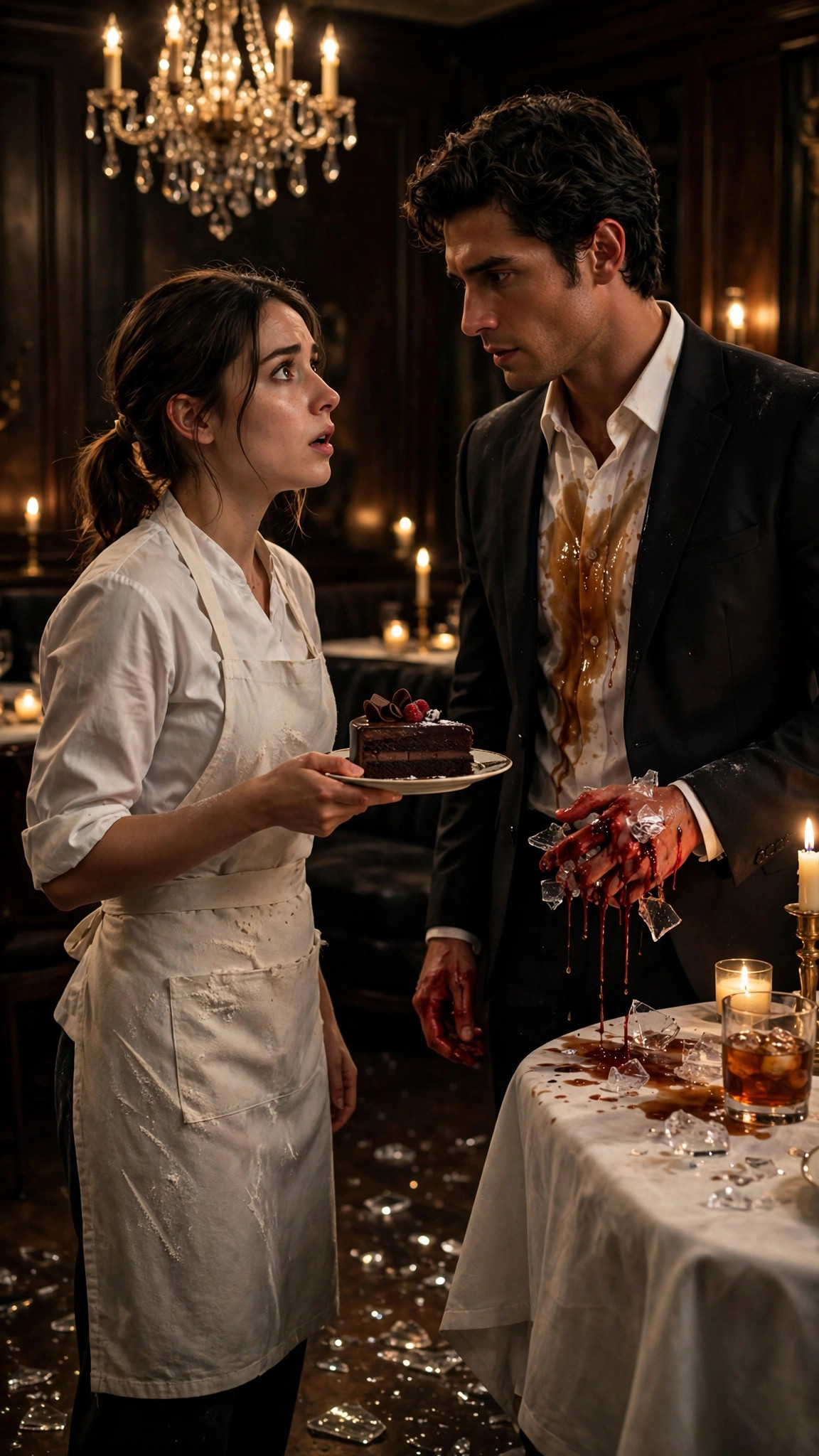
The next morning, I arrived at the Imperial at five as always, and the first thing I noticed was the black car parked across the street. It was a sedan with tinted windows, and it had not been there yesterday. I told myself it was nothing. Rich people parked black cars on Michigan Avenue all the time.
By seven, I had forgotten about it. By noon, I had forgotten about the whole night, or at least I had buried it under work, the way I buried everything I did not know how to feel. Lunch service was busy. A bride came in to taste wedding cakes. Priya burned a tray of macarons and blamed the oven, which was fair, because the oven was old and spiteful.
At three in the afternoon, Anthony came into my kitchen and closed the door behind him. That was unusual. Anthony never closed doors. He liked to be seen, and he liked to see everything.
"Camila," he said, "we need to talk."
"About what?" I asked. My hands were in a bowl of ganache.
"About last night. About Mr. Moretti. About what you are going to do."
"I am not going to do anything," I said. "I am going to bake, the way I always do."
Anthony laughed, but there was no humor in it. "Camila, you don't understand. A man like Lorenzo Moretti does not say the things he said last night and then forget about them. He is going to come back. And when he does, you need to be ready."
"Ready for what?" I asked.
He did not answer. He looked at the door, then back at me, and lowered his voice. "Just be careful. That is all I am saying. Be careful, and do not go anywhere alone. And if anyone you do not know asks you questions about the restaurant, or about Mr. Hale, or about me, you tell me first. Do you understand?"
Before I could answer, the kitchen door opened and Marcus Hale himself walked in. Marcus Hale was fifty-two years old, tall and heavy, with gray hair and a face that had once been handsome and was now mostly tired. He owned the Imperial. He had built it from nothing, the way Rosa had built her bakery, and he was proud of it in a way that made him easy to like and hard to work for.
"Camila," he said, "can I have a word? In my office."
I followed him down the hall to his small office, past the wine cellar and the dry storage, and he closed the door and gestured for me to sit. He did not sit. He stood behind his desk with his hands braced on it, and he looked at me the way a man looks at someone he is about to disappoint.
"Last night," he said, "I was not in the dining room when Mr. Moretti spoke to you. I was in the bar. I heard about it afterward, from Anthony. And I need you to know something, Camila, because you deserve to know it before anyone else tells you."
He paused, and his hands tightened on the desk.
"I owe Vincent Castellano four hundred thousand dollars," he said. "Gambling. I have been in debt to him for two years. I have paid the interest every month, but the principal has not moved, and last week, Castellano sent a man to tell me that he was done waiting. He wants the Imperial. He wants the building, the name, the kitchen, all of it. And he told me, very clearly, that if I do not sign the papers by the end of the month, he will take it anyway, and he will take something else besides."
"What else?" I asked, though I already knew.
"You," Marcus said quietly. "He knows who you are, Camila. Everyone in this city knows who you are. Your cake is the reason people come here. Castellano wants the best pastry chef in Chicago working in his restaurant, and he is not a man who asks politely."
My hands went cold. "How long have you known this?"
"Two weeks," he said. "I was going to tell you. I was trying to find a way out. I went to a bank. I went to two banks. No one will lend me the money, not with the restaurant as it is. And then last night, Lorenzo Moretti walked in and claimed you in front of his men, and I thought, God help me, I thought that maybe, just maybe, that was the way out."
"You thought his claim would protect me," I said.
"I thought his claim would protect all of us," Marcus said. "Castellano will not touch a woman Lorenzo Moretti has claimed in public. It would be war. And Castellano does not want a war with the Morettis. Not yet."
I stood up. My legs felt unsteady. "Mr. Hale, with respect, I did not agree to be anyone's protection. I did not agree to be claimed. I am a pastry chef. I make cakes. That is all I am."
"I know," he said. "And I am sorry. I am sorry I put you in this position. But Camila, you need to understand something. Castellano's man has been coming here for weeks. He sits at the bar and watches the kitchen door. He watches you. And last night, when Moretti claimed you, that man was still sitting there. He saw all of it. He went back to Castellano and told him. So whatever happens next, it is already happening."
I left his office without another word and went back to my kitchen, and I worked until my hands ached, because work was the only thing I knew how to do when the world stopped making sense.
At six that evening, I was walking home from the restaurant, and I saw the black car again. This time it was parked on my street, two houses down from my building. I stopped walking. My heart hammered. The car door opened, and a man got out.
He was tall, in his forties, with cold eyes and a neat, expensive suit. He did not look dangerous the way Lorenzo looked dangerous. He looked dangerous the way a snake looks dangerous, smooth and patient and certain.
"Miss Williams," he said, smiling. "Dominic Voss. I work for Mr. Castellano. I was hoping we could have a short conversation."
"I have nothing to say to you," I said.
"That is a shame," he said, "because Mr. Castellano has a great deal to say to you. He admires your work, Miss Williams. He has eaten your cake. He believes you are wasted in this little restaurant, working for a man who cannot pay his debts. He would like to offer you a position. His new restaurant, opening next month. Your own kitchen. Triple your salary. And your sister's tuition, paid in full, for as long as she is in school."
My blood went cold. He knew about Sofia. He knew about her tuition. He had done his homework.
"Tell Mr. Castellano I am not interested," I said.
Voss's smile did not change. "Miss Williams, I think you misunderstand. This was not an offer. This was a courtesy. Mr. Castellano does not like to be refused. And I should tell you, in the interest of honesty, that your sister walks home from school alone on Tuesdays and Thursdays. It would be a shame if something happened to her on one of those walks."
He said it the way a man says something about the weather. He turned, got back into his car, and drove away, and I stood on the sidewalk with my hands shaking so hard I could barely get my key into my front door.
I called Sofia the moment I was inside. She answered on the second ring, laughing about something her classmate had said, and I told her to listen to me very carefully. I told her not to walk home alone anymore, not on any day, not for any reason. I told her to take a cab, to stay with her friends, to call me the moment she got home every night.
"Cam, what is going on?" she asked, and her voice had gone small.
"I will tell you everything soon," I said. "I promise. But right now, I need you to trust me. Please."
"Okay," she whispered. "Okay, Cam. I trust you."
After she hung up, I sat on my kitchen floor with my back against the cabinets, and I cried for the first time since Rosa died. Not because I was afraid, although I was. Because I was angry. I was angry that a man I had never met had decided he owned my sister's safety. I was angry that Marcus Hale had gambled away the restaurant I had given four years of my life to. And I was angry at Lorenzo Moretti, because his claim had not protected me at all. It had painted a target on me.
Or so I thought.
I did not know that at that very moment, in a dark office across the city, Lorenzo Moretti was sitting across a desk from Marcus Hale, and Marcus Hale was crying.
Lorenzo had gone to the Imperial that afternoon, not to see me, but to see the owner. He had walked into Marcus's office without knocking, and he had put a folder on the desk, and he had said, "Four hundred thousand dollars. I know about the debt, Mr. Hale. I know about Castellano. And I know about the man at the bar."
Marcus had stared at him. "How do you know that?"
"Because Dominic Voss was sitting at the bar last night, watching your pastry chef through the glass, and I have had men watching him for two weeks," Lorenzo said. "I am buying your debt, Mr. Hale. As of tonight, you owe the money to me, not to Castellano. You will pay me back at a rate you can afford, over five years, and Castellano will never come near this restaurant again. Do you understand?"
"Why?" Marcus whispered. "Why would you do that?"
Lorenzo stood up and walked to the door. Before he left, he turned back.
"Because last night, your pastry chef made me a cake," he said, "and for the first time in seven years, I tasted something that reminded me of being alive. And because a man who cannot protect the thing that brought him back to life does not deserve to have it."
He left, and Marcus Hale sat alone in his office for a long time, with his face in his hands.
I did not know any of this yet. All I knew was that when I woke the next morning, the black car was gone from my street, and there was a different car there instead, a dark SUV with two men inside it who nodded at me politely when I walked past, and one of them said, "Good morning, Miss Williams. Mr. Moretti asked us to make sure you got to work safely."
I stopped walking. "Did he now."
"Yes, ma'am," the man said. "And your sister, too. There is a car outside her school from now on. She will not walk alone."
I should have been angry. I should have told them to leave. But I thought about Voss's voice, smooth and certain, talking about Sofia's walks home, and I thought about the way he had smiled, and I did something I had never done before in my life.
I said thank you.
When I got to the kitchen that morning, Priya was already there, and she took one look at my face and pulled me into the dry storage room, away from everyone else.
"Tell me," she said.
I told her about Voss. I told her about Sofia, and the tuition, and the threat that had not quite been a threat. Priya listened with her arms crossed, and when I finished, she swore quietly in Hindi, which she only did when she was truly angry.
"Camila, you need to understand something," she said. "I have worked in restaurants for ten years, and I know how this works. Men like Castellano do not send their best man to make a polite offer. They send him to scare you. And the fact that he knew about Sofia's schedule means someone inside this restaurant has been telling him things. Someone who knows your life. Someone who knows when Sofia walks home."
"Who?" I asked.
Priya shook her head. "I don't know. But think about it. Who in this building knows about Sofia's tuition? Who knows her schedule? Who knew you would be alone on the sidewalk last night?"
I thought about it all day while I worked. The kitchen staff knew about Sofia, of course. Everyone knew I paid her tuition; I had never hidden it. But her schedule, her walks home, the exact days, that was something else. That was the kind of detail only someone close would know, or someone who had been watching very carefully.
That afternoon, I went to the office to ask Marcus a question about a delivery, and I found Anthony standing by the desk with his phone to his ear, speaking in a low, hurried voice. When he saw me, he went pale and ended the call so fast his thumb slipped on the screen.
"Who was that?" I asked.
"No one," he said, too quickly. "A supplier. About the cream."
He smiled then, his usual smooth smile, but it did not reach his eyes, and for the first time, I noticed how often Anthony smiled without ever meaning it. I noticed, too, that his suit was new, and his watch was expensive, far more expensive than a restaurant manager's watch should have been. I had never paid attention to those things before. I paid attention now.
"Anthony," I said slowly, "have you been talking to someone about me? About Sofia?"
"Of course not," he said. "Camila, what are you saying?"
"I don't know what I'm saying," I said. "But something is wrong in this restaurant, and I think you know what it is."
He looked at me for a long moment, and for a second, I thought I saw something in his face that looked like shame. Then it was gone, and the smooth smile was back.
"You are imagining things," he said. "You have had a frightening few days. Go home early tonight. Rest. Let me handle the restaurant."
I did not go home early. I stayed until the last cake was in the oven and the kitchen was clean, and all the while I kept thinking about Priya's words, and about Anthony's new watch, and about the way he had hung up the phone so fast.
And then I went to work, and I baked, and I waited for whatever was coming next, because I knew, with a certainty that sat in my chest like a stone, that Dominic Voss was not finished with me, and that Vincent Castellano was not a man who took no for an answer, and that the claim Lorenzo Moretti had made in front of a room full of men was about to be tested.