Six months later, on a Sunday morning in May, the Marlowe Room opened its doors at eleven o'clock, and the first person through them was an old woman in a thin coat, carrying a plastic bag with everything she owned in it, and she stood in the doorway looking at the white tablecloths and the crystal chandeliers with the expression of a person who has walked into the wrong place.
Maya Carter saw her from across the dining room, and she crossed the floor in her black manager's suit, and she took the old woman's hand, and she said, "Welcome to the Marlowe Room. My name is Maya. Come and sit down. The soup is hot, and there's plenty of it."
That was how it worked now, every Sunday. Rosa's Table, they called it, after Ethan's mother, whose photograph hung on the wall by the entrance in a silver frame: Rosa Hayes, young and beautiful in her black uniform with the white apron, smiling at the camera the way she used to smile at the guests. Underneath the photograph was a small brass plaque, and on it were the words she had said to her son on the last day of her life, the words Ethan had finally understood: "A person's worth is measured by how they treat the people who cannot fight back."
The restaurant had changed in six months, and so had everything else. Maya ran the Marlowe Room now, and she ran it the way Mr. Marlowe had run it, with the tip pool counted in the open, in front of everyone, and the staff meal served every night, and the doors open to anyone who needed a hot meal on a Sunday. Rosa, the waitress who had kept the notebook, was the assistant manager now, and she kept the books in a ledger so clean that even Marco Bellini, who had seen every kind of cooked book in Chicago, said it was the most honest set of accounts he had ever looked at. Old Benito had come back from retirement to run the kitchen three days a week, and he had wept when he walked through the doors, and he had hugged Maya so hard she thought her ribs would crack, and he had said, "I knew this place would come back to life. I knew it the day that boy bought it."
Ethan had changed too. The bullet wound in his shoulder had healed, leaving a scar he touched sometimes without thinking, the way a man touches a wedding ring. He had started the long, slow work of taking the Hayes family legitimate: selling the gambling rooms, closing the loan-sharking operation, turning the trucking routes into a real company with real drivers and real paychecks and real benefits. It was not easy work. There were men in the family who had never done an honest day's work in their lives, and they grumbled, and some of them left, and Uncle Sal had told him, more than once, that he was ruining everything his father had built. But Ethan had looked at the numbers, and the numbers said the legitimate businesses made more money than the illegal ones ever had, and they made it without funerals, and that was enough.
And every night, when the dinner service was over and the last guest had gone, Ethan came to the Marlowe Room, and he sat at the corner table, and Maya came and sat across from him, and they talked about the day, about the restaurant, about Leo, about the future, and it was the best part of both their days, every single day.
Leo was thriving. He had grown two inches in six months, and he had gained weight, and his cheeks were round now, and his laugh was loud, and he had a room upstairs with a bed and a desk and a window that looked out over Michigan Avenue, and he had a shelf full of books, and a toy truck, and a drawing of his family that he had taped to the wall: a woman with dark hair, a little boy, and a tall man in a black suit, all of them holding hands. Underneath the drawing, in wobbly letters, he had written, "MY FAMILY."
He called Ethan "Mr. Ethan" for the first month. Then, one night at dinner, when Ethan was cutting up Leo's chicken for him, Leo had looked up and said, "Can I call you Dad?"
Ethan had gone very still. His knife had stopped in midair. And then he had put the knife down, very carefully, and he had looked at Leo, and he had said, in a voice that was not steady at all, "I would like that very much, Leo. I would like that more than anything in the world."
Maya had cried. Leo had climbed into Ethan's lap and hugged him around the neck, and Ethan had held him, and for a moment, the most feared man in Chicago had sat in his own restaurant holding a three-year-old boy, and his eyes had been wet, and he had not cared who saw.
In the spring, Leo started preschool, a small school two blocks from the restaurant, and on his first day, Maya walked him there holding his hand, and Ethan walked on his other side, and Leo wore his new backpack and carried his lunchbox like it was made of gold. When they reached the school gates, Leo turned around and waved, and Maya waved back, and Ethan waved back, and then they stood there together watching him walk inside, and Maya leaned against Ethan's shoulder, and she said, "He's growing up."
"He is," Ethan said. "And he's going to grow up knowing he is loved. That's the only thing that matters."
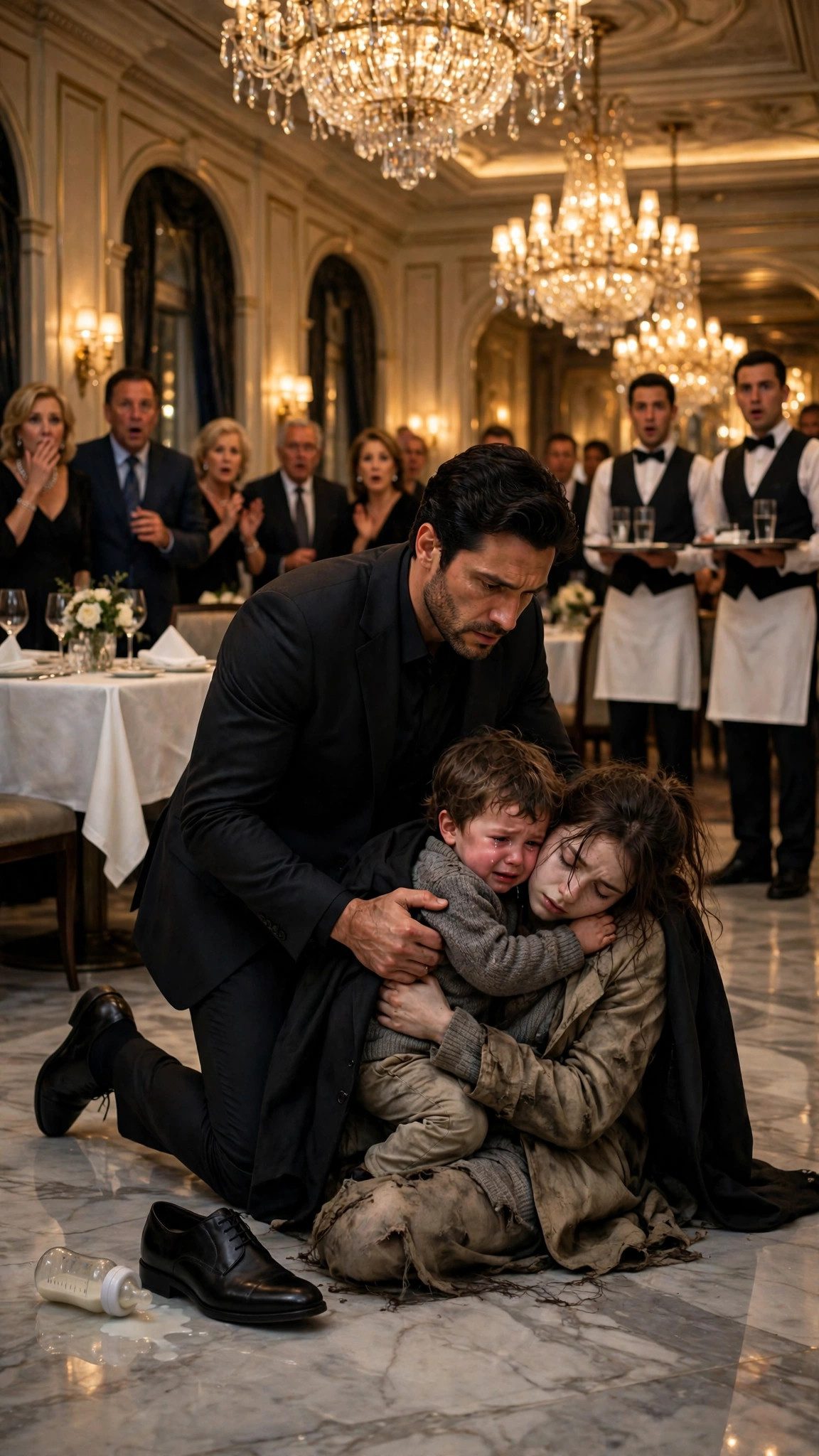
That night, after the dinner service was over and the last guest had gone and the staff had gone home, Ethan asked Maya to stay behind. The dining room was empty, the chandeliers dimmed, the marble floor gleaming in the low light, and Leo was asleep upstairs in his room, and it was just the two of them, standing in the middle of the room where, six months earlier, Maya had collapsed on the floor and Ethan had knelt beside her.
Ethan took her hands in his, and he looked at her, and for a moment he seemed almost nervous, this man who had faced down rival families and federal agents and gunmen without flinching, and Maya smiled, because she had never seen him nervous before, and it made her love him even more.
"Maya Carter," he said, "six months ago, you walked into my restaurant with nothing but twelve dollars and a little boy, and you fell on my floor, and I knelt beside you, and my life changed. I have spent fourteen years being the most feared man in Chicago. I don't want to be that man anymore. I want to be the man who comes home to you every night. I want to be Leo's father. I want to grow old with you in this restaurant, feeding people who are hungry, and I want to do it for the rest of my life."
And then he went down on one knee, right there on the marble floor, in the same spot where he had knelt beside her that first night, and he took a small velvet box out of his pocket, and inside it was a ring, a simple gold band with a single diamond, the ring his mother had worn, the ring Rosa Hayes had carried trays in for twenty-three years, and he held it up, and he said, "Will you marry me?"
Maya looked down at him, kneeling on the floor of the Marlowe Room, and she thought about the morning she woke up on a cot in a church basement, and the twelve dollars and forty cents, and the bus rides she could not afford to waste, and the bottle rolling across the marble floor, and the man who had picked up her son and held him like something precious, and she said, "Yes. Yes, Ethan. A thousand times, yes."
Leo came down the stairs in his pajamas, rubbing his eyes, and said, "Mama, why is Mr. Ethan on the floor?"
"Because he's asking me to marry him, baby," Maya said.
"Say yes, Mama," Leo said, very seriously. "Say yes, so he can be my dad forever."
"I already did," Maya said, and she laughed, and she cried, and Ethan stood up and picked Leo up in his arms, and the three of them stood together in the middle of the empty dining room, under the chandeliers, and it felt, to all of them, like coming home.
The wedding was in June, in the garden behind the restaurant, under the old oak tree that Mr. Marlowe had planted forty years earlier. Maya wore a simple white dress, the kind of dress she had always dreamed of, and her mother came, and Sister Agnes came, and Rosa and Benito and the whole staff of the Marlowe Room came, and Marco Bellini stood as Ethan's best man, and Leo carried the rings on a small velvet pillow, walking very slowly and very carefully down the aisle, because the rings were important and he did not want to drop them.
Ethan's vows were short. He was not a man of many words, and he had never been. He looked at Maya, standing in front of him in the white dress, with the oak tree above them and the restaurant behind them, and he said, "Maya Carter, I have spent my whole life being feared. You taught me what it feels like to be loved. I promise you this: I will never let you go hungry again. I will never let Leo go hungry again. And I will spend the rest of my life making sure that no one in this city ever has to collapse on a marble floor because they haven't eaten. That is my vow."
Maya's vows were longer. She talked about Daniel, and about the night Leo was born, and about the morning she woke up on a cot in a church basement with twelve dollars and forty cents to her name. She talked about the day she walked into the Marlowe Room to demand the money she was owed, and about the man who knelt down on the floor in his brand-new Oxford shoes and put his jacket over a starving stranger. And then she said, "Ethan Hayes, you knelt for me when I couldn't stand. I will stand beside you for the rest of my life. That is my vow."
They were married as the sun went down, and the guests ate dinner in the dining room, and the band played, and Leo danced with his mother, standing on her feet, and then he danced with his new father, standing on his shoes, and everyone laughed, and everyone cried, and it was, by every measure, the happiest night the Marlowe Room had ever seen.
On the first anniversary of Rosa's Table, the dining room was so full that Maya had to set up extra tables in the garden, and the line of people waiting outside stretched halfway down the block. Elena Carter was there, in a new dress Maya had bought her, sitting at a table by the window with Leo on her lap, watching her daughter run the restaurant her grandson now called home. Elena had moved into a small apartment two blocks from the Marlowe Room, paid for by the restaurant, with a sunny kitchen and a view of the avenue, and she came to the restaurant every Sunday to help serve, because, as she said, "A woman my age doesn't retire from feeding people. She just gets better at it."
That evening, after the last guest had gone, Ethan stood in the dining room with Maya and Leo, and he looked around at the empty tables and the dark windows, and he said, "A year ago, I was the most feared man in Chicago, and I ate dinner alone at that corner table, and I thought that was what strength looked like. I was wrong. Strength looks like this. It looks like a dining room full of people who have nothing, eating like they have everything. It looks like my mother smiling down from that wall. It looks like you, Maya. And it looks like Leo, handing out bread rolls like they're made of gold."
Maya took his hand, and Leo took his other hand, and the three of them stood together in the middle of the dining room, under the chandeliers, and outside, the city of Chicago went on with its noise and its traffic and its troubles, and inside the Marlowe Room, for one more Sunday, everyone was fed, and everyone was warm, and everyone was home.
A year later, on a cold morning in February, a woman walked into the Marlowe Room carrying a little girl in her arms. The woman was thin, and her coat was worn, and her eyes were the eyes of a person who has not eaten in days. She stood in the doorway, looking at the white tablecloths and the crystal chandeliers, and she hesitated, the way Maya had hesitated a year earlier, and she started to turn around and leave.
Maya Carter Hayes saw her from across the dining room. She crossed the floor, and she took the woman's hand, and she said, "Welcome to the Marlowe Room. My name is Maya. Come and sit down. The soup is hot, and there's plenty of it."
And Ethan Hayes, sitting at his usual corner table, looked up from his newspaper and watched his wife do what his mother had done for twenty-three years, and he thought about the promise he had made to a dying woman in a hospital bed, and he thought about the starving woman who had collapsed at his feet, and the little boy who had cried for his mother, and the bullet he had taken, and the wedding under the oak tree, and the boy who now called him Dad, and he understood, at last, what his mother had been trying to tell him all along.
A man's worth is measured by how he treats the people who cannot fight back. And a man's life is measured by the people he kneels for.
Ethan Hayes had knelt for a starving mother. And in kneeling, he had finally learned how to stand.
The End.
THE END