Ethan Hayes came home from the hospital on a Sunday morning, his arm in a sling, his shoulder aching with every step, and the first thing he did was call a meeting of the Hayes family council.
The council met in the back room of a social club on the South Side, the way it always had, around a long wooden table scarred with cigarette burns and coffee rings, and the men who sat at that table were the men who had run Chicago with Ethan's father and then with Ethan himself: his uncle Sal, sixty-eight years old, with white hair and hands like hammers; his cousin Tommy, who ran the trucking routes; old Frankie Lombardo, who had been the family's consigliere since before Ethan was born. They were hard men, all of them, men who had survived by being harder than the men who wanted what they had, and they looked at Ethan's sling and his bandaged shoulder, and they waited to hear what their boss was going to do about Vincent Castellano.
"Castellano tried to kill me in my own restaurant," Ethan said. "In front of a hundred people. He used my own manager to do it. And I know what you're all thinking. You're thinking we answer it the way we've always answered it. We find his men, we find his warehouses, we burn it all down, and we make sure nobody ever tries it again."
Uncle Sal nodded, slowly. "That's the way, Ethan. That's the way your father would have done it. Castellano needs to understand that the Hayes family does not forgive."
"My father is dead," Ethan said, and his voice was quiet, but the room went silent anyway, because no one had ever heard Ethan Hayes speak about his father that way. "My father died in his car outside a warehouse, and I buried him on a Tuesday, and I have spent fourteen years doing things the way my father did them, and look where it got me. Shot in my own restaurant. A waitress and her little boy nearly killed because a man I trusted sold me for fifty thousand dollars. A war that never ends, because every time we answer violence with violence, somebody's son comes back for revenge."
He looked around the table, at the hard faces of the men who had raised him, and he thought about his mother, and about the promise he had made her in a hospital room when he was nineteen years old, and he thought about Maya Carter kneeling beside him on the marble floor with her hands pressed against his shoulder, and Leo asleep in the little room upstairs, and he knew, with a clarity he had never felt before, exactly what he was going to do.
"Castellano is going to prison," Ethan said. "The FBI has the ledger. They have the bank account. They have Voss, and they have the gunman, and they have enough to put Castellano away for the rest of his life. Agent Reyes arrested him this morning, at his own house, in front of his own family. He will die in a federal prison, and his organization will fall apart without him, and we will not have to bury a single one of our own men to make it happen. That is my decision."
The room erupted. Uncle Sal was on his feet, shouting. Tommy was shouting too. Old Frankie Lombardo sat very still, his hands folded on the table, watching Ethan the way he had watched him since he was a boy, and when the shouting died down, Frankie spoke, in a voice like gravel.
"The boy is right," Frankie said. "And you all know it. We have been fighting Castellano for twenty years. Twenty years of funerals. And now the law is going to do what we never could, and put him in a cage, and our boss is going to walk away with his hands clean. That is not weakness. That is winning."
It took three hours. Three hours of arguing, of shouting, of old men pounding the table and young men looking at their shoes. But in the end, the council voted, and the vote was for Ethan, and Uncle Sal, who had been the loudest voice against him, came around the table afterward and put his hand on Ethan's good shoulder, and said, "Your father would have hated this, Ethan. But your mother — your mother would have been proud."
After the others had gone, old Frankie Lombardo stayed behind, and he poured two glasses of whiskey, and he set one in front of Ethan, and he sat down across from him, and for a long time, neither of them spoke. Frankie had been the family's consigliere since before Ethan was born. He had held Ethan as a baby. He had stood beside Frank Hayes at a hundred meetings. He was the only man alive who had known Ethan's father as a young man, before the streets had hardened him into something cold.
"Your father was not always the man you remember," Frankie said at last, his voice low and rough. "When he was young, he was like you. He laughed. He was generous. He gave money to men who had nothing, and he never told anyone about it. And then the streets took it from him, piece by piece, the way they take it from all of us, until there was nothing left but the fear. I watched it happen, Ethan, and I did nothing, because I thought that was the price of surviving. But you — you are doing something your father never could. You are taking it back. And I want you to know that I am proud of you. And your mother — God rest her soul — she would be proud of you too."
Ethan looked at the old man across the table, and he felt something in his throat tighten, and he raised his glass, and he said, "To my mother."
"To Rosa," Frankie said, and they drank, and the whiskey burned, and for the first time in fourteen years, Ethan Hayes felt like he was exactly where he was supposed to be.
The morning after the council voted, Maya stood in the kitchen of the Marlowe Room with an envelope in her hand, and the entire staff gathered around her: Rosa, and the young busboys, and the dishwasher, and the bartender, and the two new waitresses who had replaced the girls Voss had fired. They were all watching her, and they were all afraid, because in their experience, when the boss called a meeting in the kitchen, somebody was about to be fired.
Maya opened the envelope, and she took out a stack of checks, and she said, "These are yours. Every dollar Mr. Voss stole from you, with interest, paid out of the restaurant's accounts. Rosa, yours is the biggest, because you've been here the longest, and because you kept the notebook that proved it. I want you all to know that from today on, the tip pool is counted in the open, in front of everyone, the way Mr. Marlowe used to do it. And if anyone ever takes a dollar that belongs to you again, you come to me, and I will deal with it. Do you understand?"
There was silence in the kitchen for a moment. And then Rosa started crying, quiet tears running down her face, and she took her check with both hands, the way a person takes something sacred, and she said, "Eleven years. Eleven years I waited for someone to say that to me."
The busboys cheered. The dishwasher hugged Maya. The bartender, a tough old man named Sal who had worked at the Marlowe Room for twenty years and had never once shown emotion in front of anyone, wiped his eyes with the back of his hand and turned away quickly, pretending to check the glasses.
And old Benito, who had come back from retirement to run the kitchen three days a week, stood in the doorway with his arms crossed, and he nodded at Maya, slowly, with the grave approval of a man who had seen everything, and he said, "Your mother would be proud of you, Rosa. And Mr. Marlowe would be proud of this restaurant. It is coming back to life, one dollar at a time."
That Sunday, they held the first Rosa's Table, a quiet test before the official start. Maya had worried that no one would come, or that the wrong people would come, or that the regular guests would be frightened away. But by noon, the dining room was full of people who had never once eaten in a restaurant like the Marlowe Room: a man who slept in his car, a woman with three children and no husband, an old veteran in a wheelchair, a teenage boy who ate three bowls of soup and then asked, very politely, if he could take one home for his little sister. Maya fed them all, and Leo handed out bread rolls, very seriously, one to each person, and Ethan stood in the doorway watching, and when the last guest had gone, he came over to Maya, and he put his arm around her, and he said, "My mother used to say that a restaurant is not the building. It's the people who eat in it. I think she would have liked today."
"I think she would have too," Maya said.
That afternoon, Ethan went to see Derek Voss. Voss was in a holding cell at the federal building downtown, wearing an orange jumpsuit, his hair uncombed, his face gray, and when he saw Ethan standing on the other side of the bars, he started crying.
"Please," Voss said. "Mr. Hayes, please. I know what I did. I know I stole from you. I know I sold you to Castellano. I was in debt, I owed money to the wrong people, Castellano said he'd make it go away if I helped him. Please, I'm begging you. Don't have me killed. I'll do anything. I'll testify. I'll give back every dollar. Just don't kill me."
Ethan looked at him for a long time. He thought about what the old Ethan would have done, the Ethan of a month ago, the man who could order a dining room emptied with a raised hand and not feel a thing about it. That man would have had Voss taken out to the docks and never seen again, and nobody in the room would have blinked.
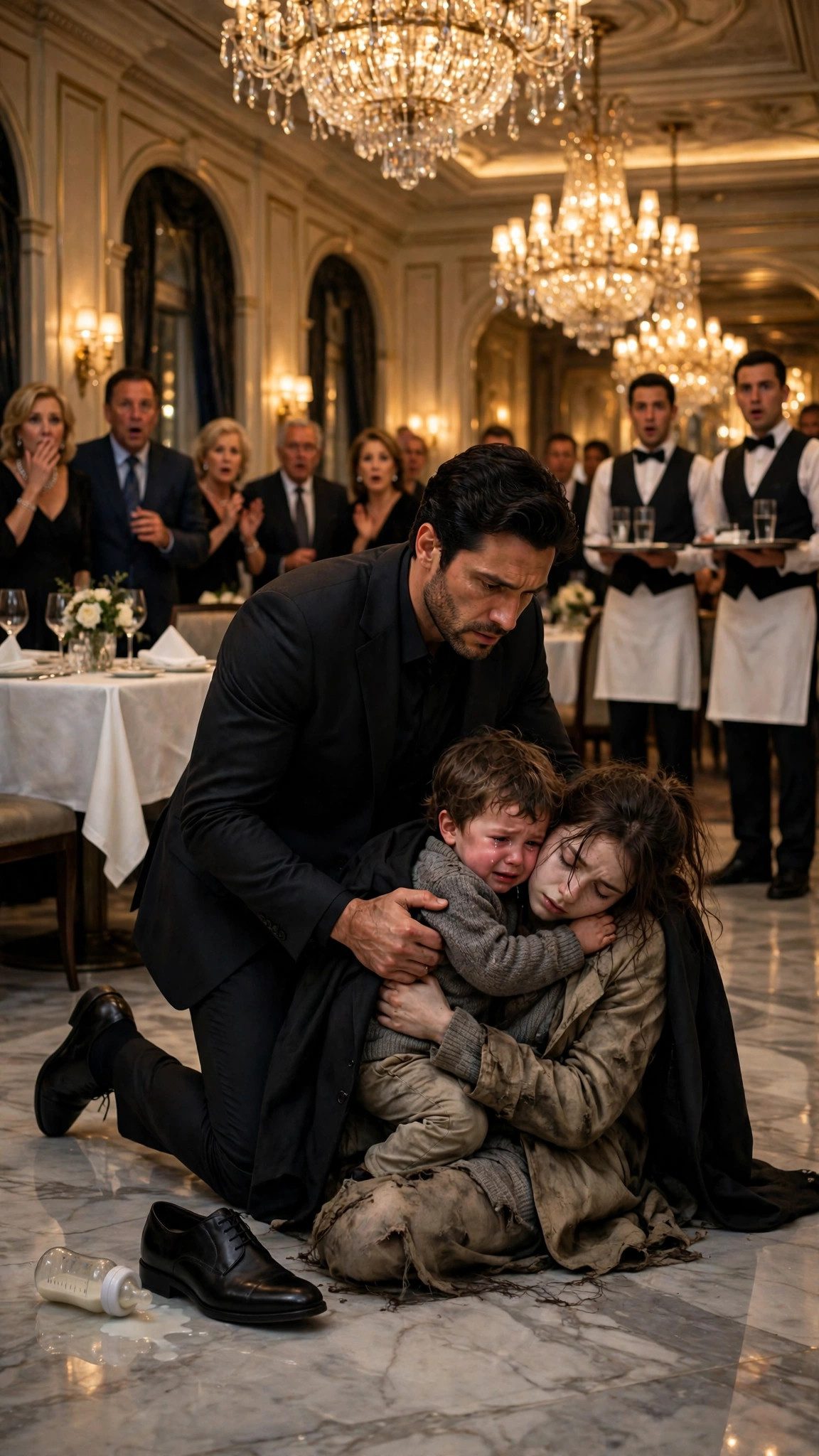
But Ethan Hayes was not that man anymore. He was a man who had knelt on a marble floor and put his jacket over a starving stranger. He was a man who had taken a bullet for a waitress. He was a man whose mother had told him not to let the streets take his heart, and who had finally, at thirty-eight years old, understood what she meant.
"You are going to testify," Ethan said. "You are going to tell Agent Reyes everything, every dollar, every phone call, every name. And you are going to give back every cent you stole from my staff, with interest. And then you are going to prison, Derek, for a long time. But you are going to walk into that prison alive, because I am not going to kill you. Do you know why?"
Voss shook his head, tears running down his face.
"Because a woman who had nothing left in the world knelt on the floor of my restaurant and begged me not to let her son grow up without a mother, and she was right about something I forgot a long time ago. Mercy is not weakness, Derek. Mercy is the only thing that separates us from the animals. And my mother — my mother was a waitress in that restaurant for twenty-three years, and she taught me that a person's worth is measured by how they treat the people who cannot fight back. You failed that test. But I am not going to fail it by killing you."
He turned and walked away, and behind him, Derek Voss sat down on the bench in his cell and wept like a child, and Ethan Hayes went back to the Marlowe Room, where Maya Carter was waiting for him in the private dining room, with a pot of chicken soup on the table and Leo drawing pictures at the desk by the window, and he sat down across from her, and he told her everything that had happened, and she listened, and when he was finished, she reached across the table and took his good hand in hers.
"Your mother would be proud of you," she said, and her voice was soft, and her eyes were shining, and Ethan Hayes felt something in his chest loosen, the way a fist loosens when it finally lets go of something it has been holding too tight for too long.
"There's one more thing," he said. "I want you to run the restaurant, Maya. Not as head waitress. As manager. The whole place. The dining room, the kitchen, the staff, the books. You'll have my full backing, and Marco will help you with anything you need, and your first order of business is to pay back every dollar Voss stole, to every single person he stole it from, with interest, out of the restaurant's accounts. And after that, I want you to do something else. I want you to start a tradition. Every Sunday, the Marlowe Room is going to feed anyone who walks through that door and says they're hungry. No questions. No payment. Just a hot meal and a warm place to sit. My mother's name goes on the door, and her picture goes on the wall, and nobody in this city will ever collapse on my floor again because they haven't eaten."
Maya stared at him. "You'd do that? For strangers?"
"I'd do it for my mother," Ethan said. "And I'd do it for you. And I'd do it for Leo. And I'd do it because a month ago, I was the most feared man in Chicago, and I was also the loneliest man in Chicago, and I didn't even know it until a starving woman fell at my feet and taught me what it feels like to be needed."
Maya reached across the table then, and she kissed him. It was not a grand kiss. It was not a kiss from a movie. It was a quiet kiss, on the mouth, in a private dining room with a pot of chicken soup on the table and a little boy drawing pictures by the window, and it was the most honest thing either of them had ever done. And when she pulled away, she was smiling, and he was smiling, and Leo looked up from his drawing and said, "Mama, are you kissing Mr. Ethan?"
"Yes, baby," Maya said. "I think I am."
"Good," Leo said, with the solemn wisdom of a three-year-old. "He needs a kiss. He saved us."