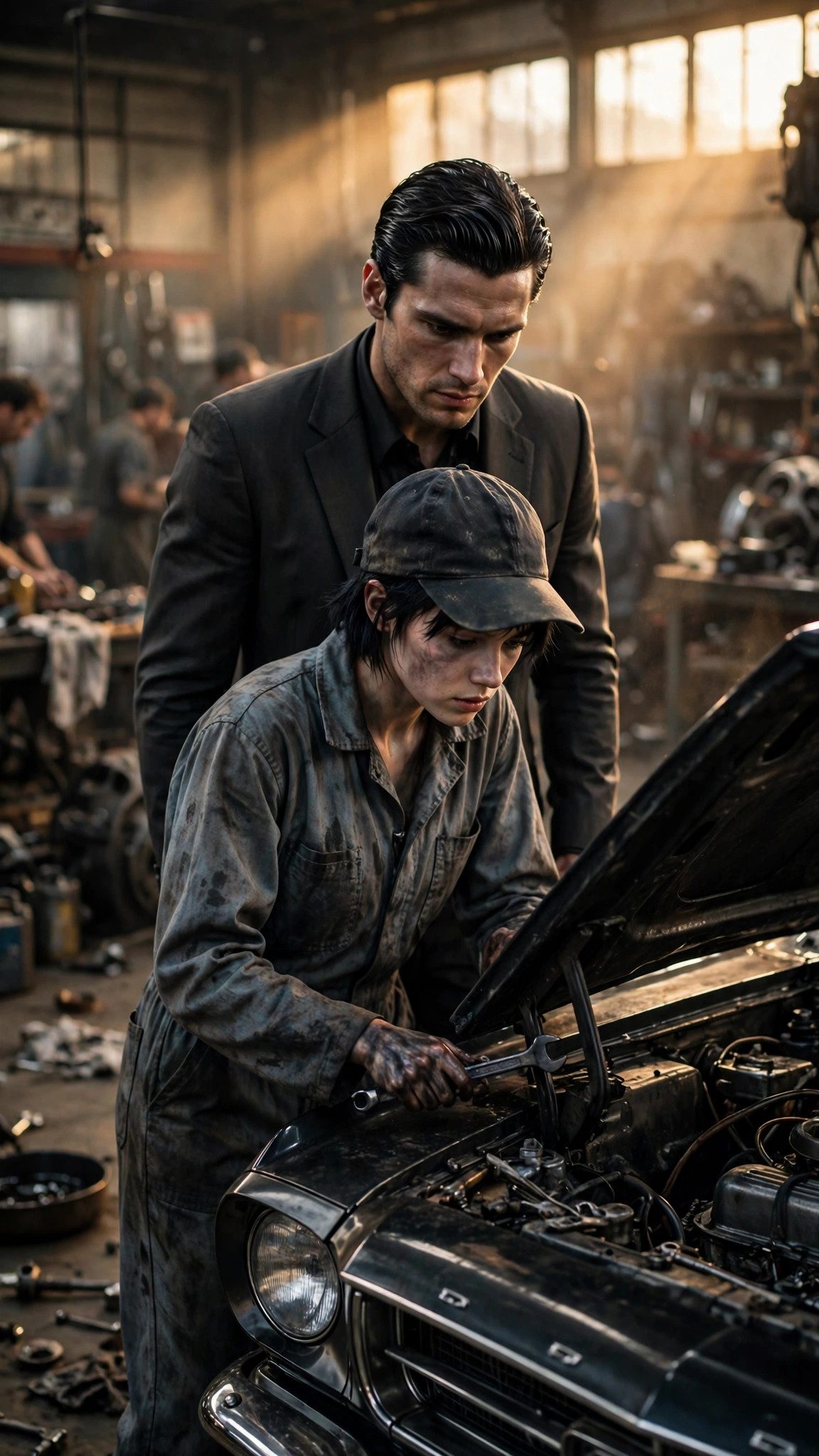
Seven months after I cut off my hair, bound my chest, and vanished before my forced wedding, Chicago's most feared crime boss finally looked straight at me.
I was standing under the hood of his black 1967 Mustang with grease on my hands and my heart hammering against my ribs, and the whole garage had gone silent behind me. Tony Mercer, the shop manager, was staring at me like I had just pulled a bullet out of the engine with my bare hands. The other mechanics had found sudden, urgent reasons to look at the floor.
And then I heard the footsteps. Heavy. Slow. Deliberate. Crossing the concrete behind me, the way a man walks when he owns every inch of ground under his shoes.
I did not turn around. I could not turn around. For seven months I had lived with one rule carved into the inside of my skull: never let Dante Moretti look at you. Never let him see you. Because the moment he really looked at Eli Ross, the quiet young mechanic who never caused trouble, he would see the lie underneath.
But I had already fixed his car, and there was no way to unfix it.
"Again," I had said, ten feet away from the Mustang, my voice low and rough the way I had trained it to be. "Start it again."
Tony had frowned. "What?"
"Start it again."
The engine had growled, and there it was, a tiny hesitation hidden beneath the sound, so small that three mechanics had missed it and I had heard it from across the shop. Eleven minutes later I had found it: a hairline fracture in an old vacuum line buried under the intake assembly, a crack so fine you could miss it if you blinked.
"Well, I'll be damned," Tony had said.
A smile had escaped me before I could stop it. That was my mistake. Eli Ross never smiled. Eli Ross kept his head down and his mouth shut and his hands busy, and Eli Ross never, ever smiled at his own work in front of the boss.
The footsteps stopped directly behind me.
"Turn around, mechanic."
His voice was low and calm, and somehow that was worse than shouting. I wiped my hands on a rag that was already black with grease, and I turned around, and Dante Moretti was standing two feet away from me, and for the first time in seven months, the most dangerous man in Chicago was looking at Eli Ross like he had finally seen me.
I had rehearsed this moment a hundred times in my head, lying awake on the thin mattress in my rented room above the laundromat on Division Street, staring at the water stain on the ceiling. In every version, I kept my face blank and my voice steady and I said something short and forgettable, and he moved on. In every version, I survived.
But in none of those versions had I counted on his eyes. They were dark, and still, and they did not blink, and they were studying my face the way a man studies an engine he cannot figure out — not angry, not suspicious, just certain that something here did not fit, and determined to find out what it was.
"What's your name?" he asked.
"Eli Ross," I said. My voice came out lower than usual, rough from seven months of practice, and steady. Thank God it was steady.
"How long have you worked here, Eli Ross?"
"Seven months, sir."
"And in seven months, you have never spoken to me."
"No, sir."
"Why did you speak today?"
I swallowed. "Because the car was going to keep misfiring, sir. And nobody else heard it."
He was quiet for a moment, and the silence in the garage felt like a held breath. Then he looked past me, at the Mustang, and back at my face.
"Come to my office at six," he said. "When the shop closes."
"Yes, sir."
He turned and walked away, and the garage exhaled, and Tony Mercer grabbed my arm the second Dante was out of earshot.
"Do you have any idea what you just did?" he whispered. "He never asks anyone to his office. Nobody. Not in six years."
I nodded, because my throat had closed up and I could not speak. I went back to my bench and I picked up a wrench and I tried to work, and my hands were shaking so badly I dropped it twice.
Six o'clock. His office. I had seven months of lies stacked between me and that door, and in three hours I would have to walk through it and stand in front of the one man in Chicago who had built his whole empire on a single rule: never lie to Dante Moretti.
Every breath I had taken beneath his roof for seven months was a lie.
I thought about the night I became Eli Ross, because when you are about to lose everything, your mind goes back to the night you chose to lose it all on purpose.
The night I disappeared, fifty guests were asleep inside my father's Lake Forest mansion, waiting to celebrate the future everyone had chosen for me. By noon the next day, I was supposed to sit beside Marcus Bellamy, smile for photographs, and listen while our fathers finalized the wedding I had already refused three times.
Marcus was forty-six. I was twenty-five. People called him powerful because he owned trucking companies, warehouses, restaurants, and enough influence across Chicago to make grown men lower their voices when they said his name. To me, he was simply the man who once squeezed my wrist under a dinner table and whispered, "You'll learn that saying no to me is just another way of asking me to be patient."
My father heard him. He said nothing. My father never said anything when it mattered. He had spent my whole life saying nothing, and calling it love, and calling it protection, and calling it the way the world worked.
My mother had died when I was sixteen, and after that there was no one left in that house who would say the word no for me. So I learned to say it myself, three times, and each time my father looked at me the way you look at a child who does not understand the price of things.
"You don't understand what this marriage means for this family," he said, the last time. "Marcus Bellamy is not a man you refuse."
"He is forty-six years old, Father. He grabbed my wrist at dinner."
"He was testing you," my father said, and he did not look at me when he said it, which told me everything I needed to know about what he really thought.
That night, at 12:43 a.m., I locked my bedroom door and stood in front of the mirror with scissors in my hand. Long black hair framed the face of Elena Russo — the obedient daughter, the bargaining piece, the woman Marcus expected to own by summer. I looked at her for a long time. I had spent twenty-five years being her, and she had never once saved me.
The first lock of hair hit the marble counter. By the fourth, my hands had stopped shaking.
Running as Elena would have been useless. My father would search airports, hotels, train stations, college friends, and every place I had ever mentioned. Marcus had investigators, my father had political connections, and together they could drag Elena Russo back before she made it out of Illinois.
So Elena Russo had to disappear completely.
I pulled on my dead brother Michael's loose work pants and flannel shirt. Michael had been twenty-two when a drunk driver took him on the Kennedy Expressway, four years ago, and I had kept his clothes in the back of my closet because throwing them away felt like burying him twice. Now his clothes were going to save me. I bound my chest with strips of an old sheet, darkened my eyebrows with a pencil, hid my ruined hair beneath a baseball cap, and forced my voice lower.
"My name is Eli Ross." Too soft. "Eli Ross." That sounded believable. Barely.
At 3:17 a.m., I crawled through the laundry-room window carrying $684, Michael's old tool roll, and one duffel bag. The tool roll was the most important thing I owned. Michael had taught me to fix engines when I was twelve years old, sitting on a stool in our father's garage while he explained what every sound meant, and I had never forgotten a single lesson. Engines did not lie. Engines did not want anything from you. Engines either worked or they didn't, and if they didn't, there was always a reason, and the reason could always be found.
By sunrise, Elena Russo no longer existed.
I took a bus to the West Side and found a room above a laundromat on Division Street, paid two weeks in advance in cash, and told the landlady my name was Eli Ross and I was a mechanic looking for work. She did not ask questions. People on the West Side rarely did.
On my third day, I walked into Moretti Motorworks with Michael's tool roll under my arm and asked Tony Mercer if they needed a mechanic.
Tony looked me up and down — the loose coveralls, the cap pulled low, the thin frame, the hands that were too clean — and he laughed.
"You're a kid," he said. "How old are you, nineteen?"
"Twenty-three," I lied. I had decided Eli Ross would be twenty-three, old enough to be taken seriously, young enough that nobody would wonder why he had no history.
"Can you actually fix anything, or are you just carrying that roll to look the part?"
"Give me something broken," I said.
He gave me a 1974 Corvette with a dead starter and a fuel line full of rust, and I had it running in forty minutes. He watched the whole thing with his arms crossed, and when the engine turned over clean, he nodded once.
"Five days a week. Six in the morning. Don't be late, don't steal, don't lie to Mr. Moretti, and don't ask questions about the cars that come in after dark."
"Yes, sir."
"And Eli —" He paused. "Mr. Moretti owns this place. He comes in most days, but he doesn't talk to the mechanics. He watches. If he ever looks at you twice, you're done. Understand?"
I understood. For seven months, I made sure he never looked at me twice. I kept my head down. I never stayed after work. I never drank with the other mechanics, never used the locker-room showers, never took off my cap indoors, never let anyone get close enough to ask questions. I ate lunch alone on the loading dock. I spoke only when spoken to, and then only in short sentences, in the low voice I had practiced in the mirror until it stopped sounding like mine.
The disguise became second nature. Loose coveralls hid everything. The cap hid my hair. The lowered voice hid my real one. The silence hid the rest. Eli Ross was quiet, careful, forgettable — and that was exactly the point.
Moretti Motorworks was a restoration shop only on the surface. Behind its steel gates came vintage Ferraris, armored SUVs, rare muscle cars, and men nobody asked questions about. The owner was Dante Moretti. Half of Chicago feared him. The other half worked very hard not to offend him. Everyone in that garage knew one rule: never lie to Dante Moretti.
Every breath I took beneath his roof was a lie.
But engines don't care who you are. Engines don't care about your name or your past or the men looking for you. For seven months, the engines were the only honest thing in my life, and I gave them everything I had. I fixed things nobody else could fix, and I did it quietly, and I told myself that was enough. I told myself that if I stayed quiet and small and invisible, I could survive like this forever.
Then his black 1967 Mustang started misfiring.
Three mechanics failed to fix it, including Tony Mercer. While working ten feet away, I heard the engine turn over and felt every nerve in my body sharpen. "Again," I said. "Start it again." And eleven minutes later, I found the hairline fracture in the old vacuum line, and Tony stared at me, and the garage went silent, and Dante Moretti turned around and looked straight at me for the first time.
Now it was 3:47 in the afternoon, and I had a little more than two hours before I had to walk into his office at six o'clock, and I did not know what he wanted, and I did not know how to survive it.
I went back to work. There was nothing else to do. I changed the oil on a Bentley. I replaced a brake line on a pickup. I kept my hands busy and my head down, and every few minutes I caught one of the other mechanics watching me out of the corner of his eye, the way people watch someone who has just been noticed by a dangerous man.
At five o'clock, Tony came to my bench.
"Eli," he said, quietly. "Whatever he asks you in there, tell the truth. I mean it. Mr. Moretti can smell a lie from across a room. I've seen men try it. It never ends well."
"I don't lie, Tony," I said, and the words tasted like ash in my mouth, because I had done nothing but lie since the night I cut my hair.
Tony looked at me for a long moment, and something in his face shifted, like he was seeing me for the first time too. "You're a good mechanic, kid," he said. "The best I've seen in years. Whatever happens in there, remember that."
He walked away, and I stood there with a wrench in my hand, and I thought about Michael, who had taught me everything I knew about engines, and who had died before he could teach me how to survive the men who owned them.
At 5:55, I washed my hands, put on a clean shirt from my locker, and walked up the metal stairs to Dante Moretti's office. The door was open. He was sitting behind his desk, looking out the window at the garage below, and he did not turn around when I knocked.
"Come in, Eli Ross," he said. "Close the door."
I closed the door. My hands were shaking, and I hid them behind my back, and I stood in the middle of his office, and I waited.
He turned his chair around slowly, and his eyes found my face, and he looked at me the way he had looked at me in the garage — like a man studying an engine he could not figure out.
"Seven months," he said. "Seven months you have worked in my shop, and today is the first day I have ever heard your voice."
"Yes, sir."
"Do you know why that is, Eli?"
I swallowed. "Because I keep my head down, sir."
"No," he said. "That is not why." He leaned forward, and his voice dropped lower. "It is because you are hiding something. And I want to know what it is."
My heart stopped. For one terrible second, the whole world went silent, and all I could hear was my own breathing, too fast, too shallow, giving me away.
And then I did the only thing I could think of to do. I told him the truth — or at least, the first piece of it.
"I'm hiding from a man who wants to marry me, sir," I said. "A man I refused three times. And if he finds me, he will take me back, and my father will let him."
Dante Moretti stared at me. And for the first time since I had walked into his office, his face changed.
"Tell me his name," he said.
And I did.