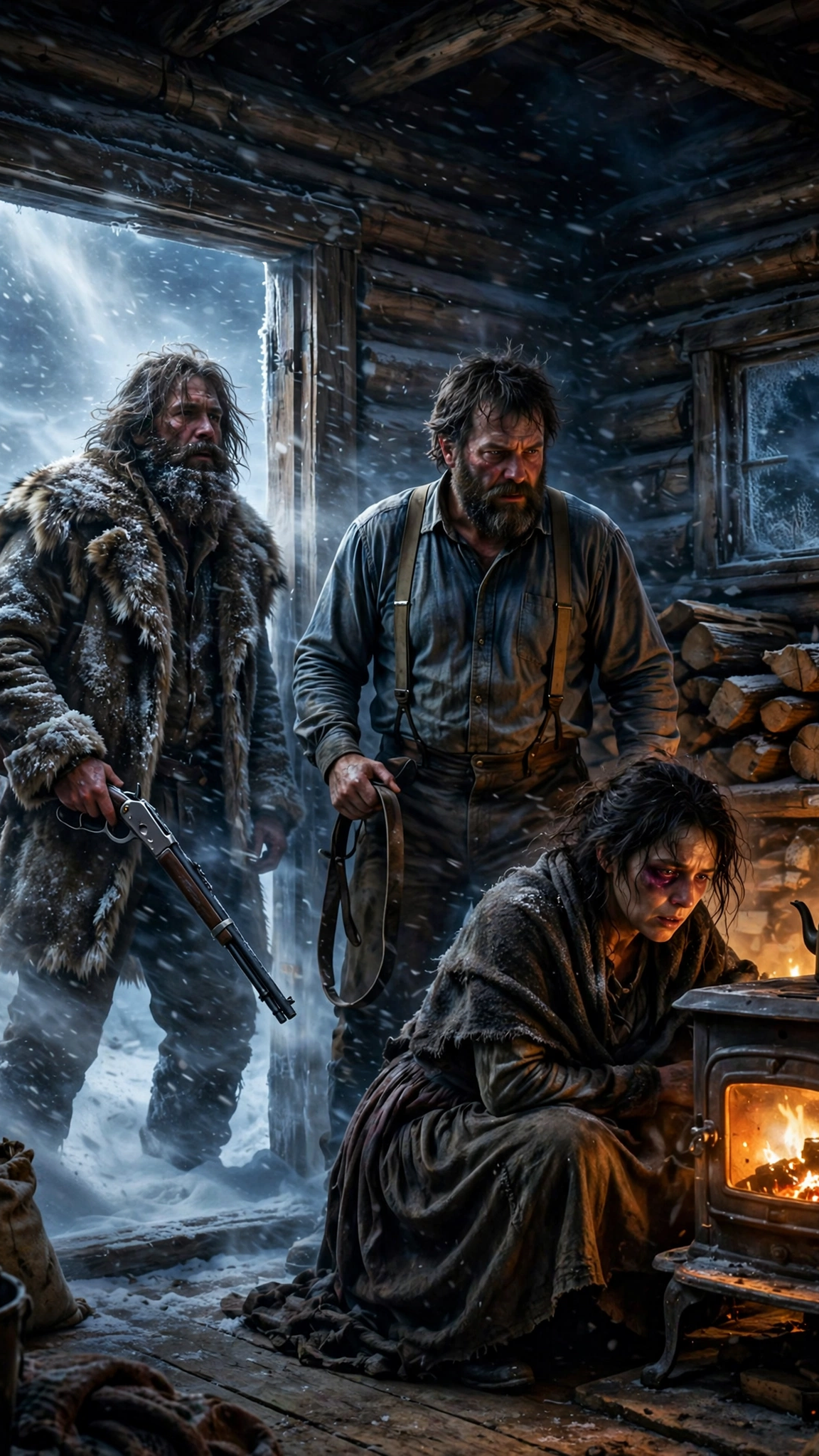
Hazel woke to the sound of the storm, and for one confused moment she did not know where she was.
Then she felt the blanket around her shoulders, and the warmth of the stove on her face, and the hard plank floor under her back, and she remembered: she had slept by the fire. She had slept without listening for footsteps. She had slept, and nothing bad had happened, and the world had not ended.
She opened her eyes. The cabin was gray with morning, the kind of gray that comes through frost-covered windows when the sun is up somewhere behind the storm but cannot get through. Harlon was still by the stove, sitting on the same stool, holding a tin cup in both hands. The Winchester leaned against the stool. Baron was still in the bed, on his back, staring at the ceiling.
Hazel sat up. Her neck ached from the floor. Her swollen eye throbbed. She looked at Harlon, and Harlon looked at her, and he nodded, the way a man nods at a person he has kept watch over all night.
"Morning," he said. "Storm's worse. Won't break today. Maybe not tomorrow either."
Hazel nodded. She stood up, folding the blanket, and she went to the stove, and she put the coffee on, and she did the morning things the way she had done them a thousand times — except that this morning there was a man by the stove who had kept watch all night, and a husband in the bed who had not touched her, and a rifle leaning against the stool, and the whole cabin felt different, the way a house feels different after a fire has been put out.
Baron got up. He did not speak. He put on his boots. He went to the door and opened it a crack, and the wind shoved snow inside, and he shut it again, and he stood there for a moment with his hand on the door, and Hazel could see his shoulders go tight, and she knew what he was thinking: the storm had him trapped in this cabin with a stranger who had a rifle and a wife who had seen him humiliated, and there was nowhere to go and nothing to do about it.
He sat down at the table. He ate the porridge she gave him without a word. He drank his coffee without a word. He did not look at Harlon. He did not look at Hazel. He looked at the table, and at the floor, and at the walls, and Hazel understood that he was doing what she had done for three years: making himself small, keeping his eyes down, waiting for the danger to pass.
It was a strange thing to see. She had never seen Baron afraid before. She had seen him angry, and drunk, and sullen, and cruel, but she had never seen him afraid, and the sight of it did something to her that she did not expect. It did not make her glad. It did not make her sorry. It made her clear-headed, the way cold water makes a person clear-headed, and she looked at him — really looked at him, the way she had not looked at him in years — and she saw what was there.
He was a small man. Not in body — his body was big, broad, strong — but in the way that mattered. He was a man who had failed at his land and failed at his marriage and failed at everything he had ever tried to be, and he had taken all of that failure out on the only person smaller than he was. He was not a monster. He was a coward. And a coward with a belt is more dangerous than a monster, because a monster does not need a reason, and a coward always does.
She looked away. She did not want to think about him. She wanted to think about the morning, and the fire, and the man by the stove who had kept watch all night.
Harlon spent the morning mending the roof. The storm was too bad to go outside for long, but the leak in the corner had gotten worse, and he climbed up with a hammer and a handful of shingles, and he worked in the cold for an hour, and he came back down with snow on his shoulders and ice in his beard, and he sat by the stove and warmed his hands, and he did not complain. Hazel watched him work, and she thought about how long it had been since anyone in this cabin had fixed anything without being told to, and without making a show of it, and without expecting to be thanked.
At noon, Baron went out to the woodpile. He came back with an armful of wood, and he filled the woodbox, and he did it without being asked, and without a word, and Hazel watched him do it, and she understood what it meant: he was showing Harlon that he could be a good husband. He was performing. He was putting on a show for the stranger with the rifle, the way a dog shows its belly to a bigger dog. She had seen him do it before, in the early days, when the trader came — a sudden burst of kindness, a sudden show of industry, all of it for an audience, all of it gone the moment the audience left.
She did not say anything. She watched him fill the woodbox, and she watched Harlon watch him fill the woodbox, and she watched Harlon's face, and Harlon's face did not change. He was not fooled. She could see that he was not fooled, and the knowledge of it steadied her, the way a wall steadies a person leaning against it.
In the afternoon, when Baron had gone back to the bed to sleep off the morning's drink, Harlon sat by the stove, and Hazel sat across from him with her mending, and they talked.
It was not a long conversation. Harlon was not a talkative man. But he talked about the mountains, about the trapping lines he ran in the high country, about the cabin he had built for himself and his wife, a small log cabin with a good stove and a garden, not unlike this one. He talked about the fever that had taken her, ten years ago, in the spring, when the snow was melting and the rivers were running high. He talked about how he had buried her himself, under a pine tree, and how he had stayed in the mountains ever since, because the mountains did not ask him questions, and the mountains did not expect him to be anything but what he was.
"She was a good woman," he said, looking at the fire. "Better than I deserved. I think about her every day. Not the way I used to — not like a wound. Like a room in a house I used to live in. I don't live there anymore, but I remember the way the light came through the windows."
Hazel listened. She did not know what to say. She had never heard a man talk about a woman that way — as if the woman had been a person, with a light in her windows, and not a piece of property. She wanted to ask him more, but she had forgotten how to ask questions, and so she told him something instead.
She told him about her father. She told him about the settlement, and the debts, and the wedding, and the wagon ride, and the first blow over the burned beans. She told him about the trader's wife and the salve under the floorboard. She told him about Mrs. Odegard and the six miles and the cup of sugar. She told him about the knife in her mother's trunk. She told him all of it in a low, steady voice, the way a person tells a story they have told themselves a hundred times in the dark, and Harlon listened, and he did not interrupt, and he did not look away, and when she was finished, he nodded, and he said, "You did what you had to do to stay alive. There's no shame in that."
Hazel had not cried in three years. She had refused to cry — crying gave him a reason, and she had learned not to give him reasons. But now, sitting by the stove with a mountain man who had kept watch all night, she felt her eyes sting, and she looked down at her mending, and she blinked hard, and she did not cry, and Harlon pretended not to notice, and the fire crackled, and the storm screamed, and the cabin was warm.
In the bed, in the dark corner, Baron lay awake and listened.
He heard all of it. He heard Hazel's voice, low and steady, telling the stranger things she had never told him. He heard Harlon's voice, low and calm, answering her. He heard the fire, and the storm, and the silence between the words, and the humiliation of the night before came back to him, and the rage came back with it, and it sat in his chest like a hot coal, and it grew.
He did not move. He did not speak. He lay in the dark and listened, and he waited, and he thought about the shotgun on the table, empty, and the shells in the stranger's pocket, and the belt on its nail, and the rifle leaning against the stool, and he thought about what he would do when the storm broke and the stranger left, and the cabin was his again, and there was no one to watch.
He thought about it for a long time. And the longer he thought about it, the more certain he became.
He would not wait for the storm to break. He would not wait for the stranger to leave. He would settle it tonight, while the stranger slept, the way a man settles a debt when no one is watching.
Outside, the blizzard raged on, white and blind and merciless. Inside, the iron stove glowed orange, and Hazel mended her husband's shirt by the firelight, and Harlon watched the fire, and Baron lay in the dark and planned, and the night came on, hour by hour, and the rifle leaned against the stool, and the storm did not break.
—
The evening came on gray and early, the way winter evenings always came on, and Hazel made supper — beans again, and the last of the salt pork, and bread that was two days old and hard as a rock but still bread. She served it in silence, and Harlon thanked her, and Baron ate with his eyes on his plate, and the storm screamed, and the lanterns swayed, and the cabin felt smaller than it had felt that morning, as if the walls had moved inward while no one was looking.
After supper, Baron went to the bottle. Hazel watched him do it, and she felt the old fear come back, the familiar fear, the fear that lived in her belly like a cold stone. She had felt safe that morning. She had felt safe all day. But the bottle was out, and the evening was young, and the stranger was only one man, and the stranger had to sleep sometime, and Baron knew it, and she knew it, and the fear came back, because fear was the only thing in this cabin that had never once let her down.
Harlon saw it. He saw her hands go still on her mending. He saw her eyes go to the bottle and then away. He did not say anything. He got up from his stool, and he went to the woodbox, and he took out a log, and he fed the stove, and he sat back down, and he said, very quietly, "I'm not going anywhere tonight, Hazel."
It was the first time he had said her name.
Hazel looked at him. His gray eyes were steady. His hands were still. The Winchester leaned against the stool within reach. And she understood what he was telling her: that he knew what she was afraid of, and that he was staying awake, and that the night would pass the way the night before had passed, with the fire burning and the rifle within reach and the storm outside and the cabin safe.
She nodded. She went back to her mending. Her hands stopped shaking. The fear did not go away — the fear never went away, not entirely, not in this cabin — but it grew smaller, the way a fire grows smaller when it has nothing left to burn, and she sat by the stove with her needle moving in and out, and Harlon watched the fire, and Baron drank from the bottle, and the night came on, hour by hour.
At some point, Baron stood up. He swayed. He looked at Harlon, and he looked at Hazel, and he opened his mouth as if to say something, and then he closed it again, and he went to the bed, and he lay down, and he pulled the blanket over himself, and he was asleep within minutes, snoring, the bottle still in his hand.
Hazel stayed by the stove. She did not know what to do. She had never stayed up after Baron slept, not in three years, not once. But tonight was different. Tonight there was a man by the stove with a Winchester, and the man had said her name, and the man had said he was not going anywhere, and Hazel felt, for the first time in three years, that she could stay up if she wanted to.
She stayed up. She mended the shirt. Harlon watched the fire. The storm screamed. The cabin was warm. And in the dark corner, in the bed, Baron lay asleep and dreamed whatever a man like Baron dreams, and Hazel did not care, because for the first time in three years, she was not listening for his footsteps.
She was listening to the fire. And the fire said: you are still alive. And the storm said: you are still here. And the man by the stove said nothing at all, which was the kindest thing anyone had said to her in three years.