"Does your secretary have a boyfriend?"
The question should have been innocent. It should have been nothing — a throwaway line from a man who liked to fill silence with his own voice, a little joke to loosen the air before the real talking began. But the moment Vincent Calder said it, the whole room changed, and I knew, the way you know when a storm has already decided to come down, that nothing about this meeting would ever be the same again.
We were on the thirty-fourth floor of Vescari Holdings, behind polished glass walls that looked out over the whole city, and the conference table between us was mahogany, long enough to seat sixteen men and expensive enough to buy a house. The men around it were used to controlling every conversation they entered. They were investors, attorneys, and operators — men who measured their own worth in the millions and other people's worth in what they could be made to do. Vincent Calder leaned back in his chair with a confident smile and looked at me. Not with respect. Not with curiosity. With the careless confidence of a powerful man who believed everything around him could be claimed.
"If she doesn't," Vincent said smoothly, "I'd be happy to fix that."
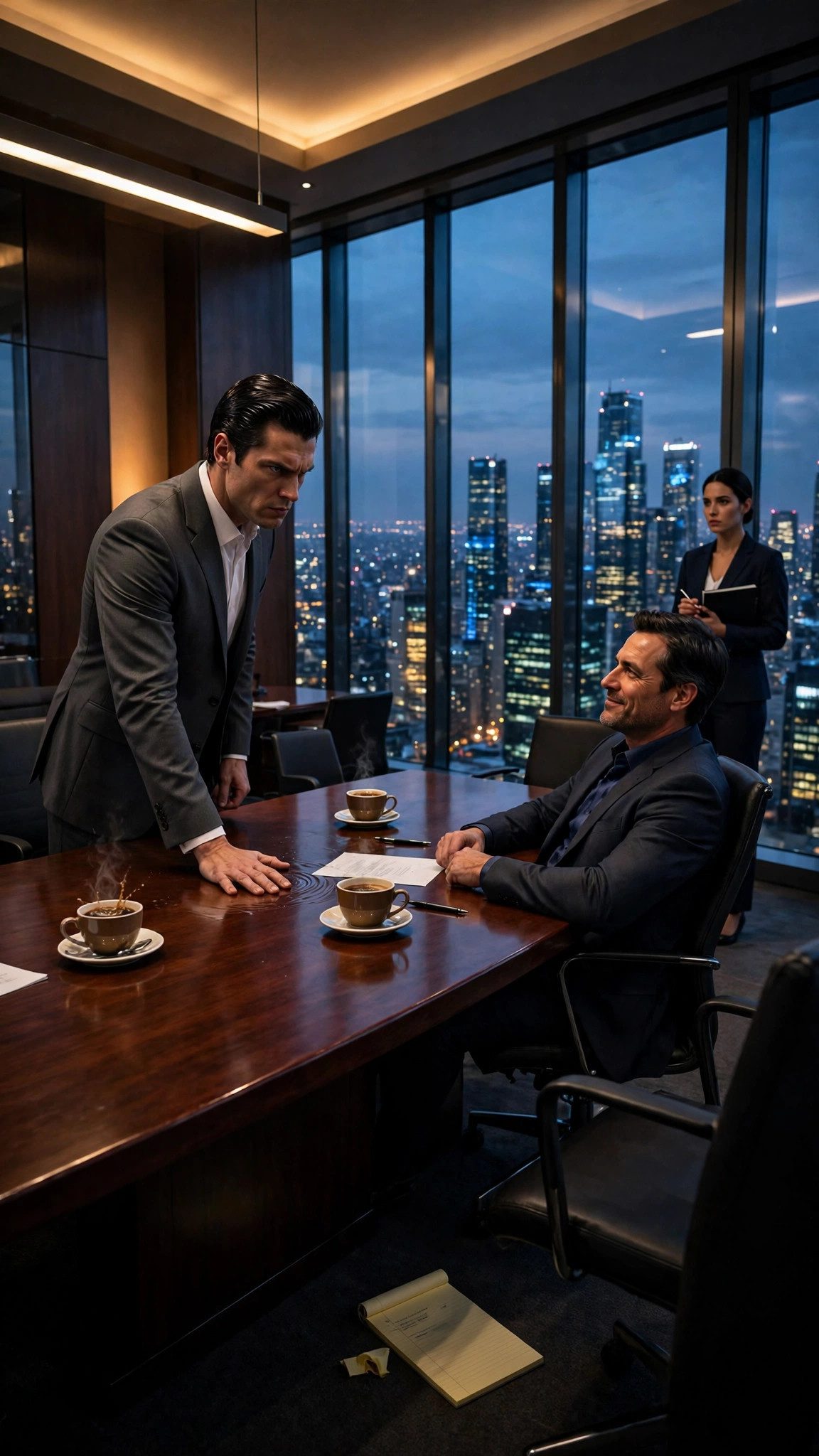
Before I could respond, Adrian Vescari's hand slammed against the mahogany conference table.
The sound exploded through the room like a gunshot. Coffee shook inside porcelain cups. A legal pad slipped off the edge of the table and landed on the carpet. Every person around the table froze. And I stood near the wall with my pen still hovering above my notebook, my heart beating so hard I was certain everyone in the room could hear it.
For two years, I had worked as Adrian Vescari's executive secretary. I had watched politicians, investors, attorneys, and dangerous men walk into his office believing they had control, only to leave with quieter voices and nervous expressions. I knew Adrian's anger better than most people. He never screamed. He never needed to throw anything. He became silent. That was always when people should have been afraid.
His gray eyes locked onto Vincent, and the silence after the impact was far more frightening than the sound itself.
"This meeting is finished," Adrian said.
Vincent blinked, almost offended by the interruption. "We're discussing a forty-million-dollar distribution agreement."
"Not anymore."
"Adrian, don't be ridiculous."
Adrian slowly stood from his chair. At thirty-five, he carried himself with the kind of authority that made his perfectly tailored suit seem more intimidating than any weapon. He didn't need to remind people who he was. Everyone already knew.
"No," Adrian said coldly. "You forgot where you were."
Something shifted in Vincent's expression. Then he understood. And somehow, that scared me more than his question. This was never about a simple compliment. Vincent had not stumbled into that question by accident. He had aimed it. He had watched Adrian for two years, the way a hunter watches a man he intends to bring down, and he had finally found the place where the armor was thin.
Vincent buttoned his jacket and looked toward me. "I meant no offense, Miss Morgan."
I remained quiet. But Adrian didn't.
"Don't look at her again."
The room became completely still. Vincent's jaw tightened, but he didn't argue. He gathered his things, walked toward the door, and left without another word. His attorney followed, then the investors, then the rest of the men, filing out of the conference room like men leaving a church after a funeral, careful not to make a sound.
The moment the doors closed, I realized I was alone with the most dangerous man I had ever known.
Adrian stayed at the head of the table, staring at the closed doors as if part of his restraint had disappeared with Vincent. I slowly collected my notebook.
"I'll return to my desk."
"No."
The single word stopped me. I turned around. Adrian was looking at me differently. I had spent two years studying every expression on his face. I knew when he was calculating a business deal, when he was disappointed by results, and when someone had betrayed him. But this was different.
"Close the door, Tessa."
My fingers tightened around the notebook. He had never called me Tessa inside the office. Never. At work, I was always Miss Morgan. Sometimes Morgan when there was an emergency. But never Tessa.
I closed the door.
When I turned back, Adrian was standing closer than before. His expression was impossible to read. Then he asked the question that changed everything.
"Are you seeing someone?"
I did not answer him right away. I could not. Because the truth was that I had been asking myself a different question for two years, and I had never dared to answer it either.
The question was this: how long could a woman stand three feet away from a man like Adrian Vescari, day after day, and pretend she did not notice him?
Two years earlier, I had walked into this building with a borrowed suit, a secondhand briefcase, and a resume that nobody in this city should have taken seriously. I was twenty-six years old, and I had exactly eleven dollars in my bank account and a mother in a hospital bed on the other side of town who needed medicine I could not afford. The job posting had said only this: Executive Secretary to the Chief Executive, Vescari Holdings. Discretion required. No exceptions.
I had not known, then, what Vescari Holdings really was. I had not known that the polished glass tower on the river was the clean face of a family that had run half the city's docks and warehouses for three generations, or that the man at the top of it was feared by people who feared no one. I had only known that the salary would pay for my mother's medicine, and that the woman who interviewed me — a sharp-eyed office manager named Ruth Delgado — had looked at my hands and said, "You don't shake. Good. Mr. Vescari hates shaking hands."
On my first morning, Ruth walked me to the thirty-fourth floor and told me the rules. "Mr. Vescari arrives at seven. His coffee is black, no sugar, in the blue cup, never the white one. His schedule is in the black binder. You do not knock on his door unless the building is on fire, and if the building is on fire, you send an email first. He does not like questions. He does not like small talk. He does not like anyone in his office after six o'clock. Do you understand?"
"Yes," I said.
"One more thing," Ruth said, lowering her voice. "Two years ago, Mr. Vescari lost his fiancée. Her name was Sofia. Do not mention her. Do not ask about her. There is a photograph of her in his office, on the shelf behind his desk, and if you ever see him looking at it, you leave the room. Do you understand?"
"Yes," I said again, and I meant it.
I understood grief. My father had died when I was nineteen, a heart attack in the middle of a warehouse shift, and my mother had never been the same afterward. I knew what it was to live in a house where one room was kept exactly as it had been, and where some names were never spoken aloud. So I made myself a promise on that first morning: I would be invisible, efficient, and unbreakable. I would be the best secretary Adrian Vescari had ever had, and I would never, ever become a problem in his life.
For two years, I kept that promise. I learned his schedule down to the minute. I learned that he took his coffee at seven, his first meeting at eight, and his lunch — when he remembered to eat at all — at his desk, standing up, reading contracts. I learned that he signed documents with a black fountain pen and never with a ballpoint. I learned that he hated the sound of ringing phones and loved the sound of rain against the glass. I learned that he had a scar on his left hand, thin and white, that he rubbed with his thumb when he was thinking hard about something he did not want to decide.
And I learned, slowly and against my will, that Adrian Vescari was not the monster the city believed him to be.
The city believed he was cold. The city believed he was ruthless. The city believed he had no heart at all. But I saw the things no one else saw. I saw him pay, quietly and without a word to anyone, for the surgery of a warehouse foreman's little girl. I saw him stand in the rain at a dockworker's funeral, his suit ruined, his head bowed, because the man had worked for his family for forty years and Adrian believed a boss should bury his own. I saw him read, late at night, the letters that came from the families of men who had died working for him, and I saw him answer every single one by hand.
I saw all of it. And I told myself it did not matter. I told myself that noticing a man's kindness was not the same as falling in love with him. I told myself that every morning when I put on my dark suit and picked up my notebook and pen, and I told myself that every night when I went home to my small apartment and my mother's voice on the phone, asking me if I had eaten, asking me if I was happy, asking me if there was a man in my life yet.
"Not yet, Mama," I always said. "There's no one. There's no time."
It was a lie. There was a man. There had been a man for two years. He was the man behind the glass wall, the man in the perfectly tailored suit, the man who called me Miss Morgan and never once looked at me the way a man looks at a woman he wants.
Or so I had believed, until the morning Vincent Calder asked his question, and Adrian Vescari slammed his hand against the table, and the whole careful structure of the last two years came apart in a single second.
That morning, before the meeting began, I had noticed Vincent Calder watching me. He had arrived twenty minutes early, which was unusual for a man who liked to make other people wait, and he had stood by the glass wall with his coffee, looking out at the river, while his attorney spread documents across the table. When I came in with the water carafe and the extra legal pads, he turned and smiled at me — the kind of smile that appraises a woman the way a buyer appraises a painting, deciding what she is worth and whether she can be bought.
"You're new," he said. "I don't remember you from the last negotiation."
"I've worked for Mr. Vescari for two years," I said.
"Two years," he repeated, as if the number interested him more than the answer. "And in two years, has he ever once taken you to dinner?"
I kept my face still. "Mr. Vescari does not take his staff to dinner."
"No," Vincent said, and his smile widened. "He doesn't. That's what makes it interesting."
I had not understood him then. I had thought he was only being rude, the way powerful men are rude to women they consider beneath them. I had set down the carafe, arranged the pads, and left the room without another word. Ruth was waiting by the elevator with a file in her hands, and she took one look at my face and said, "Don't let him get to you. Calder is a vulture. He circles until he finds something soft."
"I'm not soft," I said.
"I know," Ruth said. "That's why you're still here. Half the secretaries in this building would have quit in the first month. You didn't. But Tessa —" She lowered her voice. "Be careful today. Calder didn't come here for a distribution deal. He came here for something else. I can feel it."
Ruth had worked in this building for nineteen years. She could feel a storm coming the way old sailors feel it in their knees. I should have listened to her more carefully. But I had a schedule to keep, and a notebook to carry, and a boss who expected the world to run on time. So I went back to my desk, and I waited for eight o'clock, and I told myself that nothing unusual would happen.
I was wrong. Something unusual had already happened. It had happened the moment Vincent Calder walked into that conference room and decided that the way to bring down Adrian Vescari was not through his money, or his docks, or his warehouses.
It was through me.
Now Adrian stood three feet away from me in the empty conference room, and the question he had just asked hung between us like something alive.
"Are you seeing someone?"
I looked at his face. I looked at the gray eyes I had studied for two years. And for the first time, I saw what had been there all along, hidden under the silence and the rules and the name he never used.
He was afraid. Adrian Vescari, the most feared man in the city, was afraid of my answer.
And in that moment, I understood something that frightened me even more than his fear. Vincent Calder had not asked his question by accident. He had asked it because he already knew. He had seen what I had refused to see. He had found the one thing in the world that could make Adrian Vescari lose control.
Me.
"No," I said quietly. "I'm not seeing anyone."
Something moved behind Adrian's eyes — relief, or grief, or something older than both. He took one step closer, and the whole room seemed to narrow down to the space between us, to the notebook in my hands, to the pen I had been holding for two years like a shield.
"Tessa," he said, and my name in his voice sounded like a door opening after a very long winter. "There is something I have buried for two years. And I think it is time you knew what it is."
Outside the glass walls, the city went on with its business. Cars moved along the river. People walked into buildings and out of them, carrying briefcases and coffee cups and ordinary lives. But inside the conference room on the thirty-fourth floor, the world had narrowed to two people and a question that had already ended a forty-million-dollar deal.
And I knew, standing there with my notebook pressed against my chest, that whatever Adrian Vescari said next, there would be no going back to the way things had been. The two years of Miss Morgan were over.
The two years of silence were over.
And the most dangerous part of all of it was this: I did not want to go back.