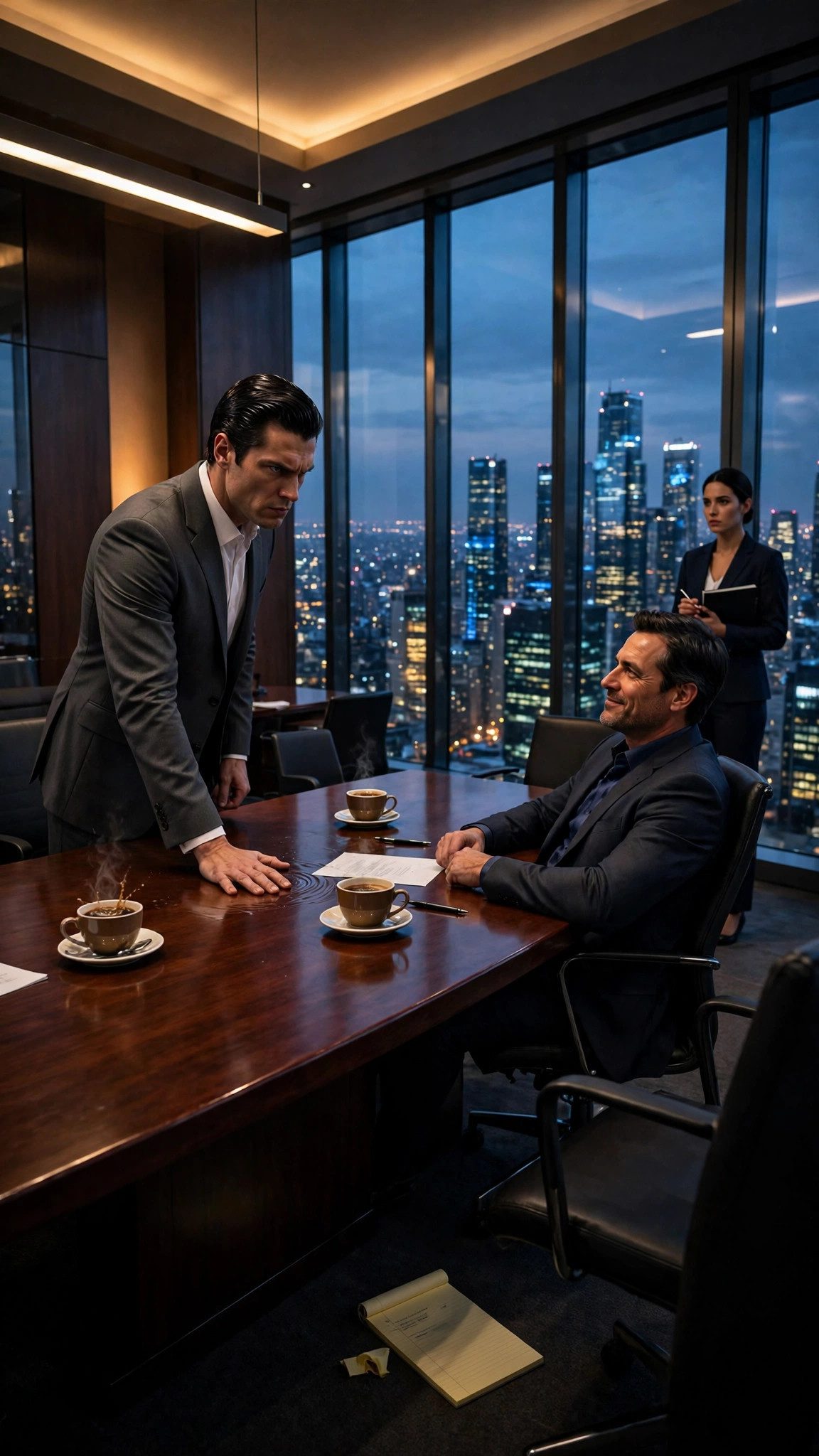
The first rule of working for Adrian Vescari was simple: be early, be exact, and be invisible.
I learned it on my second day, when I arrived at 6:58 in the morning and found him already at his desk, reading a contract, a cup of black coffee steaming beside him. He did not look up. He did not say good morning. He said, "The Henderson file is on the wrong shelf. Fix it before eight."
I fixed it. I did not ask which shelf was the right one. I found it myself, because that was the job — to know things before he asked, to solve problems before they reached his desk, to be the quiet machinery that kept his world running while he stood at the top of it and made decisions that moved millions of dollars.
By the end of the first week, I understood the shape of his life. Adrian Vescari woke at five. He ran six miles along the river before the sun came up. He arrived at the office at seven, and he worked until seven in the evening, sometimes later, sometimes until midnight when a deal was closing or a crisis was burning somewhere in the city. He ate lunch at his desk, standing up, reading. He did not take vacations. He did not take weekends. He did not have friends who called him just to talk. The only personal item on his desk was a silver pen that had belonged to his father, and the only photograph in his office was the one on the shelf behind his desk — a young woman with dark hair and a laughing smile, in a silver frame that he dusted himself every Friday morning, before anyone else arrived.
Sofia. His fiancée. Dead for two years.
Ruth had told me not to mention her, and I never did. But I watched, the way a secretary watches everything, and I learned the rhythm of Adrian's grief. On the fourteenth of every month, he came in later than usual — eight o'clock instead of seven — and his suit was always black, and his eyes were always red at the edges, and he worked in complete silence until noon. On those days, I made his coffee twice as strong, and I cancelled everything that could be cancelled, and I told anyone who called that Mr. Vescari was unavailable. I never asked why. I did not need to ask. The fourteenth was the day Sofia had died. I had found it in the old files, in a police report I was not supposed to see, filed away in a cabinet that no one had opened in two years: Sofia Marchetti, twenty-nine years old, killed in a car bombing on the fourteenth of March, two years ago. The bomb had been meant for Adrian. She had been driving his car.
I read that report once, late at night, when the office was empty and the city was quiet below the glass. And then I put it back, and I never read it again, and I never told anyone what I knew. But from that night on, I understood Adrian Vescari in a way that no one else in the building did.
He was not cold. He was a man holding himself together with rules, because the rules were the only thing standing between him and the grief that would swallow him whole.
That was why he never raised his voice. That was why he never touched anyone, never lingered in a doorway, never let a conversation run past its purpose. That was why he called me Miss Morgan, and why he kept three feet of distance between us at all times, as if closeness itself were a kind of danger.
And that was why, for two years, I told myself that the careful, quiet way he watched over me was only the way a good boss watches over a good employee.
But it was not only that. I knew it was not only that, even when I refused to say it out loud.
It was in the small things. The winter my mother caught pneumonia and the hospital bill came to more than I earned in three months, I found an envelope on my desk one morning with no name on it and no note inside — only enough cash to cover the bill, down to the dollar. I never found out who left it. But the week before, I had mentioned the bill once, in passing, to Ruth, in the break room, when I thought no one else could hear. And Adrian's office door had been open. And his coffee had gone cold that morning, untouched, while he sat at his desk and stared at the wall.
It was in the way he remembered things no boss should remember. That I took my coffee with one sugar, not two. That my mother's birthday was in October, and that she liked white lilies. That I had once said, in a meeting about a shipping contract, that I had studied accounting in college before my father died and I had to quit to take care of my mother — and that six months later, without a word, he had moved me from taking minutes to reviewing the quarterly reports, and then to sitting in on the budget meetings, and then to handling the correspondence with the company's auditors. He never explained it. He never praised me. He simply opened doors, one at a time, and waited to see if I would walk through them.
It was in the way he protected me without ever admitting he was doing it. When a visiting investor from out of town put his hand on my back at a dinner and left it there too long, Adrian was across the room in four seconds, and the man's hand was gone, and the man never came back to the office again. Adrian never mentioned it. He simply said, the next morning, "You will not attend dinners with outside investors anymore. You will take the minutes from the office." As if it were a matter of efficiency. As if it were not the act of a man who had just marked a line in the floor and dared someone to cross it.
And it was in the way he looked at me when he thought I was not looking.
I caught him once, in the reflection of the glass wall, during a meeting that ran long and late. The room was full of men arguing about a warehouse lease, and I was standing in the corner with my notebook, and Adrian was supposed to be listening to the argument. But his eyes were on the glass, and in the glass, they were on me. Not the way a boss looks at a secretary. The way a man looks at a woman he has been trying not to see for two years.
I looked down at my notebook very quickly. My hands were shaking. And when the meeting ended, Adrian walked past me without a word, and I went home that night and sat in my small kitchen and told myself, very firmly, that I had imagined it.
I had not imagined it. I know that now. But at the time, imagining it was easier than admitting the truth — that I had fallen in love with my boss, and that my boss, the most feared man in the city, might have fallen in love with me, and that there was nothing in the world more dangerous than that.
My mother knew. Mothers always know.
"You're different lately," she said to me one Sunday, over the phone, while I was making tea in my apartment and looking out at the rain. "You hum when you cook. You never used to hum."
"I'm fine, Mama."
"You work too much. A girl your age should have a life. A man. A family."
"There's no one, Mama. There's no time."
"Tessa," she said, and her voice went soft in the way it only did when she was about to say something true. "Your father used to say that a person can be busy for a hundred years and still be lonely. Don't be busy, my love. Be happy."
I did not tell her about Adrian. I did not tell her that the man I thought about when I hummed in the kitchen was a man who ran half the city's docks and warehouses, a man whose name made grown men lower their voices. I did not tell her that I had spent two years memorizing the way he took his coffee and the scar on his left hand and the sound of his footsteps in the hallway. I did not tell her that I had started to dream about him — not the frightening dreams, not the ones where he was angry, but the quiet ones, where he was simply standing beside me in a kitchen, drinking coffee, asking me about my day, like an ordinary man.
I told her nothing. I said good night. I hung up the phone. And I sat in the dark of my apartment for a long time, listening to the rain, and thinking about the photograph on the shelf behind Adrian's desk, and about the woman in the silver frame, and about the question I had never dared to ask myself out loud.
If Adrian Vescari ever looked at me the way he once looked at Sofia — what would I do?
I thought I knew the answer. I thought I would run. I thought I would hand in my resignation and disappear, because a woman who loved a man like Adrian Vescari would only ever be a weakness, and a weakness was the one thing that could get him killed.
I was wrong about that, too.
Because on the morning Vincent Calder asked his question, I learned something I had never understood about Adrian Vescari. He was not afraid of being weak. He was afraid of being happy. He had buried his heart under two years of rules and silence because the last time he had let himself love someone, she had died in his car, on the fourteenth of March, and he had spent two years believing that his love was the thing that had killed her.
I remembered the day he hired me as clearly as if it had happened that morning.
The interview had not been in the conference room. It had been in his office, behind the glass wall, with the city spread out below us and the photograph of Sofia watching from the shelf. Adrian had sat behind his desk and looked at my resume for exactly eleven seconds. Then he had set it down, folded his hands, and asked me three questions.
"Can you keep a secret?"
"Yes," I said.
"Can you work late without complaining?"
"Yes."
"Can you look at a man who has done terrible things and still do your job?"
I had paused then, because it was not the kind of question anyone had ever asked me in an interview. But I had looked at his face — at the gray eyes, at the tired lines around them, at the man who was only thirty-three years old and already carried himself like someone twice that age — and I had said the only honest thing I could think of.
"I don't know what you've done, Mr. Vescari. But I know what I need. I need this job. And if keeping your secrets is part of it, then I'll keep them."
He had studied me for a long time. Then he had stood up, walked to the window, and looked out at the river for what felt like a full minute. When he turned back, he said, "You start Monday. Seven o'clock. Don't be late."
That was all. No handshake. No smile. No welcome. Just a job, and a door, and a man who had decided, in eleven seconds, that I would do.
Later, Ruth told me that Adrian had interviewed fourteen people for that job. He had rejected all of them in under five minutes each. I was the only one he had asked the third question. I never found out why. But sometimes, late at night, I wondered if he had seen something in me that day — something he had been looking for without knowing it — and had hired me not because I was the best secretary, but because I was the only one who had not been afraid of him.
The Christmas Eve of my first year, I stayed late to finish the year-end reports. The office was empty. The lights of the city were coming on below the glass, and the snow was falling in slow, heavy flakes against the windows. I was the only person on the thirty-fourth floor, and I had told myself I would finish the last report and then go home to my mother, who was waiting with dinner.
At nine o'clock, the elevator opened, and Adrian walked in. He was not supposed to be there. He was supposed to be at a charity gala downtown, in a tuxedo, shaking hands with the mayor. Instead he was in his office clothes, his coat dusted with snow, carrying two paper cups of coffee.
"I thought you would still be here," he said, and set one of the cups on my desk. "Black, no sugar. I know you take one sugar. I didn't know how much was in the packet, so I guessed."
I stared at the cup. "Thank you, Mr. Vescari."
"Merry Christmas, Miss Morgan," he said. And then he went into his office, closed the door, and worked until midnight, while I finished my reports, and neither of us said another word.
When I left that night, there was a small package on my desk. Inside it was a scarf — dark blue, soft wool, the kind of scarf that costs more than a week's salary. There was no card. No note. No name. But the next morning, when I wore it to work, Adrian looked at it for exactly one second longer than he looked at anything else, and then he looked away, and he never mentioned it again.
I wore that scarf every winter for two years. I am wearing it now, in my memory, as I stand in this conference room and wait for him to speak.
And now, standing in the empty conference room with my notebook pressed against my chest, I was about to find out whether two years of silence had been enough to keep him safe.
Or whether it had only been enough to keep him alone.