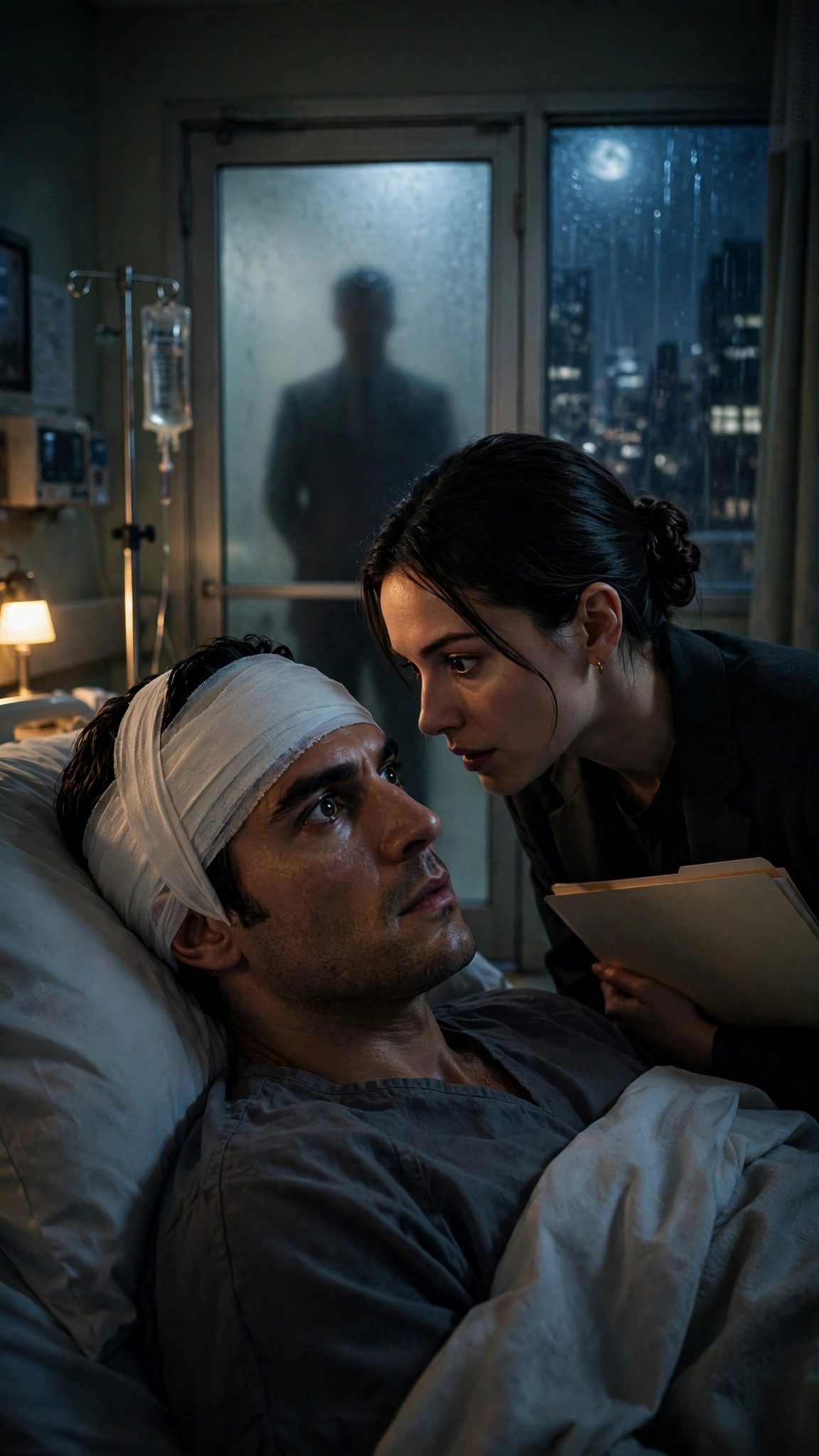
Thursday came the way Thursdays always come in Manhattan: grey at first, then gold, then grey again, with the wind coming off the river and the smell of rain in the air, as if the city itself were holding its breath.
I left the hospital that morning, for the first time since the shooting, in a wheelchair, with a blanket over my knees and a bandage still wrapped around my head, playing the part of the wounded boss one last time. The nurses helped me into the car, and Marco drove, and Frankie sat in the front seat with his eyes on the mirrors, and Emily sat beside me in the back, with the folder on her lap, and none of us spoke, because there was nothing left to say that had not already been said.
Agent Daniel Reyes was waiting for us at the warehouse on Pier Nine, a tall man in his forties with tired eyes and a suit that had seen better days, and a team of FBI agents in dark jackets who moved through the warehouse the way professionals move: quietly, efficiently, without wasted motion. He shook my hand, and his grip was firm, and he looked at my bandage, and he said, "Mr. Moretti. Thank you for coming. I know this is not easy."
"It is not easy," I said. "But it is necessary. And it is the law. That is why I called you, Agent Reyes. Because I have spent nine years settling things the old way, and the old way only ever made more blood. This time, I want the law to do what the law is for."
Reyes nodded, and he showed me the plan, the way a general shows a plan to a man who is about to go into battle: the warehouse, the cranes, the places where his men would hide, the cameras, the recording equipment, the exact spot where Sal would stand when he arrived, believing he was meeting a man with a briefcase, and the exact moment when Reyes would step out of the shadows and show him the warrant.
"Sal will come at two o'clock," Reyes said. "He will come because he believes you are meeting someone here, and he believes he can finish what he started in the restaurant. He will bring at least two men with him. Possibly three. They will be armed. My men will be in position by one. You will be in the van, with Ms. Carter, watching on the monitors. When Sal arrives, we will let him walk in. We will let him look for the man with the briefcase. And then we will take him. Quietly. Cleanly. Without a shot, if we can manage it."
"And Castellano?" I asked.
"Castellano will be at his house in Brooklyn," Reyes said. "We have a team there, waiting. The moment we take Sal, they will take Castellano. We have the phone records. We have the payments. We have the boy from the hospital, who has already told us everything. We have the driver, Tommy Falco, who has already agreed to testify. We have Sal's own calls, recorded, in which he tells Castellano where you will be and when. We have everything we need, Mr. Moretti. All we needed was a witness who would stand up in court and say it out loud. Sal is going to be that witness, whether he wants to be or not."
I looked at the warehouse, at the water beyond it, grey and steady, at the cranes standing against the sky like the skeletons of giants, and I thought about the man who was going to walk into this place in less than an hour, believing he was about to finish a job, and I thought about the thirty years he had spent in the family, and the docks he had run, and the money he had taken, and the bullet he had paid for, and I felt something I had not expected to feel.
I felt sorry for him. Not for what he had done. For what he had thrown away. For the thirty years of loyalty he had traded for a bag of cash and a promise from a man who would have killed him the moment he was no longer useful.
I thought about the day my father died, nine years ago, when Sal had stood beside my father's coffin in a black suit, with his hand on my shoulder, and he had said, "Your father was a good man, Vincent. He trusted you with everything. Do not let him down." I thought about the first meeting I had ever chaired, when I was twenty-nine and terrified, and Sal had been the first man to stand up and say, "The boss is right," when no one else would. I thought about the Christmas parties at his house in Brooklyn, and his wife's cooking, and his son's graduation, and all the years of loyalty that had come before the money, and I felt the grief of it, sharp and clean, the way grief feels when it is mixed with anger.
"He was a good man once," Emily said quietly, beside me, as if she had been reading my thoughts. "That is what makes it worse. He was not born a traitor. He became one, a little at a time, the way a man becomes anything bad: one small decision, and then another, and then one more, until the decisions add up to a bullet."
I nodded. "I know. And that is why I am letting the law take him. Because the old way would have been a grave, and the law way is a courtroom, and a courtroom gives a man a chance to tell the truth. Sal is going to tell the truth. He is going to tell it because he has no other choice, and because somewhere underneath all of it, the man who stood beside my father's coffin is still in there, and he knows what he did."
We waited then, in the van, watching the monitors, while the minutes ticked past and the wind came off the river and the cranes stood against the sky. Marco sat beside me, silent, his hands folded, the way a man sits when he is waiting for something he has been waiting for a long time. Frankie watched the road. Leo watched the water. Emily held the folder on her lap, and she did not open it, because everything in it had already been done, and now all that was left was the waiting.
At 1:47, Sal arrived.
He came in a black car, the way he always came to meetings, with Tommy Falco driving and two men in the back seat, and he stepped out onto the pier, and he looked around, and I watched him on the monitor in the van, and I saw the moment he realized something was wrong. The way he stopped. The way his hand moved toward his jacket. The way his eyes went to the warehouse doors, which were closed, and to the cranes, which were empty, and to the water, which was grey and still.
"Where is he?" he said, to no one, to the empty pier, to the wind coming off the river. "Where is the man with the briefcase?"
And then Agent Reyes stepped out of the warehouse, with his badge in his hand, and his men stepped out behind him, and the sound of their boots on the concrete was the loudest sound I had ever heard, and Sal DeLuca, fifty-four years old, a capo who had been with the family since before I was born, stood on Pier Nine with his mouth open and his hand halfway to his jacket, and he understood, in a single terrible second, that he had walked into a trap, and that the trap had been waiting for him since the night he sold me to a gunman.
"Salvatore DeLuca," Reyes said, in a calm, professional voice. "You are under arrest for conspiracy to commit murder, attempted murder, and racketeering. You have the right to remain silent."
Sal did not remain silent. He looked at the agents, and he looked at the warehouse, and he looked at the van where I was sitting, and he must have seen me, or sensed me, because he turned toward the van, and he said, in a voice that was raw and broken, "Vincent. Vincent, please. I can explain."
I opened the van door, and I stood up, slowly, because my head still hurt, and the bandage was still there, and the blanket fell from my knees, and I walked across the pier toward him, with Emily beside me, and Marco behind me, and Frankie behind him, and Leo behind him, and the FBI agents watching everything, and I stopped in front of the man who had tried to kill me, and I looked at him, and I said the thing I had been waiting to say since I woke up in the hospital.
"I remember everything, Sal."
He stared at me. His face went white. His mouth opened and closed, and no sound came out, and I saw the truth settle into him, the way the truth settles into a man when there is nowhere left to hide from it.
"You remember," he whispered.
"I remember everything," I said. "I remember the meeting. I remember the lights going out. I remember the gunfire. I remember the bullet. And I remember that only five people knew where I would be, and that you were one of them, and that you sold the time and the place to Castellano for money. I know how much. I know when. I know where. Emily knows, too. She has the phone records. She has the photographs. She has everything."
Sal looked at Emily, and then at Marco, and then at Frankie, and then at Leo, and I saw him understand, finally, what had happened. He had not been betrayed by his men. He had been caught by them. By the woman with the folder, and the driver who had walked the marina in the rain, and the restaurant owner who had tried every key on an empty storage unit, and the right hand who had driven up and down Long Island looking for a blue door that did not exist.
"I did it for the docks," he said, and his voice broke. "The docks were mine. They were mine for thirty years. And you were going to take them away. You were going to make them legitimate. You were going to give them to someone else. I couldn't let that happen. I couldn't."
"I was going to take care of you," I said, and my voice was steady, and it was the voice of the boss, and it was also the voice of a man who had once trusted this man with his life. "I had the papers drawn up. A share of the legitimate business. A new position. A way to retire with dignity. They are in my office safe, Sal. They have been there for three weeks. I was going to give them to you after the meeting. After the docks went legitimate. You did not have to kill me to keep the docks. You only had to wait one more night."
He stared at me, and tears came into his eyes, and he said, "I didn't know."
"You didn't ask," I said. "That was your mistake, Sal. You did not ask. You decided. And your decision put a bullet in my head, and a boy in a hospital with a pillow in his hands, and a gunman in an alley behind a restaurant. That is what your decision cost. And now the law is going to decide what it costs you."
Agent Reyes stepped forward, and his men took Sal by the arms, gently, professionally, and they led him toward the cars, and Tommy Falco was already in one of the cars, and the two men from the back seat were already in another, and Sal looked back at me, just once, and he said, "Tell my son I am sorry. Tell him I did it for him. Tell him—"
"Tell him yourself," I said. "In court. When you testify. Because you are going to testify, Sal. You are going to tell the court everything, about Castellano, and the money, and the shooting, and the hospital. And if you do, the law will be merciful to you, the way the law is merciful to men who tell the truth. That is the deal Agent Reyes is offering you. Take it. It is more mercy than you showed me."
He nodded, slowly, and the agents led him away, and the cars drove off the pier, and the wind came off the river, and the cranes stood against the sky, and I stood on Pier Nine with Emily beside me and my men behind me, and I felt the weight of nine years lift off my shoulders, just a little, the way a weight lifts when you finally set it down.
Agent Reyes shook my hand again, and he said, "Castellano is being arrested as we speak, Mr. Moretti. We have his phone. We have his money. We have his men. This is the end of him. And it is because of you, and because of Ms. Carter, and because of the men who stood by you. You did this the right way. You let the law do what the law is for."
"Thank you, Agent Reyes," I said. "And thank you for believing me. For believing a man who was pretending to forget."
He smiled, a tired, professional smile. "I have been doing this for twenty years, Mr. Moretti. I have learned to tell the difference between a man who has forgotten and a man who is pretending. You were never a good actor. Your eyes never stopped watching. That was how I knew."
He left then, with his men, and the pier was quiet, and the water was grey and steady, and Emily took my hand, and Marco put his hand on my shoulder, and Frankie and Leo stood behind us, and the five of us stood on Pier Nine, and for the first time since the shooting, I did not feel like a man who was pretending.
I felt like a man who had remembered everything. And who had finally, finally, done something about it.