Vincent Corvino was not a man. He was a headline.
Chicago developers returned his calls before their wives'. Union representatives remembered his birthday. Men who controlled warehouses, trucking companies, construction crews, and half the freight moving through the South Side never sat down at Vincent's table until he did.
At thirty-four, he had inherited a complicated empire from a father who believed respect was more valuable than money and fear was more reliable than either. His father, Antonio Corvino, had built the family business out of nothing but a truck, a warehouse, and a reputation for keeping his word. Vincent had taken that business and turned it into something larger and colder. He owned the freight. He owned the docks. He owned the men who moved the goods and the men who guarded the goods and the men who decided which goods moved first.
He had never once doubted that the empire would be his forever. Men like Vincent did not doubt. Doubt was for other people.
Lauren had been the only person who ever made him doubt anything, and she had done it by making him laugh.
He met her when he was twenty-six, at a charity gala his father had forced him to attend. She was standing by the bar in a red silk dress, arguing with a bartender about whether a martini should be stirred or shaken, and she was losing the argument with such confidence that Vincent had to walk over and watch.
"You stir a martini," she said, without looking at him. "Shaking it bruises the gin. Anyone who shakes a martini is a barbarian."
"I shake mine," Vincent said.
She turned and looked at him then, really looked at him, and her eyes were the color of dark honey and absolutely unimpressed.
"Then you're a barbarian," she said. "A well-dressed one, but a barbarian."
Vincent Corvino, who had never been spoken to that way in his entire life, laughed. He laughed so hard that the men at the next table turned to stare, and his father's old friends whispered to each other that the boy had finally met someone who was not afraid of him.
That night, Lauren climbed onto the back of his motorcycle wearing that red silk dress, and she laughed at the city lights as they rode along the lakefront. She wrapped her arms around his waist and pressed her cheek against his back, and the whole city seemed to belong to them. The wind was cold and the engine was loud and the lights of the skyline blurred into gold, and Vincent thought, for the first time in his life, that he wanted something more than power.
He wanted her.
They married a year later, in a small church on the North Side, with only family and a few old friends. Lauren wore white. Vincent wore a suit his father had bought for him. His father cried during the vows, which surprised everyone, including his father.
For seven years, the marriage worked the way good marriages work. Not perfectly. Not without fights. Lauren hated the empire. She hated the late nights, the guarded phone calls, the men in dark suits who came to the house at midnight. She hated the way Vincent's name made people lower their voices. She wanted him to sell the docks and buy a vineyard in California. Vincent wanted to keep the empire and give her everything it could buy.
They fought about it. They made up. They fought about it again. That was marriage. That was normal.
What was not normal was the trial.
Six years ago, a fire broke out in a Corvino warehouse on the South Side. A dockworker named Frank Marchetti died in that fire. He was forty-one years old. He had a wife named Elena and two children, a boy and a girl, and he had worked for the Corvino family for eleven years.
The fire was an accident. A faulty wire, a spark, a pallet of chemicals stored too close to a heater. The investigators said so. The insurance company said so. The fire department said so.
But the prosecutor said otherwise. The prosecutor said Vincent Corvino had ordered the warehouse locked from the outside during a union dispute, and that Frank Marchetti had burned to death because of it. The prosecutor had a witness, a warehouse supervisor who had been fired for stealing, who swore he had seen the lock.
Vincent went to trial for murder.
For eleven weeks, he sat in a courtroom on the twenty-third floor of a downtown building, wearing a suit and a tie, listening to men in suits describe him as a monster. Lauren sat beside him every day, holding his hand under the table, her face pale and furious.
And in the gallery, in the third row, sat a woman in black.
Vincent noticed her on the third day of the trial. She was fifty-two years old, with gray hair pulled back into a tight knot, and she wore the same black dress every single day. She never spoke. She never took notes. She simply sat there, her hands folded in her lap, watching him.
He asked his lawyer who she was.
"Elena Marchetti," the lawyer said. "Frank's widow. She comes every day. She has not missed a single session."
Vincent looked at her again, and he understood something he had never understood before. To the rest of the world, he was a headline, a name, a man in a suit. To this woman, he was the man who had killed her husband. It did not matter what the investigators said. It did not matter what the fire department said. It mattered what she believed, and she believed he was guilty.
The jury found him not guilty. The warehouse supervisor admitted on the stand that he had been paid to lie. The lock had never existed. The fire had been an accident, exactly as the investigators said.
Vincent walked out of the courtroom a free man, and Lauren cried in the car all the way home, and his father opened a bottle of champagne that had been waiting in the cellar for ten years.
But Elena Marchetti was still there, in the third row, watching him walk out. And Vincent never forgot her face. He never forgot the way she looked at him — not with hatred, exactly, but with something worse. With patience. With the look of a woman who had decided that the law had failed her and that she would have to wait for justice somewhere else.
He did not think about her again for six years. He had no reason to. The empire was growing. Lauren was happy, or happy enough. The world moved on.
Then, on a warm evening in late spring, Vincent stood outside a restaurant beneath the awning, moments before he walked toward a car where a shooter was waiting for him.
Lauren had been inside, already seated, already ordering a drink. They were celebrating. Vincent had just closed the biggest freight deal of his career, a contract that would put Corvino trucks on every highway in the Midwest, and Lauren had suggested dinner at the restaurant where they had their first date after the wedding.
Vincent remembered standing under the awning, looking at his phone, checking a message from his driver. He remembered the warm air and the smell of rain that had not yet fallen. He remembered thinking that he should buy Lauren something nice, something to make up for the late nights.
He did not remember the shot.
He remembered the sound, a crack that was too sharp to be a firework and too close to be thunder. He remembered the pavement coming up to meet him, hard and fast. He remembered Lauren's voice, screaming his name from inside the restaurant, and the way the world went white and then black and then white again.
He woke up in a hospital, three days later, with a tube in his throat and Lauren holding his hand. The doctors told him a bullet had struck his T12 vertebra and damaged a nerve. The injury was permanent. He would never walk again.
Vincent Corvino, who had never once doubted anything, learned what doubt felt like in a hospital bed, staring at a ceiling that never changed.
His upper body remained powerful. Years of training and the relentless rehabilitation exercises the doctors ordered kept his arms and shoulders strong. But the legs stayed still. They did not respond. They did not twitch. They did not even ache. They were simply gone, as if they belonged to someone else.
Everything changed. The empire did not stop — empires never stop — but Vincent had to run it from a wheelchair, from a desk, from a room. His captains came to him now. His lieutenants reported to him in his study. The men who had once feared him still feared him, but Vincent could see the question in their eyes. How long could a king rule from a chair?
Lauren changed too. At first, she was everything. She slept in the hospital chair for two weeks. She learned to change his dressings. She held his hand through the physical therapy sessions that left him sweating and cursing.
But slowly, quietly, something shifted. She stopped sleeping in his room. She started spending more time at charity meetings. She brought white roses and replaced them every three days, and she spoke to him less and less, as though the words had run out.
Vincent told himself it was grief. He told himself it was exhaustion. He told himself that a woman could only watch her husband suffer for so long before she had to look away.
He did not let himself think the other thing. He did not let himself think that she might have been relieved.
Then Tessa Morgan arrived.
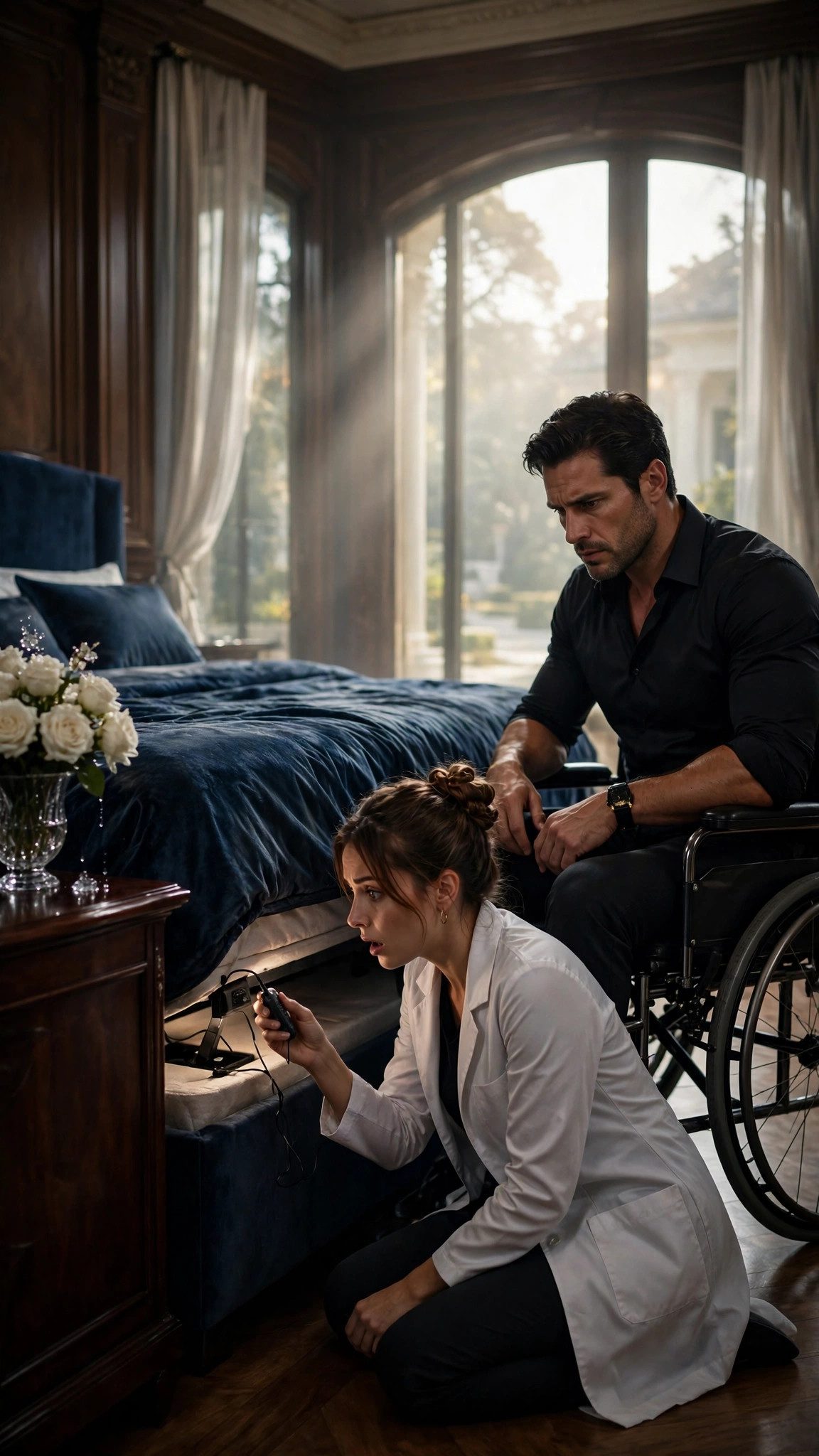
She was twenty-seven, though exhaustion occasionally made her look older. Brown hair was twisted into a knot. She wore a white coat over a black shirt and white trousers. Her movements were efficient and precise. She did not soften her voice when she spoke to him. She did not pity him. She did not flinch when his strong hands grew frustrated and tried to push the limits of his legs.
"You're not a patient," she told him on her first day. "You're a man in a chair. There's a difference. Patients wait to be fixed. Men in chairs decide what happens next."
Vincent had not laughed in six months. He laughed that day.
Tessa handled him carefully but confidently, like his body remained a body instead of becoming a medical exhibit. That alone made the two hours of that Tuesday morning bearable.
And then she slipped one hand beneath the mattress while she was changing the sheets, and she stopped, and everything Vincent thought he knew about the last six months fell apart.
He had been assured repeatedly that the injury was permanent. He had been assured repeatedly that the shooting was a random act, a robbery gone wrong, a man who had panicked and fired.
But a listening device under his mattress was not random. A photograph of him about to be shot was not random. A receipt for fifty thousand dollars with his wife's signature was not random.
Someone had planned the shooting. Someone had watched him. Someone had listened to him. And someone was still watching, still listening, still waiting.
Vincent sat in his wheelchair in the second-floor master suite, and he thought about the woman in the third row of the courtroom, in the black dress, with her hands folded in her lap, watching him.
He had forgotten her. She had not forgotten him.
And he understood, with a clarity that was almost peaceful, that the bullet in his spine had not been the end of something. It had been the beginning.
The beginning of what, he did not yet know. But he knew it had started long before the bullet. It had started in a courtroom, six years ago, with a fire and a widow and a verdict that had satisfied the law but satisfied no one else.
In the hospital, in those first weeks, Vincent had learned what it meant to be helpless. He had learned what it meant to need someone to lift you, to turn you, to wash you, to feed you. He had learned what it meant to lie in a bed and listen to doctors talk about you as if you were not in the room.
"The damage is at T12," the surgeon had said, standing at the foot of the bed with a chart in his hand. "The bullet struck the vertebra and damaged the nerve. The injury is permanent. He will never walk again. He will need a wheelchair. He will need full-time care."
Lauren had been standing beside the bed, holding Vincent's hand, and she had not cried. Not then. She had simply nodded, the way a woman nods when she is given terrible news and has decided, in that moment, that she will not fall apart.
She did not leave his side. She ate her meals in that chair. She read to him from the newspaper when he was too tired to hold it himself. She learned to check his blood pressure and the names of every medication, and she wrote them all down in a small notebook she kept in her purse, in handwriting so neat it looked printed.
The nurses were amazed. "Most wives go home at night," one of them told Vincent, when Lauren was out of the room. "Your wife doesn't leave. She hasn't left since you got here."
Vincent had believed, in those first weeks, that Lauren would never leave. He had believed that the shooting had brought them closer together, that the shared suffering had made their marriage stronger. He had believed that love was enough.
He had been wrong. Love was not enough. Love needed truth, and truth needed courage, and courage was something Vincent had not yet learned to ask for.
But he was learning. Slowly. Painfully. One day at a time.
And on this Tuesday morning, with a listening device on his bed and a photograph in his hand, Vincent Corvino began to learn the most important lesson of his life: that the past does not stay in the past, that it waits and watches and listens, and that the only way to defeat it is to face it, head on, with your eyes open.