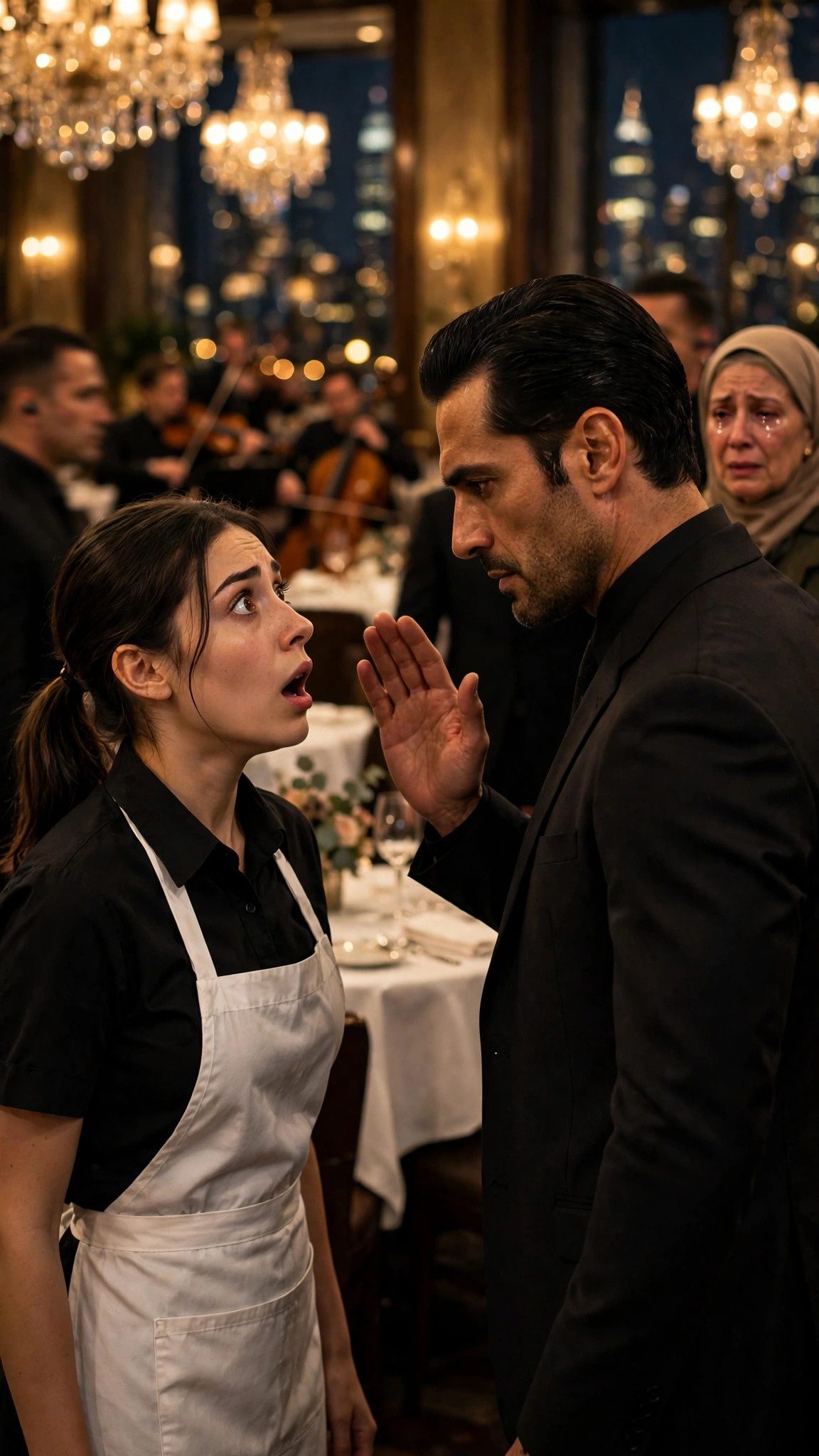
I did not sleep that night.
Amina put me in a bedroom at the top of the brownstone, a room with blue walls and a window that looked out over the garden, and she told me it had been my mother's room, and she left a lamp burning in the hallway, the way a mother leaves a lamp burning for a child who is afraid of the dark, and she closed the door softly behind her, and I lay in my mother's bed, in my mother's house, in a room I had never seen before, and I stared at the ceiling, and I tried to make sense of everything I had learned.
My mother had been Layla Rahal. My grandmother was Amina Rahal. My uncle was Kareem Rahal, the most feared Arab mafia boss in New York. I had a family, a real family, with a house in Brooklyn Heights and a history that went back generations to a white stone house in Beirut with olive trees in the garden, and I had not known any of it, because my father had hidden it from me, and my grandfather had burned the letters, and the world had conspired to keep me small and alone and counting my tips in a little notebook.
I thought about my father, asleep in his apartment in Queens, with his saxophone in its case by the door, and I wondered if he knew. I wondered if he had known all along who my mother's family was, and had chosen to keep me away from them, to protect me, or to protect himself. I wondered if he had been afraid of them, the way I had been afraid of Kareem when he first walked into my restaurant. I wondered if he had done the right thing, or the wrong thing, or if there had ever been a right thing to do at all.
And I thought about the little wooden box at the back of his closet, the locked box I had never been allowed to open, and I knew, with a certainty that felt like a hand closing around my heart, what was inside it. Photographs. Letters. Answers. My mother had left me more than words. She had left me proof. And my father had kept it locked away, because he had been afraid of what would happen if I ever found it.
In the morning, I went downstairs, and Amina was in the kitchen, making breakfast, and Kareem was sitting at the table with Nabil, drinking coffee, reading a newspaper, and when I walked in, they both stood up, as if I were a guest of honor, and Amina put a plate in front of me, eggs and bread and olives and cheese, and she said, "Eat, habibti. You are too thin. Your mother was too thin, too. It runs in the family."
I ate. I had not realized how hungry I was. And while I ate, Kareem watched me, not the way he had watched me in the restaurant, like a man studying a painting, but the way a man watches his family, with a kind of quiet wonder, as if he could not quite believe I was real.
After breakfast, Amina took me into the sitting room, and she opened a drawer in an old wooden cabinet, and she took out a small velvet pouch, and she poured its contents into my hand.
It was a locket. A small gold locket, on a fine gold chain, worn smooth by years of wear. I opened it, and inside, on one side, was a tiny photograph of a young woman with dark hair and a laugh like a bell, standing on a beach in Lebanon with the sea behind her. On the other side, in careful handwriting, were two words in Arabic, and underneath them, in English, in my mother's handwriting, the words I had carried in my chest for nineteen years.
"Ya habibi, la tuqatiluh."
My hands were shaking so hard I nearly dropped it.
"This was your mother's," Amina said. "She wore it every day. When she left this house, she took it with her, and she never took it off, not once, not even in the hospital. The nurses gave it to your father, after she died. He brought it here, once, years ago, in the middle of the night, and he put it in my hands, and he said, 'This belongs to your family. I kept it for Nia, but she is too young, and I am afraid. Keep it until she is old enough to understand.' And then he left, and I never saw him again."
She closed my fingers around the locket.
"It is yours now," she said. "It has always been yours."
I put the chain around my neck, and the locket settled against my skin, warm from Amina's hand, and I felt my mother's presence so strongly that for a moment I could not breathe, as if she were standing right behind me, with her arms around me, whispering the words into my ear.
"Ya habibi, la tuqatiluh. Ya habibi, ruuh ahlaykum."
My love, don't kill him. My love, go home to your family.
Kareem cleared his throat. He set down his coffee cup, and he looked at Nabil, and Nabil nodded, and Kareem turned to me, and his face was serious, the face of a man who had a decision to make.
"Nia," he said, "there is something else you need to know. Tariq is still out there. He knows that I know what he did. He knows that Castellano's money is in his bank account, and that Nabil has the records, and that the family council meets tonight. He is frightened, and a frightened man is dangerous. And Marcus Hale, your manager, he is still at the Bellweather Room, still stealing from you, still selling information to Castellano's men. I can deal with both of them. I can deal with them the way my father would have dealt with them. Or I can deal with them another way. The way your mother would have wanted."
He paused, and he looked at me, and I understood what he was asking. He was asking me to choose. He was asking the girl who had spoken the sentence to decide what the sentence meant. Mercy, or vengeance. The old way, or a new way.
"What is the other way?" I asked.
"The family council," Nabil said. "Tonight. All the heads of the family, all the elders, all the men who have served the Rahals for generations. Kareem brings the evidence before them. The bank records. The shipping manifests. The photographs. Tariq is called to answer. If the council finds him guilty, he is cast out. Not killed. Cast out. He loses his name, his money, his place. He leaves New York, and he never comes back. It is a punishment our family has used for a hundred years, and it is a punishment worse than death, for a man like Tariq."
"And Hale?" I asked.
Kareem smiled, and for the first time, his smile did not frighten me.
"Hale is yours," he said. "You have counted every dollar he stole from you, in your little notebook. Tonight, you will go back to the Bellweather Room, and you will show him the notebook, and you will tell him that you know, and you will watch him try to lie his way out of it, and then I will walk in, and I will tell him that he has two choices. He can return every dollar he stole, from every waitress, and he can leave New York, and he can never work in a restaurant again. Or he can explain himself to the police, with Nabil's folder in their hands."
I thought about it. I thought about the envelope, and the numbers that never matched, and the two years I had spent smiling while a man stole from me, and I thought about the other waitresses, the girls who smoked on the fire escape and traded stories about the guests, girls who had counted their tips the way I had counted mine, girls who had gone home to walk-up apartments and eaten dinner standing at their kitchen counters, and I knew what my answer was.
"I want to face him myself," I said. "I want to look him in the eye, and I want him to know that I know. I don't want you to do it for me. I want to do it myself."
Kareem looked at me for a long moment, and then he nodded, slowly, the way a man nods when he has just learned something new about someone he thought he already understood.
"Your mother would have said the same thing," he said. "She was brave, too. Braver than me. Braver than all of us."
That afternoon, Nabil drove me back to Queens, to my father's apartment, and I stood outside the door for a long time before I knocked, because I did not know what I was going to say to him, and I did not know how he was going to react, and I was afraid, in a way I had not been afraid since I was nine years old and the machines in the hospital room made their long flat sound.
He opened the door, and he looked at me, and his face went pale, because he could see it in my eyes, he could see that I knew, and he stepped back, and he said, "Nia. What happened?"
I told him. I told him everything, about the Bellweather Room, and Kareem, and Amina, and the locket, and the sentence, and the limousine turning around, and he listened without interrupting, and his hands shook, and when I finished, he was quiet for a long time, and then he went to the back of his closet, and he took out the little wooden box, and he put it on the kitchen table between us, and he unlocked it with a key he wore on a chain around his neck, and he opened the lid.
Inside were photographs. Dozens of them. My mother on a beach in Lebanon. My mother in a kitchen in Brooklyn, laughing, flour on her hands. My mother holding me as a baby, wrapped in a white blanket. My mother and my father on their wedding day, in a courthouse on a rainy Tuesday, two strangers standing behind them as witnesses, both of them smiling like they had just won the lottery.
And underneath the photographs, at the very bottom of the box, was a letter, in my mother's handwriting, addressed to me.
"My dearest Nia," it began. "If you are reading this, then you are old enough to know the truth, and I am not there to tell it to you, and I am sorry for that, more sorry than you will ever know…"
I read it standing at my father's kitchen table, with tears running down my face, and when I finished, my father put his arms around me, and he held me the way he had held me in the hospital hallway nineteen years ago, and he said, "I kept it from you because I was afraid, Nia. I was afraid of them. I was afraid of what they would do to you. But I was wrong. I should have told you. Your mother would have wanted you to know."
"I know now, Papa," I said. "And I am not afraid anymore."
That night, the family council met. And I went back to the Bellweather Room, with my little notebook in my apron pocket, and my mother's locket around my neck, and Kareem Rahal walking beside me, and I was ready to face the man who had stolen from me, and to take back everything he had taken, not just from me, but from every girl who had ever counted her tips in a little notebook and smiled while a thief took them away.
Before we left the house, Nabil took me into Kareem's study, and he opened the folder, and he showed me the pages inside, one by one, so that I would understand exactly what we were walking into. There were bank records, showing deposits into an account in Marcus Hale's name, deposits that matched, to the dollar, the tips that had gone missing from the envelope, week after week, for two years. There were photographs of Hale meeting a man in a gray coat in an alley behind the restaurant, handing over a folded piece of paper, taking an envelope in return. And there was a list, in Nabil's careful handwriting, of every waitress who had worked at the Bellweather Room in the last three years, with the amounts each one had lost.
"This is your evidence," Nabil said, "and it is your right. You do not need Kareem to speak for you. You do not need me to speak for you. You have the numbers, Nia. Numbers do not lie, and numbers do not frighten. When you show him that notebook, he will know that you know, and he will know that there is nowhere left for him to hide."
I thought about Rosa, who had worked at the Bellweather Room for eleven years, and who had once told me, on the fire escape during a break, that she had stopped counting her tips a long time ago, because counting only made the hurt worse. I thought about Mei, nineteen years old, who sent half her pay home to her mother in Fujian, and who had once shown me a photograph of a little house with a red door, and said, "One day, Nia. One day I will buy my mother that house." I thought about all the girls who had counted, and all the girls who had stopped counting, and I felt something harden inside me, something that had been soft and frightened for twenty-eight years, and I knew that when I walked into that restaurant, I would not be walking in alone. I would be walking in with every one of them beside me.
Kareem was waiting by the door, and when I came down the stairs with the notebook in my hand, he looked at me, and he nodded, slowly, the way a man nods when he has just learned something new about someone he thought he already understood.
"Your mother would have been proud of you tonight," he said.
"She will be," I said. "She is. I can feel her. She is standing right beside me, and she is not afraid, and neither am I."