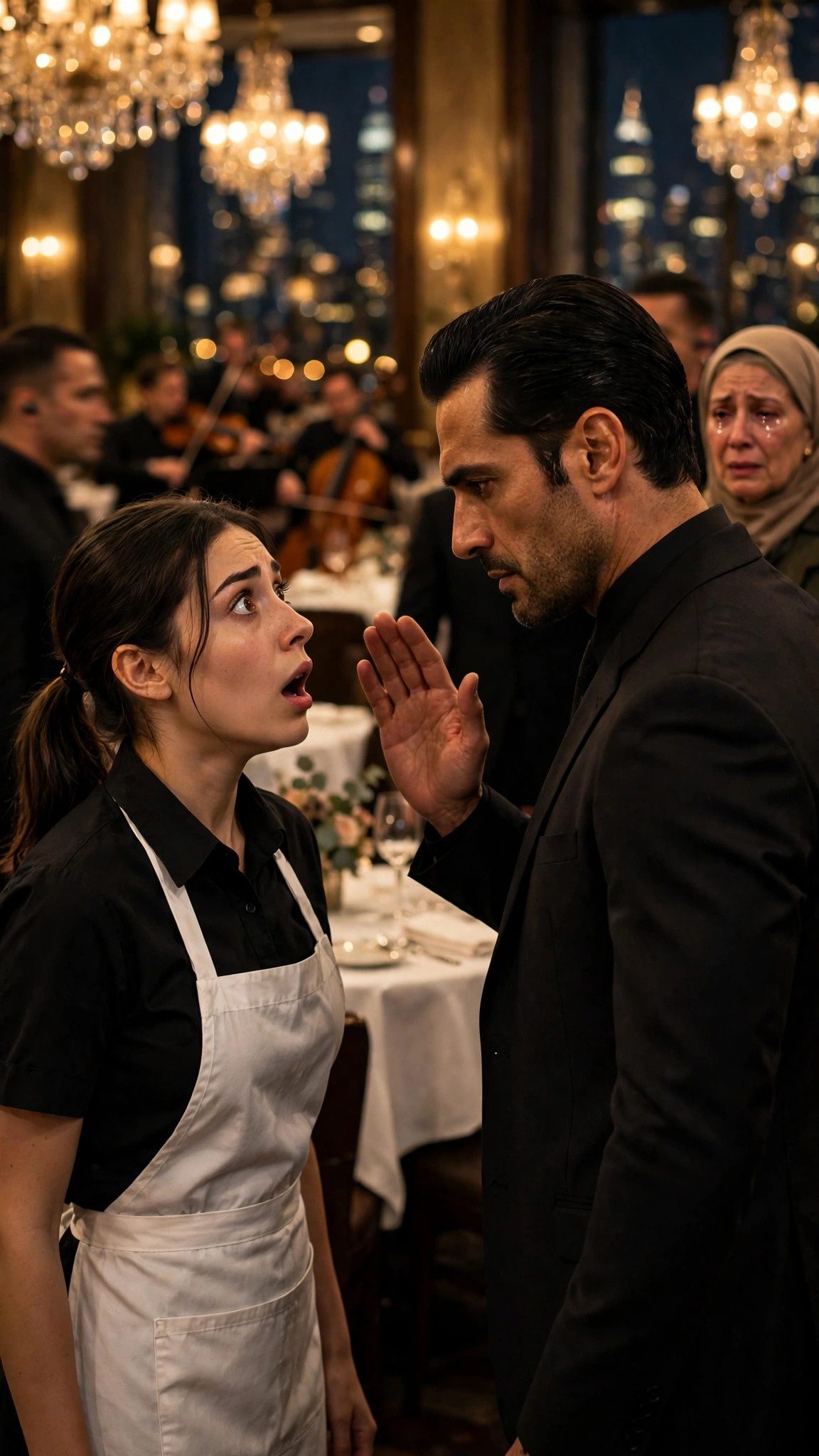
The Bellweather Room looked different that night.
I had walked through its doors a hundred times, a thousand times, in my black uniform with my tray balanced on my hand, and I had always felt small inside it, small and invisible, a piece of furniture that served food to people who owned buildings. But tonight, I walked in with Kareem Rahal beside me, and Nabil behind us, and my mother's locket around my neck, and my little notebook in my apron pocket, and I did not feel small at all. I felt like a woman who had come to collect a debt.
Marcus Hale was standing by the kitchen door, the way he always stood, with his clipboard in his hand and his greasy smile on his face, and when he saw me walk in with Kareem, the smile slid off his face like butter off a hot plate, and his skin went the color of old paper, and he took a step backward, and then another, until his back was against the wall.
"Nia," he said, and his voice came out high and thin. "You are not on the schedule tonight. You are not supposed to be here."
"I am here to collect my tips," I said, and my voice was steady, and it surprised me, because nothing else about me had ever been steady. "All of them. Every dollar you stole from me for two years. And every dollar you stole from every other waitress in this restaurant."
He laughed, a short, nervous laugh, and he said, "I don't know what you are talking about. The house takes its share. The kitchen takes its share. The bar takes its share. You know that. Everyone knows that."
I took the notebook out of my apron pocket, and I opened it, and I held it up, and the pages were full of my tiny careful numbers, two years of numbers, table after table, week after week, and I said, "Table six, forty dollars. Table twelve, twenty-five. Table three, a hundred-dollar bill folded into a swan. I counted, Mr. Hale. I always counted. And at the end of every week, the numbers did not match. Do you know why they did not match? Because you took the difference. You took it from me, and from Rosa, and from Mei, and from every girl who ever worked in this restaurant, and you put it in your pocket, and you told us it was the house's share."
The dining room had gone quiet. The guests at the tables were watching. The other waitresses were standing frozen with their trays in their hands, and Rosa, who had worked at the Bellweather Room for eleven years, was staring at me with her mouth open, and Mei, who was nineteen and sent half her pay home to her mother in Fujian, had tears in her eyes.
"And that is not all you did," I said, and I took a step closer to him, and my voice did not shake, not once. "You sold information about this restaurant to Vincent Castellano's men. You told them who dined here, and when, and where they sat, and which car they drove. You told them Kareem Rahal would be here last night. You put a target on his back, and on mine, and on every person in this room, for money. How much did they pay you, Mr. Hale? How much was our safety worth?"
His face went from white to a sickly gray, and his mouth opened and closed, and no sound came out, and then Kareem stepped forward, and he stood beside me, and he looked at Marcus Hale the way a mountain looks at a pebble, and he said, in his deep calm voice, "You have two choices, Mr. Hale. You can return every dollar you stole, from every waitress, with interest, and you can leave New York tonight, and you can never work in a restaurant again. Or you can explain yourself to the police, with Nabil's folder in their hands, and you can explain to them why a restaurant manager was selling the movements of a mafia boss to his enemies."
Hale's knees buckled. He grabbed the doorframe to keep himself upright, and he looked at me, and his eyes were wild, and he said, "Please. Please, Nia. I have a family. I have children. I didn't mean… I didn't know… Castellano's men, they came to me, they said it was just information, just who was eating where, they said nobody would get hurt…"
"Nobody got hurt," I said, "because my grandmother arranged a dinner, and because my mother taught me a sentence, and because a limousine turned around. But somebody could have been hurt, Mr. Hale. I could have been hurt. Rosa could have been hurt. Mei could have been hurt. You sold us, and you did it for money, and you did it while you smiled at us every day and told us the house takes its share."
I looked at Rosa, and at Mei, and at the other waitresses, and I said, "He stole from all of us. And tonight, he is going to pay us all back."
Kareem nodded to Nabil, and Nabil took out his phone, and made a call, and within twenty minutes, a man in a suit arrived with a briefcase, and Hale was taken into the back office, and the numbers in my notebook were added up, and the numbers in Rosa's memory were added up, and the numbers in Mei's careful records were added up, and by midnight, every waitress in the Bellweather Room had been paid back, in full, with interest, in cash, counted out on the kitchen table, and Marcus Hale had signed a confession, and had left New York in a car with two of Kareem's men, to catch a bus to a town far away, where he would never work in a restaurant again.
But the night was not over. Because while I was collecting what I was owed, Tariq Rahal was making his own move.
He had heard about the family council. He knew that Nabil had the bank records, and the shipping manifests, and the photographs. He knew that Castellano's money was in his account, and that there was no way to explain it away. And he knew that Kareem, the man he had grown up with, the man who had played soccer with him in the streets of Beirut, was going to stand before the council that night and ask for his exile, and that exile, for a man like Tariq, was a punishment worse than death.
So Tariq did what frightened men do. He reached for a weapon he thought would save him. He reached for me.
I was walking back to the limousine after midnight, with Kareem and Nabil beside me, the money from Hale safe in my bag, the locket warm against my skin, when a black car pulled up to the curb, and two men got out, and one of them grabbed my arm, hard, and said, "Come with us, miss. Mr. Castellano would like to have a word with you."
I screamed. I do not remember deciding to scream. The sound came out of me before I could think, and Kareem moved faster than I had ever seen a man move, faster than I thought a man his size could move, and he was between me and the men before I had finished screaming, and Nabil was beside him, and the driver was out of the limousine with a tire iron in his hand, and the two men looked at the three of them, and at the bodyguards coming out of the restaurant behind us, and they let go of my arm, and they got back into their car, and they drove away, fast, into the October night.
Kareem held me while I shook. His arms were strong, and his suit smelled of vanilla and smoke, and he said, "You are safe, Nia. You are safe. I will not let anyone hurt you. Not Tariq. Not Castellano. Not anyone. Not while I am alive."
"They wanted to take me," I whispered. "Because I am your weakness. Because I am the one person you would not sacrifice."
"Yes," he said, and he did not lie to me, not even to make me feel better. "That is why they wanted you. And that is why I will never let them have you. You are my sister's daughter. You are my family. And a Rahal protects his family."
We drove to the council that night, to a house in Brooklyn with a long table and twenty chairs, where the elders of the family sat waiting, men with gray hair and lined faces, men who had served the Rahals for generations, and Kareem stood before them, and he laid out the evidence, the bank records, the shipping manifests, the photographs, and he told them what Tariq had done, and he told them what Castellano had tried to do, and he told them about me, about his sister's daughter, about the sentence that had turned the limousine around, and he asked them for one thing.
Not death. Exile.
"I will not kill my cousin," he said, and his voice filled the room, deep and calm and certain. "My sister's daughter spoke the words to me, and the words are the law of this family. 'Ya habibi, la tuqatiluh.' My love, don't kill him. I have heard those words, and I will obey them. Tariq will leave New York tonight, and he will never come back, and his name will be struck from our family, and his money will be given to the families of the men he endangered. That is my judgment. That is the mercy my sister would have wanted. That is the mercy I choose."
The elders were silent for a long time. And then, one by one, they nodded. And the oldest among them, a man named Yusuf, who had known my grandfather, stood up, and he looked at me, sitting beside Amina at the end of the table, and he said, "Your mother would be proud of you, child. You spoke the words, and the words saved a life, and they changed the heart of the most feared man in New York. That is no small thing. That is the work of a Rahal."
And that was the night I stopped being a waitress who counted her tips in a little notebook, and became something else entirely.
I became family.
The council did not end when the elders nodded. Old Yusuf, the man who had known my grandfather, stood up, and he walked slowly around the long table, and he stopped in front of me, and he looked down at me with eyes that had seen seventy years of the Rahal family's history, and he said, "Child, I knew your grandfather. I knew your mother when she was a little girl, running through this house with ribbons in her hair. And I am an old man, and I have seen this family do many things, some proud and some shameful, and I want you to know that what happened tonight, what your uncle did tonight, choosing mercy over vengeance, that is the proudest moment I have seen in fifty years."
He took my hand in both of his, and his hands were spotted with age, and they shook a little, and he said, "Welcome home, Nia Rahal Brooks. Welcome home."
After the council, we drove back to Brooklyn Heights in the limousine, and the streets were quiet, and the city glittered around us, and Kareem sat beside me, and he was very still, and I could see that the night had cost him something, that choosing mercy over vengeance had not been easy, that part of him had still wanted to go to the docks, and to say the six words, and to be the man his father had been. But he had chosen otherwise, and the choice had changed him, and I could see it in his face, in the way his shoulders had loosened, in the way his hands lay open in his lap instead of clenched into fists.
"Are you all right?" I asked him.
"I am," he said, and he sounded surprised by it. "I thought I would feel weaker, choosing mercy. I thought I would feel as if I had failed. But I feel lighter. I feel as if I have put down something heavy that I have been carrying for a very long time. Your mother used to say that mercy is not weakness, Nia. She used to say that it takes more strength to spare a life than to take one. I never believed her. Tonight, I do."
Amina, sitting on my other side, reached across me and took her son's hand, and she said, "Your father would have been proud of you tonight, Kareem. He was a hard man, but he loved this family, and he loved Layla, and if he could see you now, he would know that his son has become a better man than he was."
We arrived at the brownstone, and Amina went inside, and Nabil went to make a telephone call, and Kareem and I stood on the sidewalk for a moment, under the streetlight, with the jasmine smelling sweet in the garden, and he said, "Tomorrow, we will begin. Tomorrow, I will start turning the shipping company toward the light, and you will start learning how to run a restaurant, and we will build something new, you and I, something our family has never built before. A family that does not need to be feared to be respected."
"And Tariq?" I asked.
"Tariq is gone," he said. "He left tonight, on a plane to a country where no one knows his name. He will live. He will live with what he did, and that is punishment enough. Your mother would have wanted it that way. The words say so. 'Ya habibi, la tuqatiluh.' My love, don't kill him. I have heard them now, Nia. I will never forget them."
I went inside, and I climbed the stairs to my mother's room, with its blue walls and its window looking out over the garden, and I lay down in her bed, and I touched the locket around my neck, and I whispered the words one more time, not in fear, but in gratitude, and I fell asleep to the sound of the city below, and for the first time in my life, I did not dream of being alone.