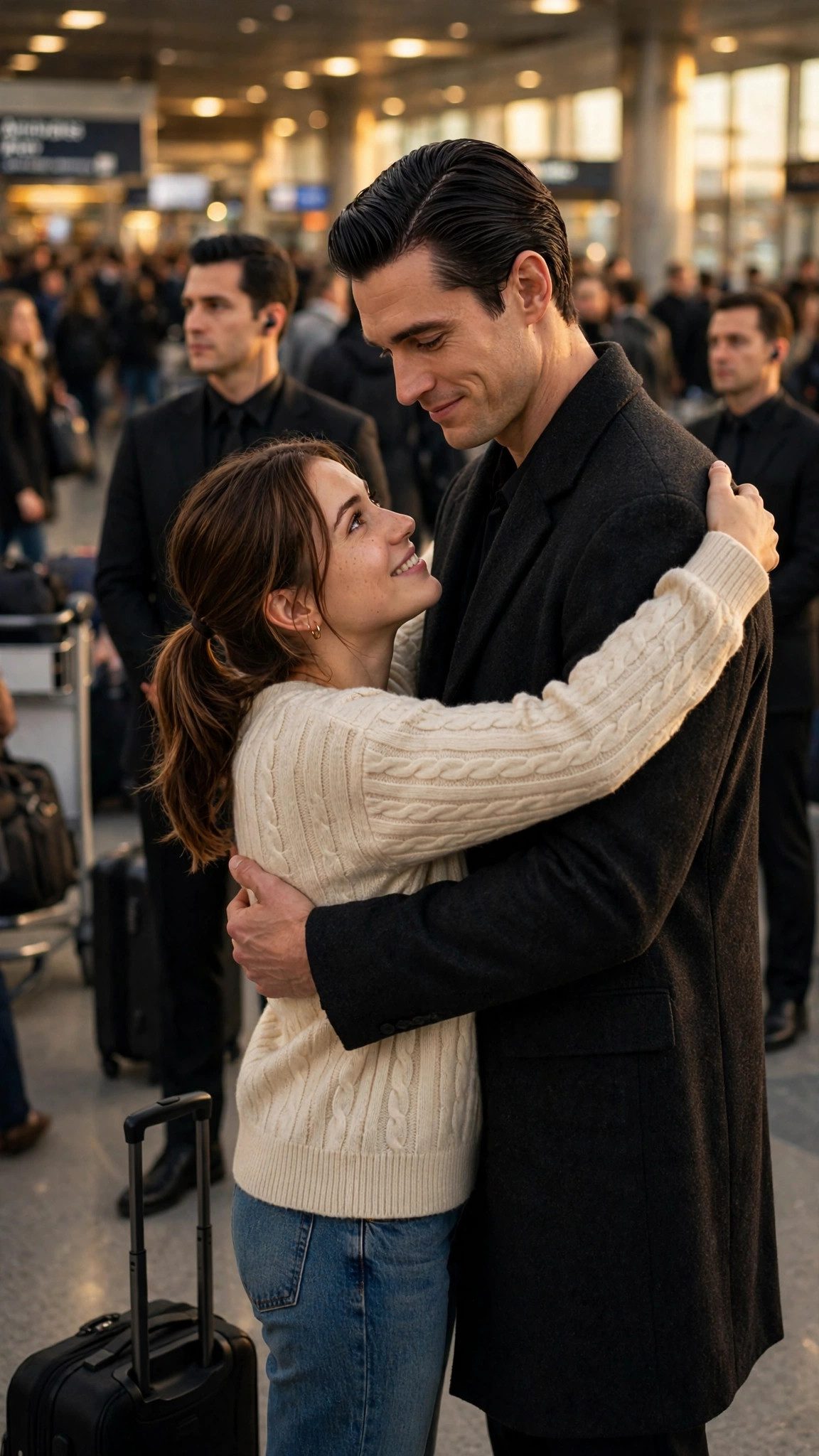
The next day, at four o'clock exactly, Ethan Caldwell walked into Gatehouse Coffee and sat down at table twelve.
He did not look like a man who owned half of Chicago. He looked like a man who had come in from the rain — coat gone, tie loosened, shirtsleeves rolled to the elbows, a newspaper folded under one arm. His bodyguards took their usual seats near the doors, and Rocco, the older one with the gray at his temples, nodded at me like we were old friends. I was not sure whether to be flattered or terrified.
"You're back," I said, setting a coffee in front of him without being asked. Black, no sugar. I had remembered from yesterday. I tried not to think about what it meant that I had remembered.
"I said four o'clock," Ethan said. "I keep my appointments."
"Even with baristas you met by accident?"
"Especially with baristas I met by accident." He took a sip and looked at me over the rim. "You asked your brother."
It wasn't a question. "I did."
"And?"
"And he told me to stay away from you."
Ethan smiled, a slow, dry smile. "Your brother is a wise man. You should listen to him."
"Then why are you here?"
"Because I want to know something," he said, setting the cup down. "Three years ago, a Meridian Freight truck was hijacked on I-90. A driver named Marcus Doyle was killed. The police file went quiet. Do you know why?"
My blood went cold. "You just told me to stay away from you, and now you're asking me about a dead man?"
"I'm asking you," Ethan said, "because your brother is investigating that death, and he is doing it badly. He is asking questions in places where questions get people hurt. I would like to know what he has found, before he gets himself killed finding it."
"He thinks your organization is connected to it," I said, before I could stop myself. "He thinks Meridian put Marcus on that road, and somebody buried the truth."
Ethan was quiet for a long time. The terminal hummed around us — announcements, rolling suitcases, the hiss of the steamer behind the counter. When he spoke again, his voice was lower, and the amusement was gone.
"Meridian Freight is mine," he said. "Every truck, every manifest, every driver. If someone in my organization buried the truth about Marcus Doyle's death, I want to know who. And if someone outside my organization killed him, I want to know that too. But your brother is not the man to find out. He is too close to it. He is grieving, and grief makes men careless."
"And you're not grieving?" I said. "A man died working for your company."
"I am," Ethan said, and the honesty of it caught me off guard. "I am grieving, Miss Reed. I just grieve quietly. I have had a great deal of practice."
He stood up, straightened his cuffs, and left a twenty on the table, the same as yesterday. At the door he turned.
"Tomorrow," he said. "Four o'clock. Bring whatever your brother has found. I will bring whatever I have found. And we will see which one of us is closer to the truth."
He left, and I stood at table twelve with my hands in my apron pockets, and I thought about what he had just said, and about the way he had said it, and about the fact that the most feared man in Chicago had just asked a barista for help.
That night I called Luke. I told him about the meeting. I told him what Ethan had said. There was a long silence on the other end of the line, and then Luke said, in a voice I had never heard from him before — a voice that was afraid — "Hannah, do not bring him anything. Do you understand me? Do not bring him my notebook. Do not bring him the manifest. Do not bring him anything."
"Why not?" I said. "If he really wants to know who killed Marcus—"
"Because if he's lying," Luke said, "you will have handed him everything he needs to bury it forever. And if he's telling the truth, he doesn't need my notebook. He has the whole company. He can find it himself."
"Luke—"
"Promise me, Hannah. Promise me you won't bring him anything."
I promised. I meant it when I promised. And then I went to work the next day, and at four o'clock Ethan Caldwell sat down at table twelve, and he looked at my empty hands, and he smiled like a man who had expected exactly that.
"You didn't bring anything," he said.
"My brother told me not to."
"Your brother is a wise man," Ethan said again. "Sit down, Hannah."
"I can't sit down. I'm working."
"Carlos," Ethan called, without raising his voice, and my manager appeared at the counter like he had been summoned by a bell. "Miss Reed is taking her break now. I will pay for the time."
Carlos looked at me, looked at Ethan, and nodded. "Take your break, Hannah," he said, and walked away before I could argue.
I sat down across from Ethan Caldwell at table twelve, and I folded my hands on the table, and I said, "You have five minutes."
"I only need three," he said. "Your brother is right not to trust me. He should not trust me. But he should also know this: three years ago, the night Marcus Doyle died, I was in New York. I did not order that hijacking. I did not order that cover-up. And I have spent three years wondering why a police file about one of my drivers went quiet in two weeks."
"Then who did?" I asked.
"That," Ethan said, "is what I intend to find out. And I intend to find out with your help, because your brother will not help me, and I cannot do it alone. Not this time."
"Why me?" I said. "I'm a barista. I make coffee."
"You are the only person in this city," Ethan said, "who has ever hugged me by accident and then had the nerve to apologize for it properly. Everyone else in my life is either afraid of me or wants something from me. You are neither. That makes you the only person I can trust with this."
I stared at him. "You want me to spy on my own brother."
"No," Ethan said. "I want you to keep your brother alive. He is asking questions in the wrong places, Hannah. There are men in my organization who do not want those questions asked. If he keeps asking them alone, he will disappear the way Marcus Doyle disappeared — quietly, with flowers and a closed file. I am offering you a different way. Work with me. Let me protect him. Let me find the truth before someone else buries it."
The terminal announcement crackled overhead. A flight to Denver, final boarding. Somewhere behind me, Priya dropped a cup, and Carlos swore softly in Spanish.
"Why should I believe you?" I whispered.
Ethan reached into his jacket — slowly, so the bodyguards would not move, so I would not flinch — and took out a folded piece of paper. He slid it across the table. It was a copy of a police report. Marcus Doyle's name was at the top. And at the bottom, in a handwriting I did not recognize, someone had written two words in red ink.
*Buried. Voss.*
"Dominic Voss," Ethan said quietly. "My lieutenant. My right hand for twelve years. The man who runs Meridian Freight day to day while I run everything else. If anyone buried that file, it was him. And if it was him, then I have a traitor in my own house, and I need to know how deep the rot goes before I cut it out."
I looked at the paper. I looked at Ethan. And I thought about my brother, sitting in his apartment with his notebook and his locked box, asking questions in the wrong places, and I thought about Marcus Doyle, laughing in a photograph with a fish in his hands, and I thought about the fact that the most feared man in Chicago had just shown me the one piece of paper that could get him killed.
"Okay," I said, and my voice was steady even though my hands were shaking under the table. "Okay. I'll help you. But if you hurt my brother — if you touch one hair on his head — I will find a way to make you regret it, and I don't care who you are."
Ethan Caldwell looked at me for a long moment. And then, very slowly, he smiled — not the dry, careful smile from the airport, but a real one, the kind that changed his whole face.
"Miss Reed," he said, "I believe you. And that is the first time I have believed anyone in a very long time."
Over the next week, Ethan came to table twelve every day at four o'clock.
It became a ritual. I would finish the lunch rush, wipe down the counter, and at exactly four o'clock the door would open and he would walk in, coat gone by then, tie loosened, Rocco and Marco taking their seats near the doors like furniture that happened to be armed. He always ordered the same thing — black coffee, no sugar — and he always left a twenty on the table for a four-dollar coffee, and Carlos stopped pretending not to notice and started pretending it was the most normal thing in the world.
We talked about everything except the thing we were supposed to be talking about. He asked me about the regulars. I told him about the pilot who called me "kid" and the flight attendant with the red scarf. He told me about the Meridian Club on Rush Street, about the shipping routes, about the private security firm that guarded half the warehouses on the South Side. He told me about his father, a man named Anthony Caldwell who had built the organization from nothing and died when Ethan was twenty-four, leaving his only son an empire and a target on his back.
"I didn't choose this life," he said one afternoon, turning his cup in slow circles. "I inherited it. My father used to say that a man doesn't choose his family, but he chooses what kind of man he is inside it. I've spent fourteen years trying to be the kind of man who doesn't have to apologize for his name."
"And are you?" I asked.
"Most days," he said. "Some days I wonder."
One evening, after closing, I found him waiting outside the coffee shop in the rain. No bodyguards in sight — which frightened me more than their presence, because it meant he had told them to stay away, and a man like Ethan Caldwell did not dismiss his bodyguards for just anyone.
"Walk with me," he said. It wasn't a question, but it wasn't an order either. It was something in between, the way everything with him was something in between.
We walked through Terminal C in the rain-streaked light, past the shuttered shops and the last stragglers hurrying for their flights, and he told me about Marcus Doyle. Not the police report version. The real version, the one he had pieced together from three years of quiet questions: that Marcus had called Luke the night before he died because the manifest was wrong; that the truck had been carrying something it wasn't supposed to be carrying; that the hijackers had known exactly which truck to stop and exactly what was inside it, which meant someone inside Meridian had told them.
"Someone inside," I repeated. "Voss."
"Voss runs the day-to-day," Ethan said. "He signs the manifests. He assigns the routes. If the manifest was wrong, he either wrote it wrong or he let someone else write it wrong. And if the hijackers knew the route, someone gave it to them."
"Why would Voss do that?" I asked. "He's your right hand. He's been with you for twelve years."
"Because," Ethan said, stopping under an awning while the rain hammered down around us, "the truck wasn't carrying electronics, Hannah. It was carrying money. Cash, from the gambling rooms, on its way to a laundry in Milwaukee. Two million dollars in a truck that was supposed to be carrying televisions. Someone skimmed it. Someone sold the route to the Castellano family, and the Castellanos sent their men, and Marcus Doyle got in the way."
He looked at me, and his gray eyes were dark in the rain-light.
"And the police file went quiet because Voss paid for it to go quiet. And Marcus's family got flowers and a closed casket and a company that moved on."
I thought about Marcus's photograph on Luke's desk, the fish, the big stupid grin. I thought about my brother, carrying that coffin in the rain.
"So what do we do?" I asked.
"We find the proof," Ethan said. "Voss is careful. He has been careful for three years. But careful men make mistakes when they think nobody is watching. Your brother has been watching him for eight months. I have been watching him for three years. Between the two of us, we will find the mistake."
He walked me all the way to the train that night, standing under the awning while I went down the steps, and just before I disappeared he called out, "Hannah."
I turned. "Yes?"
"Thank you," he said. "For not being afraid of me."
"I'm still afraid of you," I said honestly. "I'm just more afraid of what happens to my brother if I walk away."
He smiled — the real smile, the one that changed his whole face. "Good," he said. "Fear keeps you sharp. Just don't let it keep you away."
I rode the train home in the rain, and I thought about the man at table twelve, and about the way he had said my name, and about the fact that I had just agreed to help the most feared man in Chicago take down his own right hand. And I thought about Luke, sitting in his apartment with his notebook and his locked box, and I thought about Marcus Doyle, and I knew that whatever happened next, there was no going back to my small, ordinary life.
The hug had been an accident. Everything after it was a choice. And I had made mine.