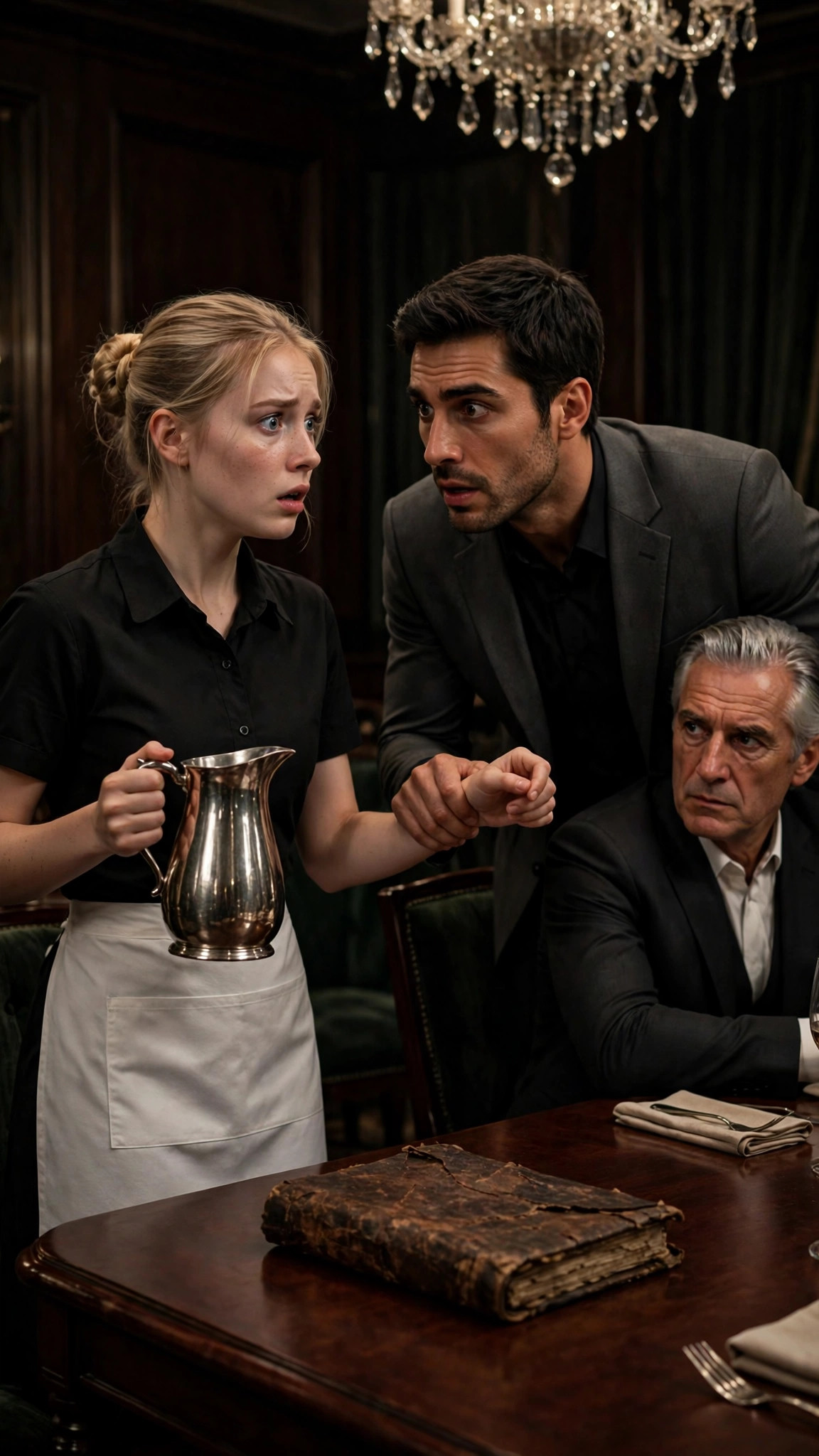
The Sapphire Dining Room was the most beautiful room I had ever stood in, and the most frightening. The carpet was the deep blue of the sea at midnight. The chandelier hung low over the mahogany table, its crystals catching the light and throwing it back in small, sharp pieces across the walls. The table itself was long enough to seat twenty, but tonight there were only four men at it, and the empty chairs made the room feel even larger, even quieter, like a church after the congregation has gone home.
Dominic Russo sat at the head of the table. He did not look up when I came in. He was looking at Constantine, and his eyes were the color of cold coffee, and they did not blink. He wore a charcoal suit and a white shirt with no tie, and he sat the way men sit when they own the building they are sitting in.
Silas stood near the door, broad and silent, his close-cropped dark hair catching the light from the hall. Gabriel stood near the window, lean and still, his hands clasped in front of him, watching the street below the way a man watches a road he has already memorized. They were Dominic's enforcers, and they did not speak, and they did not need to. Their silence was the loudest thing in the room.
Arthur sat to Dominic's right, pale and sweating, his thinning brown hair sticking to his forehead. He had a glass of water in front of him that he had not touched. His hands were folded on the table, and they were trembling, just a little, the way hands tremble when a man is trying very hard not to be afraid and failing.
Constantine sat across from Dominic, smiling. He was fifty-five, angular, salt-and-pepper hair combed back from a high forehead, a dark tailored suit that probably cost more than my father's entire wardrobe. He held a glass of red wine the way a man holds a weapon he is proud of, and he smiled at Dominic the way a snake smiles at a bird it has already decided to eat.
"We agreed to twenty percent," Dominic said. His voice was low and calm, the voice of a man who has never needed to raise it.
"Times change," Constantine replied. His accent was faint, Eastern European, the kind of accent that makes every sentence sound like a secret. "My risk increased. So did my price."
I moved along the edge of the room with my pitcher, refilling their glasses. Water for Arthur, who did not drink it. Water for Dominic, who did not look at me. Water for Constantine, who watched my hands as I poured, the way a man watches a waitress to see if she is nervous.
I was nervous. My hands were steady only because I had spent three years teaching them to be steady. Inside, my heart was hammering against my ribs so hard I was certain the whole room could hear it.
"Twenty percent was the price last month," Constantine said. "This month, the docks are watched. The harbor master has new friends. My people take new risks. Thirty percent is fair."
"Thirty percent is theft," Dominic said.
"Thirty percent is business."
Dominic leaned forward, just slightly, and the whole room seemed to lean with him. "I built my business in this city when you were still selling guns out of a warehouse in Odessa, Constantine. I do not pay thirty percent to a middleman in my own city."
Constantine's smile did not move. "Then perhaps you will understand after reading our updated ledger."
He reached into his jacket and pulled out the journal.
It was battered and old, the leather cracked and dark with age, the pages swollen, the binding held together with a strip of something that might once have been a belt. It looked like it had been carried through wars. It looked like it had been hidden in walls and dug out of floors. It looked, to anyone who did not know what it was, like garbage.
To me, it looked like a door I had seen before.
Constantine placed it on the table, in the center, between the two men, like a judge placing evidence between a prosecutor and a defendant. "Everything is in here," he said. "Every shipment. Every price. Every name. Read it, and you will see that thirty percent is generous."
Dominic motioned toward Arthur. "Read it."
Arthur reached for the journal with hands that shook so badly he had to steady them on the table first. He opened it. The pages were covered in dense, looping script, lines of letters I recognized even from across the table, letters that leaned and curled like vines. My blood turned cold.
It was ancient Corsican dialect, tangled with Soviet prison shorthand, buried beneath a Cold War intelligence cipher. I had seen something disturbingly similar while helping my father decode an old military letter, years ago, at our kitchen table in Queens. My father had called it a dead language wearing a dead code like a coat. He had told me that only a handful of people in the world had ever learned to read it, and that most of them were dead, and the rest wished they were.
I was pouring water beside Arthur when my eyes crossed the first page. I did not mean to read it. I had spent three years training myself not to read things in rooms like this. But my father's training was stronger than my fear, and before I could stop myself, the letters rearranged themselves in my head the way they always had, the way they had rearranged themselves on the kitchen table when I was fifteen and my father was teaching me to see the key inside the lock.
The first sentence was a ledger entry. A shipment. A date. A name.
Arthur's hands began trembling harder. "I can't read this."
Dominic's eyes narrowed. "What?"
"It's encrypted. Dead language, mixed systems. Without the original key, nobody can translate it."
Constantine leaned back in his chair, smiling, swirling his wine. "My people understand it. Your experts can waste weeks. By then, my shipment will already be moving."
Dominic slowly stood. His chair scraping against the floor sounded like a threat. "You expect me to negotiate blind in my own city?"
"It's business."
"No," Dominic said quietly. "It's disrespect."
He seized the journal and slammed it onto the table. Crystal glasses jumped against the wood. Water sloshed over the rim of Arthur's untouched glass. Constantine did not flinch. He only smiled wider, the way a man smiles when he believes the other man has just lost his temper, and a man who loses his temper has already lost the negotiation.
Then Dominic laughed. It was not a happy laugh. It was the laugh of a man who has just decided to change the rules of the game.
"Translate this," he said, looking around the room. "I'll give ten million dollars to anyone who can read a single page."
Nobody moved. Silas did not move. Gabriel did not move. Arthur stared at the journal like it was a snake. Constantine sipped his wine.
My heart hammered against my ribs. Stay invisible. That instinct had kept me safe for years. I could lower my eyes, carry my pitcher back to the kitchen, and remain the forgettable waitress everyone believed I was. I could walk out of the Sapphire Room and go back to my small life, my small apartment, my eighty-seven thousand dollars of debt, and never think about this night again.
Then I saw Constantine smiling.
I saw the way he smiled at Dominic, the way a man smiles when he is stealing from you and you cannot prove it. I saw the way he looked at the journal, the way a man looks at a weapon only he knows how to fire. And I thought about my father, sitting at our kitchen table in Queens, teaching his daughter a dead language because he believed that knowledge was the only thing nobody could steal from you.
And before common sense could stop me, I looked directly at the journal.
I read the first sentence aloud.
My voice was quiet. It was the voice of a waitress who had spent three years learning not to be heard. But in that room, in that silence, it sounded like a gunshot.
Arthur's face drained of color. Constantine stopped smiling. Dominic slowly turned toward me. For several unbearable seconds, nobody breathed. His eyes moved from the journal to my face as if he were seeing me for the first time.
Then he asked the one question I'd spent years making sure no powerful man would ever have reason to ask.
"Who are you?"
I stood there with my pitcher in my hand, my plain blonde bun, my black uniform, my white apron, and I felt the whole room looking at me the way rooms full of dangerous men look at a person they have just realized they underestimated. Silas had taken a step forward from the wall. Gabriel's hand had moved, very slightly, toward the inside of his jacket. Arthur was staring at me with his mouth open, like a man who had just watched a ghost walk into the room.
Constantine was the first to recover. He set his wine glass down, very carefully, and he looked at me with new eyes, cold and calculating, the eyes of a man who has just realized that a piece on the board he thought was a pawn is actually a queen.
"She guessed," he said. "A lucky guess. The girl heard a word somewhere. It means nothing."
"It means everything," Dominic said, without taking his eyes off me. "Say it again."
I looked at the journal. The letters were still there, looping and curling, the dead language wearing its dead code like a coat. I read the sentence again, slowly, word by word, and then I translated it into English, so that every man in the room would understand exactly what the dead language had said.
"The Castellano guns leave Pier Nine at midnight," I said. "Bought with Russo money."
The silence that followed was different from the silence before. The silence before had been the silence of a negotiation. This silence was the silence of a bomb that has just been discovered under the table.
Constantine's face did not change. That was the most frightening thing about him. His smile was gone, but his face did not change. He simply sat there, very still, like a man who has just realized that his best weapon has been taken away from him, and is already calculating what his next weapon will be.
"Impossible," he said softly. "No one outside my organization can read that cipher. No one alive."
"Then I suppose," Dominic said, "that your organization has a problem."
He turned back to me. His hand came down on my wrist, not hard enough to hurt, hard enough to hold. He did not raise his voice. He did not need to. In a room full of men who killed people for a living, the quietest voice in the room was the most dangerous one.
"Your name," he said. It was not a question. It was a command, the way a king commands a subject to kneel.
"Elena Marsh," I said. My voice was steady. I was surprised by how steady it was, because nothing else about me was steady. My hands were shaking. My knees were shaking. The whole shining city outside the windows seemed to be shaking, or maybe that was just me.
"Elena Marsh," Dominic repeated, the way a man repeats a name he intends to remember. "You work here."
"Yes."
"You read dead languages."
"I read this one."
"How?"
I thought about my father. I thought about the kitchen table in Queens, and the photocopies of old manuscripts, and the summer in Croatia, and the flat in Budapest, and the brass compass I had sold to pay for his medicine. I thought about eighty-seven thousand dollars, and a battered leather notebook full of alphabets, and a man who had spent his life chasing languages that were already dying because he believed that a language only dies when the last person who can speak it decides to stay silent.
"My father taught me," I said.
Dominic looked at the journal. He looked at Constantine. He looked back at me. And in his eyes, I saw the exact moment a man like him understands that the most valuable thing in the room is not the journal, and not the shipment, and not the ten million dollars he had just offered to a stranger.
It was the waitress who could read the dead.
"You're coming with me," he said.
Constantine stood up. "Dominic. She is a waitress. She read one sentence. One sentence proves nothing. Let her go back to her kitchen, and let us finish our business like men."
Dominic did not let go of my wrist. "Our business is finished for tonight, Constantine. Your ledger says you have been selling my weapons to my enemies and charging me for the privilege. Your ledger says the Castellanos sail at midnight with guns I paid for. So our business is finished. The only question left is what I do about it."
He looked at me. "And the only person in this room who can answer that question is standing right here, holding a water pitcher."
Constantine's eyes moved to me, and in them I saw something I had never seen in a man's eyes before. Not anger. Not fear. Calculation. He was looking at me the way a man looks at a locked door when he has just realized that the key is standing in front of him, wearing a waitress uniform.
"Careful, Dominic," he said softly. "A girl who can read the dead is a girl a great many people will want. And a great many people will want her quiet."
"Then they will have to come through me," Dominic said.
He pulled me gently toward the door, and Silas opened it, and Gabriel stepped aside, and I walked out of the Sapphire Dining Room with Dominic Russo's hand around my wrist and ten million dollars' worth of dead language in my head, and I understood, with a clarity that frightened me more than anything else that night, that my life of being invisible was over.
Behind us, in the blue-carpeted room, Constantine picked up his wine glass and drank, alone, in the silence, smiling a smile that did not reach his eyes.