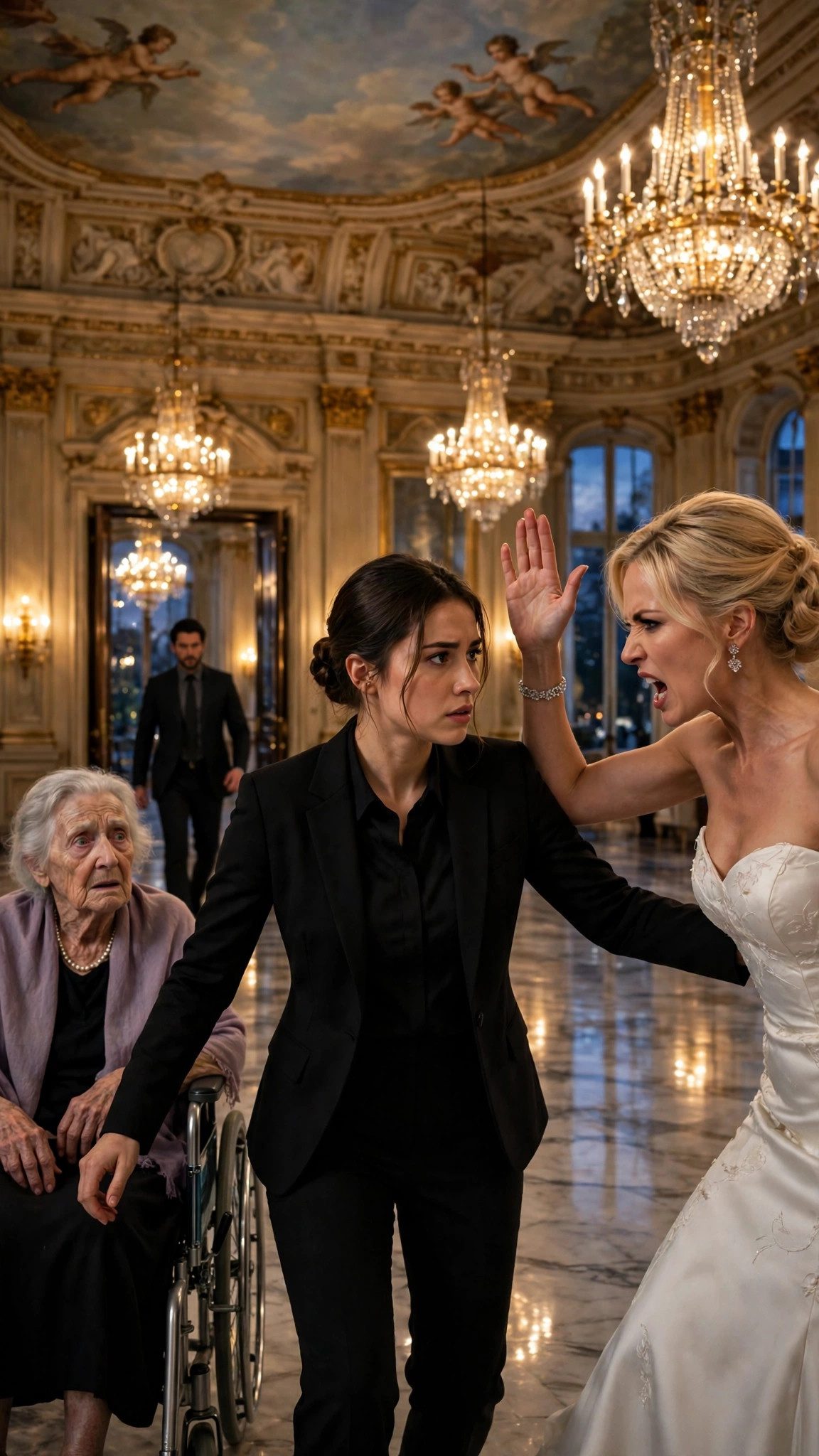
The morning after the men came to the garden, Julian Cross did something no one in his family had ever done before.
He called the FBI.
I was in my little office off the kitchen, going through the invoices, trying to pretend that the night before had been a bad dream, when Paulie knocked on the door and said, "Mr. Cross wants to see you in the library. Bring the camera footage. Bring everything."
I brought the laptop, and I brought the ledger where I kept the hotel's records, and I brought the letter from the bank that had started all of it, and I walked to the library, and I found Julian standing by the window with a man I had never seen before. The man was tall and broad, with short dark hair and a suit that did not fit him as well as Julian's suit fit Julian, and he had a badge on his belt, and a tired, kind face, the face of a man who had spent twenty years chasing people who thought they were above the law.
"Emma," Julian said, "this is Special Agent Daniel Reyes, Federal Bureau of Investigation. He is here because I asked him to come. Agent Reyes, this is Emma Hart. She runs this hotel. She is the reason I am still alive to make this call."
Agent Reyes shook my hand, and his grip was firm, and his eyes were steady, and he said, "Ms. Hart, Mr. Cross has told me about the ring, and the slap, and the men in the garden. What I need from you is the truth, all of it, in order, from the beginning. Can you do that?"
I could. I told him everything. I told him about the morning the ring went missing, and the search of my locker, and the diamond in the wooden box. I told him about Eleanor, and what she had seen in the corridor, and the way her mind went foggy and then clear again. I told him about the party, and the slap, and the marble floor, and Julian walking in. I told him about the kitchen, and Vivian trying to fire my mother. I told him about the night in the hallway, when I heard Vivian say that her father owed Castellano four million dollars, and that Castellano wanted the docks.
Agent Reyes listened, and he took notes, and he asked questions, short ones, the way Julian asked questions, and when I finished, he nodded, and he said, "Ms. Hart, you have just given me the last piece of a puzzle I have been working on for three years."
"What puzzle?" I asked.
"Vincent Castellano," he said. "We have been trying to build a case against him for three years. We know he controls the docks. We know he lends money to families like the Calders and then owns them. We know he sends men to break windows and trample gardens when people say no. What we did not have, until now, was a witness who could connect him to the Calder debt, and a victim who was willing to stand up in court and point at him."
"Marcus Calder," Julian said quietly. "He owes Castellano four million dollars. He told his daughter the only way out was to marry me. He told Castellano the same thing. Castellano was going to own the docks through my money. Through my marriage."
"And now the marriage is over," Agent Reyes said. "And Marcus Calder is a frightened man with a four-million-dollar debt and no way to pay it. Frightened men talk, Mr. Cross. Frightened men make deals. If I can get to Marcus before Castellano does, I can get him to testify. And if Marcus testifies, and Ms. Hart testifies, and Mrs. Cross testifies, we can put Vincent Castellano away for the rest of his life."
Eleanor, who had been sitting in her wheelchair by the window, listening to all of it, turned her head then, and her blue eyes were clear, clearer than I had seen them in weeks, and she said, in a voice that was strong and steady and not foggy at all, "I will testify, young man. I am eighty-one years old. I have seen a woman plant a diamond in a girl's locker. I have seen a woman raise her hand to hit me. I am not afraid of Vincent Castellano. I am not afraid of anyone. I will tell the truth, in court, in front of God and everybody."
Agent Reyes smiled, a small, tired smile, and he said, "Mrs. Cross, you are the bravest witness I have met in twenty years."
That afternoon, the law began to move, and it moved fast, the way the law moves when it finally has what it needs.
Agent Reyes and his team went to Marcus Calder's house in the city, and they found him sitting in his study with a glass of whiskey in his hand, staring at a pile of bills he could not pay. They showed him the photographs of his daughter planting the ring. They showed him the footage from the hotel cameras. They told him that Vivian was facing charges for theft and fraud and assault, and that the only way to save her was to tell the truth about Castellano, all of it, in court, under oath.
Marcus Calder broke. He broke the way frightened men break, all at once, like a dam giving way. He told them everything. He told them about the four million dollars. He told them about the loans, and the interest, and the threats. He told them about the night Castellano's men had come to his house and put a gun on his kitchen table and told him that his daughter's wedding was the only way out. He told them about the docks, and the shipping routes, and the warehouses, and the men who moved things through the port at night, things that were never written down in any ledger.
And then he told them the most important thing of all. He told them where Castellano kept his real ledger, the black leather book where he wrote down every debt and every payment and every name, in his own handwriting, in a safe in the basement of a warehouse on the Hudson docks.
"It is all there," Marcus said, and his voice shook, and his hands shook, and tears ran down his face. "Every name. Every dollar. Every threat. It is all there. Take it. Take it all. Just keep my daughter safe. Please. Keep Vivian safe."
Agent Reyes kept his word. Vivian was not charged with theft, because the ring had been returned, and because she had cooperated, and because she had testified against her own father and against Castellano, and because, in the end, she was a frightened young woman who had been used by the men around her, first by her father, and then by Castellano, and then by her own fear. She left New York. She went to California. She started over. I never saw her again, and I never wanted to, but I did not hate her, not in the end. I pitied her. Because she had wanted to be loved, and she had tried to buy love with a diamond ring, and it had not worked, and it was never going to work.
Marcus Calder testified in court, and he was sentenced to eight years in federal prison for racketeering and fraud. He cried when the sentence was read, and he looked at his daughter, and he mouthed the words "I am sorry," and Vivian mouthed the words "I forgive you," and the courtroom was silent, because even in a courtroom, even in the middle of a trial about a crime boss and four million dollars, there are moments when you remember that the people on trial are still people, with daughters and fathers and broken hearts.
And Vincent Castellano, the man who had sent his men to our garden in the dark, the man who had put a gun on Marcus Calder's kitchen table, the man who had wanted the docks and the hotel and everything else, was arrested at dawn in his penthouse in the city, in his silk pajamas, with his lawyers shouting and his men running, and the black leather ledger was found in the safe in the basement of the warehouse on the docks, and it had every name and every dollar and every threat written down in his own handwriting.
He was tried, and he was convicted, and he was sentenced to life in federal prison without the possibility of parole. He will die in prison. He will never see the Hudson River again. He will never send his men to anyone's garden again.
The trial lasted three weeks, and I testified, and Eleanor testified, and Paulie testified, and the whole hotel held its breath, and when the verdict came in, guilty on all counts, the courtroom erupted, and Agent Reyes shook my hand, and he said, "Ms. Hart, you did this. You and your grandmother. You stood up when no one else would. Do not ever forget that."
The week after the verdict, Julian called the whole staff together in the ballroom, all twenty-one of us, housekeepers and cooks and gardeners and waiters, and my parents stood at the front with me, and my mother held my father's hand, and Rosa stood beside them with her arms crossed, the way she always stood when she was waiting to hear something important.
Julian stood at the head of the room, and he looked at all of us, one by one, and he said, "I owe all of you an apology. I brought trouble to this house. I brought a woman who did not respect you, and a family that did not respect you, and a man who sent his men to your garden in the dark. That was my fault. I chose the wrong promise. I chose a ring over the people who keep this house alive. I will not make that mistake again."
He turned to my mother then, and he said, "Mrs. Hart, you have worked in this house for twenty-three years, and you have climbed those stairs every morning on knees that do not work anymore. From today, you will not climb stairs. You will train the new housekeepers. You will be the head of housekeeping, and you will sit at a desk, and you will tell other people what to do, the way you have been telling me what to do since the day I bought this place."
My mother cried then, quietly, into her handkerchief, and my father put his arm around her, and his strong hands were shaking, and Julian turned to him, and he said, "Mr. Hart, the gardens are yours. All of them. Forever. No one will ever tell you the roses are the wrong color again. And if you need another boy to help you, or two boys, or ten boys, you will have them. The gardens are the heart of this house, and you are the man who keeps the heart beating."
And then he turned to Rosa, and he said, "Mrs. Delgado, you have cleaned this hotel for fifty years, and you have never once raised your voice, and you have never once been wrong about a person. From today, you are the general manager of the housekeeping staff, and your word is law, and if anyone argues with you, they answer to me."
Rosa nodded, once, the way a queen nods, and she said, "Thank you, Mr. Cross. It is about time someone noticed."
The whole room laughed then, and the tension broke, and the staff went back to work, and the hotel came back to life, the way it had come back to life a year ago, only this time it was different, because this time we all knew that the man who owned the house was not just a landlord. He was one of us. He was family.
That evening, I went to the library to read to Eleanor, the way I did every evening, and she was sitting by the window in her wheelchair, looking out at the river, and her silver hair was neat, and her blue eyes were clear, and she held out her thin hand to me, and she said, "Emma, come here, child. I have something to tell you."
"What is it, Grandmother?" I asked, and I sat beside her, and I took her hand, and it was warm, warmer than it had been in weeks.
"My grandson is going to ask you a question," she said, and she smiled, a small, fierce, triumphant smile. "And when he asks it, I want you to say yes. Do you understand? Say yes, Emma. Say yes, and do not look back, and do not be afraid, because you have already survived the worst thing this house has ever seen, and the best thing is still coming."
"How do you know?" I whispered.
"Because I am eighty-one years old," she said, "and I have watched my grandson build walls around himself for twenty years, and I have watched you knock those walls down, one brick at a time, just by being who you are. And because, Emma, you are not just a maid. You are the best thing that has ever happened to this family. And my grandson knows it. He has always known it. He was just too afraid to say it."
I kissed her cheek then, and I held her hand, and we sat together in the library while the light went down over the river, and I thought about everything that had happened, the ring and the slap and the garden and the trial, and I thought about everything that was still to come, and for the first time in months, I was not afraid.
But the law could not fix everything. The law could put Castellano in prison. The law could put Marcus in prison. The law could not fix the roof that had leaked, or the boiler that had rattled, or the roses that had been trampled in the garden. The law could not fix my mother's knees, or my father's back, or the years we had spent afraid of losing the house.
Only one thing could fix those things. Only one person could fix those things. And he was standing in the library of The Whitmore House, looking out at the river, with his hands in his pockets, waiting for me to come and find him.
I went to find him. I walked down the long hallway, past the ballroom with its painted ceiling, past the kitchen where my mother was wiping down a table, past the garden where my father was planting new roses in the dirt where the old ones had been trampled. I walked into the library, and Julian Cross turned around, and he looked at me, and his gray eyes were clear, and his voice was steady, and he said the words I had been waiting a year to hear.
"Emma," he said. "The law did what it could do. Now I need to do what I should have done a year ago, the day I walked into this house and you showed me everything. I need to ask you something, and I need you to answer me honestly, the way you have always answered me honestly."
"What is it?" I whispered.
"Emma Hart," he said, and he took my hands in both of his, and his hands were warm, and rough, and steady. "Will you marry me? Not for business. Not for an arrangement. Not for the docks. For love. Because you are the best thing that has ever happened to my life, and because this house is not a home without you in it, and because I am tired of being afraid, and I am tired of being alone, and I do not want to be alone anymore."
I looked at him, and I thought about the night I was six years old, sitting on a flour sack in the kitchen, thinking this was the most beautiful place in the world. I thought about my mother, climbing the stairs with her bucket. I thought about my father, pruning roses nobody paid him to prune. I thought about Eleanor, holding my hand in the library, telling me that one day her grandson would look at me the way he looks at the river.
And I said the only word that mattered.
"Yes."