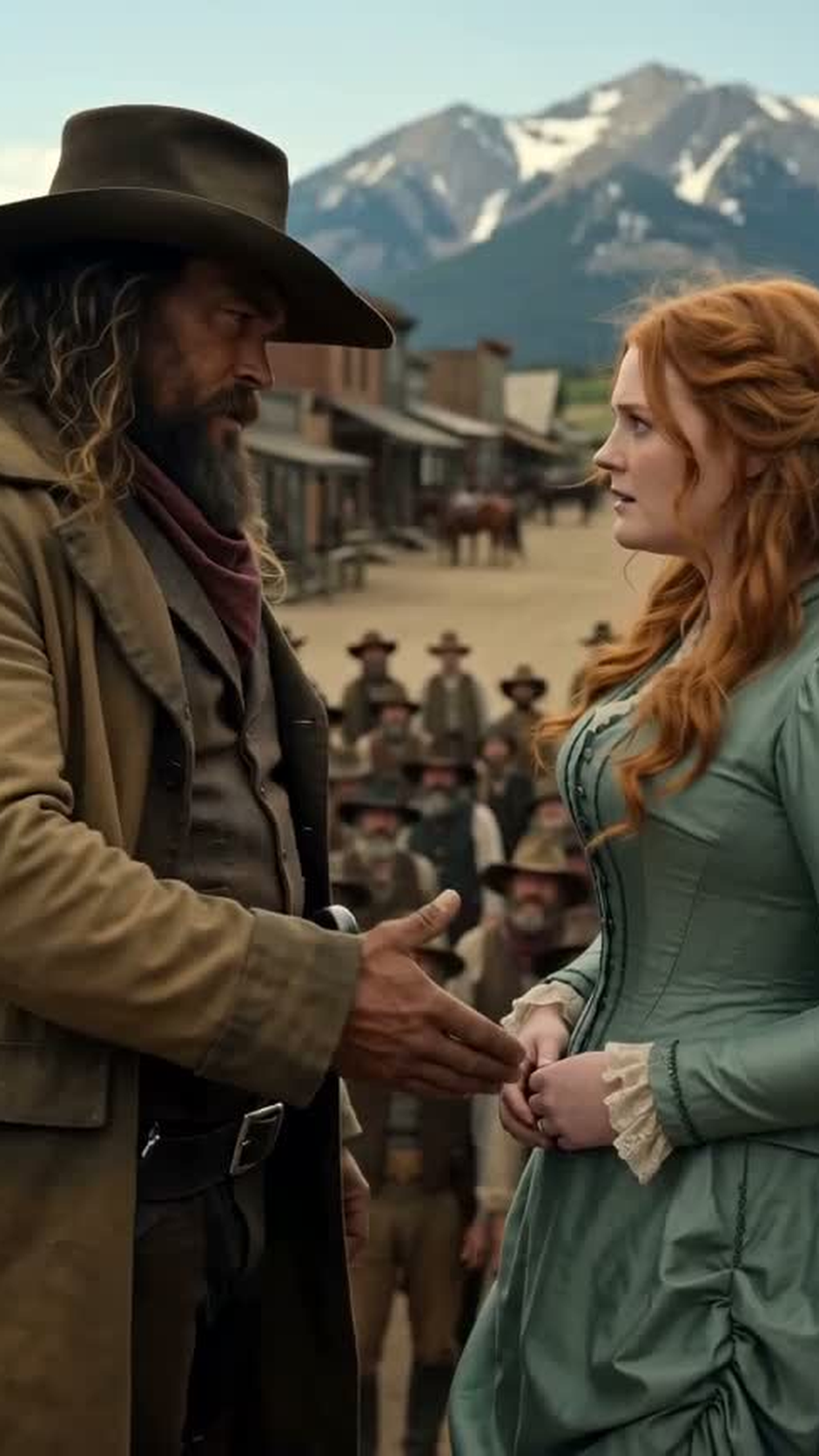
They sold Mrs. Pell first, and kindly — the widow went for one hundred and twenty dollars to a silver-haired rancher who took off his hat before he took her hand, and the crowd approved of the match the way crowds approve of anything that confirms their opinion of themselves. Liddy, seventeen and terrified and pretty as a Christmas card, went for one hundred and eighty to a merchant's son, and cried with relief, and Natalie was glad for her with her whole heart and did not have time to be anything else, because Rose had gone briskly for ninety-five to a mining engineer with spectacles — Rose winking, actually winking, as she came down the steps — and then there was no one left on the benches behind the platform but Natalie.
She climbed the steps alone.
What happened on that platform has already been told, and it happened exactly so: the gavel, the heat, the snicker from the front rank, she could pull a plow herself, the elderly farmer's embarrassed twenty-five, the bored man's thirty, and the auctioneer's smile going thin as river ice. But what no one in Willow Ford knew — what the camera of that afternoon could not show — was what it cost her to keep her shoulders straight through the whole of it. Every laugh was a specific weight. She carried them the way she had carried water buckets as a girl, one in each hand, without spilling, because spilling was the one thing Zimmermans did not do.
And then the hand rose out of the crowd, and the laughter broke, and the deep quiet voice said five hundred, and in gold, and the gavel came down like the crack of the world splitting — and Natalie came down the wooden steps with her skirt gathered in both hands and her heart going like a hammer on an anvil, and stood on the ground of the square, and the biggest man she had ever seen took off his hat to her.
"Why me?" she asked him.
"They don't know your worth," he said.
He extended his hand, palm up, and waited.
Everything Natalie had been taught said that this was the moment to be afraid. She had been sold — whatever courteous word the Society put on it — to a stranger out of the mountains, a man with a knife at his belt and a reputation like a locked door, and she was now to take his hand and go with him to a place no map named, and no one in that square, no one in that territory, no one in the world, would think to ask after her if she never came back down. Her brother was two thousand miles away. Her passage debt was paid — by this man, in gold, five hundred dollars of it, which meant that by every custom of the place and time she belonged to him now in a way that frightened her considerably more than the platform had.
And yet.
He had taken off his hat. In the whole of that long day, in the whole of the long journey west and the longer years before it, no man had ever stood in front of a crowd that was laughing at her and taken off his hat. He had not looked at her body. He had not looked away from her face. He was waiting — actually waiting, his enormous hand held out and steady and entirely without demand — for her to decide.
Natalie Zimmerman put her hand in Dominic Brennan's hand, and the square of Willow Ford, which had mocked her at noon, made a sound it had not planned to make: something between a cheer and a sigh, the sound of a crowd that knows it has been shown up.
His hand closed around hers the way a door closes against weather — completely, and without slamming.
The signing took ten minutes, in the assay office, with the gold weighed out of a buckskin pouch on the brass scales while Tobias Crane perspired gently over the Society's ledgers and made three errors in the figures that Natalie corrected without thinking, in her beautiful hand, in the margin. The mountain man watched her do it. Something crossed his face — not surprise, she thought. Recognition, perhaps. The look of a man who has bid on a horse and discovered it can read.
Then it was done. She was, by the laws of contract and the customs of Idaho Territory, the affianced bride of Dominic Brennan of no fixed address, and her trunk was lashed to a pack mule, and there was nothing — nothing — between her and the mountains but the length of one afternoon.
He did not speak as they rode out of town. He rode a great raw-boned gray gelding that made other horses look unfinished, and he set a pace the mule could keep, and twice in the first hour he stopped at rises in the trail — not to rest, Natalie understood eventually, but to look back. Not at the town. At their back-trail. At the dust of it, read the way other men read newspapers.
"Are we followed?" she asked at last, because silence had begun to feel like a country she would have to live in, and she wished to know its laws. She had rehearsed a dozen questions for this ride — about his house, his intentions, his cooking arrangements, whether there was a church within reach of wherever they were going, and what a woman was expected to call a man who had bought her in a public square — and every one of them had dissolved at the back of her throat, because the man rode the way weather moves, as a condition rather than a conversation. It was the question about being followed that finally made it out of her whole. It turned out to be the right one.
"Not yet," he said.
"Why would we be?"
He looked at her then, riding beside her through the sagebrush with the mountains growing up out of the earth ahead of them like the beginning of the world, and she had the sense that he was deciding something about her — how much truth she could carry, perhaps. Zimmerman-fashion, she sat up straight under the deciding.
"A man pays five hundred in gold for a bride," Dominic Brennan said at last, "every fool in three counties starts wondering where the gold comes from. And some of them stop wondering, and start following." He turned his eyes back to the trail. "Best they wonder a while longer."
An hour out of town the trail crossed a creek running bank-full from the high country, and the pack mule — a creature with opinions — chose the middle of it to lie down, packs, trunk, and all, in three feet of fast brown water. Dominic waded in to haul on the lead rope and got nowhere but wet. Natalie studied the problem the way her father would have, hitched her skirt without a word, walked into the creek, got both arms under the belly strap, and heaved — and the mule, astonished at being out-argued by physics, scrambled up the far bank with its load half swimming behind it. She stood in the water up to her knees with her skirt dripping and her hair coming down, and Dominic Brennan looked at her for a long moment with an expression she could not read at all.
"In the square," he said at last, "the farmer bid twenty-five. Then Pruitt bid thirty, bored-like, to own a fence post." He wrung out the end of the lead rope. "I have been thinking on the way out of town that I still paid too little."
"For the mule work alone," Natalie said, "you did." And she climbed back into her saddle with her dignity in the odd condition of being simultaneously soaked and entirely intact, and rode on feeling the afternoon sun warm on her wet shoulders, and thought that this was perhaps the first honest transaction of her adult life: she had shown a man exactly what she was, all of it, in a creek, and he had revised his estimate upward.
They camped that night in a stand of cottonwoods beside a creek, in a country already turning cold at the edges. Natalie, who had prepared herself — through the long evening of the ride, through every mile of the silence — for the moment when the bargain would be collected, watched him build the fire and set up the camp with the economy of a man who had done it ten thousand times, and then watched him do the thing that rearranged every fear she had brought with her out of Willow Ford.
He pitched the small canvas tent for her. He put her blankets in it, and her trunk at its foot, and her mother's sewing basket where her hand would find it in the dark. Then he took his own bedroll to the far side of the fire, and his rifle, and laid them down in the open, between her tent and the dark of the trees.
"We're not married, Miss Zimmerman," he said, seeing her face. "There's a preacher in these mountains comes through in the fall, and there's my word in the meantime. You'll sleep safe as church." He settled his hat over his eyes. "Eat something. Tomorrow's the hard part of the road."
Before he slept, he did one more thing, and she watched him do it without understanding until it was finished. He took down his rifle, cleaned it by firelight with the unhurried care of a man performing a sacrament, and then — instead of keeping it by his own bedroll — he leaned it against a cottonwood within reach of her tent, and laid his hunting knife beside it, point down in the earth. "Your side of the fire's yours," he said, when he saw her watching. "A person ought to hold their own side of a camp." She had traveled eleven days in the company of a contract that made her a man's property under four separate legal instruments; the mountain man had been in sole possession of her safety for one afternoon, and had spent it handing her weapons and sleeping between her and the dark. Natalie filed the fact carefully, the way she filed all entries she did not yet know how to total.
She sat by the fire in the cold enormous dark, eating beans from a tin plate, looking at the stars that stood closer here than they ever had in Missouri — and Natalie, who had been sold that day to a stranger, who was riding into a wilderness with a man whose only biography was a warning, found that the fear she had packed so carefully had quietly come open somewhere on the trail, and half of it had fallen out along the way.
"Mr. Brennan," she said.
"Dominic," said the hat.
"Dominic. You said the hard part of the road is tomorrow. Where does the road go tomorrow? I have looked at these mountains for three days from the stage. I did not see a pass."
In the dark beyond the fire, she heard him shift, and when he spoke there was something in his voice she had not heard in it yet — not softness, exactly. The sound of a man opening a door he keeps locked.
"That's the point of it, Miss Zimmerman," he said. "Nobody sees it. Sleep now."
She lay down in her tent in the dark with the creek talking outside, and stared up at canvas, and thought about a wall of rock with no road through it, and about a hand held out in a dusty square, steady as a table, waiting for her to decide.
It occurred to her, just before sleep, that she had not yet asked him the only question that mattered, the one she had asked in the square and been given an answer that was no answer at all.
Why me?
She would ask it again tomorrow, she decided. In front of the wall of rock. Wherever the road went that no one could see.