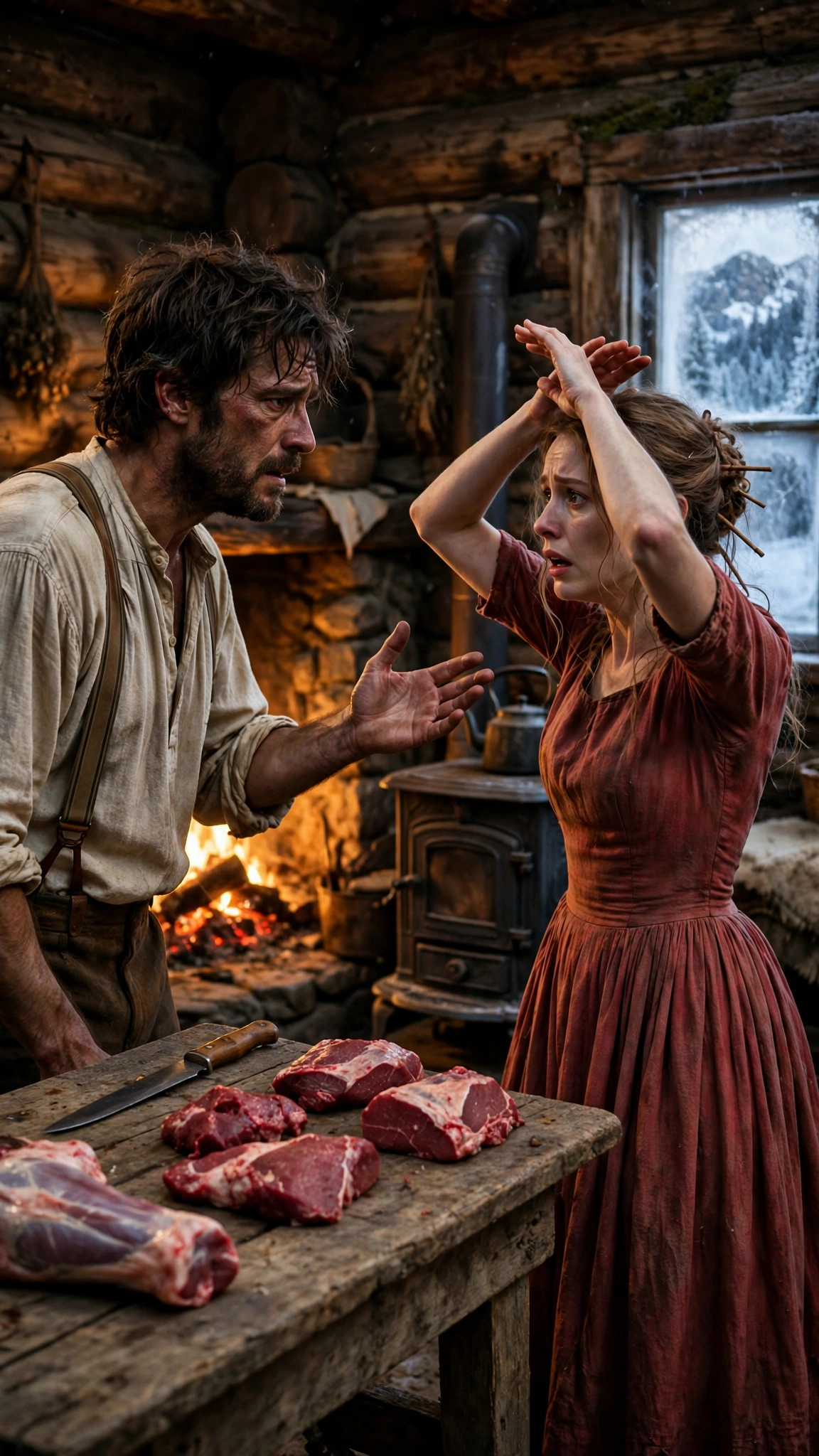
Marshal Eben Cross rode up the mountain the next morning with three men behind him — the judge's clerk, a thin young man with ink on his fingers and a satchel full of papers, and two deputies, broad-shouldered and grim-faced, with rifles in their saddle scabbards.
They came up the trail in the cold morning light, and Mave watched them from the cabin window, her hands clasped tight in her lap, her heart beating fast, and Gideon stood beside her with his hand on her shoulder, steady and warm, and he said, "It's all right. This is the law, Mave. The real law. Not Voss's law."
Reverend Bell rode with them, his coat flapping, his Bible in his saddlebag, and when he dismounted in the yard, he came straight to Mave, and he took her hands in his, and he looked at her with eyes full of sorrow and joy both.
"It's over, child," he said. "I've brought the church book, and Jonah's record, and my own sworn statement. Voss cannot lie his way out of this. Not anymore."
They waited in the cabin, all of them — Gideon, Mave, the reverend, the marshal, the clerk, the deputies — sitting around the wooden table with the fire crackling in the stone fireplace, and the coffee pot on the iron stove, and the morning light coming through the frost-covered window, and Mave sat with Jonah's letter folded in her lap, her fingers tracing the creases, and she waited for the sound she had been dreading for five years.
It came at midday. Hoofbeats on the trail below, slow and deliberate, a single horse picking its way up the wet track, and then Merritt Voss rode into the yard, tall and thin in his dark coat, his hat pulled low, his face pale as river water in winter, and behind him, riding a step behind, came the county sheriff's man from Bitterroot, a nervous young fellow with a badge too big for his coat.
Voss dismounted, and he looked at the cabin, and at the horses tethered in the yard, and at the deputies standing on the porch, and for a moment — just a moment — Mave saw something flicker in his pale eyes. It was not anger. It was not surprise. It was fear. The same fear he had made her feel, a hundred times, in the back room of the trading post. And seeing it, she understood, at last, that he had always been afraid, too — afraid of being found out, afraid of the truth, afraid of the day when someone would stand up to him and say no.
Marshal Cross stepped out onto the porch, and he held up a paper, and his voice was flat and official, the voice of a man doing his duty.
"Merritt Voss," he said, "I have here a sworn statement from the Reverend Amos Bell, and the record of the Bitterroot church, and a letter in the hand of Jonah Hale, deceased, proving that the debt you claim against the widow Hale was paid in full before her husband's death, and that the paper you hold is a forgery. I also have the testimony of the widow herself, and of her husband, Gideon Marsh, regarding assault upon her person. You are under arrest for fraud, forgery, and assault, and you will come with me to the county seat to answer for it."
Voss stood in the yard, and his face went white, and then red, and then white again, and he opened his mouth, and for a moment Mave thought he would shout, or threaten, or try to run. But he did none of those things. He looked at the marshal, and at the deputies, and at the reverend, and at Gideon standing in the doorway with his hands at his sides, and he understood, as Mave had once understood, that the cage had closed, and that there was no way out of it.
"This is a mistake," he said, and his voice shook. "This woman is my property. I have a paper. I have—"
"You have nothing," the marshal said, and he stepped down from the porch, and the deputies moved in on either side of Voss, and the clerk opened his satchel and took out the church record, and the reverend laid his hand on the book, and the whole yard went quiet, except for the wind in the pines and the creek running somewhere below.
Mave stood in the doorway beside Gideon, and she watched them lead Voss away — his hands bound, his head bowed, his fine dark coat muddy at the hem — and she felt nothing. Not triumph. Not joy. Not even relief, not yet. Only a great, hollow quiet, as if a noise that had been ringing in her ears for five years had suddenly stopped, and she did not know what to do with the silence.
Then Gideon took her hand, and he led her back inside, and he sat her down at the table, and he poured her a cup of coffee, and he sat across from her with his hands flat on the wood, where she could see them, empty and open, and he waited, and the fire crackled, and the morning light came through the window, and Mave looked at him, and she began, very quietly, to cry.
She cried for Jonah, who had loved her and warned her and hidden a letter in her mother's Bible. She cried for the years she had lost, and the bruises she had carried, and the lie she had lived inside. She cried for the girl she had been, nineteen years old, standing on the church steps in May, saying yes to a laughing man with a red beard, not knowing what the world would do to her. And she cried, at last, for herself — for Mave Calloway, thirty-one years old, a widow, a wife, a woman who had climbed a mountain in the snow to find a door, and who had found it, and who had walked through it, and who was free.
Gideon did not try to stop her tears. He did not tell her to be strong. He simply sat across the table from her, his hands open on the wood, and he waited, and when her crying slowed, and then stopped, he reached across the table, slowly, and he took her hand in his, and he held it, and he said, very quietly, "It's over, Mave. He's gone. You're safe. And I'm here."
That afternoon, Reverend Bell married them again.
It was Mave's idea. She had been married to Gideon once already, in this same cabin, in the firelight, with her eyes on the floorboards and her voice so soft the reverend had to ask her to say it again. But that had been a marriage of necessity — a marriage made in fear, and in cold, and in the hope of safety. This, she told the reverend, would be a marriage of choice.
So they stood together in the yard, in the spring sunlight, with the snow melting on the ridge and the pines green against the white sky, and the marshal and the deputies and the clerk stood as witnesses, and Reverend Bell opened his Bible, and he read the service, and this time Mave did not look at the floorboards. She looked at Gideon. She looked at his tall, broad figure in his cream linen shirt and brown suspenders, his tousled dark-brown hair, his short beard, his weathered hands, and she saw the man who had set the knife flat on the table, far from her, and who had said, It's only a knife. She saw the man who had sat at the table with his empty hands flat on the wood and asked, Who did this to you? She saw the man who had stood in the yard, unarmed, between her and Merritt Voss, and who had not moved.
And when the reverend asked her if she would take this man to be her husband, she said, "I will," in a voice clear and strong enough for the whole mountain to hear.
Gideon took her hands in his, and he looked at her, and his dark eyes were steady, and he said, "I will," and the reverend closed his Bible, and he said, "Then by the power vested in me, I pronounce you husband and wife — again, and truly, and for good."
The marshal and the deputies cheered, and the clerk clapped, and the reverend laughed, and Mave laughed too, and Gideon — Gideon, who had not smiled in ten winters, not since he buried his brother under the pine on the ridge — Gideon smiled, a slow, real smile that reached his eyes, and he took Mave in his arms, gently, carefully, as if she were something precious, and he kissed her, there in the yard, in the spring sunlight, with the whole mountain watching.
That evening, they ate supper together at the wooden table, and the fire crackled in the stone fireplace, and the wind moved softly over the roof, and Mave looked around the cabin — at the iron stove, and the wash tub in the corner, and the shelf with Gideon's father's books, and the narrow bed, and the frost-covered window — and she thought about how strange it was, that a place she had come to in fear had become a home, and that a man she had married as a stranger had become her husband, truly, and that the sentence she had not been able to finish on the sixth day of her marriage had finally, at last, found its ending.
Later, when the fire was low and the night was quiet, she sat beside Gideon on the pallet by the fire, and she took his hand, and she looked at him, and she finished the sentence aloud, in the firelight, in the voice of a woman who was no longer afraid.
"He told me I belonged to him," she said. "He told me Jonah sold me. He told me I was his property, and I believed him, because I had no one to tell me otherwise. But he was wrong. Jonah never sold me. I never belonged to him. I belong to no man but the one I choose. And I choose you."
Gideon looked at her, and he squeezed her hand, and he said, very quietly, "And I choose you, Mave. Today, and tomorrow, and every day after."
Outside, the snow was melting on the ridge, and the creek was running free, and the spring was coming to the mountain, slow and sure, like water finding its level. Inside the cabin, the fire burned low and steady, and Mave Calloway — Mave Marsh — lay down beside her husband in the narrow bed, and she listened to his breathing in the dark, and she thought about the garden she would plant in the spring, and the seeds she would sow, and the life she would build, one day at a time, in the cabin on the mountain, with the man who had set the knife flat on the table and said, It's only a knife.
And she slept, at last, without fear, and without dreams of the trading post, and when morning came, cold and clear, with pale light through the frost-covered window, she woke to the smell of coffee and woodsmoke, and to the sound of Gideon moving quietly around the cabin, and to the knowledge that she was safe, and that she was loved, and that she was home.
In the weeks that followed, the mountain changed around them, the way it always did in spring. The snow retreated from the lower slopes, and the creek ran full and loud, and the first green shoots pushed up through the wet earth in the yard. Mave planted her garden on the south side of the cabin, in the patch of ground Gideon cleared for her with his own hands — potatoes and beans and carrots and squash, and a row of wildflowers along the fence, because Gideon said a garden ought to have something beautiful in it, not only something useful, and Mave agreed, and she planted the flowers herself, pressing each seed into the dark earth with her fingers, thinking about the way her mother had once done the same thing, in the yard of the house in Bitterroot, on a spring morning long ago.
Mrs. Pruitt wrote to her from Bitterroot, a letter carried up the mountain by Elias Crowe, who had come to see how they were getting on. The letter said that Voss & Co. had been sold, and that the new owner was an honest man from the county seat, and that the trading post was a different place now, and that Mrs. Pruitt was glad, and that she prayed for Mave every Sunday. Mave read the letter twice, and then she folded it into her mother's Bible, beside Jonah's letter, and she thought about the town below, and the church with the cracked bell, and the cottonwoods in the churchyard, and she found, to her surprise, that she could think about Bitterroot now without fear — only with a kind of sadness, and a kind of gratitude, for the road that had led her away from it and up the mountain, to the cabin, and to Gideon, and to the life she had now.
And when the first beans came up in the garden, green and strong in the dark earth, Mave stood in the yard in the morning light, her hands dirty from the soil, her hair loosened from its pins, and she looked up at the pine on the ridge, and at the mountains going up and up into the blue sky, and she thought about the knife on the floor, and the bruises on her ribs, and the sentence she had finished at last, and she thought: this is what a life is. Not the fear. Not the lie. This — the garden, the cabin, the man inside making coffee, the mountains standing guard around them all — this is what a life is.