Story Genres: MAFIA BOSS

  • Chapter 3: The Billionaire’s Name on the Papers That Could Destroy My Home

    Chapter 3: The Billionaire’s Name on the Papers That Could Destroy My Home

    By morning, I had made three decisions.

    I would not tell the children about the threatened property claim until I knew what it meant.

    I would not sign anything sent by Whitmore Holdings.

    And I would never again allow Charles Mercer or Judith Whitmore to make me feel powerless.

    The first person I called was my attorney, Rebecca Hayes.

    Rebecca had been my closest friend since I moved to Kentucky. We met when Violet was a baby, after I mistakenly delivered wedding flowers to the funeral home where Rebecca was helping settle her aunt's estate.

    She'd looked at the enormous arrangement of pink peonies and started laughing.

    “Well,” she'd said, “Aunt Margaret always wanted a dramatic exit.”

    By the following summer, Rebecca had become the first person outside my family to know the full story of my marriage.

    Now she listened while I explained the telephone call.

    When I finished, she was silent.

    “That doesn't sound right,” she finally said.

    “I know.”

    “No, Emily. I mean legally. A corporation doesn't acquire the right to foreclose on your property simply because someone says you owed them money years ago.”

    “Then what are they doing?”

    “Trying to convince you they have leverage, perhaps. We need to see the actual documents.”

    I breathed out.

    For the first time since Daniel appeared, I felt something like relief.

    Rebecca was a practical woman.

    She believed in evidence, signed documents, and the kind of truth that could survive cross-examination.

    “Can you come over?” I asked.

    “I'll be there after I finish at the courthouse.”

    “And Rebecca?”

    “Yes?”

    “Daniel is in town.”

    A long silence followed.

    Then she said, “As in Daniel Whitmore?”

    “Yes.”

    “The man who threw you out while his mother accused you of theft?”

    “That Daniel.”

    “Good Lord.”

    “He came yesterday.”

    “Why?”

    “An anonymous letter.”

    Rebecca exhaled slowly.

    “Emily, promise me you won't speak to him alone about the financial case.”

    “I won't.”

    “And don't let your emotions make legal decisions for you.”

    I almost smiled.

    “You know me better than that.”

    “Actually, I know exactly how much you once loved that man.”

    I had no answer.

    Because she was right.

    Love could make a person foolish.

    And even after nine years, I was beginning to fear there were parts of my heart that had never learned the difference between forgiveness and surrender.

    After breakfast, I took Violet and Ben to school.

    Violet spent the entire drive staring out the window.

    Usually, she filled the truck with questions about animals, books, and whether clouds could get tired.

    That morning, she barely spoke.

    When we reached the elementary school, she unbuckled her seat belt but didn't open the door.

    “Mommy?”

    “Yes, sweetheart?”

    “Did the man yesterday make you cry?”

    I looked at her in the rearview mirror.

    “He reminded me of something sad.”

    “Was he mean to you?”

    I hesitated.

    Children deserved honesty.

    But they also deserved to be protected from adult burdens they weren't ready to carry.

    “He hurt my feelings a long time ago.”

    Violet considered that.

    “Did he say sorry?”

    “Yes.”

    “Then why were you still sad?”

    I turned around in my seat.

    “Because sometimes saying sorry is the beginning of fixing something, not the end.”

    She nodded thoughtfully.

    “Like when Ben broke my music box?”

    “Exactly.”

    “He said sorry, but it was still broken.”

    “That's right.”

    “Grandpa Henry fixed it, though.”

    Grandpa Henry was our neighbor, a retired mechanic who had adopted us emotionally long before I felt brave enough to admit we needed help.

    I smiled.

    “Yes, he did.”

    Violet looked toward the school.

    “Maybe somebody can fix what happened to you.”

    I reached back and squeezed her hand.

    “Maybe, baby.”

    She climbed out of the truck.

    Then she turned and waved.

    “Love you!”

    “More than all the stars.”

    “Even the ones nobody found yet?”

    “Especially those.”

    She grinned and ran toward the school entrance.

    I watched until she disappeared inside.

    Only then did I allow myself to breathe.

    I had no intention of letting Daniel's return destroy the childhood I'd worked so hard to give her.

    But I was beginning to realize that keeping the truth hidden might hurt her in a different way.

    By noon, Rebecca had obtained a copy of the property filing.

    She spread the documents across my kitchen table.

    My hands went cold when I saw the company name.

    Blue Ridge Development Partners, LLC.

    Beneath it was a reference to Whitmore Holdings as the majority investor.

    “Here's what they're claiming,” Rebecca explained. “They're asserting that you signed a repayment agreement connected to the old foundation matter and pledged an interest in this property as collateral.”

    I stared at her.

    “I didn't even own this house when that accusation happened.”

    Rebecca nodded.

    “That's one reason the document is suspicious.”

    She slid another page toward me.

    It was dated seven months after I'd left the mansion.

    Seven months.

    I remembered that month with unbearable clarity.

    I had been pregnant, sleeping badly, and working part-time at a florist in Louisville.

    My grandmother's farmhouse had only recently become available to me after probate.

    The document showed my signature.

    It was close.

    Very close.

    But the final letter curved differently.

    And the address beside it was one I hadn't occupied in years.

    “I never signed this,” I said.

    “I believe you.”

    “What happens now?”

    “We challenge the validity of the claim. They'd have to establish a legitimate debt and enforceable security interest. And I'll seek to prevent any improper collection or interference with the property.”

    I stared at the papers.

    For nine years, I'd been running from the accusation.

    Now it had followed me into my kitchen.

    “Why would Mercer do this after all this time?”

    Rebecca considered the question.

    “Maybe because this land is worth more than you realize.”

    She opened a folder containing a map.

    Several farms around Bell Hollow were highlighted in yellow.

    My property was in the middle.

    “The county has been considering a large infrastructure project along this corridor.”

    I leaned closer.

    “What kind of project?”

    “A distribution and technology complex. Commercial development. Access roads. Utility connections.”

    My stomach sank.

    The open fields, the creek, the little school bus route, the old barns that had stood for generations.

    All of it could become part of some billionaire's investment plan.

    “And my farm?”

    Rebecca pointed to a narrow strip of land beside the creek.

    “Your property would provide a convenient access route.”

    I stared at her.

    “So somebody decided my home was easier to take than negotiate for.”

    “That's one possibility. We need evidence before making that accusation.”

    There was a knock on the door.

    My heart jumped.

    Rebecca looked toward the hallway.

    “Are you expecting someone?”

    “No.”

    I stood and walked to the front window.

    Daniel was on the porch.

    He wasn't holding flowers this time.

    Only a manila folder.

    For a moment, I simply stared.

    Then I opened the door a few inches.

    “You promised not to come back unless I asked.”

    “I know,” he said immediately. “I'm sorry.”

    I folded my arms.

    “Then why are you here?”

    He raised the folder.

    “Because I found something you need to see.”

    Rebecca appeared behind me.

    “Mr. Whitmore?”

    Daniel looked surprised.

    “Rebecca Hayes?”

    She raised an eyebrow.

    “You remember me.”

    “Emily mentioned you years ago.”

    “She also mentioned that you were supposed to leave her alone.”

    I almost laughed.

    Daniel didn't.

    Instead, he nodded.

    “I understand. But there may be a serious problem involving my company.”

    Rebecca's expression changed.

    “What kind of problem?”

    “A development project.”

    She stepped closer.

    “Blue Ridge Development Partners?”

    Daniel stared at her.

    “How do you know that name?”

    I felt a sharp rush of anger.

    “Because your company is trying to take my farm.”

    He went completely still.

    “What?”

    Rebecca watched him carefully.

    “Would you like to explain why a company controlled by Whitmore Holdings has filed a disputed claim against Emily's property?”

    Daniel shook his head.

    “I didn't know.”

    I let out a short laugh.

    “Of course you didn't.”

    “Emily, I'm serious.”

    “So was I nine years ago.”

    His face tightened.

    Rebecca stepped between us.

    “Mr. Whitmore, this is now a legal matter. Anything you have should go through counsel.”

    Daniel nodded.

    “Agreed.”

    He handed her the folder.

    Inside were internal project summaries and a preliminary acquisition map.

    Daniel pointed to a highlighted section.

    “I received a briefing this morning about a series of rural properties being assembled for commercial development. I recognized the road name.”

    Rebecca examined the pages.

    “Did you authorize these acquisitions?”

    “I approved an investment framework last year. The subsidiary's management handles individual properties. But I never authorized anyone to manufacture a claim against a homeowner.”

    I stared at him.

    “Yet your company is doing it.”

    “Yes,” he said.

    No excuses.

    No deflection.

    Just the admission.

    That unsettled me more than I expected.

    “I've ordered an independent review,” he continued. “The relevant files are being preserved, and I instructed the legal department not to take enforcement action against this property while the claim is investigated.”

    Rebecca looked up.

    “That instruction should be documented.”

    “It will be.”

    “And it doesn't erase any rights Emily may have.”

    “I understand.”

    He looked toward me.

    “I came to tell you before you heard it from someone else.”

    “I already heard it from your attorney.”

    “He isn't my attorney.”

    Daniel's voice changed.

    “Who contacted you?”

    “Andrew Price.”

    His expression hardened.

    “From where?”

    “Blue Ridge Development Partners.”

    Daniel looked at Rebecca.

    “May I see the notice?”

    She handed him a copy.

    I watched his eyes move down the page.

    Then I saw something I hadn't expected.

    Anger.

    Not the cold anger he'd shown when he believed I had betrayed him.

    Something different.

    He looked genuinely disturbed.

    “Charles Mercer,” he whispered.

    “Yes,” I said. “Your trusted friend.”

    Daniel closed his eyes.

    “Mercer retired from Whitmore Holdings four years ago.”

    Rebecca frowned.

    “Then why is he certifying claims for a current subsidiary?”

    “That's what I intend to find out.”

    I leaned against the doorway.

    “Nine years ago, he told you I stole money from the foundation.”

    Daniel looked at me.

    “I remember.”

    “And now he's using that same accusation to threaten my home.”

    “I see that.”

    “Do you?”

    My voice sharpened.

    “Because last time, you decided a signed piece of paper mattered more than your wife.”

    Daniel looked down at the notice.

    “You're right.”

    The simple admission knocked the breath out of me.

    I had expected him to argue.

    To say he had been misled.

    To tell me his mother had only wanted to protect the family.

    Instead, he stood there in the Kentucky sunshine and accepted what I said.

    “I was wrong,” he continued. “And I should have investigated instead of sending you away.”

    I looked at Rebecca.

    She remained silent.

    Daniel took a breath.

    “I can't undo that. But I can make sure the evidence isn't buried again.”

    I wanted to believe him.

    That frightened me.

    Because believing Daniel Whitmore had once cost me nearly everything.

    “There's something else,” Rebecca said.

    She pointed to a signature line on the corporate filing.

    “Emily's signature isn't the only one that matters here. The document claims to have been witnessed by a foundation officer.”

    Daniel looked.

    His expression changed.

    “That can't be right.”

    “Why?”

    “Because the person named here was dead by the date on the document.”

    My pulse quickened.

    “Who?”

    He turned the paper toward me.

    The name was typed clearly beneath the witness line.

    Robert Whitmore.

    Daniel's father.

    I stared at it.

    “Robert died before Violet was born,” I whispered.

    Daniel nodded.

    “My father died two months before the date on this agreement.”

    The kitchen seemed to shrink around us.

    For years, I'd thought the accusation against me was simply cruel.

    Now I was looking at evidence suggesting someone had fabricated financial documents using the name of a dead man.

    And they hadn't stopped.

    Rebecca reached for her phone.

    “We need certified records, the original filing, and a forensic examination. Nobody touches these papers without making copies.”

    Daniel looked at me.

    “Emily, I swear I didn't know.”

    I studied his face.

    “Nine years ago, you swore you'd never stop protecting me.”

    His shoulders sank.

    “I know.”

    “And then you were the person I needed protection from.”

    He looked as if he wanted to speak, but stopped himself.

    That was when the screen door opened behind us.

    Violet stood in the hallway.

    My heart lurched.

    The school had called earlier to say a water main problem was forcing an early dismissal, and our neighbor Henry had offered to bring the children home.

    In the chaos of the documents, I'd lost track of the time.

    “Mommy?”

    I turned.

    “Hi, sweetheart.”

    She noticed Daniel immediately.

    “Oh. It's you.”

    Daniel's expression softened.

    “Hello, Violet.”

    She looked surprised.

    “You remembered my name.”

    “Yes.”

    Ben appeared behind her.

    He clutched his rabbit and looked suspiciously at Daniel.

    “You're the flower man.”

    Daniel almost smiled.

    “I suppose I am.”

    Ben considered him.

    “You made Mommy sad.”

    The silence that followed was terrible.

    I started forward.

    “Ben—”

    But Daniel crouched slightly, keeping several feet between them.

    “You're right,” he said gently.

    My son blinked.

    “Are you bad?”

    Daniel looked up at me.

    Then he answered with a seriousness that made my chest ache.

    “I did something very wrong a long time ago.”

    Ben tightened his grip on his rabbit.

    “Did you say sorry?”

    “Yes.”

    “Did Mommy forgive you?”

    Daniel's eyes moved toward mine.

    “No,” he answered. “Not yet.”

    Ben nodded as though this made perfect sense.

    “Sometimes sorry takes a long time.”

    A faint smile touched Daniel's mouth.

    “I think you're right.”

    Violet stepped forward.

    She studied his face carefully.

    I watched her eyes move over his hair, his jaw, his expression.

    Then she looked toward me.

    “Mommy, can I ask something?”

    “Of course.”

    “Why does he look like the man in your wedding picture?”

    Daniel went completely still.

    Rebecca lowered her eyes.

    I felt as though a trapdoor had opened beneath my feet.

    “Violet,” I said carefully, “why don't you take Ben upstairs?”

    “But I just want to know.”

    “I understand, sweetheart.”

    She looked hurt.

    And that hurt me more than anything Daniel could have said.

    I'd always promised her that our family would be built on honesty.

    I had told her the man in the photograph was someone I'd loved a long time ago.

    I had explained that sometimes marriages ended because adults made mistakes.

    But I'd never told her his name.

    And I'd never told her where he was.

    “Please,” I whispered.

    Violet looked at Daniel one last time.

    Then she took Ben's hand and went upstairs.

    When their bedroom door closed, I turned toward my ex-husband.

    “You need to go.”

    Daniel nodded.

    But before leaving, he reached into his folder and removed a sealed envelope.

    “I found this among the archived correspondence from my old office.”

    I stared at it.

    Across the front, in handwriting I knew better than my own, was my name.

    Daniel Whitmore.

    Below it was an address.

    The address of the little apartment where I'd lived when I was pregnant.

    I reached for the envelope.

    “What is this?”

    He swallowed.

    “A letter someone returned to my office nine years ago.”

    I slowly opened it.

    Inside was a folded page.

    My own handwriting covered both sides.

    At the bottom was the sentence I'd never forgotten writing.

    Daniel, I don't know if you'll believe me about the money. But I'm begging you to believe me about our baby.

    My vision blurred.

    I looked up.

    Daniel was staring at me.

    “I never saw that letter,” he whispered.

    I couldn't speak.

    Because the envelope had been opened before it was returned.

    And across the back, pressed into the paper with a small silver embosser, was the personal seal of Judith Whitmore.

    Daniel's mother had seen the letter.

    She had known.

    And she had kept it from him.

    I looked at Daniel.

    For the first time in nine years, there was no anger in my voice.

    Only grief.

    “Your mother knew I was pregnant.”

    Daniel's face went white.

    Then I said the words that made his entire world collapse.

    “And the little girl upstairs has been waiting eight years to understand why her father never came home.”
  • Chapter 2: The Night He Chose His Mother Over His Wife

    Chapter 2: The Night He Chose His Mother Over His Wife

    The telephone kept ringing.

    Daniel stood motionless on my porch, waiting for an answer to the question I had spent eight years hoping I'd never have to hear.

    “Is she mine?”

    I looked at the kitchen window.

    Violet had disappeared from view. Ben's little green toy tractor sat abandoned on the windowsill, exactly where he'd left it that morning.

    A toy tractor.

    A glass of lemonade.

    A child asking an innocent question.

    Such ordinary things, and yet the entire life I'd built suddenly felt as fragile as the glass Daniel was holding.

    “I can't talk about this right now,” I whispered.

    “Emily, please.”

    “Not in front of my children.”

    He looked toward the door, and a terrible realization seemed to cross his face.

    He had spent nine years believing I was somewhere beyond his reach, perhaps happily remarried, perhaps forgetting him a little more each year.

    He had never considered the possibility that his own future might have been growing up in a farmhouse without him.

    But I wasn't prepared to give him an answer simply because he'd finally decided to ask the question.

    “I'll call you,” I said.

    “You don't have my number.”

    He reached into his pocket and pulled out a business card.

    Even after nine years, he still carried those expensive white cards with his name embossed in dark lettering.

    Daniel Whitmore. Chairman and Chief Executive Officer. Whitmore Holdings.

    I remembered the first time he'd handed me one as a joke.

    We'd been twenty-three, standing in line at a coffee shop in Boston. He had told me that if I ever needed anything, I could contact his office.

    I'd laughed and written my number on the back.

    He'd called me before I even reached the sidewalk.

    That had been the man I'd fallen in love with.

    Not the billionaire.

    Not the heir to a fortune.

    Just Daniel.

    Now I took his card with trembling fingers.

    “I'll be in town,” he said. “The inn on Main Street.”

    “Fine.”

    “I won't come back unless you ask me.”

    That promise mattered.

    Not because I trusted it yet, but because he hadn't tried to cross the threshold after I told him to leave.

    He placed the lemonade glass on the porch railing, collected the fallen flowers, and carefully set the bouquet beside the door.

    Then he stepped backward.

    “I know I don't deserve anything from you,” he said. “But if there's something I need to know, please don't let my mistakes hurt them.”

    I looked at him.

    “Your mistakes already have.”

    He absorbed the words without argument.

    Then he turned toward the gravel driveway.

    I watched him walk away.

    He paused beside the dark pickup, glanced once toward the farmhouse, and continued down the drive toward the rental car he'd parked beyond the gate.

    I stood there until he disappeared from sight.

    Only then did I close the door.

    And only then did my knees begin to shake.

    “Mommy?”

    Violet stood near the kitchen entrance.

    Ben was beside her, clutching his stuffed rabbit.

    “Did the sad man leave?” he asked.

    “Yes, baby.”

    “Is he coming back?”

    “I don't know.”

    Violet studied me.

    “Are you crying?”

    I touched my face.

    My cheeks were wet.

    I hadn't even realized it.

    “Just a little.”

    She walked toward me and wrapped her arms around my waist.

    “You can have my good blanket tonight,” she offered.

    That nearly undid me.

    My daughter had inherited my mother's kindness and Daniel's dark, thoughtful eyes.

    Sometimes looking at her felt like looking at everything I'd lost and everything I'd been given, all at once.

    I hugged her tightly.

    “Thank you, sweetheart.”

    But when I finally got the children settled with their afternoon snack, I went upstairs and opened the old cedar chest at the foot of my bed.

    Inside, beneath winter sweaters and a stack of birthday cards, was a photograph from another lifetime.

    Daniel and I were standing beneath the chandeliers of the Whitmore mansion.

    He was wearing a tuxedo.

    I was wearing a simple ivory wedding dress.

    He had one hand against my cheek, and I was smiling so widely my eyes had nearly disappeared.

    On the back, he'd written:

    No matter how big this world gets, you will always be my home.

    I sat on the edge of the bed.

    And suddenly, I was twenty-five again.

    Nine years earlier, the Whitmore mansion had smelled of fresh roses and polished wood.

    It was a magnificent house in Connecticut, with forty-two rooms, a marble entrance hall, a sweeping staircase, and gardens maintained by a staff of twelve.

    I never felt entirely comfortable there.

    I'd grown up in a modest Pennsylvania neighborhood where my mother clipped grocery coupons and my father worked double shifts at a machine shop.

    In our house, people washed their own dishes.

    At the Whitmore mansion, people quietly appeared to take away your empty glass before you realized you'd finished drinking.

    Daniel used to laugh when I insisted on making my own breakfast.

    “You married into a very ridiculous family,” he'd say.

    “I married you.”

    He'd kiss my forehead.

    “Then God help you.”

    For the first three years of our marriage, he was everything I could have wanted.

    He remembered anniversaries.

    He sent me handwritten notes.

    He attended my father's funeral and stood beside me when I could barely remain upright.

    He bought me expensive things I never asked for, but he also stopped beside the road whenever he saw wildflowers because he knew I'd love them.

    I believed our marriage was stronger than the difference between our worlds.

    I was wrong.

    The change began when Daniel's father, Robert Whitmore, suffered a stroke.

    Robert had founded Whitmore Holdings decades earlier and built it into a company worth billions.

    He was difficult, demanding, and sometimes frighteningly direct.

    But he had always treated me with kindness.

    “You're the only person in this house who tells my son when he's being an idiot,” he told me once. “That makes you valuable.”

    After his stroke, Daniel became acting chairman.

    Overnight, my husband transformed into a man who slept four hours a night and spoke to lawyers more often than he spoke to me.

    His mother, Judith Whitmore, seemed delighted by the change.

    Judith had never liked me.

    She was the kind of woman who could insult someone while making it sound like concern.

    At our wedding rehearsal dinner, she'd smiled and told me, “I hope you understand, Emily, that marrying into this family requires a certain level of sophistication.”

    I smiled back.

    “And I hope you understand that marrying Daniel doesn't require your approval.”

    She never forgave me for that.

    For years, she'd made little remarks about my clothes, my manners, and my family.

    But after Robert's stroke, those remarks became something darker.

    She began asking questions about my access to the Whitmore Family Foundation.

    I had volunteered to organize some of the foundation's charitable records because the accounting office had fallen behind after a staffing change.

    The foundation provided grants to rural schools, food banks, and medical clinics.

    It was the one part of the family business that made me feel useful.

    Daniel had encouraged me to help.

    His mother hadn't.

    “You're not an accountant,” she reminded me one afternoon.

    “No, but I can organize invoices.”

    “Sometimes enthusiasm is more dangerous than incompetence.”

    I'd ignored her.

    I should have paid closer attention.

    The foundation's chief financial officer, Charles Mercer, was a polished, silver-haired man who had worked for the Whitmore family for nearly two decades.

    Everyone trusted him.

    Daniel trusted him.

    Judith relied on him.

    Robert had once described him as “a man who knows where every dollar is buried.”

    At the time, I thought it was a compliment.

    Three weeks before our marriage collapsed, I noticed something strange in the foundation's records.

    A grant of $2.4 million had been transferred to an organization supposedly building medical facilities in rural Appalachia.

    The organization had a legitimate-sounding name.

    But when I called the number listed on the paperwork, it was disconnected.

    I searched the state charity registry.

    Nothing.

    Then I compared the bank authorization records with the foundation's internal ledger.

    The money had been transferred using an approval code associated with my temporary administrative account.

    My account could organize documents.

    It wasn't supposed to authorize payments.

    I immediately called Charles Mercer.

    He arrived at the office within twenty minutes.

    “It's a reconciliation error,” he assured me.

    “Then why does it show my approval code?”

    “Software issue.”

    “Shouldn't we tell Daniel?”

    His smile vanished.

    “Daniel has enough problems right now.”

    “I think he'd want to know.”

    Charles leaned forward.

    “Emily, these systems are more complicated than you realize. Let the professionals handle it.”

    I didn't like his tone.

    That evening, I told Daniel about the transfer.

    He was sitting at his desk, staring at a stack of quarterly earnings reports.

    “Mercer says it's a technical error,” I explained.

    Daniel rubbed his forehead.

    “Then let him correct it.”

    “But the authorization—”

    “Emily, please.”

    He looked exhausted.

    “I've had three board members threaten to resign today. My father can barely speak. Can we discuss this tomorrow?”

    I wanted to tell him that something felt wrong.

    Instead, I kissed his forehead.

    “Tomorrow,” I agreed.

    Tomorrow never came.

    Two days later, Daniel's mother accused me of stealing the money.

    I still remembered every detail.

    The sound of rain against the windows.

    The silver tray of untouched coffee.

    The heavy curtains in Daniel's study.

    And Judith Whitmore standing beside the fireplace holding a thick folder.

    Daniel was behind his desk.

    Charles Mercer stood beside him.

    Neither man would look at me.

    “What's happening?” I asked.

    Judith slowly opened the folder.

    “We've discovered something very disappointing.”

    She placed a bank statement on the desk.

    My name appeared beside a transfer authorization.

    Beneath it was what looked like my signature.

    I stared at the paper.

    “I didn't sign that.”

    Judith sighed.

    “Emily, please don't make this uglier.”

    I looked at Daniel.

    “What's going on?”

    He finally raised his head.

    “Did you transfer money from the foundation?”

    “No.”

    “Emily.”

    “I said no.”

    Charles stepped forward.

    “The approval was processed through Mrs. Whitmore's account. The destination company is connected to a bank account created with information from her former address.”

    My old Pennsylvania address.

    The one I'd lived at before marrying Daniel.

    I felt sick.

    “That's impossible.”

    Judith folded her hands.

    “We understand you've had difficulty adjusting to our family's lifestyle.”

    I stared at her.

    “What does that have to do with anything?”

    “Sometimes people who come from less fortunate circumstances develop unhealthy relationships with money.”

    I turned toward Daniel.

    “Are you hearing this?”

    He looked away.

    And that was the first moment I knew something terrible was happening.

    Not because his mother had accused me.

    But because my husband had stopped defending me.

    “Daniel,” I whispered, “you know me.”

    He didn't answer.

    “You know I wouldn't steal.”

    His jaw tightened.

    “Then explain the records.”

    “I can't explain documents someone forged!”

    “Please lower your voice.”

    I remember staring at him.

    Not at Judith.

    Not at Charles.

    At my husband.

    Because those four words were more devastating than the accusation itself.

    Please lower your voice.

    He wasn't asking whether I was innocent.

    He was asking me not to embarrass him.

    I stepped closer to his desk.

    “Look at me.”

    He did.

    I could see that he was hurting.

    I could also see that he had already made a decision.

    “Tell me you believe me,” I said.

    His silence lasted only a few seconds.

    It felt like an eternity.

    “Emily,” he finally said, “I don't know what to believe anymore.”

    Something inside me broke.

    Judith placed another document on the desk.

    A separation agreement.

    It offered a financial settlement in exchange for my agreement not to challenge the foundation's allegations or speak publicly about the matter.

    I didn't even touch it.

    “You planned this?”

    Daniel looked at the papers.

    “It's temporary. Until we understand what happened.”

    “Then why is there a separation agreement?”

    “Because we need distance.”

    I remember laughing.

    A terrible, disbelieving sound.

    “Distance?”

    “You can't stay here tonight.”

    The words were so quiet that I almost didn't understand them.

    “Excuse me?”

    Daniel stood.

    “Mother has arranged a car.”

    I stepped backward.

    “You're throwing me out?”

    He looked miserable.

    But he didn't correct me.

    Outside, thunder shook the windows.

    I remembered thinking that storms had never frightened me before.

    Now I couldn't breathe.

    “Daniel, please. We can investigate this together.”

    “I can't do this right now.”

    “I am your wife.”

    He looked toward the floor.

    “Not everything can be fixed by saying that.”

    I stared at him.

    Then I removed my wedding ring.

    My fingers were shaking so badly I dropped it onto his desk.

    The small diamond made a soft clicking sound against the polished wood.

    It was the loudest sound in the room.

    “If you let me walk out of this house tonight,” I whispered, “don't expect me to come running back when you decide I'm worth believing.”

    Daniel didn't move.

    Judith called for the housekeeper.

    Ruth Bell appeared in the doorway.

    She had worked for the Whitmore family longer than I'd been alive.

    She looked at my face, then at the papers on the desk.

    I saw understanding turn into horror.

    “Mrs. Whitmore?” she whispered.

    “Please help Emily pack,” Judith said.

    Ruth's lips pressed together.

    For a moment, I thought she might argue.

    Instead, she took my hand.

    “Come with me, dear.”

    Upstairs, Ruth helped me fill the old blue suitcase.

    Not the beautiful luggage Daniel had bought for our honeymoon.

    The old one with the broken wheel.

    I wanted something that belonged to the girl I had been before I became a Whitmore.

    Ruth carefully folded my sweaters.

    She didn't ask questions.

    But when she placed my grandmother's photograph inside the suitcase, she whispered, “Don't sign anything tonight.”

    I looked at her.

    “Why?”

    She glanced toward the hallway.

    “Just promise me.”

    I promised.

    Before leaving, I walked downstairs one last time.

    Daniel stood beside the front windows.

    His hands were in his pockets.

    I waited for him to turn around.

    To stop me.

    To say he loved me.

    To tell me the marriage we'd built mattered more than a folder full of suspicious documents.

    He didn't.

    The security guard opened the front door.

    Rain blew into the entrance hall.

    I dragged my suitcase down the marble steps.

    The broken wheel caught against the edge of the driveway.

    I nearly fell.

    And still, Daniel didn't come after me.

    That night, I stayed in a motel thirty miles away.

    I cried until morning.

    Three weeks later, I discovered I was pregnant.

    At first, I stared at the test in disbelief.

    Then I sat on the bathroom floor and held it against my chest.

    I had wanted a child for years.

    Daniel and I had spoken about names, schools, and the kind of parents we wanted to become.

    We'd imagined a little girl with my smile.

    A little boy with his dark hair.

    And now I was going to have a baby.

    Alone.

    I tried calling Daniel.

    His private number went straight to voicemail.

    I called his office.

    His assistant told me he was unavailable.

    I wrote a letter.

    Then another.

    I sent the ultrasound photograph in a padded envelope addressed directly to him.

    Six weeks later, the envelope was returned.

    Recipient unavailable.

    When I called the mansion, Judith answered.

    “Daniel doesn't wish to be disturbed,” she told me.

    “Tell him I'm pregnant.”

    There was silence.

    Then she said, “Emily, inventing a child won't repair your reputation.”

    I almost dropped the phone.

    “I'm not inventing anything.”

    “Daniel is moving forward. I suggest you do the same.”

    She hung up.

    I didn't know whether she ever told him.

    I didn't know whether he chose to ignore me or whether someone was deliberately keeping us apart.

    Eventually, I stopped trying.

    I signed the divorce papers through an attorney, keeping only what I had brought into the marriage. I refused the settlement that required my silence.

    Then I moved to Kentucky.

    My grandmother had left me a small farmhouse outside Bell Hollow.

    The roof leaked.

    The kitchen cabinets were crooked.

    The barn was nearly collapsing.

    But it was mine.

    And nobody could throw me out of it simply because they stopped believing in me.

    I planted roses beside the porch.

    I found work arranging flowers for a local funeral home.

    I learned how to stretch twenty dollars into a week's worth of groceries.

    When Violet was born, I held her against my chest and made a promise.

    “You will never have to beg someone to love you.”

    I kissed her tiny forehead.

    “And you will never have to earn the right to feel safe in your own home.”

    Eight years passed.

    I built a small flower business called Second Bloom Farm.

    I raised Violet.

    Later, when my cousin Clara died unexpectedly, I took in her little boy, Ben, and eventually became his legal adoptive mother.

    We became a family of three.

    Not the family I'd imagined when I married Daniel.

    But a family filled with laughter, muddy boots, pancake breakfasts, bedtime stories, and unconditional love.

    For the first time in years, I was happy.

    Then the anonymous envelope arrived.

    And four days later, Daniel appeared on my porch.

    I was still sitting on the edge of my bed when the telephone rang again.

    This time, I answered.

    “Second Bloom Farm. Emily speaking.”

    There was a pause.

    Then a man's voice said, “Mrs. Whitmore?”

    My blood ran cold.

    Nobody had called me that in nearly nine years.

    “Who is this?”

    “I'm calling regarding your property on Willow Creek Road.”

    I stood.

    “What about it?”

    “My name is Andrew Price. I'm an attorney representing a commercial land acquisition group.”

    I looked toward the window.

    “What acquisition group?”

    He hesitated.

    Then he spoke the name I'd hoped never to hear again.

    “Whitmore Holdings.”

    My hand tightened around the telephone.

    “That must be a mistake.”

    “I'm afraid not. There appears to be an outstanding financial claim connected to the property.”

    “What kind of claim?”

    “A lien resulting from an unresolved corporate obligation.”

    I felt the room tilt.

    “I don't have any corporate obligations.”

    “Mrs. Whitmore, our records indicate otherwise.”

    Then he said something that brought the past rushing back in a single sickening wave.

    “The obligation originated nine years ago, under your former married name.”

    I slowly sat down.

    “That's impossible.”

    “The amount, including interest and administrative costs, now exceeds three million dollars.”

    I couldn't speak.

    The attorney continued.

    “Unless this matter is resolved, the property may become subject to legal proceedings.”

    I looked through the window at the porch.

    At the roses.

    At the place where my children had learned to walk.

    At the little farmhouse that had saved my life.

    And I understood something horrifying.

    Someone wasn't simply trying to remind me of the past.

    Someone was using the past to take away everything I'd built.

    “Mr. Price,” I asked, forcing my voice to remain steady, “who authorized this claim?”

    Paper rustled on the other end.

    Then came the answer.

    “The original claim was certified by Charles Mercer.”

    I closed my eyes.

    The same man.

    The same accusation.

    Nine years later, Charles Mercer was still coming after me.

    But this time, I wasn't a frightened twenty-five-year-old standing alone in a mansion.

    This time, I had two children to protect.

    And I was not going to let anyone steal our home.

  • Chapter 1: The Man Who Came Back With White Flowers

    Chapter 1: The Man Who Came Back With White Flowers

    The moment I opened my farmhouse door and saw my ex-husband standing on the porch, my heart seemed to forget how to beat.

    “Daniel?”

    His name escaped my lips before I could stop it.

    Nine years.

    Nine years since Daniel Whitmore had looked me in the eyes and told me I was no longer welcome in the mansion we had once called home.

    Nine years since I had walked through those enormous iron gates carrying a suitcase, a broken heart, and absolutely no idea that the most important part of my life was still waiting to begin.

    And now he was standing in front of me.

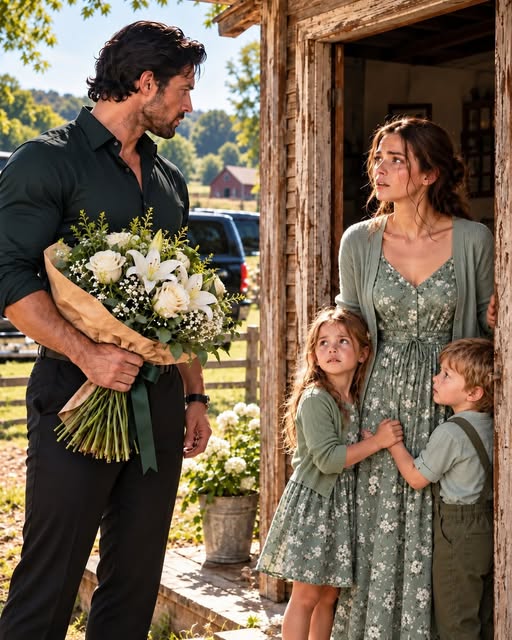
    Not in one of his expensive Italian suits. Not surrounded by the security guards who had once followed him everywhere. Not wearing the cold, untouchable expression that had destroyed our marriage.

    He wore a dark green button-down shirt, black trousers, and a simple wristwatch. His dark hair was slightly longer than I remembered, and there was gray beginning to appear near his temples.

    But I would have recognized those eyes anywhere.

    They were the same dark eyes that had once watched me walk down the aisle.

    The same eyes that had looked through me like I was a stranger on the night he threw me away.

    In his hands was an enormous bouquet of white roses and lilies, wrapped in brown paper and tied with a dark green ribbon.

    My favorite flowers.

    I had once told him that white lilies reminded me of my grandmother's garden, where everything felt safe and nothing terrible could happen.

    Apparently, he remembered.

    That realization hurt more than I expected.

    The farmhouse door slipped from my fingers and struck its wooden stopper with a sharp crack.

    My little boy gasped.

    “Mommy!”

    Ben grabbed the hem of my cardigan and pressed himself against my leg.

    My daughter, Violet, who had been standing beside me waiting to go outside, tightened both hands around my dress.

    “Mommy,” she whispered, looking up at me, “who is that man?”

    I couldn't answer.

    Because Daniel had finally noticed them.

    His expression changed so dramatically that for one terrifying second, I thought he might faint.

    His eyes moved from Violet's face to Ben's, then slowly returned to mine.

    His grip tightened around the bouquet.

    “Emily,” he said, and his voice sounded nothing like the confident voice I remembered. “You have children?”

    I instinctively stepped backward.

    Violet moved with me, her small fingers still twisted into the fabric of my floral dress.

    Daniel took a half step forward.

    I immediately pulled my children closer.

    He stopped.

    The movement was so abrupt that several white roses slipped from their paper wrapping and fell onto the old wooden porch.

    One rolled toward my feet.

    I instinctively bent my fingers toward it.

    Then I caught myself.

    For years, I had trained myself not to reach for anything Daniel Whitmore offered.

    Not flowers.

    Not apologies.

    Not the memory of a love that had almost destroyed me.

    “Emily,” he whispered again.

    I raised my chin.

    “You shouldn't be here.”

    He looked as though I had struck him.

    Perhaps that was unfair.

    But I remembered a night when I had said nearly those exact words to him, begging him not to close the door on our marriage.

    He had closed it anyway.

    Behind me, Violet tugged my dress.

    “Mommy, do you know him?”

    I swallowed.

    “Yes, sweetheart.”

    “Is he a friend?”

    The innocent question nearly broke me.

    Daniel looked at me.

    And for the first time in nine years, I saw fear in his eyes.

    Not fear of losing money.

    Not fear of disappointing shareholders or watching his company collapse.

    Fear of what I might say next.

    “No,” I answered quietly. “He's someone I used to know.”

    Daniel's jaw tightened.

    A muscle moved near his cheek.

    “That's all I am?”

    I stared at him.

    The audacity of that question almost made me laugh.

    Nine years ago, I would have done anything to hear him ask whether he still mattered to me.

    Today, all I wanted was to get my children safely back inside.

    “Violet, take Ben to the kitchen, please.”

    My daughter's brown eyes widened.

    “But Mommy—”

    “There's lemonade in the refrigerator. You can pour him a small glass.”

    She knew something was wrong.

    Violet had always been unusually observant. She noticed when my smile was too quick, when the bills on the kitchen counter stayed there longer than usual, and when I became quiet after seeing happy families together at church.

    She studied Daniel once more.

    Then she took her brother's hand.

    “Come on, Ben.”

    He hesitated.

    “Is Mommy okay?”

    “I'm fine, baby,” I promised.

    It was a lie.

    But mothers become very good at lying about their own pain when their children need to feel safe.

    The children disappeared into the kitchen, their footsteps fading across the old pine floor.

    Daniel watched them until they were gone.

    Then he turned back toward me.

    “Emily, who are they?”

    “My children.”

    “I understand that, but—”

    “Do you?”

    He flinched.

    The late-afternoon sunshine slanted across the porch, turning the old fence gold. Beyond him, my dark pickup truck sat beside the gravel driveway, its passenger door covered with a faint scrape from a farm supply store parking lot.

    Everything looked painfully ordinary.

    The flowerpots beneath the porch railing were overflowing with white petunias. A breeze stirred the leaves of the enormous maple tree beside the barn. Somewhere beyond the pasture, our neighbor's old dog barked twice.

    The world had not stopped.

    Only mine had.

    “Why are you here, Daniel?”

    He looked down at the bouquet.

    “I wanted to see you.”

    “After nine years?”

    “Yes.”

    “Why?”

    His fingers moved nervously against the brown paper.

    “Because I received a letter.”

    I stared at him.

    “What letter?”

    “An anonymous letter. It arrived at my office in Manhattan last Thursday.”

    I said nothing.

    He continued.

    “There was no return address. No signature. Just directions to this farmhouse and a message.”

    “What message?”

    He hesitated.

    “You destroyed something you never understood. If you still have a conscience, go to Kentucky and find the woman you abandoned.”

    A cold sensation spread through my chest.

    Who would send such a letter?

    Very few people knew where I lived.

    Even fewer knew what Daniel had done to me.

    And almost nobody knew the entire truth.

    “Did it say anything else?” I asked.

    He watched my face.

    “It said I should leave my pride behind.”

    I looked at the flowers.

    “Apparently you decided to bring an apology instead.”

    “I brought the flowers because I remembered you loved them.”

    I folded my arms.

    “You remembered the flowers.”

    “Emily—”

    “You remembered my favorite flowers, but you couldn't remember that I was your wife when your mother accused me of stealing from your family.”

    His face drained of color.

    There it was.

    The past, finally standing between us.

    A past he had spent nine years pretending did not exist.

    “I know,” he said.

    “No, Daniel. You don't.”

    His gaze lowered.

    For a moment, neither of us spoke.

    I had imagined this meeting a thousand times during the first two years after our separation.

    In some versions, he came begging for forgiveness.

    In others, I slammed the door before he could speak.

    Sometimes I imagined telling him everything he had missed.

    Sometimes I dreamed that I would feel absolutely nothing.

    But I had never imagined him standing on my porch while the two most precious people in my life waited inside.

    And I had never expected the sight of him to bring back so much love alongside so much anger.

    “Emily,” he said carefully, “I didn't come here to defend what I did.”

    “Then what did you come to do?”

    “To apologize.”

    I looked at him.

    A bitter smile formed on my lips.

    “Do you know how many nights I waited for those words?”

    His eyes filled with pain.

    “I'm sorry.”

    I shook my head.

    “I waited until the sun came up. I waited every time the phone rang. I waited when the mail arrived. I waited when I heard a car outside my apartment.”

    “Emily, please—”

    “I waited while I packed away my wedding dress because I couldn't bear looking at it. I waited while I learned how to live without the man who promised he'd never leave me.”

    My voice began to tremble.

    I hated that.

    I had spent years building a life where Daniel Whitmore no longer had the power to make me cry.

    And now he had been standing on my porch for less than ten minutes.

    “Do you know when I finally stopped waiting?” I asked.

    He shook his head.

    “The day I realized I was the only person trying to save our marriage.”

    Daniel closed his eyes.

    His face looked older in that moment.

    Much older than thirty-five.

    “I made the worst mistake of my life,” he said.

    I looked past him at the fields.

    The grass was turning yellow at the edges, a sign that autumn would arrive soon. In a few weeks, I would need to repair the greenhouse roof before the first frost.

    There were school lunches to prepare.

    A small business to run.

    Two children to raise.

    I didn't have room in my life for a billionaire's sudden attack of conscience.

    “Then you'll have to live with it,” I answered.

    I reached for the door.

    “Emily, wait.”

    Something in his voice made me stop.

    Not because I wanted to.

    Because there was desperation in it that I had never heard before.

    “When I received that letter, I thought someone was trying to hurt you.”

    My hand tightened around the doorframe.

    “What?”

    “The person who wrote it knew things about our marriage that weren't public. Things about the night you left.”

    My stomach turned.

    “What things?”

    Daniel hesitated.

    “The letter mentioned the blue suitcase.”

    My breath caught.

    I hadn't thought about that suitcase in years.

    It had been a cheap blue suitcase with a broken wheel, the one I'd owned before marrying into the Whitmore family.

    Daniel had insisted I throw it away after our honeymoon.

    I hadn't.

    And when he ordered me out of the mansion, it was the only suitcase his mother allowed me to take.

    The detail was too specific.

    Too intimate.

    Someone had watched that night unfold.

    Someone who remembered.

    “Who sent it?” I whispered.

    “I don't know.”

    “Did your mother?”

    His expression hardened.

    “I haven't told her about the letter.”

    That surprised me.

    For most of our marriage, Daniel had treated his mother's opinions as unquestionable truths.

    Especially when those opinions concerned me.

    “What does she know about this trip?”

    “Nothing.”

    I gave a short, humorless laugh.

    “That's a first.”

    He accepted the remark without defending himself.

    Another first.

    Then his eyes moved toward the kitchen window.

    I knew what he was thinking.

    The children.

    The unanswered question.

    He glanced back at me.

    “How old are they?”

    Every muscle in my body stiffened.

    “That's none of your business.”

    He nodded slowly, but his eyes were bright.

    “I know I don't have the right to ask.”

    “Then don't.”

    “Emily, I spent nine years believing you were somewhere living another life. I imagined you'd remarried. I imagined you were happy. I thought—”

    “You thought about me?”

    He looked genuinely wounded.

    “Every day.”

    I stared at him.

    “Then you should have picked up a phone.”

    “I tried once.”

    My heart lurched despite myself.

    “When?”

    “Three years after the divorce.”

    I searched his face.

    I remembered that year.

    It was the year Violet had turned two.

    The year she'd learned to say the word daddy because she heard other children using it at daycare.

    The year I'd cried in the grocery store after she pointed at a stranger and asked if he was hers.

    “There was a number in Nashville,” Daniel continued. “I called, but it had been disconnected.”

    I remembered that number.

    I had changed it after receiving a frightening message from someone connected to Whitmore Holdings.

    Someone who warned me that reopening the financial accusations against Daniel's family would have consequences.

    “Why didn't you try again?” I asked.

    Daniel opened his mouth.

    Then he closed it.

    Because there was no acceptable answer.

    That was when I heard the screen door inside creak.

    Violet stood several feet behind me.

    She was holding a glass of lemonade with both hands.

    “Mommy?”

    I turned immediately.

    “Sweetheart, I asked you to stay in the kitchen.”

    “I know.” She looked embarrassed. “But I thought maybe the man was thirsty.”

    My throat tightened.

    That was Violet.

    She couldn't bear seeing someone uncomfortable, even someone she didn't know.

    Daniel looked at her, and something softened in his expression.

    “That's very kind of you,” he said.

    Violet studied him with solemn curiosity.

    “You look sad.”

    Daniel swallowed.

    “I suppose I am.”

    “Did somebody die?”

    The question struck him harder than she could possibly understand.

    “No,” he answered softly. “Nobody died.”

    “Then maybe you can fix it.”

    I felt my eyes burn.

    Daniel looked at her as though she had just told him the secret to saving his life.

    “I hope so,” he whispered.

    Violet took a few steps forward and held out the lemonade.

    Daniel looked at me before accepting it.

    I didn't nod.

    I didn't smile.

    But I didn't stop her, either.

    He accepted the glass carefully.

    “Thank you,” he said.

    “You're welcome.”

    She looked at the bouquet.

    “Those are pretty. Mommy grows flowers like those.”

    “I know,” Daniel said.

    Then he seemed to realize his mistake.

    Or perhaps he realized how little he actually knew.

    “I mean, she always loved flowers.”

    Violet smiled faintly.

    “She makes bouquets for weddings. And funerals. And sometimes for people who are just having a bad day.”

    Daniel glanced toward the flowerbeds.

    “That sounds like your mother.”

    Something about the tenderness in his voice made me angry.

    He had no right to speak as though he knew the woman I'd become.

    He knew the twenty-five-year-old Emily who used to wait up for him after board meetings.

    He did not know the woman who had learned to fix leaking pipes, negotiate with wholesalers, raise children alone, and survive on four hours of sleep.

    He did not know the woman who had stood outside a hospital nursery with tears streaming down her face because the baby inside had his eyes.

    “Violet,” I said, “please go check on your brother.”

    She nodded.

    But before she turned away, she asked Daniel one more question.

    “Have you ever been here before?”

    “No, sweetheart.”

    She considered that.

    “Then how did you know where we lived?”

    Daniel froze.

    I felt my pulse quicken.

    He looked at me.

    “A letter told me.”

    Violet's expression changed.

    “A letter?”

    “Yes.”

    “Was it in a yellow envelope?”

    The air seemed to leave my lungs.

    Daniel went completely still.

    “Why would you ask that?” he said.

    Violet looked confused by the sudden seriousness in his voice.

    “Because somebody left a yellow envelope in our mailbox last week. Mommy put it in the drawer where she keeps important things.”

    I stared at my daughter.

    I knew exactly which envelope she meant.

    It had arrived four days earlier.

    Inside was a single photocopied page from a financial document dated nine years ago.

    A page I had spent years trying to find.

    And at the bottom was a handwritten sentence.

    He was never supposed to see what really happened.

    I had told myself it was a cruel prank.

    I had told myself to ignore it.

    But now Daniel was standing on my porch because of another anonymous letter.

    And suddenly, nothing felt accidental.

    “Emily?” he asked.

    I looked at him.

    For the first time since opening the door, I wasn't thinking about our divorce.

    I was thinking about the person who had destroyed our marriage.

    And whether that person had finally decided to finish what they started.

    “Daniel,” I said quietly, “you need to leave.”

    His brow furrowed.

    “What's wrong?”

    “Please.”

    I glanced toward the road.

    A dark sedan was moving slowly past the fence.

    The driver didn't turn toward the farmhouse.

    But the car slowed just long enough to make the hair on the back of my neck rise.

    Daniel followed my gaze.

    “Emily, is someone bothering you?”

    I didn't answer.

    Because behind me, Violet was staring at Daniel's face with a puzzled expression.

    The expression she always wore when she was trying to understand something difficult.

    “Mommy?” she whispered.

    I turned.

    “What is it, baby?”

    She looked from Daniel to the small framed photograph hanging on the wall beside the kitchen.

    It was a photograph I'd forgotten to move.

    An old wedding picture.

    Daniel and me, smiling beneath an archway covered in white roses.

    My daughter's voice was barely audible.

    “Mommy…”

    She pointed toward the photograph.

    “Is that the man you told me about?”

    Daniel's face went white.

    And I realized that after nine years of protecting my daughter's heart, the one question I had dreaded most was finally about to be asked.

    But I wasn't ready to answer it.

    Not yet.

    Not until I knew why the past had come looking for us.

    Not until I knew who had sent those letters.

    And certainly not while Daniel Whitmore stood on my porch holding the flowers he should have brought me nine years earlier.

    I moved in front of Violet.

    “Sweetheart, go inside.”

    She hesitated, then obeyed.

    Daniel watched her disappear.

    When he finally spoke, his voice was almost unrecognizable.

    “Emily…”

    I couldn't look at him.

    “Don't.”

    “How old is your daughter?”

    I closed my eyes.

    The silence stretched between us.

    Then I heard him whisper the words that changed everything.

    “Emily… is she mine?”

    I opened my eyes.

    And somewhere inside the farmhouse, the telephone began to ring.

  • Chapter 7: The Birthday He Finally Came Home

    Chapter 7: The Birthday He Finally Came Home

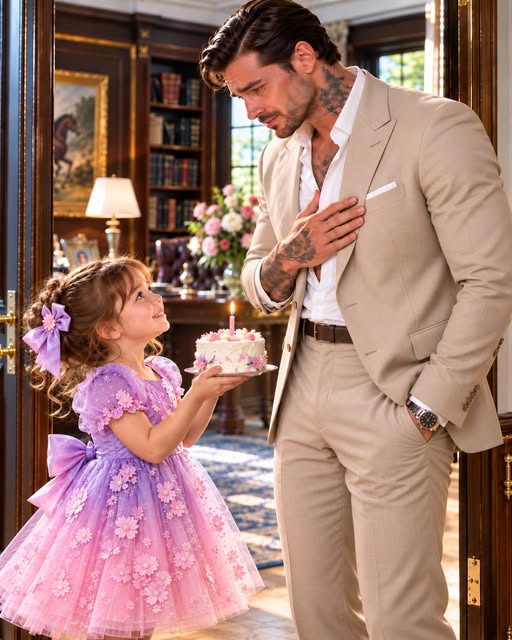
    Five years after a three-year-old girl walked into Gabriel Valenti's private study carrying a crooked birthday cake, she was standing in a small bakery kitchen with frosting on her nose.

    "Mia Morgan, you are absolutely not supposed to eat the decorations."

    Eight-year-old Mia looked at her mother.

    "I wasn't eating them."

    Claire raised an eyebrow.

    "Then why is there pink frosting on your face?"

    Mia considered the question.

    "Maybe it jumped."

    Claire laughed.

    "Of course it did."

    The bakery smelled of fresh vanilla, cinnamon, and warm butter.

    Outside, the streets of Chicago were glowing beneath the golden colors of October. Families hurried past the windows. A delivery truck stopped beside the curb. Across the street, children carried backpacks home from school.

    The sign above the bakery door read:

    THE LITTLE CANDLE BAKERY — CLAIRE MORGAN

    Claire had opened the business nearly two years earlier.

    Not with Gabriel Valenti's money.

    Not with a secret payment or a favor from someone connected to his former empire.

    She had used her savings, a small-business loan, and the earnings from months of baking custom cakes in a rented commercial kitchen.

    Her first year had nearly exhausted her.

    She had worked before sunrise, washed dishes until midnight, and spent countless afternoons wondering whether she had made a terrible mistake.

    But slowly, customers returned.

    They brought friends.

    Then neighbors.

    Then coworkers.

    Soon, the bakery became known for its homemade cakes, generous slices, and the kind of warmth people couldn't purchase from expensive dessert boutiques.

    Claire hired three employees.

    She paid them fairly.

    She closed early on Sundays so everyone could spend time with family.

    And every October, she prepared one very special birthday cake.

    A small vanilla cake.

    Pink-and-white frosting.

    Crooked flowers.

    One candle.

    Because some traditions were too important to perfect.

    "Mommy?" Mia asked.

    "Yes, sweetheart?"

    "Do you think Mr. Gabriel remembers?"

    Claire stopped spreading frosting.

    "Remembers what?"

    "The first cake."

    Her expression softened.

    "I think he remembers it every day."

    Mia looked pleased.

    "Good. Because this one's even better."

    Claire examined the cake.

    One side was noticeably taller than the other.

    The flowers leaned toward the edge.

    The birthday message appeared to have been written during a minor earthquake.

    "It's beautiful," she said.

    Mia grinned.

    "That's what I told you."

    Claire leaned down and kissed her daughter's forehead.

    For a moment, she thought about how different their lives had become.

    Five years earlier, she had been a frightened young widow working inside a dangerous man's mansion.

    She had been afraid of losing her job.

    Afraid of failing her daughter.

    Afraid that Daniel's death would remain an unanswered tragedy forever.

    Now she owned a thriving bakery.

    Her daughter was happy.

    And the truth about Daniel's death had finally been established in court.

    He had been murdered because he refused to abandon the evidence he had collected.

    The men responsible had been convicted.

    Victor Romano had received a lengthy prison sentence for his role in the conspiracy that destroyed Isabel Valenti's life and led to Daniel's death.

    Others involved in the crimes had also been brought to justice.

    Nothing could bring Daniel home.

    But Claire no longer had to live with uncertainty.

    And Mia would grow up knowing the truth about her father's courage.

    Gabriel had spent the intervening years paying for the choices he made.

    Prison was nothing like the world he had once controlled.

    He couldn't order someone to bring him an expensive meal.

    He couldn't summon a driver or demand privacy whenever he felt overwhelmed.

    His wealth no longer insulated him from consequences.

    He lived according to rules he didn't make.

    He waited in lines.

    He shared ordinary spaces.

    He learned how little his reputation mattered once the doors were locked behind him.

    But the hardest part was missing the life that continued outside.

    Sofia graduated from high school while he was incarcerated.

    Gabriel watched a recording of the ceremony afterward, sitting alone with tears moving silently down his face.

    She looked beautiful in her graduation gown.

    She carried herself with the confidence of her mother.

    And when she received her diploma, she glanced toward the camera and placed one hand over her heart.

    Their signal.

    The same gesture they had exchanged in the courtroom years earlier.

    Gabriel returned it instinctively, even though she couldn't see him.

    He missed Mia's fifth birthday.

    Then her sixth.

    Then her seventh.

    But he kept his promise.

    He wrote every week.

    Sometimes the letters were long.

    Sometimes they contained only stories about his childhood, descriptions of books he had read, or questions about Sofia's classes.

    He learned that fatherhood didn't always require grand gestures.

    Sometimes it required listening carefully to someone describe an ordinary Tuesday.

    Sofia wrote about exams, friends, arguments, and dreams.

    She told him when she was disappointed.

    She challenged him when he became defensive.

    She refused to pretend that his past had disappeared simply because he regretted it.

    And Gabriel came to value those difficult conversations.

    They were honest.

    They were real.

    And they belonged to a relationship that had finally stopped depending on secrets.

    Claire wrote occasionally too.

    Her letters were more reserved.

    She told him about the bakery.

    About Mia's first day of school.

    About the community fundraiser established in Daniel's memory.

    She didn't offer forgiveness on behalf of her husband.

    She didn't pretend Gabriel's guilt was unimportant.

    But she acknowledged his effort to change.

    And every October, an envelope arrived containing a handmade birthday card.

    The first showed a crooked pink cake.

    The second included stick figures holding hands.

    The third had glitter that spilled across Gabriel's table when he opened it.

    The fourth was a carefully drawn picture of an enormous house beside a tiny bakery.

    Across the top, Mia had written:

    I hope you are not lonely anymore.

    Gabriel kept every card.

    He read them when he felt ashamed.

    He read them when he missed Sofia.

    He read them when the years seemed too long.

    And whenever he wondered whether becoming a better man was worth the cost, he remembered the child who had once asked him whether he was in trouble.

    On the morning of his fifty-sixth birthday, Gabriel stood outside the correctional facility carrying a small cardboard box.

    He had completed the custodial portion of his sentence and was being released subject to the applicable conditions of supervision.

    His expensive cars were gone.

    The sprawling mansion had been sold.

    Much of his former wealth had been forfeited, used to satisfy lawful financial obligations, or directed toward restitution.

    The organization that once answered to him had been dismantled through investigations and prosecutions.

    He wore simple dark trousers, a gray sweater, and a coat Sofia had purchased for him.

    His hair was threaded with silver.

    The tattoos remained.

    His shoulders were still broad.

    But his expression was different.

    Less guarded.

    Less demanding.

    He looked like a man who understood that the world didn't owe him a welcome.

    A familiar car waited near the entrance.

    Sofia stood beside it.

    She was twenty now.

    Her hair fell past her shoulders, and her resemblance to Isabel was stronger than ever.

    She had begun studying social work and volunteered with an organization assisting children whose families had been affected by violence.

    When Gabriel saw her, he stopped walking.

    For a moment, he couldn't speak.

    Sofia smiled.

    "Hi, Dad."

    His eyes filled.

    "Hi, sweetheart."

    She walked toward him.

    Five years earlier, she had refused his first attempt at an embrace.

    Today, she opened her arms without hesitation.

    Gabriel held her.

    Not like a powerful man reclaiming something that belonged to him.

    Like a father grateful for the chance to begin again.

    "Happy birthday," she whispered.

    He laughed softly.

    "That's a pretty good present."

    She stepped back.

    "I have something else planned."

    He looked suspicious.

    "Should I be worried?"

    "Probably."

    He laughed again.

    It felt unfamiliar.

    Wonderful.

    And free.

    Their first stop was a cemetery.

    Gabriel had requested it.

    Sofia understood why.

    They walked together beneath the autumn trees until they reached Isabel's grave.

    Fresh flowers rested against the headstone.

    For years, Gabriel had sent arrangements through other people.

    Now he knelt before her grave himself.

    "Hello, Isabel," he whispered.

    His voice shook.

    "I finally came back."

    Sofia stood a few steps away.

    Gabriel touched the edge of the stone.

    He remembered his wife standing in their kitchen, flour on her cheek, telling him that no amount of money could replace an afternoon spent with people he loved.

    He remembered laughing at her seriousness.

    He remembered promising he would find a way to leave his dangerous world behind.

    He had broken that promise.

    But he no longer intended to hide behind excuses.

    "I wish I'd listened," he said.

    The wind moved through the leaves.

    "I wish I'd understood how brave you were."

    He looked down.

    "I couldn't save you. And I made terrible decisions afterward."

    Tears filled his eyes.

    "But Sofia is safe. She's strong. She's kind. And she still knows how to laugh."

    Gabriel smiled through his tears.

    "She's so much like you."

    Sofia moved beside him.

    She knelt and placed her hand over his.

    For a long time, they remained there together.

    They didn't need to pretend the past could be repaired.

    They simply allowed themselves to grieve.

    Afterward, they walked to Daniel Morgan's grave.

    Gabriel carried white flowers.

    He stood before the headstone.

    "I owe you more than I can ever repay," he said quietly.

    Sofia squeezed his hand.

    Gabriel continued.

    "You tried to tell the truth when the rest of us were afraid to hear it. You saved my daughter. And I failed to protect you when you asked for help."

    He placed the flowers down.

    "Your family is doing well. Claire built something beautiful. Mia is growing into a wonderful girl."

    He paused.

    "I'll spend the rest of my life honoring what you tried to do."

    A breeze lifted the corner of the ribbon tied around the flowers.

    Sofia looked at him.

    "Do you feel better?"

    Gabriel considered the question.

    "Not exactly."

    "Then what do you feel?"

    He looked toward the sky.

    "Grateful that I can finally stand here without pretending I don't know the truth."

    At noon, Sofia drove him to a small apartment on the city's quieter outskirts.

    Gabriel had arranged the rental through his attorney using lawful funds available to him.

    It wasn't luxurious.

    There were two bedrooms, a modest kitchen, a narrow balcony, and a living room with sunlight falling across wooden floors.

    Gabriel walked inside.

    He examined the plain furniture.

    A secondhand bookshelf stood against one wall.

    The kitchen contained a simple coffee maker.

    There were no marble statues.

    No chandeliers.

    No armed guards.

    He looked around slowly.

    "It's perfect."

    Sofia laughed.

    "Dad, you used to live in a mansion."

    "I remember."

    "And this is perfect?"

    Gabriel approached the window.

    Outside, a little boy was learning to ride a bicycle while his father ran alongside him.

    The father caught the handlebars when the boy lost his balance.

    Then he let go.

    Gabriel watched the child pedal forward, laughing.

    "Yes," he said softly. "This is perfect."

    Sofia placed his cardboard box on the table.

    "Do you want to unpack?"

    "In a minute."

    He opened the box.

    Inside were clothes, a few books, letters, and the birthday cards Mia had sent him.

    He placed the cards beside a framed photograph of Isabel.

    Then he removed the oldest one.

    Pink paper.

    Crooked hearts.

    A message dictated by a three-year-old girl.

    I hope you are happy.

    Gabriel smiled.

    Sofia watched him.

    "You still have that?"

    "I'll always have it."

    She sat beside him.

    "Are you nervous about tonight?"

    "A little."

    "Why?"

    "I don't know what to expect."

    Sofia leaned against his shoulder.

    "An eight-year-old girl with an unreasonable amount of frosting."

    Gabriel laughed.

    "That sounds dangerous."

    "Terrifying."

    For the first time in many years, he felt anticipation without fear.

    He was going to a birthday party.

    Not a gathering of men seeking favors.

    Not a performance designed to demonstrate wealth.

    A real birthday.

    With people who wanted nothing from him except honesty and kindness.

    The Little Candle Bakery closed early that evening.

    Claire had arranged a small celebration after the final customers left.

    There were no television cameras.

    No wealthy donors.

    No politicians.

    Just a handful of friends, several bakery employees, Evelyn Caruso, Sofia, Claire, and Mia.

    When Gabriel stepped through the door, the room became quiet.

    He stopped just inside.

    The bakery's warm lights reflected from glass display cases.

    Fresh flowers stood on the tables.

    A handwritten banner stretched across the counter.

    WELCOME HOME, MR. GABRIEL!

    Mia stood beneath it wearing a lavender dress.

    She had grown taller.

    Her curls were longer.

    But the ribbon in her hair was almost identical to the one she had worn five years earlier.

    Gabriel stared.

    "Mia?"

    She grinned.

    "Mr. Gabriel!"

    Then she ran toward him.

    He crouched.

    She threw her arms around his neck.

    Gabriel held her gently.

    "Look at you," he whispered. "You're practically grown."

    "I'm eight!"

    "So I've heard."

    "And I can read big books now."

    "That's impressive."

    "And I know multiplication."

    Gabriel smiled.

    "Much more impressive than anything I can do."

    Mia leaned back to study his face.

    "You look different."

    "Do I?"

    "Your hair has more white."

    Gabriel laughed.

    "That's what happens when you get old."

    "Are you very old?"

    "Ancient."

    Mia giggled.

    Then her expression became serious.

    "Are you still in trouble?"

    The room fell quiet.

    Gabriel looked at her.

    Five years ago, those same words had changed his life.

    He could have offered a cheerful answer.

    He could have told her everything was fine.

    Instead, he chose the truth.

    "I was in trouble, sweetheart. I had to take responsibility for some bad things I did."

    Mia considered that.

    "Like when I broke Mommy's flowerpot?"

    Gabriel smiled.

    "A little more serious than that."

    "Did you say sorry?"

    "Yes."

    "Did it work?"

    Gabriel looked toward Claire.

    She stood beside the counter, watching quietly.

    "Not right away," he answered.

    "Then what did you do?"

    "I tried to make things right. And I kept trying."

    Mia nodded.

    "That's what Mommy says."

    Gabriel brushed a stray curl from her forehead.

    "Your mommy is a very wise woman."

    Claire gave him a small, genuine smile.

    For years, their relationship had been shaped by pain, suspicion, and responsibility.

    Now they had something simpler.

    Mutual respect.

    Gabriel had learned that Claire didn't need him to rescue her.

    She had rescued herself.

    And Claire had learned that change was possible without pretending the past had never happened.

    Their friendship wasn't built upon forgetting.

    It was built upon remembering accurately and choosing to live differently.

    "Okay!" Mia announced. "Everybody has to come over here!"

    She took Gabriel's hand and pulled him toward the largest table.

    In the center stood a small birthday cake.

    It was crooked.

    Painfully crooked.

    One side leaned toward the other.

    The pink flowers were uneven.

    And the writing looked remarkably similar to the cake she had made at three.

    Gabriel stared.

    Then he looked at Claire.

    "You didn't."

    Claire folded her arms.

    "I had absolutely nothing to do with the crooked decorations."

    Mia raised her hand.

    "I did!"

    Gabriel laughed.

    "Of course you did."

    Sofia approached.

    "Recognize it?"

    Gabriel nodded slowly.

    "It's just like the first one."

    Mia beamed.

    "I made it the same because Mommy said the first cake was important."

    Gabriel looked at Claire.

    Her eyes were shining.

    "It was," she said softly.

    Evelyn placed a hand on Sofia's shoulder.

    For a moment, Gabriel thought about the birthday party five years earlier.

    The giant chandeliers.

    The expensive champagne.

    The one hundred and seventeen guests.

    The powerful men competing for his attention.

    He remembered leaving them downstairs because none of it meant anything.

    He had believed wealth could provide everything except the one thing he desperately wanted.

    His family.

    Now he stood inside a modest bakery, surrounded by people who knew the worst things about him.

    And they had still chosen to welcome him home.

    Mia lifted a candle.

    "Only one?"

    Gabriel smiled.

    "Only one."

    "Because fifty-six candles would make too much fire."

    Everyone laughed.

    Gabriel looked toward Sofia.

    For a brief instant, he remembered Isabel in their old kitchen saying almost the same thing.

    Some memories still hurt.

    But they no longer destroyed him.

    Sometimes they reminded him that love could survive in unexpected places.

    Claire lit the candle.

    The little flame flickered.

    "Make a wish," Mia instructed.

    Gabriel looked at the faces around him.

    Claire.

    Mia.

    Sofia.

    Evelyn.

    Friends.

    People who had supported his efforts to change while refusing to excuse what he had done.

    He closed his eyes.

    Five years earlier, he had wished only for Sofia to remain safe.

    Tonight, he wished for something different.

    Let me be worthy of the time I still have.

    He opened his eyes.

    Then he blew out the candle.

    Everyone applauded.

    Mia jumped up and down.

    "Did you wish for a big house?"

    Gabriel laughed.

    "No."

    "A new car?"

    "No."

    "Lots of money?"

    He shook his head.

    "Not that either."

    She frowned.

    "Then what did you wish for?"

    Gabriel knelt so that their eyes were level.

    "Something I already have."

    Mia looked confused.

    "Then why'd you wish for it?"

    He smiled.

    "Because I want to take good care of it."

    Later that evening, after the cake had been cut and the last dishes washed, Gabriel stood alone beside the bakery window.

    Outside, Chicago continued moving beneath the autumn sky.

    For a moment, the old loneliness returned.

    He knew he couldn't erase the harm his choices had caused.

    No birthday party could bring Isabel or Daniel back.

    No amount of regret could restore Sofia's childhood.

    And no good deed could make his criminal past disappear.

    But he had learned that redemption wasn't the same as erasing history.

    It was accepting history and choosing what to do next.

    He had plans.

    Modest ones.

    He wanted to continue working with the organizations assisting victims affected by the crimes he had helped expose, where his participation was welcomed and permitted.

    He wanted to keep meeting the conditions of his supervision.

    He wanted to help Sofia with ordinary things, like moving apartments, studying for exams, and making dinner when she was too tired to cook.

    He wanted to visit Daniel's grave every year.

    And he wanted to attend every birthday party to which Mia invited him.

    He didn't need to be feared.

    He didn't need an empire.

    He needed to be present.

    Behind him, Sofia approached.

    "Hey, Dad."

    He turned.

    "Hey."

    "I have one more thing for you."

    She handed him a small wrapped package.

    Gabriel opened it carefully.

    Inside was a silver picture frame.

    The photograph showed four people standing together in the bakery kitchen.

    Claire, smiling.

    Mia, laughing.

    Sofia, leaning toward her father.

    And Gabriel himself, caught in a moment of genuine happiness.

    He stared at the picture.

    For years, the only family photograph in his study had been one he kept hidden from the world.

    Now Sofia had given him a new photograph.

    One he didn't need to conceal.

    "Do you like it?" she asked.

    Gabriel looked at her.

    "I love it."

    She smiled.

    "Good. I thought you needed something for your apartment."

    He nodded.

    "I know exactly where it'll go."

    Sofia touched his arm.

    "Beside Mom's picture?"

    "Yes."

    She leaned against him.

    "I think she'd like that."

    Gabriel's eyes filled.

    "I hope so."

    They stood together in comfortable silence.

    Then Mia appeared from behind the counter carrying a small paper bag.

    "Mr. Gabriel!"

    He turned.

    "Yes, sweetheart?"

    "You forgot something!"

    She handed him the bag.

    Inside were two slices of leftover birthday cake.

    Gabriel looked inside.

    "What's this?"

    "Breakfast."

    He laughed.

    "Cake for breakfast?"

    Mia looked scandalized by his question.

    "It's your birthday."

    "Fair point."

    She reached for his hand.

    "Can I tell you a secret?"

    Gabriel smiled.

    "Of course."

    Mia leaned closer.

    Then she whispered, "I made the cake crooked on purpose."

    He pretended to be shocked.

    "You did?"

    She nodded.

    "Because the first crooked cake made you smile."

    Gabriel felt his throat tighten.

    She looked up at him.

    "And I wanted you to smile again."

    For a moment, he couldn't speak.

    He thought about the frightened man who had opened his study door five years earlier.

    A man surrounded by wealth but empty inside.

    A man who believed loneliness was permanent.

    A man whose greatest secret had become a prison of his own making.

    And he thought about the tiny girl who had stepped into his world without understanding its dangers.

    She hadn't threatened him.

    She hadn't demanded anything.

    She had simply offered him a cake.

    And asked whether he needed help.

    Gabriel slowly lowered himself onto one knee.

    He placed a hand over his heart.

    "Mia, do you know something?"

    "What?"

    "You gave me the most important birthday present I've ever received."

    She glanced at the paper bag.

    "The cake?"

    He smiled.

    "The chance to become a better man."

    Mia thought about that.

    Then she wrapped her little arms around his neck.

    "You're welcome, Mr. Gabriel."

    Gabriel held her.

    And for the first time in his adult life, he understood that the greatest thing a powerful man could do wasn't to control the people around him.

    It was to love them without trying to own them.

    To protect them without stealing their choices.

    To tell the truth even when it cost him everything.

    And to remain present when life became difficult.

    Outside, the evening bells rang across the neighborhood.

    Inside the bakery, Claire turned off the ovens while Sofia began stacking chairs.

    Mia asked whether they could bake another cake the following weekend.

    Gabriel laughed and offered to help.

    Claire warned him that he would have to wash dishes like everyone else.

    He agreed immediately.

    Sofia teased him about wearing a pink apron.

    He told her he would wear whatever she chose.

    Everyone laughed.

    There was no dramatic declaration.

    No expensive gift.

    No promise of another empire.

    Only an ordinary evening with people who cared about one another.

    And that was more than enough.

    Because five years earlier, Gabriel Valenti had believed his story was already over.

    He had buried his happiness with his wife.

    Hidden his daughter from the world.

    And surrounded himself with people who feared him instead of loving him.

    Then a three-year-old girl appeared at his study door carrying a crooked homemade birthday cake.

    She asked one innocent question.

    "Are you in trouble?"

    He had been.

    But her kindness gave him a reason to stop hiding.

    And on his fifty-sixth birthday, Gabriel finally knew the answer to the question he had silently asked himself for eight years.

    Was a man who had done terrible things still capable of building a life around something good?

    He couldn't undo the past.

    But he could choose the future.

    And that night, as he walked home beneath the Chicago stars with a framed family photograph in one hand and a paper bag of birthday cake in the other, Gabriel Valenti knew exactly what mattered.

    He had lost his empire.

    He had surrendered his power.

    He had paid for his mistakes.

    But he had regained the chance to be a father.

    He had found friends who expected him to be better.

    And he had discovered that the richest life in the world didn't require a mansion, expensive gifts, or a room filled with powerful men.

    Sometimes it began with a little girl in a lavender dress, one crooked cake, and the courage to finally tell the truth.

    THE END.

  • Chapter 6: The Day the Mafia Boss Chose the Truth

    Chapter 6: The Day the Mafia Boss Chose the Truth

    The last place Gabriel Valenti expected to find himself was inside a federal conference room, voluntarily explaining how his criminal organization had operated.

    Yet there he sat.

    No bodyguards.

    No expensive whiskey.

    No men waiting outside to carry out his instructions.

    Just an attorney, two federal investigators, and a thick stack of documents that could send him to prison.

    Mara Ellis opened a folder.

    "Before we continue, I need you to understand something."

    Gabriel looked at her.

    "Go ahead."

    "Your cooperation doesn't erase your previous conduct."

    "I understand."

    "You may face charges unrelated to the fire."

    "I understand that too."

    "And there are people who will accuse you of cooperating only because your former associate betrayed you."

    Gabriel looked down at his tattooed hands.

    "Maybe there's some truth in that."

    Mara waited.

    Gabriel continued.

    "If Victor hadn't betrayed me, perhaps I'd still be making excuses for myself. Perhaps I'd still be telling my daughter that everything I did was necessary."

    He raised his eyes.

    "But knowing the reason I finally opened my eyes doesn't change what I've seen."

    For a long moment, nobody spoke.

    Then Mara said, "All right. Let's begin."

    Gabriel spent the next six hours giving investigators information he had once promised to take to his grave.

    He identified companies used to conceal unlawful payments.

    He explained relationships between corrupt intermediaries and supposedly legitimate business operations.

    He described transactions that had enriched his associates while exposing employees and ordinary residents to financial harm.

    He identified records that might support restitution claims.

    He didn't attempt to disguise his participation.

    Jonathan Reed repeatedly advised him to consider the legal consequences of particular admissions.

    Gabriel listened.

    Then he answered truthfully.

    By the time the meeting ended, the man who entered the building as Chicago's most feared crime boss understood that his old life was effectively over.

    He felt something he hadn't experienced in years.

    Not relief.

    Not happiness.

    Something quieter.

    The knowledge that he had finally stopped running from himself.

    Meanwhile, investigators were examining the old lakeside property.

    The house where Isabel died had been destroyed by the fire and later demolished.

    Only the foundation, a stone retaining wall, and a few weathered garden features remained.

    For eight years, the land had sat untouched.

    Then Victor attempted to sell it through a company connected to one of his associates.

    The rushed transaction caught investigators' attention.

    Property records showed that the proposed buyer intended to demolish the remaining structures and excavate the site.

    Environmental inspectors had previously identified an underground storage room that had not been fully documented after the fire.

    Daniel Morgan's maintenance drawings contained a reference to the same room.

    With the necessary legal authorization, investigators examined the site.

    Inside a sealed metal cabinet, they discovered deteriorated paper records and several damaged electronic storage devices.

    Most of the electronic material was unusable.

    But some documents had survived.

    They included old foundation invoices, copies of contractor agreements, and a handwritten inventory.

    The documents supported a disturbing conclusion.

    The property had been used to store financial records connected to Victor's hidden operations.

    Isabel had discovered them.

    And someone had attempted to destroy those records shortly before the fire spread through the house.

    The fire had not simply been an attack intended to frighten Gabriel.

    It had begun as an attempt to eliminate evidence.

    Then it had become a fatal crime.

    Investigators also uncovered a name in Daniel's files.

    Anthony Bellini.

    A former maintenance supervisor who had worked at the property before the fire.

    Anthony was now sixty-three and living quietly in Michigan.

    When agents contacted him, he initially refused to speak.

    Then they showed him photographs of Daniel Morgan and Isabel Valenti.

    He began to cry.

    "I told them the doors were locked," he whispered.

    Mara leaned forward.

    "Who did you tell?"

    "Mr. Romano."

    "What did he say?"

    "He said somebody would fix them before the family arrived."

    Anthony covered his face.

    "But nobody did."

    The following afternoon, Claire visited Daniel's grave.

    She carried white flowers.

    Mia walked beside her, holding a small paper butterfly she had colored that morning.

    The cemetery was quiet.

    Autumn leaves moved across the grass.

    Claire knelt in front of the headstone.

    Daniel Morgan. Beloved Husband and Father.

    For two years, she had come here carrying questions nobody could answer.

    Why had he been driving that night?

    Why had he sounded so worried during their final telephone call?

    Why had he kissed Mia twice before leaving, as though he somehow knew he might not return?

    Today, Claire had more answers.

    And somehow, the answers made the loss feel fresh again.

    "Hi, Danny," she whispered.

    Mia placed the butterfly beside the flowers.

    "Hi, Daddy."

    Claire took a shaky breath.

    "Your little girl is getting so big."

    Mia smiled.

    "I made him a present."

    "I see that, sweetheart."

    "Do you think he likes it?"

    Claire brushed a curl away from her daughter's face.

    "I think he'd love it."

    Mia looked at the headstone.

    "Can Daddy see us?"

    Claire considered how to answer.

    "I think the love people leave behind stays with us."

    "Like in our hearts?"

    "Exactly."

    Mia pressed her hand against her chest.

    "Then he's here."

    Claire began crying.

    Her daughter hugged her neck.

    "It's okay, Mommy. We can share him."

    Claire held her tightly.

    She thought about Daniel saving Sofia.

    About the years he had spent carrying a dangerous truth.

    And about the bravery it must have taken for him to gather evidence while knowing that powerful people wanted him silent.

    "You were a good man," she whispered toward the grave.

    For the first time since his death, she didn't wonder whether a careless mistake had taken him away.

    She knew he had been trying to do the right thing.

    And she made him a promise.

    "I won't let them turn you into another forgotten story."

    Victor Romano agreed to meet Gabriel two days later.

    He believed the conversation would give him an opportunity to restore control.

    Instead of choosing the estate, Gabriel proposed a conference room inside one of his legitimate office buildings.

    Investigators had secured the necessary legal authorization to document the meeting.

    Gabriel would not be alone, and the location had been assessed for safety.

    Mara had been clear.

    "You don't improvise. You don't threaten him. You don't try to force a confession. If anything feels wrong, we end it."

    Gabriel nodded.

    "I understand."

    "He's known you for thirty years. He'll try to provoke you."

    "Probably."

    "Can you handle that?"

    Gabriel looked at Isabel's photograph, which he had brought with him.

    "I've spent most of my life responding to anger with more anger."

    "And today?"

    "Today I want answers that will hold up in court."

    Victor arrived at precisely four o'clock.

    He wore a charcoal suit, carried an expensive leather briefcase, and walked into the conference room smiling.

    "Gabriel."

    "Victor."

    The two men sat across from each other.

    For a moment, neither spoke.

    Then Victor gestured toward the empty chairs.

    "No lawyers?"

    "Not in the room."

    "Good. I was beginning to think you'd forgotten how to speak privately."

    Gabriel remained still.

    Victor leaned back.

    "Let's stop this nonsense. Whatever disagreements we have, we can settle them."

    "Can we?"

    "Of course. We've survived worse."

    Gabriel studied him.

    "Did you know Isabel was investigating the foundation?"

    Victor's smile faded.

    "You're still obsessing over that?"

    "Answer me."

    "She was asking questions."

    "About your accounts."

    "About things she didn't understand."

    Gabriel felt his pulse quicken.

    "What didn't she understand?"

    Victor sighed.

    "How business works."

    "She understood enough to recognize stolen money."

    Victor's expression hardened.

    "You really want to discuss morality?"

    Gabriel accepted the challenge.

    "No. I want to discuss what happened to my wife."

    Victor leaned forward.

    "Your wife made enemies because she wouldn't stop interfering."

    Gabriel held his gaze.

    "Did you arrange for the records at the lakeside house to be destroyed?"

    Victor stared at him.

    The silence lasted several seconds.

    Then he laughed.

    "You always were too sentimental about that woman."

    "Did you?"

    Victor looked toward the window.

    "I arranged for a problem to disappear."

    Gabriel felt his heart hammering.

    "What problem?"

    "Paperwork."

    "And the fire?"

    Victor's jaw tightened.

    "The fire wasn't supposed to spread."

    Gabriel went completely still.

    The confession hung between them.

    For eight years, he had imagined that his wife's death was the work of distant enemies.

    Now the man sitting across from him was explaining it as though describing an unfortunate business expense.

    "Isabel was inside," Gabriel said.

    Victor looked irritated.

    "She wasn't supposed to be."

    Gabriel's hands curled slowly against the table.

    "What about Sofia?"

    "I didn't know she was upstairs."

    "You knew it was a family house."

    Victor leaned forward.

    "I spent years fixing your problems, Gabriel. Years. You were too busy playing devoted husband to understand what it took to keep everything running."

    Gabriel stared at him.

    "You killed Isabel."

    Victor's expression shifted.

    "I never wanted her dead."

    "But you caused the fire."

    Victor looked away.

    "I ordered the records destroyed. I didn't tell anyone to hurt her."

    Gabriel breathed through the rage rising inside him.

    He wanted to overturn the table.

    He wanted to grab Victor by the collar and demand to know whether Isabel had called his name while the house burned.

    Instead, he thought about Sofia.

    About Claire.

    About Daniel.

    About a three-year-old girl who had taught him that doing the right thing sometimes began with refusing to do the familiar wrong thing.

    "What happened to Daniel Morgan?" Gabriel asked.

    Victor's eyes narrowed.

    "Why are we discussing a dead electrician?"

    "Because he knew."

    "He suspected."

    "He had evidence."

    "He should have destroyed it."

    Gabriel leaned forward.

    "Did you arrange his death?"

    Victor was silent.

    Gabriel waited.

    Finally, Victor answered.

    "Daniel had opportunities to walk away."

    The words chilled the room.

    "He had a wife and a child," Gabriel said.

    "He should have thought about them before making trouble."

    Gabriel looked down.

    His oldest friend had just revealed how little human life meant to him.

    For years, Victor had disguised cruelty as practicality and treachery as loyalty.

    Gabriel had accepted those disguises because doing so made his own life easier.

    That was his failure.

    And it was one he could no longer deny.

    Gabriel looked up.

    "You spent eight years convincing me the threat came from someone else."

    Victor's voice became bitter.

    "You were easy to convince."

    "Because I trusted you."

    "Because you were broken."

    Gabriel felt the words strike.

    Victor continued.

    "After Isabel died, you wanted somebody to tell you what to do. I gave you an enemy. I gave you a plan. I gave you a reason to keep breathing."

    "You took my daughter away from me."

    "No. You did that yourself."

    Gabriel stopped.

    The accusation was cruel.

    But not entirely false.

    He had chosen the deception.

    He had accepted Victor's advice.

    He had allowed fear to become an excuse for abandoning the ordinary responsibilities of fatherhood.

    And that was why Victor's final attempt to manipulate him failed.

    "You're right about one thing," Gabriel said.

    Victor smiled slightly.

    "What's that?"

    "I made the decision to send Sofia away."

    Gabriel straightened.

    "And I'll answer for it."

    Victor's smile vanished.

    "But you will answer for Isabel and Daniel."

    The conference room door opened.

    Federal agents entered.

    Victor rose abruptly.

    "What is this?"

    Mara stepped forward and identified herself.

    Victor looked at Gabriel.

    Real understanding entered his face.

    "You betrayed me."

    Gabriel held his gaze.

    "No, Victor."

    He glanced at Isabel's photograph.

    "I finally stopped betraying them."

    Victor was taken into custody without violence.

    And the man who had once controlled half of Gabriel's empire left the building under federal escort.

    The arrests didn't end with Victor.

    Investigators pursued other participants in the conspiracy, including individuals connected to the destruction of evidence, financial misconduct, and obstruction of previous inquiries.

    The original investigation into Daniel's death was reopened.

    New forensic reviews, telephone records, financial evidence, and witness statements established a stronger case that the collision had been deliberately caused.

    Eventually, prosecutors brought charges against individuals implicated in arranging it.

    Victor faced additional allegations tied to the conspiracy and the subsequent cover-up.

    The public reaction was enormous.

    Newspapers called it one of Chicago's most extraordinary organized-crime investigations in years.

    But for Claire, the headlines were secondary.

    She wanted Daniel's name cleared of rumors.

    She wanted his courage recognized.

    And she wanted Mia to grow up knowing her father hadn't abandoned them through recklessness.

    He had loved them.

    He had tried to protect the truth.

    The distinction mattered.

    Gabriel returned to the estate that evening.

    The house was quiet.

    Several employees had already accepted jobs elsewhere.

    Others remained because Gabriel had arranged for legitimate operations to continue under independent oversight while investigators examined the finances.

    The mansion no longer felt like a symbol of power.

    It felt like a building filled with ghosts.

    He entered the study.

    The homemade cake was gone, but Mia's little birthday card remained on the mantel.

    It was a folded piece of pink paper decorated with fingerprints and crooked hearts.

    Inside, Claire had written the words Mia dictated:

    Happy Birthday, Mr. Gabriel. I hope you are happy. Love, Mia.

    Gabriel read the card again.

    Then he placed it beside Isabel's photograph.

    A soft knock sounded at the door.

    Sofia stood outside.

    "Can I come in?"

    "Of course."

    She entered slowly.

    "I heard they arrested Victor."

    "Yes."

    "Did he confess?"

    "He admitted important things. The investigators will determine what can be proved and what charges follow."

    Sofia nodded.

    "Did he know Mom would die?"

    Gabriel struggled.

    "He said he didn't intend for anyone to be hurt."

    "Do you believe him?"

    Gabriel looked at her.

    "I believe he made choices without caring enough whether people would die."

    Sofia sat beside the fireplace.

    "That's almost worse."

    Gabriel joined her.

    For several minutes, they watched the flames move behind the glass.

    Then she asked, "Are you going to prison?"

    He had expected the question.

    He still wasn't prepared for it.

    "I might."

    Her eyes filled.

    "How long?"

    "I don't know yet."

    Sofia looked away.

    "So I finally find you, and you're going to leave again."

    Gabriel felt something break inside him.

    He moved closer but didn't touch her.

    "Sofia, listen to me."

    She shook her head.

    "No. I'm tired of people telling me why they have to go."

    Tears spilled down her cheeks.

    "Mom died. You disappeared. Evelyn tried her best, but it wasn't the same. And now everybody keeps saying you're brave because you're telling the truth."

    She looked at him.

    "What about me? What do I get?"

    Gabriel couldn't speak.

    "I don't want a brave father in prison. I want my dad."

    The words devastated him.

    He had spent eight years wishing for the chance to hear them.

    Now he understood how much suffering they contained.

    He carefully reached for her hand.

    This time, she didn't pull away.

    "I can't give back the years I took from you," he whispered. "And I can't promise there won't be consequences for what I've done."

    Sofia cried harder.

    "But I can promise that I won't disappear from your life again. If I'm in prison, I'll write to you. I'll call whenever I'm allowed. I'll show up for every visit you want to make."

    He swallowed.

    "And if you need space, I'll respect that too."

    Sofia stared at him through tears.

    "No more secrets?"

    "No more secrets."

    "No more people pretending you're dead?"

    "Never again."

    She moved suddenly.

    Then she threw her arms around him.

    Gabriel froze.

    Eight years.

    Eight years since he had held his daughter.

    Eight years since her arms had circled his neck.

    Eight years since he had heard her cry against his shoulder.

    Now she was fifteen, almost grown, and he couldn't find a way to hold her tightly enough without making her feel trapped.

    So he simply held her.

    And cried.

    Three months later, Gabriel stood inside a federal courtroom.

    The investigations had progressed.

    Victor and several associates faced prosecution.

    Gabriel had entered a guilty plea to charges supported by his own conduct and agreed to cooperate under a formal legal arrangement.

    His attorney explained the terms carefully.

    Cooperation would be considered at sentencing.

    But punishment remained possible.

    The court would decide.

    Before the judge pronounced sentence, Gabriel was given an opportunity to speak.

    He stood.

    For the first time in decades, he didn't care whether powerful men respected him.

    He cared whether his daughter could believe him.

    "I spent my life believing loyalty meant protecting the people closest to me," he said.

    His voice remained steady.

    "But too often, I used loyalty as an excuse to ignore wrongdoing."

    He looked toward Claire.

    "I failed a man who came to me with legitimate concerns. Daniel Morgan deserved to be heard."

    Claire lowered her eyes.

    Gabriel continued.

    "I failed my wife by dismissing warnings she risked her safety to bring to me."

    His gaze moved toward Sofia.

    "And I failed my daughter by confusing my fear with her protection."

    A long silence followed.

    "I cannot change those failures. I can only accept responsibility and spend whatever time I have left becoming someone who doesn't repeat them."

    He sat down.

    When the sentence was announced, Sofia gripped Evelyn's hand.

    Gabriel would serve a prison term.

    The exact conditions of his release would depend on the sentence, prison rules, and subsequent supervision.

    His empire, as he had known it, was finished.

    Several assets would be forfeited.

    Other funds would be directed toward restitution and lawful obligations.

    Gabriel listened without protest.

    Then court officers approached.

    He looked once toward the people seated behind him.

    Claire.

    Evelyn.

    Sofia.

    And in his memory, a little girl wearing a pink princess dress.

    He remembered the question that had begun everything.

    Are you in trouble?

    Yes.

    He had been in trouble for far longer than Mia could have understood.

    But for the first time, he was no longer hiding from the answer.

    As Gabriel was escorted from the courtroom, Sofia stood.

    "Dad!"

    He turned.

    She was crying, but her voice was clear.

    "I'm going to write to you!"

    Gabriel smiled through tears.

    "I'll write back."

    "Every week!"

    "Every week."

    She pressed a hand against her heart.

    Gabriel did the same.

    And when the courtroom doors closed behind him, the daughter he had once hidden from the world remained standing in the light.

    This time, she knew exactly where her father was.

    And she knew he intended to come home.

  • Chapter 5: The Truth Behind the Silver Ring

    Chapter 5: The Truth Behind the Silver Ring

    By Friday morning, Gabriel Valenti's face was everywhere.

    The newspapers described him as a powerful Chicago businessman whose supposedly deceased daughter had resurfaced after eight years.

    Television commentators debated whether Sofia's disappearance was connected to fraud, organized crime, or something even darker.

    Photographers gathered outside the estate gates.

    Former associates called demanding reassurance.

    And the same men who had spent years begging for Gabriel's attention suddenly began pretending they had barely known him.

    Gabriel watched the coverage without speaking.

    For most of his adult life, he had carefully controlled what the public knew about him.

    Now that control was disappearing.

    He could have retaliated.

    He could have threatened reporters, silenced former associates, or demanded that his lawyers bury every embarrassing detail beneath expensive legal arguments.

    But whenever those instincts appeared, he remembered a little girl holding a crooked cake.

    Did you do something bad?

    Did you say sorry?

    Maybe you need to try again.

    Mia's questions had been simple.

    Living up to them was proving much harder.

    Jonathan Reed entered the study carrying several folders.

    "We have a problem."

    Gabriel looked up.

    "Which one?"

    "Victor's attorney has requested copies of the statements you've provided to investigators. He claims you're attempting to frame Victor because of a business dispute."

    "Let him claim it."

    "He's also telling our corporate boards that you're mentally unfit to make decisions."

    Gabriel gave a humorless laugh.

    "That's ambitious."

    "He has supporters."

    "Of course he does."

    Jonathan placed another folder on the desk.

    "Victor is attempting to remove you from several legitimate companies before the federal investigation reaches their records."

    Gabriel opened the folder.

    The documents outlined a coordinated effort to transfer voting authority through emergency board resolutions.

    Some of the shareholders appeared frightened.

    Others appeared remarkably enthusiastic.

    Gabriel recognized several names.

    Men who had shared his dinner table.

    Men whose children had played in his gardens.

    Men who had repeatedly sworn loyalty.

    "How many?" he asked.

    "Enough to make trouble."

    Gabriel set the papers down.

    "Freeze any unauthorized transfers through the courts. Preserve every document. And tell the boards I won't oppose independent audits."

    Jonathan stared at him.

    "Audits could uncover things we haven't even discovered."

    "I know."

    "Gabriel, you're talking about opening decades of records."

    "Then open them."

    Jonathan sat down slowly.

    "You're serious."

    Gabriel looked toward Isabel's photograph.

    "For eight years, I've been trying to protect the wrong things."

    Victor Romano was furious.

    He paced the length of his penthouse office while his attorney attempted to calm him.

    "The federal agents are building a case," the attorney warned.

    "On what? The memories of a teenager? Documents from a dead electrician?"

    "Some of those documents appear authentic."

    Victor slammed his hand against the table.

    "Then challenge the chain of custody."

    "That's what we're doing."

    "Not fast enough."

    Victor stopped beside the window.

    Below him, Chicago moved through its ordinary Friday morning.

    Cars crawled along wet streets.

    Pedestrians hurried into office buildings.

    People bought coffee, carried briefcases, and went about their lives without knowing how much influence Victor once possessed.

    He had spent decades standing beside Gabriel Valenti.

    To outsiders, Gabriel was the king.

    Victor was simply the loyal adviser.

    But loyalty had never been Victor's ambition.

    Control had.

    Eight years earlier, Isabel Valenti discovered financial irregularities inside a foundation that received substantial donations from Gabriel's legitimate businesses.

    Victor had been using the foundation's accounts to conceal illegal payments, inflate invoices, and redirect millions of dollars.

    He had also begun arranging financial commitments that would eventually place several of Gabriel's companies under his indirect control.

    Isabel discovered enough to become dangerous.

    She questioned accountants.

    She requested records.

    She began comparing dates.

    When Victor realized she intended to confront Gabriel with her findings, he panicked.

    He arranged for the records at the lakeside property to be destroyed.

    The fire spread farther than anyone had anticipated.

    Isabel died.

    Sofia nearly died.

    And Gabriel's grief gave Victor the opportunity to direct the investigation away from himself.

    He convinced Gabriel that a rival organization had ordered the attack.

    Then he helped persuade him to hide Sofia.

    As long as Gabriel believed the threat came from outside, he would never examine the enemy standing beside him.

    Victor had expected the deception to last forever.

    He hadn't anticipated Daniel Morgan's persistence.

    And he certainly hadn't anticipated a three-year-old girl carrying a birthday cake.

    "There's another problem," the attorney said.

    Victor turned.

    "What?"

    "Gabriel's daughter has been speaking with federal investigators."

    Victor's expression darkened.

    "She's fifteen."

    "She's also a surviving witness."

    "She was seven when it happened."

    "Children remember things."

    Victor looked toward his right hand.

    The silver ring.

    A heavy band with a black stone, given to him by his father.

    He had worn it for nearly forty years.

    He suddenly remembered a frightened child watching him during the chaos of the fire.

    Had Sofia recognized it?

    Victor removed the ring.

    For the first time in decades, his hand looked unfamiliar without it.

    At the estate, Claire was preparing to resign.

    She had written the letter twice before deciding the third version was acceptable.

    She couldn't continue working in a house tied so closely to the circumstances of Daniel's death.

    She needed a place where Mia could grow up without hearing unfamiliar cars outside at night or seeing her mother's anxiety whenever the phone rang.

    Gabriel found her packing books in the cottage living room.

    He remained near the doorway.

    "You're leaving."

    Claire straightened.

    "Yes."

    "When?"

    "As soon as I can arrange somewhere else."

    "Is the cottage uncomfortable?"

    "No."

    "Is someone treating you badly?"

    "Not anymore."

    Gabriel nodded.

    "Then it's because of me."

    Claire closed the box.

    "Partly."

    He accepted that.

    "Can I ask where you'll go?"

    "I haven't decided."

    "Your job is secure."

    "That's generous, but I don't want Mia growing up inside your world."

    Gabriel looked toward the small pink bicycle outside.

    "Neither do I."

    Claire's expression softened slightly.

    "Mr. Valenti—"

    "Gabriel."

    She hesitated.

    "Gabriel, I appreciate everything you've done recently. But my daughter needs an ordinary childhood."

    "I understand."

    "And I need to stop building my life around surviving disasters."

    He was silent.

    Claire looked at the cardboard boxes.

    "Before Daniel died, I wanted to open a bakery."

    Gabriel glanced up.

    "You bake?"

    She smiled faintly.

    "You've tasted my cake."

    "The small one?"

    "Yes."

    "The frosting was uneven."

    Claire folded her arms.

    "Mia insisted on decorating it."

    "The sponge was a little dry."

    "Well, thank you."

    Gabriel's expression softened.

    "It was the best birthday cake I've had in eight years."

    Claire stopped smiling.

    He looked away.

    "Isabel used to bake with Sofia. Nothing fancy. Usually vanilla. They always made a mess."

    For a moment, the room became quiet.

    Then Claire said, "Daniel used to taste everything I baked. Even when it was terrible."

    Gabriel nodded.

    "You should open your bakery."

    "I don't have the money."

    "I could—"

    "No."

    He stopped.

    Claire drew a breath.

    "I know you want to help. But I don't want a bakery purchased because someone feels guilty about my husband."

    Gabriel considered her words.

    "Fair enough."

    "I want to earn it. Build it. Know it belongs to me."

    He looked at the little cottage around them.

    "You sound like Isabel."

    Claire raised an eyebrow.

    "Was that supposed to be a compliment?"

    "The highest one I know."

    Later that afternoon, Sofia asked Gabriel to tell her everything he had done after the fire.

    Not the sanitized version.

    Not the explanation involving dangerous enemies.

    Everything.

    They sat together in the same study where Mia had found the photograph.

    Evelyn remained nearby, giving Sofia the confidence to ask difficult questions.

    Gabriel began with the hospital.

    He described arriving after Isabel had already died.

    He told Sofia how Victor had shown him what appeared to be evidence of a planned attack.

    He described hearing that unidentified men were searching for surviving members of the family.

    Then he explained his decision to hide her.

    Sofia listened.

    When he finished, she asked, "Did you lie to the police?"

    Gabriel's chest tightened.

    "Yes."

    "About me?"

    "Yes."

    "About the fire?"

    "I withheld information. I signed documents supporting a false account of what happened to you."

    She stared at him.

    "Why?"

    "Because Victor convinced me that telling the truth would put you in danger."

    "But you were a grown man."

    Gabriel nodded.

    "Yes."

    "You were supposed to know better."

    "I was."

    Sofia looked toward Evelyn.

    "Did you know?"

    Evelyn's face filled with sadness.

    "I knew he was hiding you. I didn't know the full extent of the false reports."

    Sofia turned back toward her father.

    "Did Mom know what kind of things you did?"

    Gabriel looked at his hands.

    "She knew I had made decisions she couldn't accept."

    "Did she want to leave you?"

    He swallowed.

    "Sometimes."

    The answer seemed to hurt her more than he expected.

    "Why didn't she?"

    "She believed people could change."

    Sofia's eyes filled.

    "Did you?"

    Gabriel looked at her.

    "I told her I would."

    "But you didn't."

    "No."

    For a long moment, she sat very still.

    Then she rose.

    "I need to go."

    Gabriel stood instinctively.

    "Sofia—"

    "Please don't follow me."

    He stopped.

    She left with Evelyn.

    Gabriel stared at the doorway.

    He had finally told his daughter the truth.

    And the truth had driven her away again.

    That evening, Claire found Gabriel standing alone in the conservatory.

    He was looking at the garden through rain-streaked glass.

    "You look terrible," she said.

    He gave a short laugh.

    "Thank you."

    "Sofia?"

    "She's angry."

    "She has reason to be."

    "I know."

    Claire stood beside him.

    The conservatory smelled of wet soil and roses.

    For several minutes, neither spoke.

    Then Gabriel said, "I spent years believing my worst decision was sending her away."

    Claire looked at him.

    "What do you believe now?"

    "That my worst decision was refusing to question the man who told me I had no other choice."

    Claire considered that.

    "Fear can make terrible advice sound sensible."

    "Daniel knew."

    "Daniel suspected."

    "He tried to tell me."

    Claire's expression changed.

    "Did he?"

    Gabriel nodded.

    "About three months before his death, he asked to see me. He said he had doubts about the investigation."

    "What did you do?"

    "I told him to speak with Victor."

    Claire closed her eyes.

    The words hurt.

    She pictured Daniel sitting across from Gabriel, frightened but determined, asking the most powerful man he knew for help.

    And Gabriel had sent him directly to the person he distrusted.

    "I wish you hadn't told me that," she whispered.

    "I know."

    "I wish you had listened to him."

    "So do I."

    Claire stepped away.

    "I need some time."

    Gabriel didn't try to stop her.

    He had begun to understand that remorse didn't entitle him to immediate forgiveness.

    Sometimes doing the right thing meant telling the truth and allowing another person to hate you for it.

    The investigation accelerated.

    Forensic accountants traced suspicious payments from the foundation to companies controlled by Victor's associates.

    Digital analysts recovered correspondence suggesting that maintenance records had been deliberately altered.

    A retired fire investigator agreed to provide a sworn statement describing irregularities he had been pressured to ignore.

    Daniel's recordings provided evidence that he had been threatened.

    And Isabel's handwritten notes established that she had been examining the financial transactions shortly before her death.

    Mara met Gabriel privately.

    "We're getting closer."

    "To proving Victor ordered the fire?"

    "To establishing a much stronger picture of the conspiracy."

    "And Daniel?"

    "We have evidence he was threatened. We're reviewing his vehicle records, communications, and the original collision investigation."

    Gabriel leaned forward.

    "Can you prove it wasn't an accident?"

    "Not yet."

    The uncertainty frustrated him.

    For years, he had been accustomed to obtaining answers immediately.

    Now he had to accept that justice required patience, evidence, and people who couldn't be ordered to move faster.

    Mara watched him carefully.

    "There's something else."

    "What?"

    "Victor's attorneys have obtained a copy of your signed statement after the fire."

    Gabriel went still.

    "The one concerning Sofia?"

    "Yes. They intend to argue that you invented the entire threat against your daughter to conceal financial wrongdoing."

    "That's false."

    "Then we'll examine it. But the fact remains that you signed false documents."

    "I know."

    "If you testify against Victor, the defense will use your history to attack your credibility."

    Gabriel looked at the folder between them.

    "Then I'll tell the court why I lied."

    "And accept responsibility?"

    "Yes."

    Mara studied him.

    "That's going to cost you."

    Gabriel looked toward Isabel's photograph.

    "It already has."

    That night, Sofia found an old letter Evelyn had been keeping in a sealed envelope.

    It was written by Isabel several weeks before the fire.

    The letter wasn't addressed to Gabriel.

    It was addressed to Sofia.

    My sweet girl,

    One day you may discover that the world is more complicated than the stories we read together.

    Some people will tell you that being strong means never being afraid. Others will say it means never admitting you were wrong.

    I hope you never believe either of them.

    Real strength is telling the truth when a lie would make your life easier.

    It is protecting people without taking away their choices.

    And it is knowing that love is something we prove, not something we simply announce.

    Sofia stopped reading.

    Her hands shook.

    She remembered her mother's perfume.

    The feel of her hands brushing tangled hair.

    The way she laughed whenever Sofia insisted her handmade cakes looked better than expensive bakery desserts.

    She had spent eight years trying to remember the sound of that laughter.

    Now she felt as though her mother was speaking directly to her.

    The final paragraph read:

    If your father ever forgets these things, remind him.

    He has a good heart beneath years of bad habits. But even good hearts must choose what kind of people they want to become.

    And always remember, my darling, that you are loved more than any treasure in this world.

    Sofia folded the letter.

    For a long time, she cried.

    Not only for the mother she had lost.

    But for the family that might still be possible if the people who remained were brave enough to change.

    At 10:43 p.m., Gabriel received an unexpected message.

    It came from Victor Romano.

    You always did let sentimental women ruin your judgment.

    Gabriel stared at the screen.

    A second message followed.

    Meet me tomorrow. No lawyers. No agents. We need to settle this like family.

    Gabriel forwarded the messages to Mara.

    She called immediately.

    "Don't answer him."

    Gabriel looked toward the window.

    "I wasn't planning to."

    "Good. We need to document everything properly."

    He hesitated.

    "Do you think he knows what we've discovered?"

    "He knows enough to be worried."

    Gabriel looked at the photograph of Isabel.

    "He's never been frightened of me before."

    "Maybe he's frightened because he can no longer control you."

    Gabriel considered that.

    For years, Victor had counted on his pride, anger, and loyalty.

    Now those qualities were becoming liabilities Victor could no longer exploit.

    Mara continued.

    "We're reviewing a location connected to Daniel's final investigation. There may be more evidence."

    "Where?"

    "The old lakeside property."

    Gabriel felt his stomach tighten.

    The place where Isabel died.

    He hadn't returned since the fire.

    "What did you find?"

    "A recent property transfer. Victor's company attempted to sell the remaining land three days after your birthday."

    Gabriel's expression changed.

    "Why would he sell it now?"

    "That's what we intend to discover."

    After ending the call, Gabriel remained at his desk.

    Then he noticed another notification.

    A message from Sofia.

    It contained only a photograph.

    An old birthday picture of Isabel holding the crooked cake.

    Beneath it, Sofia had written:

    Mom said being brave means telling the truth.

    A second message appeared.

    I'm still angry with you, Dad. But I want you to keep your promise.

    Gabriel pressed a hand against his chest.

    Then he answered.

    I will.

    At the lakeside property, investigators were about to uncover the final piece of Daniel Morgan's work.

    And the evidence would force Victor Romano to make a desperate choice.

    Confess.

    Run.

    Or attempt one last deception against the man he had betrayed for thirty years.

  • Chapter 4: The House of Broken Promises

    Chapter 4: The House of Broken Promises

    Gabriel Valenti was halfway down the grand staircase when Mara Ellis called.

    "Stop where you are."

    He froze.

    "Where's my daughter?"

    "She's safe."

    "Then tell me where."

    "Not until you listen."

    Gabriel gripped the carved banister.

    His entire body demanded movement. For eight years, he had imagined what he would do if someone finally gave him the opportunity to see Sofia again.

    He had pictured running toward her.

    Holding her.

    Apologizing until his voice disappeared.

    Now that moment might finally arrive, and a federal agent was ordering him to remain inside his own home.

    "Mara, I am not asking for permission to see my child."

    "I'm not debating your rights as a father. I'm telling you that your daughter is frightened, someone may be trying to locate her, and you rushing through Chicago with a private security convoy will make our job harder."

    Gabriel shut his eyes.

    "What happened?"

    "Sofia reached a community outreach center on the North Side. A volunteer helped her contact us. The man's voice you heard belonged to one of the center's staff members."

    "Who was chasing her?"

    "We haven't confirmed that anyone was. She saw an unfamiliar vehicle outside and became frightened."

    "Is Victor involved?"

    "Possibly. But fear isn't proof, Gabriel."

    He exhaled slowly.

    "Can I speak to her?"

    "When she's ready."

    "She called me."

    "Yes. And that matters. But she's a fifteen-year-old girl who's lived under another identity for eight years. She gets a say in what happens next."

    Gabriel looked toward the upstairs hallway.

    The last time he had made a decision for his daughter without asking what she wanted, he had lost eight years of her life.

    "All right," he said.

    Mara seemed surprised.

    "All right?"

    "Tell her I want to see her. Tell her she doesn't have to decide tonight."

    He paused.

    "And tell her I'm sorry."

    After ending the call, Gabriel remained on the staircase.

    Downstairs, the birthday decorations were being removed.

    White roses were disappearing into cardboard boxes. Empty champagne glasses were collected from tables. Employees were polishing surfaces that had already been immaculate before the party began.

    The house was returning to its usual perfection.

    But Gabriel knew nothing inside it would ever be the same.

    Sofia Valenti sat on a worn sofa in a secure interview room, watching rainwater trickle down the window.

    She had her father's eyes.

    Not that she particularly wanted them.

    At fifteen, Sofia was old enough to recognize when adults were lying and young enough to still hope that the people she loved might have good reasons for doing it.

    She had grown up believing her mother was dead.

    That much was true.

    Everything involving her father had been more complicated.

    Evelyn Caruso had told her that Gabriel was alive but couldn't safely be part of her life. The explanation had changed slightly as Sofia grew older.

    When she was eight, it was because dangerous people might recognize them.

    When she was ten, it was because her father had complicated responsibilities.

    When she was twelve, Evelyn had told her that his presence might endanger them both.

    At fourteen, Sofia stopped accepting explanations.

    She began collecting questions instead.

    Why had no one ever shown her a police report about the fire?

    Why did photographs of her mother disappear from public records?

    Why had Evelyn insisted she never tell classmates her real surname?

    Why did packages arrive every Christmas without a return address?

    And why did her father apparently possess enough money to pay for anything except a visit?

    One afternoon, Sofia discovered an old cardboard box in Evelyn's attic.

    Inside were newspaper clippings, photographs, and several letters Isabel had written before her death.

    Most were ordinary.

    A grocery list.

    A birthday invitation.

    A postcard from Chicago.

    But one envelope contained a photograph of seven-year-old Sofia with a young man standing beside her mother.

    On the back, Isabel had written:

    Daniel Morgan, who fixed our lights and stayed for cake. Sofia says he is her new best friend.

    Sofia searched the name online.

    The results led to an obituary.

    Daniel Morgan had died two years earlier.

    He had left behind a wife named Claire and a baby daughter named Mia.

    Another search revealed that Claire worked at a large private estate outside Chicago.

    The owner was Gabriel Valenti.

    Sofia had stared at the screen for almost an hour.

    Her father had found a place for Daniel Morgan's widow inside his household.

    Yet he had never found a way to come see his own daughter.

    Something about that felt wrong.

    She bought a bus ticket using money she had saved from tutoring younger students.

    Then she left Wisconsin before sunrise.

    She didn't intend to disappear forever.

    She intended to find someone willing to tell her the truth.

    At the outreach center, Sofia met an elderly volunteer named Ruth Peterson.

    Ruth noticed that the teenager kept watching the windows.

    "Are you waiting for somebody, sweetheart?"

    Sofia hesitated.

    "I think somebody might be looking for me."

    "Do you feel safe here?"

    "I don't know."

    Ruth offered her a cup of hot chocolate.

    "You can stay while we figure that out."

    Sofia had almost started crying.

    For years, adults had treated her questions like dangerous objects.

    Ruth simply treated her like a frightened child who needed help.

    While waiting, Sofia looked through a folder of photographs she had carried from Wisconsin.

    One picture showed Gabriel standing beside Victor Romano at a fundraiser.

    She remembered Victor.

    Not clearly.

    Eight years was a long time, especially when most of the memories involved terror and confusion.

    But she remembered a silver ring.

    And a man's voice telling her father that some people had to disappear so others could survive.

    When she saw Victor's picture, a sickening sensation moved through her stomach.

    She searched more photographs.

    In one image, he stood beside her mother at a charity reception.

    On his right hand gleamed the same distinctive ring.

    Sofia had called Gabriel impulsively.

    "I found the man who killed Mom."

    But what she actually possessed was suspicion.

    Memory.

    And a fear she could no longer ignore.

    Mara Ellis explained that distinction carefully.

    "We'll examine everything you remember," she told Sofia. "But I don't want you to feel responsible for proving what happened."

    Sofia stared at the floor.

    "Then whose responsibility is it?"

    "The adults who failed to protect your family. And the people investigating the crimes."

    "My dad says he's protecting me."

    "That may be what he believes."

    "He didn't even come to my eighth birthday."

    Mara remained quiet.

    "Or my ninth. Or my tenth."

    Tears gathered in Sofia's eyes.

    "He could've called me. He could've sent one letter with his name on it."

    "You're allowed to be angry."

    Sofia wiped her cheeks.

    "I'm not just angry."

    "What else?"

    "I'm afraid that if I see him, I'll still love him."

    Mara's expression softened.

    "Those feelings can exist together."

    That afternoon, Claire arrived at the secure location with Daniel's photograph.

    Mara had asked whether she would be willing to speak with Sofia.

    Claire agreed, although she wasn't certain what she could possibly say.

    When she entered the room, the teenager stood.

    For several seconds, they stared at each other.

    Claire recognized the child from Gabriel's study.

    But the little girl had grown into a slender young woman with long dark hair, thoughtful eyes, and a posture that suggested she had spent years trying to appear braver than she felt.

    "You're Claire Morgan?" Sofia asked.

    "Yes."

    "Daniel was your husband?"

    Claire nodded.

    Sofia glanced at the photograph in Claire's hands.

    "He saved me."

    "That's what your father says."

    "Do you believe him?"

    Claire considered the question.

    "I believe Daniel would have tried to save you. Even if he didn't know who you were."

    Sofia's lower lip trembled.

    "People keep telling me what happened to him."

    "They're still investigating."

    "I'm sorry."

    Claire shook her head.

    "You don't have anything to apologize for."

    "But he died because of that night."

    "We don't know exactly why Daniel died. And none of it was your fault."

    Sofia looked away.

    Claire sat down.

    "Would you like to hear something about him?"

    The teenager nodded.

    "He sang terribly."

    Sofia blinked.

    Claire smiled through tears.

    "He loved music, but he couldn't stay on key to save his life. He used to sing while making breakfast, and I would threaten to hide the radio."

    A small smile appeared on Sofia's face.

    "He was nice to me."

    "I'm sure he was."

    "He carried me out of the fire."

    Claire reached across the table, then stopped short of touching her.

    "He would have been glad you survived."

    Sofia's eyes filled.

    "I don't remember Mom's voice very well."

    Claire felt her heart breaking for the girl.

    "Your father might have recordings."

    "He doesn't talk about her."

    "Maybe because he doesn't know how."

    Sofia frowned.

    "Do you think he's a good man?"

    Claire was silent for a long moment.

    "No," she answered carefully. "Not in every way."

    Sofia lowered her eyes.

    "But I think he has a chance to make better choices."

    "Is that enough?"

    "No. Better choices have to be followed by actions."

    The teenager studied her.

    "You're different from the people he usually knows."

    Claire almost laughed.

    "I certainly hope so."

    Gabriel and Sofia met the following evening.

    The meeting took place in a quiet room arranged by Mara, with Evelyn waiting nearby and no reporters, business associates, or armed guards in sight.

    Gabriel arrived early.

    For nearly an hour, he stood beside the window, rehearsing words that sounded inadequate even inside his own mind.

    I'm sorry.

    I missed you.

    I never stopped loving you.

    Each sentence was true.

    None could restore eight stolen years.

    When the door opened, Sofia entered wearing jeans, white sneakers, and a navy sweater.

    Gabriel turned.

    The years collapsed.

    He could still see the seven-year-old girl who had held his hand in the garden.

    But standing before him was someone older.

    Taller.

    A young woman who had lived an entire childhood he hadn't witnessed.

    "Sofia," he whispered.

    She stopped several feet away.

    "Hi, Dad."

    He had imagined hearing those words thousands of times.

    Now that they were real, he could barely remain standing.

    "You've grown."

    The sentence sounded foolish.

    Sofia glanced toward the floor.

    "That happens."

    A painful smile touched his mouth.

    "Yes. I suppose it does."

    Silence settled between them.

    Gabriel wanted to embrace her.

    His arms even moved slightly.

    Then he stopped.

    "Can I hug you?"

    Sofia's eyes filled.

    She shook her head.

    "Not yet."

    Gabriel lowered his hands immediately.

    "Okay."

    The word cost him more than anyone in the room could have understood.

    Sofia sat across from him.

    "Why did you do it?"

    He didn't pretend to misunderstand.

    "I thought keeping you away would keep you alive."

    "Why didn't you visit?"

    "I was afraid someone would follow me."

    "Why didn't you call?"

    "I was afraid your calls would be traced."

    "Why didn't you write?"

    Gabriel swallowed.

    "Because I kept telling myself that if I left you completely alone, nobody would know where to look."

    Sofia stared at him.

    "That's stupid."

    "Yes."

    She seemed startled by the admission.

    Gabriel leaned forward.

    "I don't have an excuse that makes what I did fair. I loved you. I was afraid. And I made decisions that hurt you."

    "You made me think I wasn't worth seeing."

    His eyes filled.

    "That was never true."

    "Then why did you let me believe it?"

    Gabriel couldn't answer immediately.

    Finally, he said, "Because I cared more about avoiding the danger I could imagine than about the pain I was causing you every day."

    Sofia looked down.

    "I used to think you forgot my birthday."

    "Never."

    "Then where were you?"

    "In this house. Usually alone."

    "Why?"

    "Because celebrating without you felt wrong."

    Sofia's voice cracked.

    "Then why didn't you come?"

    Gabriel covered his mouth.

    There was no answer left.

    Only a man who had mistaken absence for protection.

    And a daughter brave enough to tell him exactly what that absence had cost.

    Meanwhile, Victor Romano was beginning to lose control of the story.

    He had learned that federal investigators were examining old records connected to the fire.

    He also knew that Daniel Morgan's widow had spoken to them.

    That was intolerable.

    For eight years, Victor had maintained control through carefully arranged misinformation.

    He had told Gabriel the fire was ordered by a rival faction.

    He had helped direct the internal investigation toward men who were already dead.

    He had arranged for key witnesses to withdraw their statements.

    And when Daniel Morgan began asking questions, Victor had taken steps to ensure that his concerns would never receive proper attention.

    Now the dead electrician's records were resurfacing.

    Worse, Sofia Valenti was alive and speaking with investigators.

    Victor couldn't control her memories.

    He couldn't control Gabriel's guilt.

    And he couldn't control the unexpected bond forming between Gabriel and Claire Morgan.

    So he decided to attack their credibility.

    An anonymous message reached several local reporters.

    It accused Claire of stealing confidential material from the mansion and attempting to blackmail Gabriel Valenti.

    Another message suggested that the supposedly deceased Sofia had been hidden by her father to manipulate family trusts and avoid financial obligations.

    The allegations were incomplete, distorted, and partly constructed from facts stripped of context.

    But they were damaging.

    By the following morning, speculation was spreading.

    News organizations began asking whether Gabriel had falsified records concerning his daughter's death.

    Business partners called demanding explanations.

    Attorneys warned that criminal and civil investigations could threaten his entire financial empire.

    Gabriel read every message.

    Then he called Jonathan Reed.

    "Prepare a public statement."

    Jonathan hesitated.

    "Gabriel, we need to be careful."

    "I know."

    "Admitting the false death record could expose you to prosecution."

    "Then I'll answer for it."

    "What about your businesses?"

    "Separate the legitimate employees and lawful operations from whatever may be seized or investigated. I don't want innocent workers paying for my mistakes if it can be avoided."

    Jonathan sighed.

    "And Victor?"

    "Don't mention him publicly until the evidence is properly reviewed."

    "You're listening to legal advice?"

    Gabriel looked toward Mia's cake, now covered carefully and kept in the refrigerator.

    "I'm trying something new."

    Before he could release the statement, Sofia asked to see her mother's belongings.

    Gabriel arranged a supervised visit to the study.

    Claire accompanied her.

    Mia remained safely with Mrs. Bell at the cottage.

    Sofia entered the room slowly.

    It smelled of polished wood, old books, and expensive leather.

    Everything was larger than she remembered.

    Gabriel showed her a framed wedding photograph.

    Isabel stood beside him in a simple ivory dress, laughing at something outside the camera's view.

    Sofia touched the edge of the frame.

    "She looks happy."

    "She was."

    "With you?"

    Gabriel's voice softened.

    "Yes. For a long time."

    Sofia looked around.

    "Did she know about your business?"

    Gabriel hesitated.

    "She knew enough to worry. Not enough to feel safe."

    "Did she want you to quit?"

    "Yes."

    "Why didn't you?"

    He looked at his daughter.

    "Because I kept telling myself that everything I built was for my family."

    Sofia glanced at the enormous office.

    "And then you lost us."

    Gabriel nodded.

    "Yes."

    She turned toward the desk.

    "Where's the birthday picture?"

    He opened the drawer and removed the silver frame.

    Sofia studied her seven-year-old self.

    "Oh my gosh."

    "What?"

    "That cake."

    Gabriel smiled sadly.

    "Your mother made it."

    "I remember."

    "Do you?"

    Sofia nodded.

    "She let me decorate the flowers. I made them all lopsided."

    Gabriel laughed quietly.

    "She said they were perfect."

    "She was lying."

    "Beautifully."

    For a few seconds, father and daughter shared something neither had expected.

    A happy memory.

    Then Sofia turned the frame over.

    "Did you ever look behind this?"

    Gabriel frowned.

    "What do you mean?"

    "Mom used to hide things behind pictures."

    He stared at her.

    Sofia continued.

    "She said people never looked properly at things they thought they already understood."

    Gabriel carefully opened the backing.

    A folded sheet of paper lay concealed between the photograph and the cardboard.

    His breath caught.

    Isabel's handwriting.

    A list of dates.

    Numbers.

    Names.

    Several financial transactions involving a charitable foundation connected to Victor Romano.

    At the bottom, one sentence had been underlined twice.

    If anything happens to me, Gabriel must know who is using his name.

    Gabriel stared at the paper.

    Claire moved closer.

    "What does that mean?"

    He read the sentence again.

    A memory surfaced.

    Eight years earlier, Isabel had asked him about suspicious transfers from one of his legitimate foundations.

    He had dismissed her concerns.

    He had promised Victor would review the accounts.

    Three days later, she died.

    Gabriel looked at Sofia.

    "Your mother was investigating something."

    Sofia's expression changed.

    "Something Victor did?"

    Gabriel nodded slowly.

    "Maybe."

    Claire examined the list.

    One date matched a transfer Daniel had highlighted in his own records.

    Another matched the week before the fire.

    And beside a final entry was a notation that made Gabriel's blood run cold.

    It referred to a large payment authorized under Gabriel's name.

    He had never seen the transaction.

    Someone had used his authority.

    Someone Isabel had discovered.

    Gabriel closed his eyes.

    The fire hadn't merely destroyed his family.

    It had silenced a woman who was preparing to expose the people closest to him.

    Sofia looked at the paper.

    "She knew, didn't she?"

    Gabriel nodded.

    "She knew something."

    "And nobody listened."

    He had no defense.

    Sofia carefully took the photograph.

    For the first time, she reached toward her father.

    Not for an embrace.

    For his hand.

    Gabriel let her take it.

    "Dad," she whispered, "please don't hide anything else."

    He looked into her eyes.

    "I won't."

    But that promise was about to face its greatest test.

    Because the documents they had discovered didn't implicate Victor Romano alone.

    They also linked Gabriel's empire to years of wrongdoing he had allowed himself not to see.

    To clear Isabel's name and bring Daniel's killer to justice, Gabriel would have to expose the truth about his own organization.

    And this time, he couldn't protect his daughter by disappearing.

    He would have to stay.

    He would have to testify.

    And he would have to accept whatever happened afterward.

  • Chapter 3: The Widow’s Letter and the Night of the Fire

    Chapter 3: The Widow’s Letter and the Night of the Fire

    At 6:14 the following morning, Claire Morgan opened her cottage door and found Gabriel Valenti standing on the porch.

    He wasn't wearing one of his expensive suits.

    Instead, he wore dark trousers, a white shirt with the sleeves rolled to his elbows, and a face that suggested he hadn't slept.

    His tattoos were visible across both hands.

    Without the tailored jacket and the protection of his public persona, he looked unexpectedly human.

    He also looked frightened.

    "Mr. Valenti?"

    "We need to talk."

    Claire's hand tightened around the door.

    "About what?"

    "Your husband."

    For a moment, she couldn't move.

    Gabriel watched understanding spread across her face.

    "You knew Daniel," she whispered.

    "Yes."

    "How well?"

    "Better than I ever told you."

    Claire thought about the photograph, the hidden key, and the letter lying inside her kitchen drawer.

    A terrible anger began rising through her chest.

    "You knew him?"

    "Claire—"

    "You knew my husband, and you've allowed me to work in your house for six months without saying a word?"

    Gabriel glanced toward the cottage windows.

    "May I come inside?"

    "No."

    He accepted the answer.

    "Then we'll speak here."

    Claire stepped onto the porch and closed the door behind her.

    Mia was eating breakfast inside with Mrs. Bell, the older housekeeper who sometimes watched her during Claire's shifts.

    Claire refused to allow this conversation anywhere near her daughter.

    "What happened to Daniel?" she asked.

    Gabriel hesitated.

    "His death was investigated as an accident."

    "That isn't what I asked."

    "I know."

    "Then answer me."

    Gabriel looked away.

    For most of his life, he had relied on silence when the truth threatened to become inconvenient.

    But Claire's expression told him silence would no longer protect anyone.

    "Your husband saved my daughter eight years ago."

    Claire felt her heartbeat accelerate.

    "The girl in the photograph."

    "Yes."

    "Her name is Sofia."

    Gabriel turned sharply.

    "How do you know that?"

    Claire stared at him.

    "Because Daniel wrote her name in a letter."

    She watched his expression change.

    "You have a letter?"

    "Several pages."

    "May I see them?"

    "No."

    "Claire, this is important."

    "My husband has been dead for two years. Yesterday, I found out he was connected to your family. This morning, you appeared at my door demanding his letters."

    "I'm not demanding anything."

    "Then stop acting as though everything belongs to you."

    Gabriel went silent.

    Claire took a breath.

    "Did you know Daniel was in danger?"

    The question struck him harder than any accusation.

    "I knew there were risks."

    "Did you warn him?"

    "Not adequately."

    "Did you help him?"

    "I tried."

    "Did you get him killed?"

    Gabriel looked directly into her eyes.

    "I don't know."

    Claire stumbled backward.

    It was the worst answer he could have given.

    Not because it proved his guilt.

    Because it proved how much he had concealed.

    "You don't know?"

    "No."

    "You're Gabriel Valenti. People say you know everything happening in this city."

    "People say many things."

    "My husband is buried in Oakwood Cemetery, and our daughter barely remembers his voice. If you know something about his death, you owe me the truth."

    Gabriel lowered his head.

    "You're right."

    Claire almost laughed at the absurdity.

    A man who controlled millions, intimidated politicians, and surrounded himself with armed protection was standing on her porch admitting she was right.

    But she didn't want his agreement.

    She wanted her husband back.

    And since that was impossible, she wanted answers.

    Eight years earlier, Daniel Morgan had been working as an electrical safety contractor at an estate owned by one of Gabriel's business partners.

    Daniel wasn't wealthy.

    He wasn't connected to organized crime.

    He was a practical young man who fixed broken systems, took photographs of faulty wiring, and believed that refusing an unsafe job was worth more than a paycheck.

    On the night of the fire, he was inspecting emergency lighting at a lakeside property where Isabel Valenti had taken Sofia for a brief vacation.

    Gabriel was supposed to join them the following morning.

    He never got the chance.

    Shortly after midnight, fire spread through the house.

    The official report blamed an electrical malfunction.

    But Daniel had inspected the system only hours earlier.

    He knew the wiring hadn't failed.

    When he smelled smoke, he ran toward the bedrooms instead of escaping through the nearest exit.

    He found Isabel trying to reach her daughter through a corridor already filling with smoke.

    Daniel helped force open Sofia's bedroom door.

    Together, they brought the little girl toward a rear staircase.

    A beam collapsed.

    Daniel was knocked to the floor.

    Isabel pushed Sofia into his arms.

    "Take her!"

    Those were the last words Daniel remembered hearing her say.

    He carried Sofia through a service exit just before the upstairs windows shattered.

    Isabel never emerged.

    By morning, Gabriel had arrived at the ruined property.

    Daniel remembered him kneeling in the wet grass, clutching Sofia so tightly that the child cried out.

    He also remembered Victor Romano pulling Gabriel away.

    The men spoke privately for nearly an hour.

    Afterward, Gabriel told Daniel that the incident hadn't been an accident.

    A rival faction had threatened his family, and whoever ordered the attack might return.

    Daniel was instructed to leave Chicago temporarily.

    He received money for medical treatment and was asked never to reveal that Sofia survived.

    The public was told that Isabel and Sofia had both died in the fire.

    A sealed medical report and a falsified death record completed the deception.

    Sofia disappeared into Evelyn Caruso's care.

    And Daniel Morgan became one of a handful of people who knew the truth.

    For several years, he remained silent.

    Then he noticed details that didn't fit the official explanation.

    A security camera had been disconnected before the fire.

    An emergency exit had been deliberately blocked.

    The faulty wiring identified in the final report hadn't existed during Daniel's inspection.

    Most disturbing of all, the maintenance paperwork carried the signature of a contractor who had never visited the property.

    Daniel began keeping records.

    He approached Gabriel privately.

    But every time he raised questions, Victor Romano appeared with explanations.

    The investigation was closed.

    The rival faction responsible had supposedly been eliminated.

    Sofia was safe.

    Reopening the case would only place the child in danger.

    Daniel wanted to believe them.

    He had a new wife, Claire, and eventually a baby daughter.

    He didn't want to become involved in a conflict he barely understood.

    But guilt has a way of surviving even when fear keeps it quiet.

    Two years earlier, Daniel contacted an attorney.

    He planned to hand over everything he had collected.

    Three days later, his car left a rain-soaked highway.

    He died before the ambulance arrived.

    Claire listened without interrupting.

    Gabriel explained what he knew about the fire, Daniel's involvement, and the reasons Sofia had disappeared.

    He did not attempt to make himself sound innocent.

    When he finished, the morning sun had risen above the trees.

    Claire leaned against the porch railing.

    "So my husband saved your daughter."

    "Yes."

    "And someone may have killed him because he wanted to tell the truth."

    Gabriel's jaw tightened.

    "That's what I'm afraid of."

    "Why didn't you investigate?"

    "I did."

    "With police?"

    Gabriel didn't answer immediately.

    Claire shook her head.

    "Of course not."

    "I used people I trusted."

    "And did they find anything?"

    "They told me Daniel had been driving too fast in dangerous conditions."

    "Who told you that?"

    Gabriel hesitated.

    Claire understood before he spoke.

    "Victor?"

    "Yes."

    Her eyes filled with tears.

    "The same man who told you to hide Sofia."

    Gabriel remained silent.

    "The same man who helped cover up the fire."

    He nodded once.

    Claire stared at him.

    "How many people have to die before you stop trusting him?"

    Gabriel had no answer.

    Inside the cottage, Mia laughed at something Mrs. Bell had said.

    The sound broke Claire's composure.

    She covered her face with both hands.

    Daniel had never been reckless.

    He checked the tires before every long journey.

    He worried about wet roads.

    He drove slowly when Mia was in the car.

    Claire had spent two years wondering whether some small mistake had taken him away from them.

    Now she had to consider something worse.

    Someone might have deliberately made sure he never came home.

    Gabriel took one step forward.

    Claire raised her hand.

    "Don't."

    He stopped.

    "I am not asking you to forgive me," he said.

    "Good."

    "But my daughter is missing."

    Claire lowered her hands.

    "What?"

    "Sofia left the place where she's been living. She believes your husband knew what happened to her mother."

    Claire stared at him.

    "She's alive?"

    "Yes."

    "All these years?"

    "Yes."

    "And she's only fifteen?"

    Gabriel nodded.

    Something in Claire's expression softened despite her anger.

    She looked toward the photograph Daniel had hidden.

    "Poor girl."

    Then she looked back at Gabriel.

    "If you wanted to protect her, why did you let her grow up without you?"

    The question stripped him of his remaining defenses.

    "Because I was afraid."

    Claire blinked.

    Gabriel's voice became quiet.

    "I was afraid that if I saw her, if anyone followed me, if I let myself act like her father for even one ordinary afternoon, I'd lead the people who killed Isabel directly to her."

    "You don't know for certain who killed Isabel."

    "No."

    "Then perhaps you've been afraid of the wrong people."

    Gabriel slowly nodded.

    "That's what I'm beginning to understand."

    By noon, Gabriel had assembled a small group of people he believed were independent of Victor Romano.

    They included his longtime attorney, Jonathan Reed; a retired police investigator named Samuel Price; and a federal agent, Mara Ellis, whom Jonathan contacted through a trusted legal channel.

    Gabriel had spent much of his adult life avoiding conversations with federal investigators.

    Now he was requesting one.

    Mara Ellis arrived at the manor without sirens or an official escort.

    She was forty-two, observant, and unimpressed by the marble floors.

    "I was told you have information concerning an old suspicious fire and a potentially connected death," she said.

    Gabriel gestured toward a chair.

    "I do."

    "Before you say anything, understand that I can't promise you immunity."

    "I'm not asking for it."

    Mara studied him.

    "That's unusual."

    "I'm having an unusual week."

    Jonathan sat beside Gabriel.

    "We'd like to establish a lawful way to review evidence while protecting a minor who may be at risk."

    Mara's expression sharpened.

    "Which minor?"

    Gabriel looked at the photograph.

    "My daughter."

    The agent said nothing for several seconds.

    Then she opened her notebook.

    "Start at the beginning."

    Gabriel told the story.

    He admitted to authorizing a false account of Sofia's death.

    He admitted to concealing her survival.

    He admitted to relying upon private investigations instead of reporting evidence that suggested criminal activity.

    He didn't offer excuses.

    When he finished, Mara folded her hands.

    "If your daughter is alive, and if her disappearance was supported by falsified records, there are serious legal consequences."

    "I understand."

    "Do you?"

    Gabriel looked at her steadily.

    "I've had eight years to think about consequences. What I haven't done is face them."

    Mara nodded.

    "Then we begin with the evidence."

    Claire spent the afternoon examining Daniel's hidden key.

    There were no markings on its surface except a number etched into the brass.

    Seventeen.

    She remembered a small storage facility near Daniel's former workshop.

    He had rented a unit there during their first year of marriage.

    After his death, Claire had believed it was empty.

    She found an old invoice among his papers.

    The unit had been paid for in advance.

    The account appeared under the name Morgan Electrical Services.

    Unit 17.

    Claire called Samuel Price rather than visiting alone.

    Within an hour, she stood outside the storage facility while Price photographed the rental records and confirmed that the unit remained assigned to Daniel's company.

    Mara arranged for the contents to be documented through a proper investigative process.

    Claire supplied the key voluntarily.

    Inside were ordinary things.

    Toolboxes.

    Old extension cords.

    A broken desk chair.

    Several cardboard boxes containing electrical equipment.

    At first, nothing appeared unusual.

    Then Price noticed that one toolbox was considerably heavier than its contents justified.

    He removed the tools and inspected the base.

    A false compartment held a small digital recorder, a sealed plastic folder, and three storage drives.

    Claire stared.

    Daniel had hidden them carefully.

    As though he knew someone might search his belongings after his death.

    Mara's technicians began cataloging the evidence.

    The folder contained copies of maintenance records from the night of the fire.

    Some were signed by Daniel.

    Others were not.

    Several contained signatures that appeared to have been forged.

    The digital recorder held multiple audio files.

    Most were ordinary conversations about invoices and repair appointments.

    Then they reached a recording dated six weeks before Daniel's death.

    A man's voice filled the room.

    "You're asking questions that could hurt your family, Daniel."

    Claire's hands went cold.

    She knew the other voice.

    She had heard it laughing at Gabriel's birthday party.

    Victor Romano.

    Daniel answered.

    "I'm asking why the emergency doors were locked."

    Victor sighed.

    "That was eight years ago."

    "A woman died."

    "People die, Daniel."

    "A little girl nearly died."

    "That little girl is alive because we handled things correctly."

    Daniel's voice rose.

    "You handled the records. You handled the investigators. You handled everything. Now I've found payments that don't make sense."

    A long silence followed.

    Then Victor spoke again.

    "Go home to your wife and baby. Appreciate what you have."

    The recording ended.

    Claire stood frozen.

    She remembered the date.

    Six weeks before Daniel died.

    Mia had just learned to take her first steps.

    Daniel had been nervous and distracted, but whenever Claire asked what was wrong, he told her work was stressful.

    She had believed him.

    Now she knew someone had threatened the family he loved most.

    That evening, Gabriel sat across from Claire in the cottage kitchen.

    He hadn't brought security guards inside.

    He hadn't attempted to control the conversation.

    He simply placed Daniel's original photograph on the table.

    Claire had shown it to him after investigators documented a copy.

    "Why did Daniel have this?" she asked.

    "Isabel liked him."

    Claire looked up.

    Gabriel's expression softened.

    "She believed good people deserved to be remembered. After Daniel helped repair the house, she invited him to lunch. Sofia insisted he stay for cake."

    Claire studied the image.

    Daniel stood awkwardly beside Isabel and Sofia, his shirt sleeves rolled up.

    He looked so young.

    So alive.

    For a moment, Claire could almost hear his laugh.

    "He never told me," she whispered.

    "He believed telling you could put you in danger."

    "He should have trusted me."

    Gabriel nodded.

    "Yes."

    Claire looked at him.

    "So should you have trusted someone other than Victor."

    "Yes."

    She was surprised by his willingness to agree.

    "Are you going to do something about it?"

    "Everything I can."

    "Even if that means losing your money?"

    "Yes."

    "Your position?"

    "Yes."

    "Your freedom?"

    Gabriel paused.

    Then he answered.

    "Yes."

    Claire searched his face for dishonesty.

    She found exhaustion.

    Regret.

    And something that hadn't been there the night before.

    Resolve.

    Her phone vibrated on the table.

    An unknown number had sent a message.

    Stop looking for answers about the fire.

    Underneath was a photograph.

    Claire's stomach dropped.

    It showed the front of her cottage.

    Taken that afternoon.

    Mia's little pink bicycle was visible beside the porch.

    Claire pushed the phone toward Gabriel.

    His expression became deadly still.

    For a second, she feared he would return to the violent methods that had defined his life.

    Instead, Gabriel picked up his own phone and called Mara Ellis.

    "We have another piece of evidence," he said. "An intimidation message. I want it preserved, and I want my employees and their families protected."

    He ended the call.

    Claire looked at him.

    "You could have sent your men."

    "Yes."

    "Why didn't you?"

    Gabriel glanced toward Mia's bedroom.

    "Because your daughter asked me yesterday whether I'd done something bad."

    Claire swallowed.

    "And?"

    "I told her yes."

    He looked back at her.

    "I'd like to give her a different answer someday."

    Late that night, Mara called with disturbing news.

    Investigators had examined one of Daniel's drives.

    It contained security footage recovered from a camera that had continued recording for several minutes before the fire.

    The footage was grainy but usable.

    It showed a service entrance.

    Two unidentified men entered carrying equipment.

    A third man appeared near a parked vehicle.

    He turned toward the camera for less than two seconds.

    Then he deliberately reached up and covered the lens.

    Mara had enhanced the clearest available frame.

    She sent Gabriel an authenticated image through a secure evidence channel.

    He opened it.

    The third man wore a dark overcoat.

    His face was partially obscured by shadow.

    But Gabriel recognized his posture.

    His silver watch.

    And the distinctive ring on his right hand.

    Victor Romano.

    His oldest friend.

    The man who had comforted him when Isabel died.

    The man who had persuaded him to make Sofia disappear.

    Gabriel stared at the image for a long time.

    Then his telephone rang again.

    This time the number was unfamiliar.

    He answered.

    A young girl's voice trembled through the speaker.

    "Dad?"

    Gabriel stopped breathing.

    "Sofia?"

    A sob escaped her.

    "I found the man who killed Mom."

    Gabriel gripped the phone.

    "Where are you?"

    She whispered an address.

    Before he could respond, another voice sounded faintly in the background.

    A man said, "Sofia, we need to go."

    The call disconnected.

    Gabriel rose so suddenly that his chair struck the wall.

    For eight years, he had believed the greatest danger to his daughter came from strangers outside his family.

    Now he knew the truth.

    The man he had trusted most was standing between him and the child he had already lost once.

    And Gabriel had no intention of losing her again.

  • Chapter 2: The Daughter the World Believed Was Dead

    Chapter 2: The Daughter the World Believed Was Dead

    Claire Morgan had never seen Gabriel Valenti afraid.

    She had seen him irritated when dinner arrived late. She had seen him coldly dismiss a contractor who overcharged the estate. She had watched powerful men turn pale when Gabriel entered a room without speaking.

    But fear?

    Never.

    Until the moment her daughter pointed toward the photograph on his desk.

    "Who is she?" Mia asked again.

    Gabriel moved toward the picture.

    Nobody would have called his movement hurried. He had spent too many years practicing control for that. But Claire noticed his hand trembling when he lifted the silver frame.

    "Someone I knew," he answered.

    Mia frowned.

    "Does she live here?"

    "No."

    "Where does she live?"

    Gabriel's throat tightened.

    "Somewhere far away."

    "Does she have a mommy?"

    Claire saw the question strike him.

    His expression changed so sharply that she instinctively reached for Mia.

    "Sweetheart, that's enough. Mr. Valenti needs his privacy."

    "But I just asked—"

    "I know. Come here."

    Mia obeyed reluctantly.

    Gabriel stared at the photograph.

    The little girl in the picture was seven years old. She had bright brown eyes, thick dark curls, and an enormous purple ribbon tied badly into her hair. One front tooth was missing.

    She was holding a small birthday cake.

    Behind her stood a woman with chestnut hair and a smile that Gabriel could still remember more clearly than his own reflection.

    Isabel Valenti.

    His wife.

    The woman who had once believed there was goodness somewhere inside him.

    The woman who had died eight years earlier.

    Gabriel turned the frame facedown.

    "Take your daughter downstairs, Mrs. Morgan."

    Claire's cheeks flushed.

    "Of course. I'm terribly sorry."

    Mia tugged at her mother's sleeve.

    "But Mommy, he didn't make his wish."

    "Mia."

    Gabriel looked toward the cake.

    Its candle remained unlit.

    Something inside him twisted.

    "Wait."

    Claire stopped.

    Gabriel picked up the cake and carried it to the small table beside the fireplace.

    He opened a drawer, removed an expensive silver lighter, and touched the flame to the candle.

    Mia's face brightened.

    "There!"

    Gabriel watched the tiny flame tremble.

    "Now what?"

    "You close your eyes."

    He hesitated.

    "Mr. Valenti," Claire began gently, "you don't have to—"

    Gabriel closed his eyes.

    For one moment, he imagined a different life.

    A quiet house.

    Isabel humming in the kitchen.

    Their daughter running down the hallway.

    A birthday that didn't require security guards or expensive lies.

    He made a wish he had made every year for eight years.

    Let her be safe.

    Then he blew out the candle.

    Mia clapped.

    "Happy birthday!"

    Gabriel opened his eyes.

    "Thank you, Mia."

    The words emerged rougher than he intended.

    Claire took her daughter's hand and guided her toward the doorway.

    Before leaving, Mia turned back.

    "Mr. Gabriel?"

    "Yes?"

    "Next time, don't be sad all by yourself."

    The door closed.

    Gabriel remained staring at the little cake.

    He had just received the cheapest birthday gift of his adult life.

    And somehow, it had cost him every defense he possessed.

    Downstairs, the celebration was reaching its expensive, exhausting peak.

    Crystal glasses sparkled beneath the chandeliers. A television personality was laughing too loudly beside a real-estate developer. Two politicians who publicly despised one another were exchanging friendly jokes near the bar.

    Claire walked through the crowd with Mia pressed close to her side.

    Her heart hadn't stopped racing.

    She knew the rules.

    Gabriel's study was forbidden.

    The upstairs hallway was forbidden.

    And employees who attracted the wrong kind of attention tended not to remain employed.

    In the kitchen, she knelt before her daughter.

    "You must promise me something."

    Mia nodded solemnly.

    "No more going upstairs without Mommy."

    "Why?"

    "Because some rooms are private."

    "But Mr. Gabriel was sad."

    "I know, honey."

    "Did the cake make him happy?"

    Claire remembered Gabriel's expression as he watched the candle.

    For a second, he had looked devastated.

    "I think it meant a lot to him."

    Mia smiled.

    "Then we should make another one tomorrow."

    Claire hugged her.

    "Maybe another time."

    But as she held her daughter, she couldn't stop thinking about the photograph.

    She had only seen it for a moment.

    The little girl's face.

    The dark curls.

    The purple ribbon.

    And the woman standing behind her.

    There was something familiar about the image.

    Something connected to a memory she had spent years trying not to examine.

    She couldn't immediately understand why.

    Then she remembered the old envelope hidden in Daniel's belongings.

    The one she had never opened completely.

    Her husband had told her it contained paperwork from a job he had done before they married.

    He had also told her never to throw it away.

    She felt a sudden chill.

    Daniel had never spoken about Gabriel Valenti.

    At least, not directly.

    But shortly before his death, he had started waking from nightmares.

    And sometimes, while half asleep, he whispered a name.

    Sofia.

    Claire had assumed it belonged to someone from his past.

    Now she wasn't so sure.

    Inside the study, Gabriel retrieved his private telephone.

    He dialed a number from memory.

    The call connected after four rings.

    A woman's voice answered.

    "Gabriel?"

    "Evelyn."

    "Is something wrong?"

    "Is she safe?"

    There was a pause.

    "Yes. Of course she's safe."

    "Have you seen anyone unfamiliar near the house?"

    "Gabriel, what's happened?"

    "Answer the question."

    The woman sighed.

    "No. Everything is normal. She's upstairs studying for an exam."

    Gabriel pressed his palm against the desk.

    "Put her on."

    Another silence followed.

    "You know I can't do that."

    "Just for a minute."

    "We've discussed this."

    "It's my birthday."

    The admission escaped him before he could stop it.

    Evelyn's voice softened.

    "I know."

    "Eight years, Evelyn."

    "I know that too."

    He looked at the photograph.

    "Does she ever ask about me?"

    The answer came quietly.

    "Every year."

    Gabriel closed his eyes.

    Evelyn Caruso had once served as his wife's closest friend. She had been a nurse, a godmother, and a woman whose courage Gabriel respected more than that of any man in his organization.

    Eight years earlier, he had entrusted her with the one person he couldn't bear to lose.

    Sofia.

    His daughter.

    The child the world believed had died alongside Isabel in a fire.

    Sofia was fifteen now.

    She lived under another surname in a quiet Wisconsin town, attended a public high school, and believed her father had abandoned the life they once shared.

    She knew almost nothing about the violent network that had controlled his decisions.

    She knew only that men had come for her family.

    Her mother hadn't survived.

    And her father had sent her away.

    Gabriel sent money through accounts that could not be traced directly to him.

    He arranged medical care and schooling through Evelyn.

    He received annual photographs and occasional letters that remained locked inside his desk.

    But he never visited.

    Never called her on ordinary afternoons.

    Never stood beside her at school events.

    The last time he had held his daughter, she was seven.

    She had clung to his neck while crying that she didn't want to leave him.

    He had promised that they would see each other soon.

    He could still hear her asking, "How soon, Daddy?"

    He had never answered.

    "Gabriel," Evelyn said, "she's getting older. She understands more than you realize."

    "Understanding won't protect her."

    "Neither will growing up believing she's unwanted."

    Gabriel flinched.

    "You think I don't know what I've done?"

    "I think you've spent eight years confusing punishment with protection."

    He didn't reply.

    Evelyn continued.

    "She needs more than a bank account and a locked door."

    "I need to know she's alive."

    "And she needs to know she has a father."

    Gabriel looked at the homemade cake.

    "Something happened tonight."

    "What?"

    "A little girl brought me a birthday cake."

    Evelyn was silent.

    Then she said, "Tell me about her."

    And for the first time in eight years, Gabriel found himself talking about an ordinary child instead of discussing security arrangements.

    Victor Romano arrived at the study shortly after eleven.

    This time, he knocked.

    Gabriel was standing beside the fireplace, holding a fork.

    He had cut a small piece from Mia's cake.

    The frosting was too sweet.

    The sponge was slightly dry.

    He had eaten three bites anyway.

    Victor surveyed the scene.

    "You're eating cake up here?"

    Gabriel set down the fork.

    "Something you need?"

    "The guests are leaving."

    "Good."

    "Senator Whitcomb wanted to speak with you."

    "He has my number."

    Victor approached the desk.

    "You're in a strange mood tonight."

    Gabriel didn't answer.

    Then Victor noticed the crooked cake.

    His smile widened.

    "What's that?"

    "A birthday cake."

    "Obviously. Did the kitchen run out of professional bakers?"

    Gabriel's expression became cold.

    "Careful."

    Victor raised his hands theatrically.

    "No offense."

    He stepped closer.

    "Was that from the housekeeper's child?"

    Gabriel felt an unpleasant tightening in his chest.

    "How would you know?"

    "Everyone downstairs is talking about the little girl who escaped into the forbidden wing."

    Gabriel stared at him.

    Victor continued casually.

    "Claire Morgan. Pretty young widow. Her husband died a couple years ago, didn't he?"

    "Leave her alone."

    Victor's smile narrowed.

    "Interesting."

    "What's interesting?"

    "You usually don't care about employees' personal lives."

    "I care about people who work in my home being treated properly."

    "Of course."

    Victor picked up an expensive pen.

    "Still, I wonder whether the girl knows where she is."

    Gabriel stepped toward him.

    "Put the pen down."

    Victor obeyed.

    For several seconds, the men stood facing each other.

    They had known one another for more than thirty years.

    Victor had attended Gabriel's wedding.

    He had held Sofia as an infant.

    He had helped bury Isabel.

    And he had been the first man to insist that Gabriel's surviving daughter needed to disappear.

    Gabriel remembered the words clearly.

    If they know she's alive, they'll come back.

    At the time, he had believed Victor was saving his child.

    Now, looking at his oldest associate, he wondered why Victor was so interested in an innocent three-year-old.

    "Good night, Gabriel," Victor said.

    "Good night."

    Victor turned toward the door.

    Then he paused.

    "One more thing."

    Gabriel remained silent.

    "That old tragedy. Eight years ago."

    "What about it?"

    "You should really stop reopening wounds."

    Gabriel's eyes narrowed.

    "Why are you talking about it tonight?"

    Victor shrugged.

    "No particular reason."

    He left.

    And for the first time, Gabriel was certain his oldest friend was lying about something important.

    Claire waited until Mia was asleep before retrieving Daniel's envelope.

    Their cottage stood beyond the east gardens, a comfortable but modest building surrounded by old oak trees.

    Mia's bedroom contained pink curtains, a small bookshelf, and a night-light shaped like a moon.

    Claire checked on her daughter twice.

    Then she sat at the kitchen table with a mug of untouched tea.

    From beneath a loose floorboard in her bedroom closet, she had removed a small metal box.

    Inside were Daniel's wedding ring, a photograph from their honeymoon, his final birthday card to Mia, and several envelopes.

    Claire took out the thickest one.

    Daniel's handwriting covered the front.

    For Claire. Only if something happens to me.

    Her hands trembled.

    She had read the first page after his funeral.

    It contained an apology.

    Daniel had written that he loved her, that he loved Mia, and that there were things about his former work he had been too frightened to explain.

    Claire had been overwhelmed with grief.

    She had put the letter away.

    Reading it had felt like accepting that he was truly gone.

    Tonight, she unfolded the remaining pages.

    Claire,

    If you're reading this, I wasn't able to finish what I started.

    There are people who can make accidents look natural. They can buy silence, destroy records, and persuade honest men that speaking the truth would put their families in danger.

    I spent years believing I could stay quiet and still be a good husband and father.

    I was wrong.

    Claire stopped breathing for a moment.

    She remembered Daniel becoming anxious whenever an unfamiliar vehicle parked outside their apartment.

    She remembered him insisting they change telephone numbers.

    And she remembered how desperately he had wanted to move out of Chicago.

    She continued reading.

    Eight years ago, I helped save a child from a fire. I was told afterward that speaking about her would put her life at risk.

    For a long time, I believed that warning.

    But the wrong people know far more than they should.

    If I disappear, don't trust the first explanation you're given.

    Claire covered her mouth.

    A child.

    A fire.

    Eight years ago.

    She looked down at the final paragraph.

    There is proof. I hid what I could where nobody would think to look.

    Remember the little music box we bought before Mia was born.

    The one you always said was broken.

    It isn't.

    Claire stared across the room.

    The music box stood on Mia's dresser.

    It was a small wooden carousel decorated with painted horses.

    Daniel had bought it at a flea market during Claire's pregnancy.

    The winding mechanism had stopped working years earlier.

    She had kept it because it was one of the last presents he had given her.

    Claire hurried into the bedroom.

    Mia slept peacefully beneath her flowered blanket.

    Claire took the music box and carried it into the kitchen.

    She turned it over.

    The wooden base looked ordinary.

    Then she noticed a small indentation beside one of the screws.

    She pressed it with her thumbnail.

    A hidden panel loosened.

    Inside lay a tiny brass key and a folded photograph.

    Claire unfolded the picture.

    A young man stood beside a smiling woman in front of a magnificent stone mansion.

    Between them stood a seven-year-old girl wearing a purple ribbon.

    Claire recognized the child immediately.

    It was the same girl from Gabriel's study.

    Her eyes moved toward the young man.

    Daniel.

    Her husband.

    Eight years younger.

    Standing beside Gabriel Valenti's wife and daughter.

    Claire lowered herself into a chair.

    "Daniel," she whispered. "What were you involved in?"

    On the back of the photograph, he had written four words.

    She survived the fire.

    At Valenti Manor, Gabriel was watching security footage.

    He had reviewed the recording of Mia entering the upstairs hallway.

    The child had struggled with her cake.

    She had stopped twice to examine paintings.

    Then she had approached his door, stood on her toes, and knocked.

    He watched his own image open the door impatiently.

    The cake tilted.

    His hand caught it.

    And Mia looked up at him.

    Gabriel replayed the moment.

    Not because it contained anything suspicious.

    Because he couldn't remember the last time someone had approached him without an ulterior motive.

    His telephone rang.

    It was Evelyn.

    Her voice sounded strained.

    "Gabriel, Sofia's gone."

    Every muscle in his body tightened.

    "What?"

    "Her bedroom window is open. Her school bag is missing."

    "How long?"

    "I don't know. I thought she was studying."

    Gabriel gripped the desk.

    "Call the security team."

    "I already did."

    "Did anyone see a vehicle?"

    "No."

    "Any messages?"

    Evelyn hesitated.

    "There was a letter."

    "Read it."

    Paper rustled.

    Then Evelyn began.

    "I'm tired of living as a ghost. I know Dad is alive. I know he sends the money. And I know everybody has been lying to me about what happened to Mom."

    Gabriel closed his eyes.

    Evelyn continued.

    "I found an old photograph. There was a man in it who helped us the night of the fire. His name was Daniel Morgan."

    Gabriel's eyes snapped open.

    Daniel Morgan.

    Claire's husband.

    The dead man whose widow was now working inside his house.

    Evelyn's voice trembled.

    "I found out Daniel had a wife. Her name is Claire. I think she works for Dad now."

    Gabriel felt the room tilt.

    "Keep reading."

    "If nobody will tell me the truth, I'll find someone who can."

    The line went silent.

    Gabriel slowly sat down.

    He had spent eight years keeping his daughter hidden.

    And now she was looking for the widow of the very man whose death had never been properly explained.

    At that moment, Gabriel understood something terrifying.

    Mia's innocent birthday visit hadn't created the danger.

    It had merely exposed a danger already moving toward his family.

    And somewhere inside Chicago, someone else knew Sofia was coming.