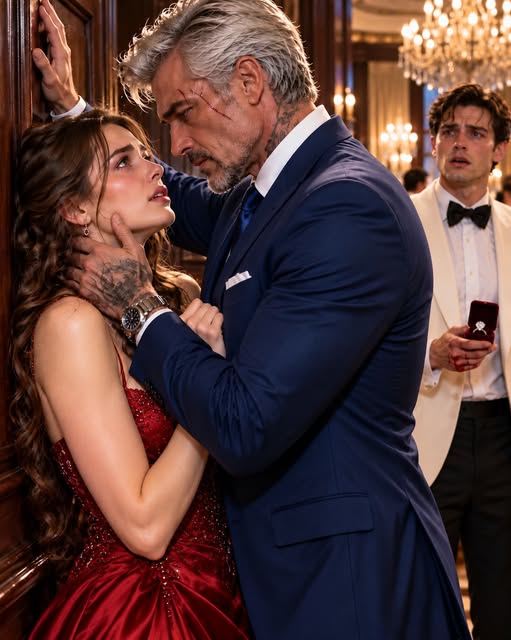
In the nine days before the summit, I learned my husband's world the way I'd once learned the bakery — by standing in it until my feet ached.
I learned the names of the five families and the shape of the council that governed them, older than the city's charter, a peace kept not by kindness but by arithmetic: what war cost, what peace paid. I learned that Alessandro's empire ran on shipping manifests and hotel ledgers, that the violence people whispered about was mostly a reputation he maintained the way you maintain a fence — because maintaining it meant seldom having to use what was behind it. I learned the household staff by name. I learned which of them had been there six years.
And I learned about Victor Hale.
He was the Caruso finance manager — a neat, silver-templed man in his fifties with a courteous smile and forty years of service he'd inherited almost like a birthright, his father having kept books for Alessandro's father. He ran the money office the way a priest runs a vestry. He had eaten at the family table every Sunday of my life-in-absentia. He sent me, that first week, a gracious note welcoming me home, with a box of candied chestnuts.
"He signs off on the household schedules," Dante said, in the study, with the door shut and the rain come back to drum the windows. He laid out the years like cards. "He approved the transfer arrangements the week you were taken — the cars, the timing, the safe apartment that wasn't safe. Three separate leaks since, every one of them in the seam between finance and logistics, every one of them costing us exactly the way a Bellandi auditor would price it. And this week — " he slid a photograph across the desk " — this week he learned we recovered Daniel's box. Forty-eight hours later, Enzo Bellandi knew to request a summit before the council could be presented with the evidence. Nobody told Enzo. Somebody sold him the timing."
"Victor Hale has a son," Alessandro said, from the window. He had been silent a long time. "A boy with debts. Bellandi debts, forgiven in tranches over six years. I found the pattern this spring. I've been waiting for the shape of the thing to finish revealing itself — and I will be honest with you both, because we are past the place where my pride gets a vote: I didn't want it to be him. His father carried me out of a burning warehouse when I was nine years old."
"Waiting ends at the summit," I said.
Alessandro turned. "Yes. It does."
The night before the summit, I couldn't eat, and Alessandro — who missed nothing, a quality alternately comforting and infuriating — had the kitchen send up soup anyway and sat across the study desk from me with the summit papers while I ignored it. He walked me through the room the way Dante walked perimeters: who would sit where, who owed whom, which of the old men had hated Enzo for forty years and would hide it, which one had loved him for forty years and would hide that. He told me Favreau's tells, and the Morvillo heir's vanity, and that the youngest don would be watching Alessandro the entire time to learn what power looked like up close, and would therefore be watching me too.
"They'll test you," he said. "Not with questions — nobody will address you directly, that would be a courtesy, and courtesy is information. They'll test you with silence. They'll speak around you as though you're furniture that can hear, and they'll measure what your face does. Enzo especially. He'll say something designed to make you flinch, or weep, or look at me for permission. Whatever enters your mind in that moment, Sophia, put it behind your eyes and let it wait. Grief is welcome at that table. Weakness is data."
"And if I fail?"
"Then I adjust, and we win anyway, more slowly and at greater cost." He said it without a flicker of doubt, and then, quieter: "You won't fail. I stood in a bakery and watched you apologize to the man who'd come to rescue you while your hand bled through a handkerchief — because thanking me would have cost you a dignity you couldn't afford to spend. A woman who can do that can sit at the council table and be furniture that hears. They have no idea what they're measuring. Let them measure."
"Will you be all right?" I asked. "With Victor. In the room below, eating lunch, believing — " I stopped. "You've known him since you were nine."
He was quiet for a moment, and turned a pencil over and over between his tattooed fingers, and I recognized, absurdly, my father's gesture — the margin-marking hand, the thinking hand, the same in a bookkeeper and a boss.
"At the table, yes," he said at last. "In November, when his granddaughter is born and I am not in the room where that family has always had me stand — no. Probably not for a long time. Grief is welcome at the table, isn't that what I said?" The pencil stilled. "Ask your question, Sophia. The one you've been carrying since the study this morning. The summit won't wait for it, and neither should you."
"Was there ever — " I had to stop and start again, and hated the stopping, and did it anyway, because the envelope rule doesn't bend for dignity. "In four years. Was there ever a moment when you thought about stopping? About letting the girl in the photographs stay lost, and living the life that was in front of you instead?"
"Once," he said. "The third winter. An investigator brought me a report that said you were dead — a fire, in another state, a young woman with no name. It took eleven days to disprove. On the ninth day I sat in the cathedral where we were married, in the back, where nobody could see the Caruso doing something as human as despair, and I tried to imagine putting the folder in a drawer and being free of it." He looked up, and his gray eyes were entirely unguarded, which in him was a kind of nakedness. "I couldn't picture the rest of the life. That's all. It wasn't nobility. The picture wouldn't form. So I got up and went back to work, and two days later the report fell apart, and I understood that even if it hadn't — even if you were smoke — I'd have spent the rest of my life looking at doors. It was never a decision, Sophia. Decisions can be revisited. It was just the shape of the world."
I reached across the desk, then — carefully, with my healed hand, over the summit papers and my father's copied ledgers — and I put my fingers over his, over the tattoos and the pencil and the thirty years of him, and he turned his hand up under mine and held on, hard, like a man holding a rail in a storm.
"Tomorrow," I said, "we finish it."
"Tomorrow," he agreed, "you finish it. I just bring the paper."
The summit met in a private dining room above one of the neutral hotels on the river — a long table, no windows, eleven chairs. Old men and their heirs. Wives did not attend. That was the first thing everyone in that room understood, and Enzo Bellandi understood it best of all, which was why Alessandro had brought me.
I walked in on his arm in a black dress someone at the estate had chosen with the precision of a military campaign, my hair down, my bandaged hand healed to a thin pink line that I did not hide, and my father's council copy of the ledgers in a slim case in Alessandro's hand. The room did what rooms do when the arithmetic changes inside them. It recalculated.
Enzo Bellandi was seventy, white-haired, immaculate, with the soft, disappointed face of a headmaster. He rose — they all rose, because whatever else these men were, they were formal — and his eyes went to me and stayed there with a mildness that was worse than hatred.
"Mrs. Caruso," he said. "How unexpected. And how recovered you look. City air agrees with some of us."
"Mr. Bellandi," I said. "I've come a long way to meet you. Six years, you could say."
"Sit, Enzo," said the eldest man at the table's head — Don Favreau, who had buried two sons in the last century's wars and feared nothing on earth anymore. "The Caruso has requested the floor, and brought his reason with him. Speak, Alessandro."
What happened over the next hour had the formality of a liturgy and the temperature of a knife fight conducted entirely in complete sentences. Alessandro laid out the accusation: that the Bellandi had murdered Daniel Chen, an accountant under council protection, for the crime of finding their second set of books; that they had purchased a widow's debts to use her as a jailer for the one living witness's daughter; that they had kept that daughter — a wife of this council, married under its own sanction — hidden and bled for six years, and attempted her abduction in daylight when she surfaced. And that the proof of the first of these crimes, and the money under all of them, was in the case on the table, in the safe-deposit originals already copied to two prosecutors, and in Daniel Chen's own annotated hand.
"The council will examine the evidence," old Favreau said at last, into a silence you could have hung a coat on. "If it is as the Caruso says — and the Bellandi will be given every hour of fairness this table owes him — then the Bellandi will answer for a murdered protected man and a stolen wife, which are the two crimes this council has never forgiven in a hundred and fifty years." His eyes, pale as winter water, moved to Enzo. "You asked for this summit, Enzo. Diplomacy, you called it. Was there something you wished to say before we begin?"
Enzo smiled. It reached nothing in his face above his mouth.
"Only that paper burns," he said, gently, to the room. "And witnesses — witnesses are such temporary things. Especially ones who have already been lost once." His gaze settled on me like a hand on a shoulder. "Mrs. Caruso. You've been found for, what, nine days? Do enjoy the sensation. It has a history of not lasting."
Alessandro stood. I felt it more than saw it — the whole room felt it, the temperature of the air itself acknowledging the most dangerous man present had decided something.
But I had asked him, the night before, for this part. Begged, actually, and then stopped begging and simply told him, the way I'd told him about Marie: I'm not asking. And so he did the hardest thing a man like him can do in a room like that.
He stayed standing at my side, and let me rise too.
"My name is Sophia Chen Caruso," I said. My voice shook on the first three words and then found its floor, the way a singer's does. "Daniel Chen was my father. For six years I believed he died on a wet road, and that my husband threw me away like something soiled, and I believed it because the Bellandi family bought my aunt's gambling debts and rented her mouth to tell me so. I have handed my wages to Bellandi collectors at my own front door, four years running, to pay for the rope they kept around my family's neck." I looked at each face at that table, one by one, the way my father must have looked at his columns. "The evidence is real. The originals are beyond your reach and mine. And I am not lost anymore. I am standing in the light where everyone at this table can see me, next to my husband, and I am finished being temporary."
It was then — in the silence after, when the old men were still deciding what they had witnessed — that Dante, who had been standing at the wall with the other seconds, stepped forward and placed one more folder on the table with the softness of a man setting down a sleeping child.
"The Caruso also presents," Alessandro said, "the account of Victor Hale. Forty years of the Bellandi's money moving through my house in his handwriting. His son's forgiven debts. His schedule memoranda from the week my wife was taken — and the one from nine days ago, which reached Enzo Bellandi before this council did." His voice went quiet enough that the room leaned in to hear the end of him. "He is in the room below, being given the courtesy of lunch while he still believes he's a trusted man. I wanted this table to know his name from me before anyone else says it. Whatever this council decides about traitors, it will not be said that the Caruso hid his own rot to prosecute another house's."
Favreau looked at him for a long moment. Then the old man nodded once, slowly, with something in it that in a younger man would have been respect.
Enzo Bellandi had stopped smiling somewhere around my father's name. When we left — on Alessandro's arm, past the seconds and the held doors — he spoke once more, too low for the table, pitched for the two of us alone, in the voice of a man reading a weather report he fully believes.
"Nine days of evidence, girl. Paper and councils." A pause. "Your husband's protection is a roof, Mrs. Caruso. Ask him, when you're alone, what his roof is made of. Everything burns eventually. Even houses. Even this one."
Story Genres: MAFIA BOSS
-

Chapter 5: The Summit
-
Chapter 4: What My Father Left Me
We opened the envelope the next morning, in the study, with the rain finally stopped and pale sun coming through the tall windows in bars.
Alessandro set it on the desk between us and then, deliberately, took his hands off it and put them flat on his own side of the wood.
"I've carried it for four years," he said. "Your father gave it to me the week before the wedding — no. The day before the wedding. He stood in this room. He put it in my hand and closed my fingers over it himself, and he said: 'When she is safe. Not before. You'll know when, and so will she, because she'll be the one who asks.' I've wanted to open it every day since the night they took you. I want you to know that I never did."
"Why are you telling me this?"
"Because you're about to read your father's last words, and I need you to know whose hands kept them." He pushed it, one inch, toward me. "Open it, Sophia. You asked. That was the condition. It was always going to be you who asked."
My stitches pulled when I worked my thumb under the flap. The glue had gone brittle with age; the envelope opened with a sound like a held breath let go.
Three things came out onto the desk.
A letter, folded in thirds, in my father's careful sloping hand.
A thin sheaf of photocopied pages, dense with columns and figures.
And a small brass key, taped — years ago, the tape yellowed now — to a stiff card printed with the name of a bank in the old financial district and a box number.
I read the letter first. I read it three times before the words would hold still.
My dearest Sophia —
If you are reading this, then I am gone, and you are safe, and those two facts are the only bargain I have left to make with God. Forgive the marriage first, because it will look to you like a cage, and I know it, and I am sorry. I found things in the Bellandi accounts that no man walks away from once he's seen them — money washed through our own docks, names of the dead paid as if they lived, a rot with roots in rooms I can't reach. They will know I found them. They may already. A paper daughter of an accountant has no protection in this city, but the wife of Alessandro Caruso has his name, his house, and his honor standing in front of her, and Alessandro — for all that the world calls him — is a man who keeps faith. I chose him for you the way a drowning man chooses the shore. Give him the chance I won't be here to explain. The pages with this letter are a copy of what I found; the originals sit where this key says they sit, and together they are worth more than gold, because they are the truth with numbers on it. When you are safe, and only then, they can end this. I love you past the end of everything I can prove. — Dad
I put the letter down very carefully, the way you'd set down something sleeping.
"He knew," I said. My voice didn't sound like mine. "He knew they were going to kill him, and he spent his last month — marrying me off. Buying me a — a shore."
"He spent his last month the way he'd spent his whole life," Alessandro said quietly. "Doing your arithmetic before his own. He was the bravest man I ever met, and I have met men the newspapers call heroes."
The photocopied pages were exactly what he'd promised: ledger sheets in two hands, the honest set and the rotten one, dates and vessel names and payments marching down the columns like ants — payments to men recorded as deceased, dues drawn on cargoes that never docked, a river of Bellandi money washed clean through legitimate Caruso-adjacent businesses without the Carusos' knowledge. My father had annotated them in pencil, in the margins, in that same sloping script. Cross-references. Initials. A name here and there, circled — and I felt my stomach turn over slowly, because I recognized what I was looking at. This was a noose, built patiently, figure by figure, by a quiet man with a desk job and a daughter.
And I recognized the penciled marks, too — not the figures, but the private grammar of them. My father had taught me bookkeeping at our kitchen table the way other fathers teach piano, and he had a system of margin symbols that was entirely his own: a small star for a figure that had been verified twice, a line in the shape of a hook for money that had entered from nowhere and needed following, and — beside the worst entries, the ones that had clearly cost him sleep — a tiny drawn door. I'd asked him once what the door meant, and he'd said, "That's an exit, sweetheart. Every set of books, honest or not, has one door in it where the truth gets out. A good accountant's job is to find the door." I had been fourteen. I had thought he was being poetic about arithmetic, the way fathers are. Now I sat in Alessandro's study with his annotated photocopies spread in front of me and counted the doors in the margins of the Bellandi ledgers, and there were eleven of them, and I understood that my father had not merely documented a crime. He had built eleven exits and labeled every one, calmly, in pencil, in the certain knowledge that somebody — perhaps a daughter, perhaps a husband, perhaps a prosecutor not yet assigned — would one day need to walk through them in the right order.
"Tell me about the council," I said. "All of it. Not the version for frightened wives — the real shape of it. If I'm going to stand in front of those men, I want to know exactly what they are, what they forgive, and what they don't."
So he told me. For an hour, with the sun moving across the desk and the ledgers between us like a dealt hand, Alessandro explained the old peace of Bellhaven: five families, one table, a code older than the port itself — protected men were sacrosanct, marriages under the council's sanction were inviolable, and debts of honor outlived the men who owed them. "Your father knew the code better than most men born to it," he said. "That's why the marriage had to be real, and public, and before witnesses from every house. He wasn't only hiding you, Sophia. He was putting you under the protection of the one law Enzo Bellandi himself has never openly broken. Everything Enzo has done since — the debts, the hiding, the shooting — he's done in shadow and through other men's hands, precisely because doing it in the light would cost him his seat at that table. The evidence doesn't just prosecute him. It drags him into the light, in front of the council, where a man like that has no armor at all."
"With the originals from the deposit box," Alessandro said, "this goes to the council of families, and to two prosecutors I can name who have been waiting a decade for exactly this, and Enzo Bellandi is finished — not shot in an alley, Sophia. Finished. Audited. Stripped. Tried, if the state moves first, and the state will move fast once the council signals it won't protect him. Killing is what he does. Paper is what kills him."
"And the man inside your house," I said. "The one who told them where I'd be moved. Six years ago. Is he in these pages?"
Alessandro went very still. "No. Your father didn't know that name. Neither do I — yet. I've narrowed it, over the years. It has to be someone with the household schedules and the finance office both. There aren't many." His jaw worked. "It's the not-knowing I can't forgive myself for. He's eaten at my table for six years."
"Then we find him too." I heard myself say it and felt the ground of my life shift under me — not cracking, settling. Into a new shape. "The box, Alessandro. When do we open the box?"
"We don't. You do. It's your name on the card — your father saw to that. The bank will want your signature and your face, and no power on earth can open it without them. That's why the hiding place worked, and that's why, once they knew you'd been found, they tried to take you off a public street in broad daylight." His eyes were steady on mine. "Understand what you are now, Sophia. Yesterday you were a waitress they were squeezing. Today you are the only key to the thing that can destroy them. Every hour that box stays shut, you are in danger. Every minute after it opens, Enzo Bellandi is."
It would have been a lie to say I wasn't afraid. I was afraid with my whole body — afraid of the box, of the street, of the quiet man across the desk and the six years folded inside the envelope, afraid most of all of the sensation rising in me underneath the fear, which was not fear at all. It was the feeling of a door that has been locked from the outside finally, finally, being tried from within.
For four years I had been managed. Hidden. Fed lies in a kitchen by a woman reading from a script, bled white in dollar bills handed over at a door I'd paid to maintain, kept too tired to think and too ashamed to be seen. My father hadn't raised a girl like that. He'd raised a girl who did the household books at fourteen and caught the grocer's arithmetic error at fifteen, and somewhere under the apron and the exhaustion, she was still in there. I'd felt her at the table with Marie. I felt her now, looking at the brass key.
"I need you to hear me," I said. "I'm not doing this because I'm your wife on a piece of paper from six years ago. I'm not doing it because you found me, or because you say it's my father's plan. I'm doing it because they killed my dad, and they used my aunt like a tool, and they kept me in a cage built out of my own wages — and I'm the one who ends it. Me. With you. Not behind you."
Alessandro was silent for a long moment. Then something happened to his face that I had never seen in it, in the cathedral six years ago or the bakery or anywhere — it softened all the way down, past control, past danger, into something that looked almost like wonder.
"Behind me was never the offer," he said. "Your father knew that too. It's why the key has your name on it."
We went to the bank that afternoon, in a convoy of three cars, with Dante riding beside the driver and Alessandro beside me in the back, and the ordinary clerks of the old financial district blinking at the procession of it. My signature shook. The box, when they brought it into the little private room and left us, was heavy for its size.
Inside: the original ledgers, bound in oilcloth. A second key. A list in my father's hand of names — witnesses, he had written at the top. Some of these people may still be alive. And underneath everything, wrapped in a handkerchief I recognized from our kitchen drawer at home — his spare, the one with the blue edge — a photograph of my parents on a beach before I was born, laughing into the wind, young in a way that made my chest ache.
I cried in the bank's little room, with the ledgers of a dead man's courage stacked beside me, and Alessandro stood with his back to me and his face to the door, guarding even that.
On the ride home, with the box on the seat between us like a third passenger, he said, "The council meets in nine days. Enzo will request a summit before then — he'll dress it as diplomacy. When he does, I want you beside me in that room. Not as my weakness, Sophia. As my witness — and as Daniel Chen's daughter, holding his evidence. But only if you choose it. I will not spend you the way they spent Marie. Say the word and you're behind walls until it's over."
I looked out at the city going by — my city, the one that had hidden me in plain sight.
"I'm done being behind walls," I said. "Teach me what I need to know before the summit. All of it. Starting with the name of the man at your table." -
Chapter 3: What Aunt Marie Knew
I didn't sleep.
The suite on the second floor was bigger than the apartment I'd shared with Marie — bigger, and quieter, and filled with the particular silence of a house with thick walls and armed men. Someone had left a nightgown on the bed that still had its tags. Someone else had left, on the dresser, a glass of water and the two pain pills I hadn't taken. I lay in the dark with my stitched hand throbbing on top of the covers and went over four years of my life the way you go over a letter you suspect was forged — holding every line up to the light.
By dawn I had a list. It had one item on it.
I found Alessandro in a study off the main hall at six in the morning, still in yesterday's shirt, sleeves rolled to the elbow, the tattoos on his forearms bare, a wall's worth of paper spread across the desk and Dante standing over it like a general over a map. Neither of them looked surprised to see me.
"You're taking me to Marie," I said.
Dante glanced at Alessandro. Alessandro looked at the papers, then at me, and I watched him decide not to argue with the tone in my voice.
"There's a car in twenty minutes," he said. "I sit in the front. You talk to her alone. If you want me in the room, you say so. If you want me gone — "
"I want the truth," I said. "Wherever it is."
Marie lived on the third floor of a walk-up across the river, in the apartment whose rent I paid. The stairs smelled of cabbage and damp plaster. Alessandro waited in the car below with two men at either end of the street, and I climbed the steps I'd climbed a thousand times with grocery bags cutting into my fingers, and knocked on the door I'd paid to keep closed against the world.
She opened it in her housecoat. Sixty-one years old and shrunken inside her own skin, her hair pinned up in the same gray knot she'd worn since my childhood. She took in my face, my bandaged hand, the good coat someone at the estate had pressed on me — and I watched the blood leave her face in a slow, terrible tide.
"Oh," she said. "Oh, no. Sophia. Baby. No."
"You knew," I said. It wasn't a question. Four years of questions had burned down to this one coal. "All this time. You knew."
She backed into the apartment and I followed her, and I closed the door behind me myself, gently, because I was afraid of what my hands would do if I let them be anything but gentle.
"Tell me about the night they moved me."
"Sophia — "
"Tell me about who told you Alessandro didn't want me. Tell me about the money, Marie. Start anywhere. Start with my father."
She sat down at the kitchen table — the same table where she'd told me about the accident, her hands around a mug she never drank from. I hadn't known, at twelve, that people did that with their hands when they were lying. Held onto things to keep from shaking apart.
"It began before he died," she whispered. "Your father found things, Sophia. Papers. Books that didn't balance — he did accounts for half the families in Bellhaven, you know that, and one winter he found a second set of books, Bellandi books, and he understood what he was looking at. He went to the Carusos. He made the marriage — him, Daniel, it was his doing, his insurance policy for you. And then in March they ran his car off the Mill Road — "
I sat down very carefully across from her, because the floor had become uncertain.
"They told me it was the wet road. You told me it was the wet road."
"I told you what I was told to tell you!" Her voice cracked like thin ice. "They came to me after the funeral, Sophia. Men from the Bellandi family. Courteous men. They showed me my markers — you have to understand, I already owed, I'd been at the tables for years before your father died, small debts, shameful little debts — and then they bought them. All of them. Consolidated, they called it. One friendly arrangement. And after that they owned the rope around my neck, and every few months they made it a little tighter, and all they ever asked — at first — all they ever asked was that I keep you close, keep you home, keep you away from that husband of yours. And later, when the questions started — when you cried at that table, at sixteen, at eighteen, asking why he never wrote — the words were already written for me. He discarded you. He signed the papers. A man like that doesn't keep a girl like you."
"There were no papers," I said.
"There were no papers." She was crying openly now, soundlessly, the way she'd taught me to cry in a house where crying had consequences. "That was the phrase they gave me. Discarded. Like you'd been — and I said it, Sophia. For years I said it. And every month they let a little of my debt breathe, and every month you handed your wages to their collectors at that very door, and I told myself it was survival. I told myself I was keeping you safe, because a hidden girl is a safe girl, and as long as you stayed small and quiet they'd never need to — "
"Need to what?"
She looked at my bandaged hand.
"The ledger," she whispered. "Your father kept a copy of everything he found. Insurance, he called it — his word, the same word he used about the marriage. The Bellandi have never known where it is. And a hidden girl can be watched, Sophia. A found girl asks questions. A found girl opens boxes."
Dante's men had found the first of it by midnight: Marie's debts had not grown the way debts grow. They'd been bought, consolidated, engineered — purchased in a block by a Bellandi front within weeks of my father's funeral, then fed, deliberately, like an animal being raised for a purpose. The knock-on-the-door men who had taken my wages for four years were Bellandi collectors. Every dollar I'd handed over had gone to the family that murdered my father — paid, in installments, for my own hiding place.
Alessandro told me all of this standing in Marie's doorway, where he had come up the stairs without a sound sometime during my aunt's confession, and I will say this for him: he did not say one word to her. He looked at her for a long moment — this woman who had raised me and ruined me in the same pair of hands — and whatever he saw there made him step aside and hold the door for her as she came out with her little suitcase, because I had already decided.
"She's coming with us," I said. "She's not staying here for them to use again. I don't care what you think. I'm not asking."
"I wasn't going to refuse," he said. "Get in the car, Mrs. Chen."
She flinched at the courtesy of it more than she would have flinched at a blow.
The drive back across the river took us through the old neighborhoods, and Marie sat beside me in the back with her suitcase on her knees like a shield, staring out at streets she'd walked for sixty years. Alessandro rode in front, beside the driver, saying nothing. The silence in that car had layers — hers, mine, his — and somewhere around the midpoint of the bridge, with the water going gray-green below us, she spoke without turning her head.
"Your mother used to say I had a gambler's heart before I ever saw a card table," she said. "She meant I always believed the next thing would save me. The next hand. The next loan. The next lie I told you — I believed every one of them was the last one I'd need. That's the sickness of it, Sophia. It isn't the losing. It's that the hoping never stops feeling like a plan." Her hands worried the clasp of the suitcase. "When they first came — the courteous men — they didn't threaten me. That's what I need you to know, so you know the exact size of my shame. They offered. A consolidation. A little breathing room. All they wanted was to know you'd be home for dinner, and not — not going back to that church, that name. It sounded like protecting you. I let it sound like protecting you, because the alternative was admitting I'd sold the last of your mother's family to a card game." She turned then, finally, and her face was stripped down to something I hadn't seen on it since I was twelve years old and she was the tallest person in my world. "By the time they asked me to say the word discarded to your face, I understood what I'd done. And I said it anyway, because by then the rope was around both our necks and I was too much a coward to be the only one who hanged. Forgive me or don't. I have it to carry either way, and that's — that's the first honest arithmetic I've done in six years."
Alessandro's eyes met mine in the rearview mirror. He said nothing. He had promised me the talk would be mine, and it was, and his silence in that moment — his refusal to make himself the hero or the judge of the thing — was the moment I first believed, in my body and not just my ears, that the man I'd married might be worth the knowing.
"I'm not going to forgive you today," I told her. "I might not know how for a long time, and I'm done lying to people in this family, including you." I put my good hand over hers on the suitcase clasp, and felt hers turn over beneath it and grip on like a drowning woman. "But you're coming home with me, and nobody is ever going to put words in your mouth again. That's where we start."
We were three blocks from the river bridge when it happened.
A gray sedan pulled out of the mouth of an alley and swung across our lane — not a crash, a block, smooth and practiced — and a second car boxed us from behind, and I understood with a clarity that arrived before fear did that this was not an accident, that nothing in my life had ever been an accident. Dante was already shouting, already moving. The man in the passenger seat beside him had his weapon out. Alessandro did something I will never forget as long as I live: he turned in his seat, braced one arm across me and Marie both like a bar, and said, very calmly, "Eyes on me. Both of you. Eyes on me."
The sedan's doors opened. Three men. I saw the first one's face clearly — young, bored, professional, a face doing a job — and then Alessandro's men were simply there, the way weather is there, cars at both ends of the street that I hadn't known were ours, and the whole geometry of the ambush inverted in about the time it takes to draw a breath.
It was over without a shot. That's the part the movies get wrong. It was over in voices, and hands shown empty, and the young professional's face going carefully blank as he understood the arithmetic had been done wrong somewhere above his pay grade. They were disarmed and held for the police Alessandro's people would call — later, in their own time, in their own way — and we drove on through the gap like a knife through silk.
Marie didn't make a sound the entire time. Neither, I realized, had I. My good hand hurt, and when I looked down I saw I was gripping Alessandro's sleeve exactly the way I'd gripped it in the bakery, and he was letting me, and his arm was still braced across us like the bar of a gate.
"That was for me," I said, when the river was behind us.
"That was for you," he agreed. "They've lost their watcher, their collector, and their hiding place in one day. Enzo Bellandi is not a man who tolerates arithmetic like that." The car turned through the estate gates, and the gates closed behind us with their deep iron finality, and Alessandro finally — finally — took his arm away.
"Now he has to come and get you himself," he said. "And that, Sophia, is when we finish it." -
Chapter 2: The House I Never Lived In
I don't remember deciding to get into the SUV.
I remember the door closing with a sound like a vault. I remember the wet leather smell, and Alessandro's shoulder against mine, solid and immovable, and the city sliding past the tinted windows in gray streaks while Dante drove with one hand and talked into his radio with the other — short, coded sentences about perimeters and rooftops and a word I caught twice: Bellandi.
I remember my hand throbbing inside the white handkerchief, in time with my heart.
"You're in shock," Alessandro said.
"I'm fine."
"You're shaking."
"I'm cold."
He shrugged out of his suit jacket — thousand-dollar tailoring, soaked through — and laid it around my shoulders with a care that made my throat close. The tattoos on his hands moved as he settled the collar: black and gray, ornamental, disappearing into his cuffs. I had forgotten about the tattoos. I had forgotten a lot of things, deliberately, the way you forget the words to a song that hurts.
"You don't have to do this," I whispered.
"Do what?"
"Any of it. The jacket. The doctor. The — " I gestured vaguely at the entire impossible morning. "You don't owe me, Alessandro. Whatever this is. If the marriage was a mistake, if it was business — "
"It was never business." He said it to the window, not to me. "That's the first thing you need to understand. And it's the thing they worked hardest to make you not understand."
The Caruso estate sat behind gates at the top of a hill above Bellhaven, the kind of house that appears in magazines under captions about old money. I had been brought here once, six years ago, in the week before the wedding — a tour conducted by a housekeeper, through rooms I was too grief-drunk to see. I had never spent a single night in it. My husband's house. I had a husband's house.
Men I didn't know materialized at the gates, at the doors, at the corners of the drive. Alessandro helped me out of the SUV — helped me, with a hand under my elbow as though I were made of the same porcelain as that cup — and steered me through a marble hall that echoed with our wet footsteps.
"Sit," he said, in a sitting room with a fire already lit, as if the house had been expecting me longer than I had.
Dr. Rosini arrived within the half hour: a silver-haired man in his sixties with a surgeon's calm and a leather bag worn soft at the corners. He unwrapped the handkerchief from my palm without comment, examined the cut, and glanced once at Alessandro.
"Deep," he said. "She caught the edge badly. Six stitches, I think."
"I can't — " I started.
"Sophia." Alessandro's voice was quiet. It was worse than shouting. "Let him work."
The anesthetic stung. The stitching itself I watched with a strange detachment, the needle passing through my skin like it belonged to somebody else, while Dr. Rosini made small talk the way professionals do when a room is full of things nobody is saying. When he finished, he bandaged my hand in clean white gauze, told me to keep it dry, pressed two pills into my good hand for the pain, and began packing his bag with the efficiency of a man who had stitched up Carusos in this house for thirty years and asked questions about none of it.
At the door he paused. "It's good to see you home, Mrs. Caruso."
I flinched. He pretended not to notice. They were all very good at that, in this house.
Alessandro saw him out and came back with tea I hadn't asked for and a plate of food I also hadn't asked for — real food, a meal, bread that was still warm. My stomach betrayed me with a sound so loud that in any other universe it would have been funny.
"Eat," he said.
"I'm not a stray dog you picked up in the rain, Alessandro."
"No." He sat across from me — not close, I noticed, never close unless the world was ending. He folded his hands and studied me over them. "You're my wife."
The word landed between us like the envelope had. Wife. I stared at my bandaged hand. The cold silver ring from the ceremony was in a tin box in my dresser drawer, next to a hair tie and eleven dollars. I had taken it off the day they moved me out of the apartment the relatives had arranged, because wearing it made the lying harder.
"Am I?" I said. "Because from where I was standing — from every room they put me in for four years — I was a girl you married in a church and then handed back. They told me you signed the separation. They told me you didn't want — " My voice cracked, traitorous. "They told me you never even asked where I'd gone."
"And you believed them."
"You never came!" The words tore out of me before I could stop them, four years of them, and I was on my feet without knowing how I'd gotten there. "Four years, Alessandro! If you wanted me, if any of this — you never came!"
"I came." His voice didn't rise. That was the worst of it — it didn't rise, it just went flat and terrible, the way deep water goes still. "I came to the apartment on Harbor Street three days after they took you, and it was empty, cleaned out like you'd never lived there. I came to your cousin's house in March and was told you'd left the country. I have a drawer — " he stopped. Recalibrated. "I have files, Sophia. Private investigators. Four of them, over four years. Port authorities, hospital records, a woman matching your description in three different states. They moved you like a shell in a street game, and every trail I bought went cold within a month, because somebody was paying to keep them cold."
He stood then, slowly, and crossed to a desk by the window, and came back with a folder — thick, soft-edged, the twin of the envelope in wear. He set it on the table between us and didn't open it.
"Dates," he said. "Receipts. Photographs of doors you weren't behind. When you trust me a little more, you can read every page. Or never. It's yours."
I opened it then. Not because I trusted him — because I needed to know what four years of searching looked like when it failed. It looked like paper. Report after report in the flat language of men paid not to care: Subject relocated prior to surveillance. Trail cold at county line. No record at address; neighbors report a young woman matching description departed "some months back," destination unknown. And clipped to the front of each report, in Alessandro's own hand — a hand I recognized from a signature on a marriage certificate I'd seen exactly once — a date, and below it a single instruction, repeated like a heartbeat down four years of pages: Keep looking.
Halfway through the folder I found a photograph of a door I recognized. My door. The Harbor Street apartment, the week after they'd moved me out — the investigator had photographed it as evidence of absence, the windows dark, a realtor's sign already up. I had stood inside that apartment on its last night packing a suitcase while a cousin I barely knew told me to hurry, that the car was waiting, that it was better this way. I'd believed the car was taking me somewhere Alessandro had arranged to be rid of me. It had never occurred to me to wonder whose car it actually was.
I closed the folder. My stitched hand ached inside its bandage.
"There's one thing I don't understand," I said. "The wedding. If my father arranged it for protection — I stood in that church and you looked like you'd rather be anywhere on earth. Was that an act?"
"No." He didn't flinch from it. "I was twenty-nine years old, and my father had been dead eleven months, and every family in this city was watching to see if the boy would hold the empire or drop it. Daniel Chen came to me with his evidence and his plan and his dying man's eyes, and I understood the arrangement was necessary, and I resented it — resented him, resented the council, resented a bride I'd met once, at the funeral, for eleven minutes. I stood in that church angry at everyone in it." His gaze didn't leave mine. "Including myself, by the end. You were eighteen and dressed in white and shaking so hard your bouquet was shedding petals, and I thought: she didn't choose this either. It was the first honest thought I'd had in months. I was going to tell you so. That night, at the reception — do you remember the reception?"
I shook my head. "Forty minutes. Then the call came, and the cars, and — "
"And they told me there'd been a threat, that the family was moving you to safety as a precaution, that it was my own people's plan." His voice went flat again. "It took me three days to learn the precaution was a kidnapping with better manners. Three days, Sophia. That's the margin your whole life was stolen in. I've never told anyone that. The envelope rule seems to require it."
I sat down because my knees had opinions about standing.
"Why?" I whispered. "Why would they do that? Marie — Aunt Marie raised me. She — "
"I don't know all of it yet." He retook his seat, and for the first time that day he looked his age — mid-thirties and carrying every one of those years in his shoulders. "I know your father's death was not an accident. I know the marriage was his idea — Daniel's — made in the last month of his life, because he knew what was coming and he wanted you inside my family's protection when it came. And I know that within a month of the wedding, the protection failed, because someone inside my own organization told them exactly where you'd be and when you'd be moved."
Someone inside. The phrase crawled over my skin.
"Dante is pulling the creditor files tonight," he went on. "Every name connected to Marie's debts. By morning I'll know who held the paper, who bought it, and who profited from keeping you tired, and poor, and quiet." His gray eyes found mine and held them. "Because that's what it was, Sophia. I stood in that bakery and did the arithmetic. Twelve-hour shifts. Handing your wages to collectors. A bruise on your wrist shaped like fingers. That wasn't poverty. That was management. Somebody was keeping you exactly where they wanted you: too exhausted to ask questions, too broke to run, and too ashamed to be found."
"I wasn't ashamed," I said, and then, quieter, hating that it was true: "I was. A little. Of all of it."
"I know," he said, and there was nothing in his voice but grief. "They counted on that too."
I ate, in the end. I ate because my hands needed something to do and because the bread was warm and because six stitches of honesty had apparently exhausted my capacity for pride. Alessandro didn't watch me eat, which I was grateful for. He stood at the window with his back to me, watching the rain hammer the gardens, one tattooed hand flat against the glass.
"You can't go back to the apartment," he said. "Not tonight. Not until Dante's people understand what happened outside that bakery. There's a suite on the second floor — yours, for as long as you need it. Nobody will come to your door. Nobody will make you stay." He turned. "But the people who shot at us today knew where you'd be, Sophia. They knew your shift, your table, your street. Hiding you was their work for four years. Finding you was always going to end like this — the only question was whether I got to you first."
And the terrible thing, the thing I couldn't say out loud, was that part of me — the part that had slept for four years with one ear open for knocking — believed every word.
"One night," I said. "I'll stay one night. And then we talk about the envelope."
"One night," he agreed, like a man signing a treaty. "And then the envelope."
But neither of us mentioned the thing sitting heaviest in the room.
My father had been murdered.
And the man everyone had taught me to fear had spent four years and a drawer full of dead ends trying to find me. -
Chapter 1: The Morning He Walked Back In
At eighteen, I was forced into a marriage with Alessandro Caruso, one of the most feared mafia bosses in the country. Four years later, I was working twelve-hour shifts in a bakery, barely surviving on leftover bread, when he suddenly walked back into my life. I accidentally spilled coffee on his shoes, and when he saw blood dripping from my hand, he ordered his men to bring a doctor. Then he leaned close and whispered, "I've spent four years trying to find you, Sophia." Before I could ask what he meant, a gunshot shattered the bakery window — and Alessandro threw himself over me.
My name is Sophia Chen.
I was twenty-four years old, broke, exhausted, and working at Moretti's Bakery in Bellhaven.
Every morning, I arrived before sunrise, when the streets were still black and the rain-slicked pavement reflected the streetlamps like spilled coins. Every evening, I left with aching feet, flour under my fingernails, and barely enough money to pay the bills. My uniform was a white blouse and a black-and-white apron dress that Mrs. Moretti insisted made us look "classic," and my long chestnut-brown hair spent twelve hours a day tied back in a low ponytail that never quite held.
My aunt Marie had raised me after my father's death. She had taken me in when I was twelve years old and the world had ended in a single phone call — a car accident, they said, a wet road, a guardrail, nothing anyone could have done. Aunt Marie gave me her spare room and her old sweaters and, for a while, her love. But over the years, she'd accumulated enormous gambling debts. Cards first. Then horses. Then loans taken out against loans, each one signed in a hand that shook a little more than the last.
And somehow, those debts had become my responsibility.
I paid the rent. Bought the groceries. Covered the utilities. And handed over almost everything I earned to men who kept demanding more — men with flat eyes who knocked on our door at hours when decent people were asleep, men who smiled at me in a way that made my skin crawl while they counted my tips on our kitchen table.
Sometimes, I went an entire day without a proper meal. A heel of bread from the day-old rack. The broken corner of a pastry that couldn't be sold. I told myself it was enough. I told myself a lot of things.
But there was something nobody at the bakery knew about me.
At eighteen, I'd been married to a mafia boss.
Alessandro Caruso.
A man whose family controlled shipping companies, luxury hotels, and much of the city's underground empire. A man people lowered their voices around, even in rooms he wasn't in.
Our marriage had been arranged after my father's death. I remembered the ceremony the way you remember a fever dream — in flashes, in fragments. The expensive flowers, white roses banked so thick their perfume turned the air syrupy. The unfamiliar faces, a cathedral of strangers in dark suits, none of them smiling. The cold silver ring placed on my finger by a hand that did not tremble, though mine shook so badly I was sure the whole church could see it. And Alessandro standing beside me, tall and broad-shouldered in a black suit, his slicked-back black hair and cold gray eyes fixed somewhere past my shoulder, looking as though he'd rather face a firing squad than marry me.
I thought he hated me.
I was eighteen years old, still wearing grief like a second skin, and I stood in that church and believed the man beside me despised me for existing.
Then everything fell apart.
Within weeks of the wedding, I was separated from him — taken away by relatives in the night-side chaos of whispered phone calls and packed suitcases, moved from one borrowed room to another, and told, firmly and repeatedly, never to contact the Caruso family again. He doesn't want you, they said. The marriage was a business arrangement, and the business is finished. A man like that doesn't keep a girl like you.
For years, I believed Alessandro had wanted me gone.
Until that rainy morning.
It was raining the way it only rains in Bellhaven in October — straight down, relentless, turning the gutters to rivers. I had been on my feet since four. The morning rush had thinned, the glass cases were full, and my whole body hummed with the particular exhaustion that lives behind the eyes. I was carrying coffee toward table seven, balancing the cup on a saucer the way I'd done ten thousand times, when my exhausted fingers simply — slipped.
The cup shattered.
Hot coffee splashed across a stranger's polished black shoes and spattered the marble floor. Porcelain went everywhere in a bright, ringing burst.
I immediately dropped to my knees.
"I'm so sorry!"
I gathered the broken porcelain with both hands, too frantic to be careful, apologizing to the floor, to the shoes, to nobody. A sharp piece sliced my palm. Blood ran down my fingers and dripped onto the white shards, and I barely felt it — pain was a luxury for people whose hands weren't their living.
Then a man's voice cut through the bakery.
"Stop."
Everyone went silent.
I looked up.
Dark hair. Black suit. Cold gray eyes.
My heart nearly stopped.
Alessandro Caruso.
Older. Broader. Even more intimidating than I remembered — the boy of twenty-something I'd married had been honed into something carved and dangerous, black-and-gray tattoos curling along the side of his neck and across the backs of his hands, a luxury watch at his wrist, his presence filling the little bakery like weather rolling in.
Two bodyguards stood behind him.
But Alessandro wasn't looking at his ruined shoes.
He was staring at my bleeding hand.
"You're hurt."
"It's nothing." I pressed my palm against my apron, as if I could hide it, hide all of it — the blood, the poverty, the four years.
"Look at me."
I slowly raised my eyes.
He studied my face the way a man reads a letter he has been waiting years to receive. Then he whispered my name.
"Sophia."
Something in his voice made my chest tighten.
He remembered me. Of course he remembered me — I had known that, somewhere beneath the stories I'd been told. But I hadn't expected him to sound like that. I hadn't expected him to sound like seeing me hurt him.
He took a clean handkerchief from his pocket — white, folded, impossibly clean — and wrapped it around my palm with a gentleness that undid me more than anger ever could have.
"This needs stitches."
"I can't afford a hospital." The words came out flat and automatic, the arithmetic of my entire life.
His jaw tightened. He looked at one of his guards.
"Call Dr. Rosini. Tell him to meet us at the estate."
I pulled away, scrambling to my feet, the handkerchief already spotting through. "I'm not going anywhere with you."
Alessandro slowly stood. He towered. He had always towered.
Mrs. Moretti, the bakery owner, hurried toward us with her hands fluttering like startled birds. "Mr. Caruso! I didn't realize you were coming! If I'd known, I would have — the private room, the — "
He barely acknowledged her. Instead, he asked, in the tone of a man asking about the weather, "How much does Sophia's family owe?"
My stomach dropped.
"That's none of your business."
He looked at his bodyguard. "Dante. Find every creditor connected to Marie Chen. I want names, amounts, and every threat they've made."
I grabbed his sleeve — grabbed it, with my bandaged, bleeding hand, like a child. "No! You don't understand. Those men are dangerous."
Alessandro looked down at me.
"Those men answer to me."
The entire bakery went silent. Even the espresso machine seemed to stop breathing.
I stepped backward. "Why do you know about my aunt?"
He didn't answer immediately. Instead, his gaze moved to my wrist, where my sleeve had ridden up — and I watched his expression change as he examined the bruise there, the yellow-green shadow of fingers that I had explained to myself so many times that I'd almost believed it.
His expression turned frighteningly cold.
"Who did this?"
I pulled my sleeve down. "I bumped into something."
He looked at me. He didn't believe a word. We both knew it, and the knowing sat between us like a third person.
Then he turned toward Mrs. Moretti. "Prepare Sophia's final paycheck. Add twelve weeks of severance."
I stared at him. "You can't just fire me!"
"I didn't fire you."
"You just ended my job!"
He leaned closer, and his voice dropped to something only I could hear. "I ended the part where people get to hurt you while you work for them."
My eyes burned. Four years of swallowed tears chose that exact moment to rebel. "I don't belong to you, Alessandro."
For a moment, something painful crossed his face — something old, and tired, and nothing like hatred.
Then he said quietly, "No, Sophia. You never belonged to me. And that's the mistake I've spent four years trying to explain."
Four years.
I stopped breathing.
"What are you talking about?"
He glanced toward the bakery windows, toward the rain and the gray street beyond, and some instinct in him shifted — I could see it happen, the way you see a door close in a man's eyes. "We need to leave."
"I'm not going anywhere until you tell me why you're here."
Alessandro looked directly into my eyes.
"Because I never agreed to let you go."
My heart pounded. All those years, I'd believed he had abandoned me — that I had been weighed, found wanting, and discarded by the man whose name was still, legally, tangled with mine. Now he was standing in front of me in a puddle of spilled coffee like he'd been searching for me all along, like the story I'd been fed was rotten at its root.
Outside, a black SUV waited in the pouring rain.
Alessandro opened the rear door. Rain drummed on the roof. Dante stood at my other side with an umbrella I hadn't seen him produce, and for one suspended second I stood on the curb between my old life and whatever this was, with my bandaged hand throbbing and my heart in my throat.
I stopped beside him. "Did you know where I was this whole time?"
Before he could answer —
BANG!
The bakery window exploded.
Glass scattered across the sidewalk in a glittering wave. Someone screamed. Alessandro grabbed me and threw himself over my body, shielding me as another bullet struck the SUV with a sound like the world cracking a knuckle. His men drew their weapons. Dante shouted into his radio. The rain kept falling through all of it, indifferent, soaking Alessandro's black suit as he held me against the vehicle, one hand protecting my head, his body a wall between me and the street.
"Stay down, Sophia."
I looked up at him through the rain. "Who's shooting at us?"
Dante approached, his expression grim, scanning the rooftops. "Boss, they found her sooner than expected."
My blood turned cold.
Found me?
I looked at Alessandro. "Who found me?"
He glanced at my bandaged hand. Then toward the shattered bakery window, where the rain was already blowing in across the pastry cases.
And when he spoke, his voice was colder than I'd ever heard it.
"The people who killed your father."
I stared at him.
My father had supposedly died in a car accident. That's what Aunt Marie had told me, sitting at our kitchen table with her hands wrapped around a mug she never drank from. That's what I'd believed for six years — through the funeral, through the wedding, through every twelve-hour shift and every knock on the door at midnight.
But Alessandro wasn't finished.
He reached inside his jacket — slowly, so Dante wouldn't mistake the movement — and pulled out an old envelope. The paper was soft with age, yellowed at the edges, worn the way only something carried for years can be worn.
On the front was my father's handwriting. I would have known it anywhere. I had a birthday card in a drawer somewhere with that same careful, sloping script.
FOR SOPHIA — WHEN SHE IS SAFE.
I looked at the envelope.
Then at the man I'd once been forced to marry.
And suddenly, I wondered whether everything I'd been told about my father's death, my marriage, and Alessandro's disappearance had been a lie. -

Chapter 7: The Woman He Chose, the Son He Almost Lost, and the Family They Finally Became
Eighteen months after I rejected Evan Marlowe in front of two hundred guests, I stood beneath the restored wooden beams of Harbor Point Community Center and watched sunlight pour through windows that someone once wanted to destroy.
Children ran across the polished floors.
Volunteers arranged books on new shelves.
A group of teenagers practiced music in the arts studio overlooking the river.
And outside, families gathered for the opening celebration of a building that had nearly become another luxury development.
I should have been thinking about speeches.
About construction deadlines.
About the countless nights Naomi and I spent reviewing drawings until our eyes ached.
Instead, I was thinking about a man with silver hair and a scar near his left eyebrow.
Vincent Marlowe.
The man I'd once believed I could never have.
The man whose silence had nearly destroyed his relationship with his son.
And the man who had spent the past eighteen months proving that love meant very little without the courage to change.
He hadn't called me that morning.
Not because we'd stopped speaking.
Quite the opposite.
We'd slowly begun seeing each other again six months earlier.
Not secretly.
Not recklessly.
And not as some dramatic reward for surviving a scandal.
We'd started with coffee.
Then long conversations.
Then an ordinary dinner at a quiet restaurant where Vincent wore no tie, ordered pasta, and admitted that he had no idea how to live without checking his phone every ten minutes.
I'd laughed.
He hadn't been offended.
He'd simply put the phone away.
That was how our relationship began.
Not with a stolen kiss.
Not with promises neither of us was ready to keep.
But with two adults learning how to be honest in the quiet moments that had once frightened them.
Still, I'd insisted we take our time.
My career was finally stable.
His legal and financial affairs remained complicated, though the most immediate threats had passed.
And Evan was rebuilding his life.
None of us wanted another beautiful moment followed by a devastating mistake.
So we'd moved slowly.
Sometimes painfully slowly.
And somewhere along the way, I stopped feeling like the woman who had fallen in love with the wrong man.
I began feeling like a woman who had finally learned how to make the right choices, even when those choices were difficult.
“Claire!”
Naomi rushed across the community center carrying a clipboard.
“You're supposed to be meeting the city representatives in ten minutes.”
I smiled.
“Good morning to you too.”
“Don't good-morning me. You're the architect of this entire transformation. People expect you to act important.”
I looked around.
“I'm acting appropriately important.”
“You're staring at the river and smiling like you're keeping a secret.”
I raised an eyebrow.
She stopped.
“Oh, don't tell me.”
“Tell you what?”
“Vincent.”
I laughed.
Naomi shook her head.
“Of course.”
Then her expression softened.
“Are you happy?”
The question surprised me.
Not because nobody had asked it before.
But because I finally knew how to answer.
“Yes.”
Naomi watched me carefully.
“Really?”
I nodded.
“Really.”
She smiled.
“Good.”
For a moment, we stood together beneath the restored ceiling.
Eighteen months earlier, I'd nearly lost the company we'd built.
Now our firm had contracts scheduled more than a year into the future.
We'd hired five employees.
We'd received recognition from two preservation organizations.
And the Harbor Point project had become proof that old buildings could serve new generations without losing their history.
I touched the brick wall beside me.
“There was a time when I thought this place would be demolished before anyone understood what it could become.”
Naomi followed my gaze.
“People said that about you too.”
I looked at her.
She shrugged.
“They thought your career was finished. They thought you'd disappear after the scandal.”
I smiled faintly.
“Some days, I almost believed them.”
“But you didn't.”
“No.”
She squeezed my shoulder.
“Then enjoy today.”
I took a deep breath.
“I will.”
Evan arrived shortly before the ceremony.
I saw him enter through the main doors wearing a dark blue suit and carrying a folder under one arm.
For a moment, my heart tightened with a familiar sadness.
There were still times when looking at him reminded me of the pain I'd caused.
But the young man walking toward me was different from the one who had stood devastated in his father's study.
He moved with quiet confidence.
Not the polished confidence he'd once used to hide insecurity.
Something steadier.
Something that belonged entirely to him.
“Claire.”
“Evan.”
He looked around the building.
“Wow.”
I smiled.
“Is that a good wow?”
He laughed.
The familiar phrase hung between us.
For a second, we both remembered the night of the engagement party.
Then Evan shook his head.
“That's a very good wow.”
He walked toward the enormous windows.
“You actually saved this place.”
“A lot of people helped.”
“But you refused to give up on it.”
I nodded.
He studied the brickwork.
“Mom would have loved this.”
My chest tightened.
“I think so too.”
Evan smiled.
“Especially the children's library.”
“There's a reading room named in her honor.”
He turned sharply.
“What?”
I gestured toward the corridor.
“The Grace Marlowe Reading Room.”
His expression changed.
“Claire…”
I shook my head gently.
“The naming was approved by the nonprofit board. Your mother's charitable work supported literacy programs for years. We wanted to recognize that.”
Evan stared toward the hallway.
Then he looked at me.
“You didn't tell me.”
“I wanted you to see it.”
For several seconds, he couldn't speak.
Then he whispered, “Thank you.”
We walked together to the reading room.
Sunlight fell across low wooden shelves and comfortable chairs.
A mural of flowering trees covered one wall.
Near the entrance was a small bronze plaque.
THE GRACE MARLOWE READING ROOM
In memory of a woman who believed every child deserved a place to dream.
Evan read the inscription twice.
Then he sat quietly in one of the chairs.
“She used to read to me every night,” he said.
I sat beside him.
“Even when she was tired?”
“Especially then.”
He smiled through gathering tears.
“She'd invent different voices for every character. My father used to stand outside the door and listen.”
I pictured Vincent, younger and less guarded, watching his wife read to their little boy.
The image made my chest ache.
Evan wiped his eyes.
“She would have liked you, Claire.”
I looked at him.
He nodded slowly.
“I think that's one of the reasons this hurt so badly. I thought I'd found someone she would have loved.”
My throat tightened.
“Evan, I'm sorry.”
He shook his head.
“We've said everything there is to say about that.”
“Maybe.”
“No,” he said gently. “We really have.”
I waited.
He looked toward the window.
“I used to think moving on meant forgetting.”
“And now?”
“Now I think it means remembering something without letting it decide the rest of your life.”
I swallowed.
“That sounds healthy.”
He smiled.
“Therapy.”
I laughed through tears.
He stood.
“Come on. You've got a building to open.”
Vincent arrived fifteen minutes before the ceremony.
I noticed him immediately.
Of course I did.
He wore a dark navy suit, though he'd left his tie at home. His silver-gray hair was neatly brushed back, and the tattoos along his neck remained visible above his white shirt.
The scar near his eyebrow still made him look intimidating.
But I knew the man beneath the expression now.
I knew he sometimes woke before dawn because decades of running businesses had trained his body to expect trouble.
I knew he loved black coffee and hated sweet desserts, though he'd politely eat anything Naomi baked because she frightened him more than most corporate lawyers.
I knew he carried an old photograph of Grace and Evan in his wallet.
And I knew that when he couldn't sleep, he sometimes walked through the garden his wife had planted, trying to remember what peace felt like.
Vincent saw me.
His expression softened.
He didn't cross the room immediately.
Instead, he waited until I'd finished speaking with a contractor.
That small act would once have seemed insignificant.
Now it meant everything.
When I approached, he smiled.
“Miss Bennett.”
I raised an eyebrow.
“Mr. Marlowe.”
“You look beautiful.”
I glanced down at my simple cream-colored dress.
“Not quite the red gown, is it?”
His expression changed slightly.
“No.”
For a moment, the memory hung between us.
Then I smiled.
“Good.”
Vincent laughed quietly.
“Very good.”
We stood together near the entrance.
“You came,” I said.
“Of course.”
“I thought you had a meeting.”
“I did.”
“And?”
“I rescheduled it.”
I stared at him.
“The Vincent Marlowe I met two years ago would never have rescheduled a meeting.”
“He was an exhausting man.”
I laughed.
“He was.”
Vincent looked around the building.
“You did something extraordinary here.”
“We did.”
“No,” he said gently. “You and your team did. You should be proud of that.”
I looked up.
“You're getting very good at letting other people take credit.”
He smiled.
“I've had practice.”
Then he glanced toward the reading room.
“Evan told me about Grace.”
My heart tightened.
“Are you okay with it?”
Vincent looked at me for a long moment.
“Claire, my wife spent years trying to convince me that money should make people safer and happier, not more afraid.”
He swallowed.
“I can't think of a better way to honor her.”
Tears stung my eyes.
“I hoped you'd feel that way.”
“I do.”
Then he said, “Thank you for remembering her as someone more than my wife or Evan's mother.”
I touched his hand briefly.
“She was her own person.”
Vincent nodded.
“Yes.”
And somehow, that acknowledgment made the room feel warmer.
The opening ceremony began beneath the restored warehouse clock.
Local officials thanked the nonprofit organizations and contractors.
Community representatives spoke about the neighborhood's history.
Naomi delivered a speech that made everyone laugh.
Then it was my turn.
I walked to the microphone.
For a moment, the audience blurred before me.
I remembered another gathering.
Another room.
Two hundred people.
A man holding a diamond ring.
And the devastating silence after I'd told him no.
The memory no longer made me want to run.
It reminded me of how much I'd learned.
“Eighteen months ago,” I began, “this building was scheduled to be demolished.”
The room grew quiet.
“Some people believed restoring it would be too expensive. Others believed the history it represented was no longer valuable.”
I looked toward the tall windows.
“But buildings are more than the materials they're made from.”
I paused.
“They hold memories. They hold mistakes. They hold evidence of the lives people lived before us.”
Vincent stood near the back of the room.
Evan was beside him.
I continued.
“Preservation isn't about pretending the past was perfect. It's about understanding what deserves to be carried forward and what needs to change.”
My voice strengthened.
“This building had serious problems. We didn't save it by ignoring them. We saved it by facing them, repairing what we could, and accepting that some things needed to be rebuilt.”
Naomi smiled at me.
I glanced at Vincent.
Then Evan.
“For me, that's what this project represents. Not a return to the past, but a chance to create something better because we learned from it.”
The audience applauded.
I stepped away from the microphone with tears in my eyes.
And for the first time, I wasn't looking at the crowd to see whether anyone approved of me.
I was looking at the life I'd built.
After the ceremony, I found Vincent and Evan standing together near the garden entrance.
They were discussing Evan's latest development project.
It was a small housing complex in Queens, designed to provide affordable apartments for working families.
Evan's company was independent of Marlowe Holdings.
He had his own investors.
His own team.
And his own reputation.
I heard Vincent ask, “Have you considered preserving the original facade?”
Evan smiled.
“Dad, not everything needs to be a restoration project.”
Vincent raised an eyebrow.
“Your girlfriend would disagree.”
I stopped walking.
Evan turned toward me.
Then he laughed.
“She's your girlfriend, Dad.”
Vincent's expression changed.
For a split second, he looked almost embarrassed.
“I am aware.”
I covered my mouth to hide a smile.
Evan shook his head.
“I never thought I'd see the day when Vincent Marlowe couldn't figure out what to say.”
“Enjoy it while it lasts,” Vincent replied.
The teasing was gentle.
Careful.
But it was real.
For months, Evan and Vincent had rebuilt their relationship through ordinary moments.
Weekly dinners.
Honest conversations.
Long walks.
Sometimes arguments.
Sometimes uncomfortable silences.
There were still subjects that hurt.
Still memories neither could revisit without sadness.
But they no longer pretended those feelings didn't exist.
Vincent had stopped trying to control Evan's decisions.
Evan had stopped measuring his own value against his father's accomplishments.
And both men had begun learning that forgiveness didn't require forgetting what happened.
It required deciding what kind of relationship they wanted to build afterward.
Evan looked at me.
“You did good today, Claire.”
“Thank you.”
He smiled.
Then he turned toward Vincent.
“Dad, can I borrow you for a minute?”
Vincent glanced at me.
I nodded.
“Go ahead.”
They walked toward the windows.
I didn't follow.
Some conversations belonged only to them.
Later, Vincent told me what Evan had said.
His son had stood beside him overlooking the river.
For a while, neither spoke.
Then Evan reached into his pocket.
He removed Grace's engagement-ring box.
Vincent looked at it.
“You still carry that?”
“Sometimes.”
Evan opened it.
The diamond caught the afternoon light.
“I've decided to keep it.”
Vincent nodded.
“I think your mother would like that.”
“Maybe someday I'll give it to someone.”
“When you're ready.”
Evan smiled.
“Yeah.”
Then he closed the box.
“Dad?”
“Yes?”
“Are you happy?”
Vincent considered the question.
“I think I'm learning how to be.”
Evan looked toward the center of the room, where I was speaking to Naomi.
“Claire makes you happy.”
Vincent remained silent.
Evan continued.
“I can see it.”
His father looked at him.
“Evan, I don't want you to feel—”
“Don't.”
Vincent stopped.
Evan took a breath.
“I'm not asking you to pretend. I'm asking you not to make decisions about your life based on what you think I can handle.”
Vincent lowered his eyes.
“I don't want to lose you.”
Evan smiled sadly.
“I know.”
For a moment, neither man moved.
Then Evan said, “You won't.”
Vincent looked up.
His son continued.
“We lost a lot because none of us knew how to tell the truth at the right time.”
Vincent nodded.
“I know.”
“I don't want us to spend the rest of our lives paying for it.”
His father's voice became rough.
“Neither do I.”
Evan looked toward the reading room named after Grace.
“Mom used to say love wasn't supposed to be a cage.”
Vincent smiled through tears.
“She did.”
“I think she'd want us both to be happy.”
Vincent placed a hand on his son's shoulder.
“I hope so.”
Evan hesitated.
Then he embraced his father.
And this time, the hug wasn't awkward.
It wasn't a desperate attempt to repair a broken relationship in a single moment.
It was simply a father and son holding each other because they wanted to.
When they stepped apart, Evan smiled.
“One thing, though.”
“What?”
“If you ever propose to Claire, do it privately.”
Vincent laughed.
A real laugh.
Warm and startled.
Evan grinned.
“Trust me on that one.”
Six months after the community center opened, Vincent invited me to dinner at the Marlowe estate.
It was a cold evening.
Snow had begun falling beyond the windows.
The ballroom was dark.
The chandeliers were dimmed.
Only the dining room and study were illuminated.
When I arrived, Vincent greeted me himself.
No formal announcement.
No line of servants.
No security escort following me through the house.
Just Vincent.
Standing in the doorway.
Looking almost nervous.
“You're early,” he said.
I smiled.
“Should I leave and come back?”
“Absolutely not.”
He took my coat.
Then paused.
“Claire.”
“Yes?”
“You look beautiful.”
I laughed.
“You've said that three times this week.”
“And I'll probably say it again.”
He kissed my forehead.
I closed my eyes.
There had been a time when the simplest affection from him seemed impossible.
Now it felt natural.
Safe.
Chosen.
We ate dinner in the smaller family dining room.
Vincent had cooked.
Or at least, he'd attempted to.
The pasta was slightly overdone.
The sauce was too salty.
And the garlic bread looked as though it had survived a minor fire.
I loved every bite.
“You could've hired a chef,” I teased.
“I've spent fifty-three years hiring people to do things for me.”
“And?”
“I wanted to do something myself.”
I smiled.
“It's terrible.”
He laughed.
“I know.”
“But I love it.”
His expression softened.
“Good.”
After dinner, we walked through the mansion.
Many of the rooms had changed.
Vincent had donated several valuable collections to museums and charities.
He no longer hosted enormous business parties designed to impress people he barely trusted.
He spent more time reading.
Gardening.
Visiting Evan.
And occasionally helping community organizations through transparent, independently administered donations.
The criminal legacy attached to his family had not disappeared overnight.
The restructuring, compliance obligations, and legal consequences had taken years of work and remained part of his history.
But Vincent no longer pretended that wealth or influence could erase what he'd done.
He spoke openly about accountability.
He kept his commitments.
And he had learned to accept that some people would never forgive him.
That was their right.
He didn't demand otherwise.
When we reached the study, I stopped.
The familiar mahogany walls stood beneath warm chandelier light.
The large desk remained near the windows.
For a moment, I could almost hear Evan's voice.
But you wanted her.
I could almost see the red ring box falling to the floor.
Vincent noticed my expression.
“You remember.”
I nodded.
“Every detail.”
He stood beside me.
“So do I.”
For several seconds, neither spoke.
Then I whispered, “I wish I'd done things differently.”
Vincent looked at me.
“So do I.”
“I wish I'd told Evan before the party.”
“Yes.”
“I wish I'd been honest with myself sooner.”
“Yes.”
I looked up.
“But I don't wish I'd met you.”
His eyes softened.
“Neither do I.”
I smiled through tears.
For a moment, we simply stood together in the room where everything had fallen apart.
Then Vincent took my hand.
“Come with me.”
He led me into the garden.
Snow covered the stone paths.
The roses Grace had planted were dormant beneath the winter sky.
Small lights glowed along the hedges.
At the center of the garden, beside the old fountain, stood a wooden bench.
Vincent stopped in front of it.
I looked around.
“What's going on?”
He took a breath.
“Something I should have done a long time ago.”
My heart began pounding.
“Vincent?”
He reached into his coat pocket.
Then paused.
“First, I want to tell you something.”
I nodded.
He looked directly into my eyes.
“When you told me you wanted me instead of Evan, I thought I was about to lose my son.”
My chest tightened.
“I know.”
“For months, I believed the only way to make things right was to refuse every feeling I had.”
I swallowed.
“But you changed.”
“Yes.”
He smiled sadly.
“I thought love meant protecting people by controlling what could hurt them. Grace spent years trying to teach me otherwise.”
A tear slipped down my cheek.
“Vincent…”
“I can't undo my past. I can't erase the pain we caused Evan. And I can't promise that our lives will always be simple.”
I laughed softly through tears.
“They haven't exactly been simple so far.”
“No.”
He smiled.
“But I can promise you something better than simplicity.”
“What?”
“Honesty. Respect. The freedom to be yourself. And a man who will stand beside you without trying to own your future.”
My heart ached.
Vincent reached into his pocket again.
This time, he removed a small dark-blue box.
Not red.
Not the box Evan had carried that terrible night.
A different box.
A different ring.
A different choice.
He opened it.
Inside was a simple, elegant diamond set in a delicate gold band.
I stared at it.
Vincent's hands were trembling.
I'd never seen him look so vulnerable.
“Claire Bennett,” he said quietly, “I loved you long before I knew what to do with those feelings.”
Tears spilled down my cheeks.
“I spent most of my life believing strength meant never needing anyone. But you've taught me that the strongest thing a person can do is be honest about what they need and who they love.”
He took a breath.
“I don't need you to become a Marlowe to prove anything to the world.”
I covered my mouth.
“I don't need a grand wedding. I don't need a perfect reputation. I don't need anyone's applause.”
He looked into my eyes.
“I only need to know whether you'd like to keep building this life with me.”
Then Vincent Marlowe, the man who had once seemed incapable of bending to anyone, lowered himself onto one knee in the snow.
“Claire, will you marry me?”
For one suspended moment, I couldn't speak.
The last proposal I'd witnessed had been surrounded by two hundred guests.
Cameras.
Expectations.
A diamond inherited from a woman whose son wanted desperately to be loved.
That night, I'd felt trapped by the future everyone believed I should want.
But now there was no audience.
No pressure.
No public humiliation waiting if I said the wrong thing.
Only a man who knew my failures.
A man whose failures I knew.
And a future we were both choosing with open eyes.
I knelt in front of him.
Snow soaked the hem of my coat.
I didn't care.
“Vincent.”
His eyes filled.
“Yes?”
I touched his cheek.
“I love you.”
He closed his eyes.
“I know.”
I laughed through tears.
“And yes.”
His eyes opened.
“Yes?”
“Yes, Vincent Marlowe. I will marry you.”
He let out a breath that sounded almost like a laugh and pulled me gently into his arms.
We stayed there for a long time.
Holding each other in the winter garden.
The snow fell around us.
And for once, neither of us was afraid of what would happen next.
We married the following spring.
Not in the ballroom.
Not beneath a chandelier.
Not in front of two hundred guests.
We married in Grace's garden, surrounded by a small group of people who genuinely wanted to be there.
Naomi stood beside me.
Vincent wore a navy suit.
I wore a simple ivory dress.
There were no reporters.
No business announcements.
No elaborate displays of wealth.
Just flowers, soft music, and the people we loved.
Evan attended.
That had been his choice.
When Vincent invited him, he'd made it clear there was no expectation.
Evan had taken several days to think.
Then he'd called his father.
“I'd like to come.”
Vincent had been silent for so long that Evan laughed.
“Dad?”
“Yes?”
“Please don't make this weird.”
Vincent laughed through tears.
“I'll try.”
At the ceremony, Evan sat in the front row.
He smiled when his father walked toward the garden altar.
And when I approached, he stood with the other guests.
Our eyes met.
For a moment, I remembered everything.
The proposal.
The ring.
His pain.
My guilt.
The long months when none of us knew whether our relationships would survive.
Then Evan nodded.
Not as the man I'd once planned to marry.
Not as someone pretending the past had never happened.
But as a person who had worked painfully hard to make peace with it.
I smiled back.
We didn't need to say anything.
Our wedding vows were simple.
Vincent promised that he would never use love as an excuse to control my choices.
I promised to tell him uncomfortable truths instead of hiding them out of fear.
We promised to respect the people we'd once hurt.
To make room for family.
To admit when we were wrong.
And to keep choosing each other in the ordinary moments, long after the beautiful ceremony was over.
When the officiant pronounced us husband and wife, Vincent smiled at me.
A smile that transformed his stern face into something warm and almost boyish.
“Mrs. Marlowe,” he whispered.
I raised an eyebrow.
“Bennett-Marlowe.”
He laughed.
“Of course.”
Then he kissed me.
Not like a man claiming something he'd won.
But like a man grateful that someone had freely chosen to share her life with him.
The applause was gentle.
Warm.
Real.
And for the first time in my life, I didn't feel as though I was acting out someone else's idea of happiness.
I was living my own.
Later that afternoon, I found Evan standing alone beside the fountain.
He held his mother's red engagement-ring box.
I hesitated.
“Mind if I join you?”
He looked up.
“Of course not.”
I stood beside him.
For a while, we watched the guests moving through the garden.
Then Evan smiled.
“You look happy.”
“I am.”
“Good.”
I looked at the box.
“You still carry it?”
“Not every day.”
He opened it.
Grace's diamond sparkled beneath the sunlight.
“Sometimes I take it out when I want to remember her.”
I nodded.
He smiled faintly.
“One day, maybe I'll give it to someone.”
“When you're ready.”
He looked at me.
“That's the thing I've finally learned.”
“What?”
“Being ready matters.”
My throat tightened.
“Yes.”
He closed the box.
Then he turned toward me.
“Claire, I want you to know something.”
I waited.
“I loved you.”
Tears filled my eyes.
“I know.”
“And losing the future I imagined with you was one of the hardest things I've ever experienced.”
I swallowed.
“I'm sorry.”
He shook his head gently.
“I know you are.”
He looked toward the garden where Vincent was talking to Naomi.
“But after everything, I understand something I didn't understand that night.”
“What?”
“You can't build a happy life by convincing someone to want the one you've chosen for them.”
A tear slipped down my cheek.
“No.”
He smiled.
“And I don't need to be my father to be worthy of love.”
My chest tightened.
“Evan, you never did.”
“I know that now.”
He looked back toward the guests.
“I've got a good life, Claire. A company I built myself. Work I care about. Friends who don't care about my last name.”
He paused.
“And my dad is finally my dad again.”
I smiled through tears.
“I'm glad.”
“Me too.”
For a moment, we stood in comfortable silence.
Then Evan turned.
“Come on.”
“Where?”
“My father is looking for you.”
I laughed.
“He's probably worried I've disappeared.”
“Knowing him, he's already considered sending a search party.”
We laughed together.
Not because we'd forgotten our past.
But because it no longer had the power to destroy us.
That evening, after the guests had gone, Vincent and I returned to the study.
The chandeliers cast a warm golden glow across the mahogany walls.
For a moment, I stood in the exact place where I'd once whispered the confession that changed our lives.
Vincent approached.
He glanced at the wall.
Then at me.
“Thinking about that night?”
I nodded.
“Do you ever wonder what would have happened if Evan hadn't heard us?”
Vincent considered the question.
“Yes.”
“And?”
He took my hand.
“I think we would have continued hiding from the truth.”
I looked up.
“And eventually hurt him even more.”
“Probably.”
I sighed.
“It's strange.”
“What is?”
“Everything began here. With a confession I was terrified to make.”
Vincent smiled sadly.
“Not everything began here.”
I tilted my head.
“What do you mean?”
He brushed a strand of hair away from my face.
“You had a life before me, Claire. Work you loved. Dreams you were determined to protect.”
I smiled.
“And?”
“And I hope you never forget that.”
My heart softened.
“I won't.”
He kissed my forehead.
For a while, we stood together in silence.
Then I glanced toward the polished wooden floor.
The place where Grace's ring box had fallen.
“Vincent?”
“Yes?”
“Do you think Grace would have forgiven us?”
His expression grew thoughtful.
“I can't speak for her.”
I nodded.
“But I think she would have wanted us to make things right with Evan, and to live honestly afterward.”
I leaned against him.
“I hope so.”
He wrapped an arm around my shoulders.
Outside, music drifted faintly from the garden.
The house that had once held so much grief felt different now.
Not because every painful memory had vanished.
But because we no longer needed to pretend those memories weren't there.
Two years earlier, I had stood in that same room wearing a sparkling red gown, terrified that my feelings would destroy a family.
And for a while, they nearly did.
Evan had lost the future he believed was certain.
Vincent had been forced to confront the secrets and choices he'd spent decades trying to bury.
I had lost my privacy, endangered my career, and faced the consequences of refusing to speak honestly until it was almost too late.
None of us escaped unchanged.
But we survived.
Evan built a life he chose for himself.
Vincent became a father who listened instead of controlled.
And I learned that love couldn't replace honesty, courage, or self-respect.
It had to exist alongside them.
That night, as Vincent reached for my hand, I looked at the man I'd once believed I could never have.
He smiled.
“What are you thinking?”
I laughed softly.
“About how different everything is.”
“Better or worse?”
I pretended to consider.
“Well, you still burn garlic bread.”
He smiled.
“A serious character flaw.”
“And you still insist on waking up before sunrise.”
“Another one.”
“And you occasionally forget that I don't need you to solve every problem.”
His expression softened.
“I'm working on that.”
I nodded.
“I know.”
He drew me gently closer.
“And despite all that?” he asked.
I looked into his eyes.
“Despite all that, I love you.”
Vincent smiled.
“I love you too, Claire.”
Outside the study, the old grandfather clock chimed.
Somewhere upstairs, a photograph of Grace and a much younger Evan rested beside a newer picture of a father and son standing together at Harbor Point.
Different years.
Different lives.
The same family, still finding its way forward.
I rested my head against Vincent's chest.
For the first time, I could look back at that terrible night without wishing I could erase everything that came afterward.
I would always regret hurting Evan.
I would always wish I had found the courage to tell him the truth sooner.
But I no longer believed that one terrible decision had to define the rest of our lives.
Because the greatest lesson I learned wasn't that forbidden love could conquer anything.
It was that love becomes worth keeping only when the people involved are willing to face the truth, accept responsibility, and give each other the freedom to choose.
Two years ago, a diamond ring fell onto a wooden floor, and I thought I'd destroyed every chance of happiness.
Now another ring rested on my finger.
Not because someone had chosen my future for me.
But because I'd finally learned how to choose it myself.
And this time, when Vincent Marlowe asked me whether I was happy, I didn't hesitate.
“Yes,” I whispered.
He kissed my forehead.
And I smiled.
Because after all the heartbreak, secrets, mistakes, and impossible choices, we'd finally found something neither money nor power could buy.
A peaceful home.
A family that had learned to forgive.
And a love that no longer needed to hide.
THE END.
-
Chapter 6: The Love That Had to Wait
Four months after the night I rejected Evan Marlowe, I walked into a hearing room carrying a folder that contained almost every important document of my professional life.
My architectural license was under review.
Not because anyone had proved I'd done something wrong.
Because my name and seal had appeared on a fraudulent demolition report, and the state licensing board needed to determine whether I had authorized it.
Naomi sat beside me.
She reached across the table and squeezed my hand.
“You're ready.”
I nodded.
I wasn't sure I believed her.
But I was no longer the frightened woman who had hidden in Vincent's study after a disastrous proposal.
I had spent four months learning that fear could follow you into a room without making your decisions for you.
The hearing began at nine.
For nearly three hours, I answered questions about Harbor Point.
I explained why I'd refused to approve demolition.
I presented my original assessment, complete with dated photographs and signed correspondence.
I showed the board how the fraudulent report contradicted my documented findings.
And I provided the independent digital-forensics analysis showing that the disputed document had been altered and submitted without my authorization.
When the hearing officer asked whether my personal relationship with the Marlowe family had influenced my architectural opinion, I looked directly at her.
“No.”
“Were you involved in a romantic relationship with a company executive?”
“I was in a relationship with Evan Marlowe during the original assessment period. But no Marlowe family member instructed me to alter my professional conclusions.”
“Did Vincent Marlowe influence your findings?”
“No.”
“Did your feelings toward him influence your work?”
I took a breath.
“No. My assessment was based on the physical condition of the buildings and the applicable preservation standards.”
She studied me.
“Miss Bennett, are you comfortable having your work independently reviewed?”
“Yes.”
The answer came without hesitation.
For years, I'd wanted someone to look beyond my age, my appearance, and my connections and judge me by the quality of my work.
Now I had the opportunity.
And I wasn't going to waste it.
The board ultimately found insufficient grounds for disciplinary action against me.
The fraudulent report had not been authorized by my firm.
My original conclusions were supported by the evidence.
And the available records indicated deliberate misuse of my professional credentials.
When the decision was announced, I didn't cheer.
I didn't jump to my feet.
I simply lowered my head and cried.
Naomi hugged me so tightly that I could barely breathe.
“You did it.”
I shook my head.
“We did.”
She laughed.
“Fine. We did.”
Outside the building, a reporter recognized me.
“Miss Bennett! Has Vincent Marlowe helped you keep your license?”
I stopped walking.
Naomi looked ready to drag me away.
But I turned toward the reporter.
“My license wasn't saved by Vincent Marlowe,” I said. “It was protected by evidence and an independent review.”
“Are you denying a relationship with him?”
“I'm discussing my professional work.”
“Do you regret rejecting Evan Marlowe?”
I swallowed.
“I regret hurting him publicly and failing to be honest sooner. I don't regret refusing a marriage I knew would be wrong.”
The reporter tried another question.
“Are you and Vincent romantically involved now?”
“No.”
It was the truth.
And somehow, saying it aloud still hurt.
Vincent and I hadn't seen each other privately in nearly three months.
We occasionally exchanged brief messages concerning the investigation.
Sometimes he asked whether I was safe.
Sometimes I asked whether Evan was doing well.
But there were no late-night confessions.
No secret dinners.
No promises about the future.
Vincent had told me that nothing romantic could begin while his son was still struggling and while his own business could affect my livelihood.
I'd agreed.
At first, the distance was almost unbearable.
I missed the way he listened before answering.
I missed the rare moments when his guarded expression softened.
I missed hearing him say my name in that low, careful voice.
But as weeks passed, something changed.
I began to understand how much of my life I'd organized around other people's expectations.
First Evan's.
Then my fear of Vincent's influence.
Then the public's judgment.
For the first time in years, I asked myself what I wanted when neither Marlowe man was standing in front of me.
The answer surprised me.
I wanted my business to survive.
I wanted my work to matter.
I wanted to build beautiful spaces that people could use without needing a millionaire to invite them inside.
And I wanted to become a woman who could tell the truth before it turned into a disaster.
Those desires existed independently of love.
Understanding that was the beginning of rebuilding myself.
Adrian Pike's arrest occurred eleven days after my hearing.
The news broke early on a Monday morning.
He was charged with offenses connected to the alleged extortion scheme and fraudulent business documentation. Prosecutors also announced that additional financial investigations remained active.
Daniel Rusk's cooperation had helped investigators reconstruct the surveillance operation at the engagement party.
Financial records linked Adrian-controlled entities to the unauthorized recording.
Communications recovered during the investigation supported the allegation that Adrian had intended to use the footage to pressure Vincent into approving Harbor Point.
But the legal process was far from finished.
Adrian denied wrongdoing through his attorneys.
His lawyers promised to challenge the evidence.
And investigators continued examining financial arrangements involving Marlowe Holdings.
Vincent wasn't celebrating.
He understood better than anyone that Adrian's downfall wouldn't automatically erase the years when they'd worked together.
Several long-standing business arrangements now faced scrutiny.
Some investors withdrew.
A planned acquisition collapsed.
The company's market value fell sharply.
Journalists who'd once described Vincent as untouchable began questioning whether his empire could survive.
Then came the announcement nobody expected.
Vincent Marlowe would step down as chief executive and surrender day-to-day control to an independent board during the restructuring process.
He would also cooperate with the review of historical business practices.
When I read the announcement, I felt something difficult to describe.
Sadness.
Fear.
And a quiet kind of respect.
Vincent had spent most of his life believing power meant never letting anyone else decide what happened next.
Now he was voluntarily entering a process he couldn't fully control.
Not because it guaranteed forgiveness.
Because continuing to hide was finally costing him more than facing the truth.
Evan called me that evening.
“Have you seen the announcement?”
“Yes.”
“What do you think?”
I considered my answer.
“I think it must have been very difficult for him.”
Evan was quiet.
“He looked relieved after signing the papers.”
I blinked.
“Relieved?”
“That's what surprised me.”
Evan exhaled.
“He spent decades building that company. I thought stepping away would destroy him.”
“Maybe carrying it was destroying him.”
A long silence followed.
Then Evan said, “That's almost exactly what he told me.”
I smiled faintly.
“How are you?”
“Better.”
“Really?”
“Not every day.”
“I understand.”
He laughed softly.
“I don't think anyone gets through something like this and suddenly becomes fine.”
“No.”
“But I'm sleeping again. I've started running. I hired a therapist.”
My throat tightened.
“I'm glad.”
“And I'm leaving Marlowe Holdings.”
I sat upright.
“Evan.”
“I'm not doing it out of anger.”
“Then why?”
“Because I've spent years trying to prove I can run my father's company. I never stopped to ask whether I wanted to.”
I looked toward my office window.
“What will you do?”
“Something smaller. Real-estate development, but focused on affordable housing and adaptive reuse. Projects where the numbers aren't measured only in profit.”
“That sounds like you.”
“I think so.”
He paused.
“Dad offered to invest.”
My stomach tightened.
“What did you say?”
“I told him no.”
“And?”
“He said he understood.”
I smiled.
“That sounds like progress.”
“It felt strange.”
“Strange how?”
“Like he was finally letting me become someone other than his heir.”
For a moment, neither spoke.
Then Evan asked, “Have you seen him?”
“No.”
“Not at all?”
“Not privately.”
“Why?”
I took a breath.
“Because we agreed there needed to be time.”
Evan was quiet.
“Was that your decision or his?”
“Both.”
He exhaled slowly.
“Good.”
The word contained no enthusiasm.
But it wasn't hostile, either.
It was simply honest.
And after everything we'd endured, honesty had become precious.
Two weeks later, I visited Harbor Point for the first time since the investigation began.
The waterfront buildings stood beneath a pale spring sky.
Weathered brick walls rose above old loading docks.
Broken windows reflected the gray water.
Weeds pushed through cracks in the pavement.
To some developers, the site was an expensive problem waiting to be demolished.
To me, it was history worth preserving.
The city had suspended the disputed demolition permissions.
A new nonprofit redevelopment partnership was considering restoring the largest warehouse into a community arts center, public library, and vocational training space.
Naomi and I had submitted a preliminary design.
We weren't guaranteed the commission.
And I wasn't willing to accept it as a favor from the Marlowe family.
The selection process would be independent.
I stood inside the enormous warehouse, imagining warm lighting, bookshelves, workshops, and children studying beneath restored timber beams.
A voice behind me said, “You can already see it, can't you?”
I turned.
Vincent stood near the entrance.
For a moment, I forgot how to breathe.
He wore a charcoal coat over a dark suit, his silver hair catching the light through the broken windows.
Without the constant security presence and commanding business entourage, he looked different.
Still imposing.
Still unmistakably Vincent Marlowe.
But less like a man who expected the world to move around him.
More like a man finally learning to stand still.
“Vincent.”
“Claire.”
Neither of us moved.
He gestured toward the warehouse.
“I came to meet the redevelopment committee. I didn't know you'd be here today.”
“I have permission to survey the interior.”
“I know.”
I raised an eyebrow.
His mouth curved slightly.
“Not because I investigated your schedule. Because your firm is on the list of invited design teams.”
Despite myself, I smiled.
“Good distinction.”
“I've been learning to make them.”
We stood several feet apart.
For a while, we discussed the building.
The roof.
The structural supports.
The possibility of retaining the original brickwork.
It was almost like our earliest conversations.
Except now every ordinary word carried the memory of everything we'd survived.
Finally, Vincent said, “I heard about your license review.”
“I passed.”
“I know.”
“You could say congratulations.”
A rare smile appeared.
“Congratulations, Claire.”
I laughed quietly.
“Thank you.”
He studied me.
“You look happier.”
I considered that.
“I think I am.”
His expression softened.
“Good.”
I hesitated.
“And you?”
Vincent looked around the empty warehouse.
“I'm not sure I've been happy in a very long time.”
My heart tightened.
“But?”
“But I can breathe.”
I nodded.
He moved toward one of the tall windows.
“Grace used to tell me I was afraid of ordinary life.”
I watched him.
“She said I knew how to negotiate with enemies, but I didn't know what to do on a quiet Sunday afternoon.”
I smiled sadly.
“She sounds wise.”
“She was.”
Vincent looked at me.
“And she was usually right.”
A silence settled.
Then I asked the question I'd been avoiding.
“Are you going to be okay?”
He didn't answer immediately.
“The investigations will take time. There may be legal consequences for things I did years ago. I'm cooperating, but I can't promise how everything will end.”
“I understand.”
“I've set aside funds for restitution where it's appropriate, and I've asked independent counsel to examine what responsibilities remain.”
“That sounds difficult.”
“It is.”
He looked toward the water.
“But pretending the past didn't exist was harder.”
I felt my chest ache.
For months, I'd loved a man whose strength seemed almost indestructible.
Now I was standing beside a man who was learning that real strength sometimes looked like admitting he'd been wrong.
We walked toward the building's exit.
Outside, the wind carried the smell of the river.
Vincent stopped before the steps.
“Claire.”
I turned.
“Yes?”
“I owe you an apology.”
I shook my head.
“You don't have to—”
“I do.”
He waited until I looked at him.
“When you told me how you felt, I was so focused on what it would mean for Evan that I barely considered what it had cost you to say it.”
I swallowed.
“You were right to think about him.”
“Yes. But I shouldn't have made you feel that your feelings were something shameful simply because they were complicated.”
Tears filled my eyes.
“I made mistakes too.”
“I know.”
“I hurt your son.”
“Yes.”
“I can't erase that.”
“No.”
He stepped closer, leaving a respectful distance between us.
“But you have taken responsibility,” he said. “And you've spent months refusing to let someone else pay for your choices.”
I looked down.
“I'm trying.”
“I know.”
For a long moment, we stood in the wind.
Then Vincent spoke again.
“I still have feelings for you.”
My heart stopped.
I looked up.
He held my gaze.
“I won't pretend otherwise.”
“Vincent—”
“But I don't want an answer from you today.”
I blinked.
“Why not?”
“Because I don't want you to confuse gratitude, relief, or the intensity of what we've been through with a decision about your future.”
I felt tears spill down my cheeks.
“You think I haven't spent months thinking about it?”
“I know you have.”
“Then why won't you let me tell you?”
His expression softened.
“Because I need to finish becoming a man who can offer you something other than complications and consequences.”
I stared at him.
“And what if I don't need you to be perfect?”
A sad smile touched his mouth.
“Then you're already more generous than I deserve.”
I shook my head.
“No. I don't want perfection. I want honesty.”
He nodded.
“And that's what I'm offering.”
The wind lifted a strand of hair across my face.
For a moment, I thought he might reach out and brush it away.
He didn't.
Instead, he said, “Whatever happens, Claire, make sure the life you build is yours.”
I whispered, “I'm trying.”
“I can see that.”
Then he stepped back.
And walked away.
I watched until he disappeared around the corner.
I didn't chase him.
Not because I didn't love him.
But because, for the first time, I understood that loving someone didn't mean abandoning the life I was building for myself.
Summer came slowly that year.
The investigation continued.
Adrian's attorneys challenged the evidence, but the prosecution proceeded.
Independent reviews uncovered serious compliance failures and improper financial arrangements within parts of the former Marlowe organization.
Vincent provided records and testimony concerning his past involvement.
The process was uncomfortable, public, and expensive.
It also exposed the extent to which he had allowed old criminal relationships to remain embedded in legitimate businesses.
He did not emerge with a spotless reputation.
Nor did he try to.
He publicly accepted responsibility for having allowed dangerous arrangements to continue too long.
The restructured company began severing those relationships under outside supervision.
Some assets were sold.
Others were placed under independent management.
And Vincent became less visible in the business pages.
For the first time in decades, newspapers stopped describing him as a man who controlled everything.
I wondered whether he found that frightening.
Sometimes, late at night, I wanted to call him.
Instead, I worked.
Naomi and I won two smaller restoration contracts.
We hired another architect.
We moved into a slightly larger office with windows that actually opened.
My name slowly disappeared from scandal headlines and began appearing in articles about historic preservation.
The transformation wasn't immediate.
Some clients still refused to work with me.
Some strangers still recognized me as the woman from the proposal video.
But I learned that rebuilding a reputation wasn't about convincing everyone.
It was about continuing to do work I could stand behind.
In September, the Harbor Point nonprofit announced the winning design team.
Bennett Preservation Studio.
My firm.
I stared at the acceptance letter for nearly five minutes before I believed it.
The selection committee's written evaluation praised our structural approach, accessibility plans, and commitment to retaining the site's historic character.
The committee also confirmed that the award had been made through an independently supervised process.
No Marlowe favor.
No hidden promise.
No debt I would someday be asked to repay.
I had earned it.
Naomi screamed when I told her.
We celebrated with takeout pizza in the office, sitting on the floor among rolled-up drawings and cardboard boxes.
At midnight, after everyone had gone home, I opened my phone.
There was a message from Evan.
Congratulations on Harbor Point. Mom would've loved a place like that.
I smiled through tears.
Thank you, Evan. That means a lot.
He replied a few minutes later.
Dad asked me whether he should congratulate you. I told him he could figure out how to send a normal message without starting an international incident.
I laughed aloud.
Then another message appeared.
From Vincent.
Congratulations, Claire. You earned this.
Six words.
No declarations.
No promises.
But I read them several times before replying.
Thank you. I hope you're doing well.
His response arrived shortly afterward.
Better than I was. One day at a time.
I placed the phone beside me.
Then I looked around my office.
The drawings.
The contracts.
The carefully built future.
And I realized I was no longer waiting for Vincent Marlowe to give my life meaning.
My life already had meaning.
If love returned, I wanted it to become part of that life.
Not the thing that swallowed everything else.
Three weeks later, Evan invited his father to walk with him through the garden behind the Marlowe estate.
It was the first invitation Vincent had received from his son in months.
The garden had been Grace's favorite place.
She'd planted roses along the stone path and insisted that the groundskeepers leave one small corner slightly wild because she liked watching butterflies settle among the flowers.
Evan stood beside the old fountain.
Vincent approached slowly.
“You wanted to see me?”
“Yes.”
For a moment, neither man spoke.
Then Evan reached into his pocket.
He removed the small red ring box.
Vincent's expression changed.
“Evan.”
His son opened it.
Grace's diamond glittered in the fading light.
“I've been carrying this around for months,” Evan said.
Vincent remained silent.
“At first, I thought keeping it close would make what happened hurt less.”
He looked down.
“It didn't.”
Vincent swallowed.
“I'm sorry.”
“I know.”
Evan closed the box.
“I thought about putting it in a safe and never looking at it again.”
“That's your choice.”
“But then I remembered Mom telling me something when I was a kid.”
Vincent looked at him.
“She said you can't make someone love you by loving them harder.”
Vincent's eyes filled.
Evan smiled sadly.
“I didn't understand what she meant back then.”
“And now?”
“Now I think she was trying to teach me that love isn't something you win.”
The older man lowered his gaze.
Evan took a breath.
“I loved Claire. I probably always will in some way. But I can't build a marriage with someone who doesn't want the same future.”
“No.”
“And you can't spend the rest of your life treating me like a child because you're afraid I'll be hurt.”
Vincent looked up.
“I know.”
Evan studied him.
“Do you?”
“Yes.”
“Then stop asking me to tell you what you're allowed to feel.”
Vincent went still.
His son continued.
“I'm not okay with everything. I'm not ready to watch you and Claire act like none of this happened.”
“I would never ask that.”
“But I don't want our relationship to be built around pretending.”
Vincent nodded.
“Neither do I.”
Evan looked at the ring.
“I need time.”
“You can have as much as you need.”
“And I need you to understand that if I choose to have you in my life, it has to be because I want you there. Not because you're Vincent Marlowe.”
For a moment, Vincent couldn't speak.
Then he whispered, “That's all I've ever really wanted.”
Evan shook his head gently.
“No, Dad. You wanted to keep me safe. Sometimes you forgot to let me live.”
Vincent's face crumpled.
A tear slipped down his cheek.
Evan stared.
He couldn't remember the last time he'd seen his father cry.
Then, slowly, he stepped forward.
Vincent didn't reach for him.
He waited.
And Evan put his arms around his father.
The embrace was awkward at first.
Two men who had spent years hiding their pain behind pride.
Then Vincent held his son tightly.
Neither said anything.
They didn't need to.
From the garden window, an old framed photograph of Grace looked out toward the roses she'd planted.
And for the first time in months, something in the Marlowe family began to heal.
But healing, I would discover, wasn't the same thing as returning to the past.
Sometimes it meant finally having the courage to choose a completely different future.
-
Chapter 5: The Secret His Mother Took to the Grave
Evan Marlowe had spent eleven years believing that his mother died peacefully, surrounded by the people she loved.
He remembered sitting beside Grace's hospital bed.
He remembered her thin fingers curling around his hand.
And he remembered his father standing at the window, looking so exhausted that, for the first time in Evan's life, Vincent Marlowe seemed old.
What Evan didn't remember was anyone telling him that his mother had spent her final months trying to dismantle the criminal legacy attached to their family.
That revelation arrived on a rainy Thursday morning.
In a sealed envelope.
Delivered anonymously to his hotel suite.
Inside were photocopies of medical correspondence, legal documents, and a handwritten note bearing Grace Marlowe's signature.
The letter began:
My dearest Vincent,
I don't know how much time I have left, but I know what I want for our son.
Evan recognized his mother's handwriting immediately.
His chest tightened.
He hadn't seen it in years.
The letter continued.
Evan deserves a life that isn't controlled by the choices your father made or the things you've done to survive them. I love you, Vincent. I always have. But love cannot be an excuse for keeping dangerous people close to our child.
Evan stopped reading.
He looked at the rain sliding down the window.
Then he returned to the page.
If you truly want to honor me, give him the truth when he's old enough to carry it. Don't leave him an empire built on fear and call it a gift.
The last line was underlined.
Promise me that whatever happens, you will choose our son over the business.
Evan lowered the letter.
His hands were shaking.
For years, he'd believed his father's obsession with protecting the family came from Grace's death.
Now he was discovering that Grace herself had been afraid of what the Marlowe empire might do to her son.
And his father had never told him.
I learned about the letter when Evan called me that afternoon.
It was the first time he'd contacted me without an obvious business reason since the engagement party.
“Claire?”
His voice sounded wrong.
Tired.
Almost hollow.
“Evan. What's happened?”
He took a breath.
“Did you know my mother wanted Dad to leave the business?”
I sat up.
“No.”
“Did he tell you anything about her?”
“Only that she was important to him.”
Evan laughed bitterly.
“Apparently she was trying to save me from my own family.”
“Evan, where did you hear that?”
“Someone sent me a letter.”
I closed my eyes.
Adrian.
It had to be connected.
“Was it an original?”
“No. A copy.”
“Then please be careful.”
His voice sharpened.
“Don't tell me my mother's handwriting isn't real.”
“I'm not saying that.”
“Then what are you saying?”
“That the letter may be genuine, but whoever sent it chose the timing for a reason.”
Silence.
Then Evan spoke more quietly.
“I don't know what to believe anymore.”
My heart ached.
For nearly two years, Evan had been the confident one.
The man who believed almost every problem had a solution.
Now he was questioning the two relationships that had shaped his life most deeply.
“Have you shown your father?” I asked.
“No.”
“Maybe you should.”
“He kept it from me.”
“Maybe. But you deserve to hear why.”
Evan breathed out.
“Would you still be telling me to hear him out if you weren't in love with him?”
The question landed hard.
I took a moment before answering.
“I hope so. But you're right to question my judgment.”
He was silent.
Then he said, “At least that's an honest answer.”
I looked toward the rain-darkened windows of my office.
“Evan, I know I've given you reasons not to trust me. But I don't want anyone using your mother to hurt you.”
His voice softened.
“I know.”
A pause.
Then he whispered, “I just wish she were here.”
Tears filled my eyes.
“I know you do.”
For a long moment, neither of us said anything.
Then Evan ended the call.
And I realized that whatever happened between Vincent and me, I wanted Evan to have his father back.
Even if that meant I could never be part of either man's future.
That evening, Evan went to the Marlowe estate.
He hadn't been back since the proposal.
The ballroom was dark.
The chandeliers were unlit.
The platform where he'd knelt in front of two hundred people had been removed.
But Evan could still see everything.
Claire standing in her red gown.
The open ring box.
The horrified silence.
His own foolish certainty that she would say yes.
He forced himself to keep walking.
Vincent was in the study.
The room looked almost exactly as it had that night.
The leather chairs.
The books.
The polished wooden wall.
Evan stopped in the doorway.
Vincent looked up.
For an instant, hope crossed his face.
“Evan.”
His son entered and closed the door.
Then he placed Grace's letter on the desk.
“Tell me why you never gave me this.”
Vincent looked down.
He didn't touch the pages immediately.
His face went pale.
“Where did you get it?”
“Does it matter?”
“Yes.”
“Somebody sent it to me.”
Vincent's jaw tightened.
“Adrian.”
“Is it real?”
Vincent looked at the signature.
Then he sat down.
“Yes.”
Evan's breath caught.
“You knew she wrote this.”
“Yes.”
“And you kept it from me.”
“I did.”
“Why?”
Vincent stared at the letter.
When he spoke, his voice was rough.
“Because I was ashamed.”
Evan blinked.
The answer seemed to surprise him more than any denial could have.
“Of what?”
Vincent leaned back.
“Of the man I was when your mother was dying.”
For a long moment, he said nothing.
Then he began.
Vincent had inherited his father's criminal relationships when he was barely twenty-three.
By then, he'd already married Grace and become a father.
He had believed money and power could protect the people he loved.
That belief became the foundation of almost every decision he made.
He invested in shipping companies.
Bought warehouses.
Expanded into real estate.
And slowly transformed the Marlowe name into something legitimate investors were willing to place on their office buildings.
But he didn't cut off the old organization completely.
Men like Adrian Pike had helped him make money when legitimate banks wouldn't.
They knew where the old records were buried.
They knew which contracts concealed favors.
And they knew how to remind Vincent that abandoning them could have consequences.
Grace had hated it.
Not the money.
Not the beautiful house.
The secrecy.
The way Vincent checked security cameras before going to bed.
The way he sometimes disappeared after midnight.
The way he believed paying dangerous men to remain quiet was the same as keeping his family safe.
When she became seriously ill, her patience disappeared.
“She told me I was raising you inside a fortress,” Vincent said, “and mistaking the walls for love.”
Evan listened without moving.
Vincent continued.
“Your mother wanted me to stop pretending I could control every consequence of my past.”
“Did you?”
“Not soon enough.”
Evan swallowed.
“What happened?”
Vincent looked toward the window.
“An old business associate made a threat against our family. It wasn't acted on, but it was serious enough that I increased security at the hospital.”
Evan's eyes widened.
“Mom knew?”
“Yes.”
“And you didn't tell me?”
“You were nineteen. She was dying. I wanted you to have the time with her without being afraid.”
Evan stared at him.
“You don't get to decide which parts of my own life I'm allowed to know.”
Vincent lowered his eyes.
“I know that now.”
“No. You've been saying that for days. But you keep doing the same thing.”
Vincent looked up.
Evan's voice trembled.
“You hide the truth because you think you're protecting me. You make decisions because you're afraid I'll get hurt. And then I find out when someone else uses your secrets against us.”
The words struck with terrible precision.
Vincent didn't interrupt.
Evan stepped closer.
“You didn't trust me enough to tell me about the business. You didn't trust me enough to tell me you had feelings for Claire. You didn't even trust me enough to give me my mother's letter.”
Vincent's eyes filled.
“I was terrified of losing you.”
Evan shook his head.
“Dad, you were so afraid of losing me that you never let me know who you really were.”
The silence that followed seemed endless.
Then Vincent reached toward the letter.
“Your mother made me promise to leave you something better than what I inherited.”
Evan looked at him.
“I thought building legitimate companies would be enough,” Vincent continued. “I thought if I moved slowly, if I kept Adrian and the others close until I could untangle the business, I could protect everyone.”
“But you couldn't.”
“No.”
Vincent swallowed.
“I made choices I regret. Some of them were illegal. Others were simply wrong. Your mother saw that more clearly than I did.”
Evan looked down at the letter.
“Did you love her?”
Vincent's expression changed.
“More than I knew how to show.”
“Then why didn't you listen?”
His father looked utterly defeated.
“Because loving someone doesn't automatically make you wise.”
Evan stood motionless.
The answer was imperfect.
Painfully so.
But for the first time, it sounded like something other than an excuse.
While Vincent and Evan were finally speaking honestly, Naomi and I received the evidence we'd been waiting for.
The contractor who'd entered the study corridor had been identified.
His name was Daniel Rusk.
He worked intermittently for a private surveillance company that supplied security personnel to corporate events.
But his presence at the Marlowe estate hadn't been authorized by Vincent's regular security director.
Instead, Rusk had entered using temporary credentials approved through Adrian Pike's executive department.
The timing matched the photograph.
More importantly, the investigators had recovered records showing that Rusk's company had billed a Pike-controlled subsidiary for an unusual surveillance assignment on the night of the engagement party.
It wasn't yet proof that Adrian had ordered the recording.
But it was enough to justify a formal investigation.
My attorney arranged for me to provide a detailed statement.
I described the events inside the study.
Vincent's hand against the wall.
My confession.
His immediate withdrawal.
Evan entering.
The ring falling.
And the anonymous messages that followed.
Answering those questions was humiliating.
I had to explain my feelings to strangers.
I had to revisit the moment I'd hurt Evan.
I had to acknowledge that the photographs accurately showed certain physical gestures, even though the implied affair had never happened.
But I didn't change the facts.
Not to protect Vincent.
Not to protect myself.
And not to make the story easier to tell.
When the interview ended, the investigator closed her notebook.
“Miss Bennett, thank you. I know this wasn't comfortable.”
I nodded.
“Will this help Evan?”
“We're examining possible offenses involving unauthorized surveillance, extortion, and document fraud. His testimony may also be important.”
I took a breath.
“Then I hope he's ready.”
Three days later, Adrian Pike made his final mistake.
He contacted Vincent directly.
Not through lawyers.
Not through the board.
He called him on a private number he'd used for nearly twenty years.
Vincent answered with Mara Ellison present.
“Adrian.”
“You've made this unnecessarily difficult.”
Vincent remained calm.
“The Harbor Point transaction is suspended.”
“Then reinstate it.”
“No.”
Adrian sighed.
“You know what happens when private family matters become public.”
Vincent looked at Mara.
She was already taking notes.
“Are you threatening my family?”
“I'm offering you an opportunity to keep them out of the news.”
“My family is already in the news.”
“There are things Evan still doesn't know.”
Vincent's expression tightened.
“My son is aware of his mother's letter.”
A long pause.
Then Adrian laughed softly.
“Ah. So he finally read it.”
“Stay away from him.”
“You've always been predictable where your family is concerned.”
Vincent didn't answer.
Adrian continued.
“You can either sign the approval and let this unpleasant situation disappear, or you can spend the next year watching everything you built collapse.”
Vincent looked toward the framed photograph of Grace and Evan on his desk.
For decades, threats like this had worked.
He had negotiated.
Paid people off.
Kept dangerous men close.
And convinced himself that controlling them protected his family.
Now his son knew what that protection had cost.
Vincent inhaled.
“No.”
Adrian became silent.
Vincent continued.
“I won't approve a fraudulent transaction. I won't sacrifice Claire's career. And I won't allow you to use my wife's memory against my son.”
“You're making a mistake.”
“Perhaps,” Vincent said. “But it's mine to make.”
He ended the call.
Then he turned to Mara.
“Preserve everything. Give the investigators whatever the law requires.”
She nodded.
“Vincent, once we start reviewing the old business arrangements, there's a chance your own past conduct will be examined.”
“I know.”
“That could become serious.”
He looked at Grace's photograph.
“I should have dealt with it years ago.”
Mara studied him.
“Are you certain?”
Vincent's answer was quiet.
“I'm finished asking my son to pay for my mistakes.”
The investigation moved quickly after that.
Electronic records connected Adrian's department to the unauthorized security credential.
Additional financial documents showed payments to a company associated with Daniel Rusk.
My original preservation report and the altered version were examined by independent specialists.
The evidence revealed significant unauthorized changes to the report.
Investigators also identified discrepancies in the digital approval history that supported Evan's claim that his authorization had been misused.
The next development was even more important.
Rusk, facing his own legal difficulties, began cooperating.
Through his attorney, he provided information indicating that Adrian's office had requested the recordings and photographs.
He also confirmed that he'd been instructed to capture compromising material involving Vincent during the engagement party.
He hadn't known what would happen in the study.
He'd simply followed Vincent and me when the opportunity appeared.
The discovery left me shaking.
Our private disaster had been turned into a weapon because someone believed Vincent's family was his greatest weakness.
And in one sense, Adrian had been right.
But he'd misunderstood something essential.
He assumed Vincent would do anything to preserve the appearance of control.
Instead, Vincent had finally begun surrendering control in order to tell the truth.
A week later, Evan came to my office.
He arrived without security, wearing jeans and a dark sweater.
For the first time in days, he looked almost rested.
Naomi greeted him politely and left us alone.
He stood near the large table where my architectural drawings were spread out.
“You're still working on Harbor Point?”
“Yes.”
“Even after everything?”
I nodded.
“The buildings are still worth saving.”
He studied the drawings.
“You always were stubborn about old buildings.”
I smiled faintly.
“Someone has to be.”
He was quiet for a moment.
Then he said, “I read my mother's letter.”
I looked up.
“The whole thing?”
“Yes.”
“How are you?”
He gave a tired laugh.
“I'm not sure.”
I waited.
He walked toward the window.
“For years, I thought Dad was this terrifying, impossible man. Then I got older and started realizing how much he loved me.”
He paused.
“And now I'm discovering that loving me didn't stop him from making terrible choices.”
I folded my hands.
“No. It didn't.”
Evan turned.
“That's the part I keep struggling with. I want him to be the good father I remember.”
“He can be someone who loves you and someone who has made mistakes.”
“I know.”
He exhaled.
“I just wish those mistakes weren't so big.”
I understood.
“Did you talk to him?”
“Yes.”
“How did it go?”
“We yelled a little.”
I raised my eyebrows.
“Both of you?”
He almost smiled.
“Mostly me.”
Then his expression grew serious.
“He told me the truth about Mom. About Adrian. About the things he did when he was younger.”
“That couldn't have been easy.”
“No.”
He looked at me.
“But I think it was the first time my father treated me like an adult instead of something he needed to protect.”
My throat tightened.
“I'm glad.”
Evan studied me for a moment.
Then he asked, “Do you still love him?”
The room went silent.
I'd been avoiding that question for weeks.
Because the answer had never really changed.
“Yes,” I said.
Evan looked away.
I quickly added, “But I'm not asking him for anything. And I'm not going to use your father's feelings as a reason to ignore what happened to you.”
He nodded slowly.
“I believe you.”
Then he said something that nearly broke me.
“You know what the worst part is?”
I shook my head.
“I can almost understand why.”
I stared.
“Evan—”
“I can understand how you might see something in him that you didn't see in me.”
Tears rose immediately.
“Please don't compare yourself to him.”
“I'm trying not to.”
“You aren't less than your father.”
He swallowed.
“I spent most of my life trying to be enough for him.”
My heart ached.
“And then I proposed to someone who wanted him instead.”
I moved closer, stopping several feet away.
“Evan, listen to me. Your worth was never determined by whether I loved you enough to marry you.”
He looked at me.
“Then why does it feel like it was?”
“Because I hurt you. And because you deserved honesty long before I gave it.”
He was silent.
I continued.
“You're a good man. You were good to me in ways that mattered. But two people can care about each other and still be wrong for each other.”
Evan looked down.
“I wish I'd known that before I bought the ring.”
I pressed my hand over my mouth.
He took a breath.
“I'm not ready to see you two together.”
“I understand.”
“I might never be completely comfortable with it.”
“I know.”
“But I don't want either of you spending the rest of your lives miserable because of me.”
I could barely speak.
“Evan—”
“I'm not giving permission,” he said gently. “I'm just telling you that I don't want to become the reason everyone stops living.”
I nodded through tears.
For a moment, he looked like the man I'd first fallen in love with.
Kind.
Wounded.
Trying, even in pain, to do the right thing.
He moved toward the door.
Then stopped.
“Claire?”
“Yes?”
“Don't let him hide things from you.”
I managed a sad smile.
“I won't.”
“He's very good at it.”
“I've noticed.”
Evan almost laughed.
Then he left.
And I understood that forgiveness wasn't a single dramatic declaration.
Sometimes it began with someone telling you a truth they were still trying to accept.
That evening, Vincent called me.
His voice sounded exhausted.
“Evan told me he saw you.”
“Yes.”
“Was that difficult?”
“Very.”
A pause.
“Thank you for being honest with him.”
“He deserved that from the beginning.”
“Yes.”
Neither spoke for several seconds.
Then I asked, “What happens now?”
Vincent looked toward the dark windows of his study.
“I've agreed to a full review of the business.”
“And your past?”
“I'll answer the questions I'm legally required to answer. I'm not going to obstruct anything.”
“Are you afraid?”
A long silence followed.
Then he said, “Yes.”
I closed my eyes.
It was the first time I'd ever heard Vincent Marlowe admit fear so plainly.
“What are you most afraid of?”
He considered the question.
“Discovering that I waited too long to become the man Grace believed I could be.”
My chest ached.
“And Evan?”
“He may never trust me completely again.”
“He spoke to you.”
“I know.”
“That's something.”
“Yes.”
Then Vincent said something I hadn't expected.
“Claire, when this is over, I need to step away from the role I've had in your life.”
I froze.
“What do you mean?”
“I need to stop being someone who can influence your contracts, your reputation, or your future simply by making a phone call.”
I sat down slowly.
“Vincent—”
“If you ever choose to be near me again, I need to know you're doing it because you want to. Not because the Marlowe name can open doors.”
Tears filled my eyes.
“I never wanted your money.”
“I know.”
“Or your influence.”
“I know that too.”
He inhaled.
“But I've spent so long controlling everything around me that I don't trust myself to understand the difference between helping someone and making their choices for them.”
For a moment, I couldn't speak.
Then I whispered, “You're finally listening.”
His voice softened.
“I'm trying.”
I closed my eyes.
Outside, rain began tapping against the windows.
The same sound that had followed so many of our worst days.
But for the first time, I didn't hear only sadness in it.
I heard change.
And somewhere in the city, Evan Marlowe was beginning to discover that he could love his father without becoming him.
Still, we had a long road ahead.
Adrian had not yet faced judgment.
My career was still in danger.
Vincent's empire was under investigation.
And none of us knew whether the fragile honesty we'd finally found would survive the consequences.
-
Chapter 4: The Man Who Thought He Owned the Marlowe Family
There is a particular kind of fear that comes from realizing a powerful man has enemies.
And another kind that comes from realizing those enemies know exactly whom he loves.
I experienced both the morning Vincent told me Evan's signature had been attached to a multimillion-dollar development agreement.
By then, I had spent thirty-six hours reading cruel messages, watching strangers speculate about my private life, and wondering whether I'd permanently destroyed the only two men I had ever loved in different ways.
But the forged Harbor Point documents changed something.
They gave me a problem I could actually fight.
I couldn't repair Evan's trust with a single apology.
I couldn't erase Vincent's feelings or mine.
And I couldn't force the internet to stop turning humiliation into entertainment.
But I could prove that I hadn't signed a false architectural assessment.
So I went to work.
Naomi and I spent the morning constructing a timeline.
We found the original assessment I'd sent Adrian Pike.
We located the email where he'd asked me to reconsider the demolition recommendation.
We found my refusal.
Then we found the forged report submitted nearly three months later.
Every document pointed toward the same conclusion.
Someone had used my professional identity without authorization.
The discovery should have been enough to send us directly to the authorities.
But Naomi noticed something I hadn't.
“Claire, look at this.”
She highlighted the approval history attached to the forged report.
The document had been submitted through a corporate account belonging to Harbor Point Development.
That company was partly controlled by Marlowe Holdings.
And the executive authorized to approve the submission was Adrian Pike.
I stared at the screen.
“He didn't even bother hiding his involvement.”
“Maybe he didn't think you'd ever challenge it.”
“Or maybe he thought nobody would believe me after the proposal video.”
Naomi looked at me.
“Then we'd better make sure the evidence speaks louder than the gossip.”
I nodded.
For the first time since the party, I felt something stronger than shame.
Anger.
Not the wild, destructive kind.
The kind that made my hands steady.
Across the city, Evan entered Marlowe Holdings headquarters for the first time since the engagement party.
He hadn't planned to return.
He'd spent the previous night considering whether to resign from the company entirely.
For years, Evan had worked under his father's shadow, trying to develop legitimate real-estate projects that would give the Marlowe name a better future.
He wasn't interested in the darker history whispered about his family.
He wanted to renovate neglected neighborhoods, finance affordable housing, and build something his mother would have been proud of.
But he'd trusted his father's executives.
Especially Adrian Pike.
Adrian was fifty-six, impeccably dressed, and known for his calm manner. He had worked with Vincent for nearly two decades and had watched Evan grow from a teenager into a young executive.
To Evan, Adrian had always been a reassuring presence.
An older family friend who offered advice without demanding affection.
That illusion ended when Evan saw the Harbor Point agreement.
Adrian had arranged a meeting in a private conference room.
“I'm glad you came,” Adrian said warmly. “You shouldn't let a personal disappointment interfere with your professional future.”
Evan stopped beside the table.
“My personal life isn't why I'm here.”
Adrian smiled.
“Of course.”
Evan held up the document.
“Why is my signature on this?”
Adrian's expression barely changed.
“Because you approved the preliminary financing authority.”
“Preliminary financing. Not final acquisition.”
“The language was broad.”
“Not that broad.”
Adrian leaned back.
“Evan, your father has been delaying this project for months. Someone needed to keep things moving.”
“By using my authorization?”
“By interpreting it as intended.”
Evan stared at him.
“Withdraw it.”
Adrian's smile disappeared.
“That would be complicated.”
“Then make it uncomplicated.”
For a moment, the older man studied him.
“You sound like your father.”
Evan felt the familiar sting.
His whole life, people had compared him to Vincent.
Sometimes as praise.
Sometimes as a warning.
Today, he didn't want to resemble him at all.
“I'm asking you to explain why a final approval bears my authorization when I never gave it.”
Adrian folded his hands.
“Be careful, Evan. You're already going through a difficult time. You don't want to make emotional decisions.”
The remark was delivered softly.
Almost sympathetically.
And that was when Evan began to understand.
Adrian wasn't merely dismissing him.
He was counting on his humiliation to make him doubt himself.
Evan placed the agreement on the table.
“I want every document connected to Harbor Point. Every amendment, every approval, and every transfer.”
“Your father might not appreciate you interfering.”
“My father can speak for himself.”
Adrian's eyes narrowed.
“And if he refuses?”
Evan looked directly at him.
“Then I'll know the problem is bigger than a misunderstanding.”
Vincent was waiting in his office when Evan emerged from the meeting.
His father stood near the windows, the skyline stretching behind him.
For a second, Evan considered turning around.
But Vincent had already seen him.
“Evan.”
He stopped.
“What?”
“I need to talk to you.”
“About Claire?”
“No.”
Evan's jaw tightened.
“That's a first.”
Vincent accepted the blow without reacting.
“About Harbor Point.”
“I've just spoken with Adrian.”
“I know.”
“Then you know someone used my name to authorize something I never approved.”
“Yes.”
Evan folded his arms.
“Did you?”
Vincent's expression hardened.
“No.”
“How do I know you're telling the truth?”
The question landed heavily.
Vincent looked away for a moment.
“You don't have much reason to trust me right now.”
“That's correct.”
“But I won't lie to you.”
Evan gave a humorless laugh.
“You didn't technically lie about Claire either.”
Vincent lowered his eyes.
“No.”
“You just let me keep walking toward a future that apparently everyone but me could see was falling apart.”
“I didn't know what Claire felt.”
“But you knew what you felt.”
“Yes.”
Evan looked at the floor.
“I still can't believe you said that.”
“I know.”
“Do you regret it?”
Vincent considered the question.
“I regret allowing myself to become emotionally involved in a situation where you could be hurt.”
“That isn't what I asked.”
“I won't pretend the feelings don't exist,” Vincent answered. “But I regret every choice that left you feeling betrayed.”
Evan's voice became rough.
“Sometimes I wish you'd just lied.”
Vincent nodded slowly.
“I know.”
The silence stretched.
Then Evan looked at the Harbor Point file.
“Tell me something. Did Mom know about Adrian?”
Vincent's expression changed immediately.
“What?”
“Did she know what kind of people you worked with?”
Vincent walked to his desk.
He sat down slowly.
“Your mother knew more than I wanted her to.”
Evan stared.
“About the business?”
“About my father. About the organization I inherited. About the things I did when I was younger.”
Evan swallowed.
“Why didn't you tell me?”
“Because by the time you were old enough to understand, I was trying to make sure none of it touched your life.”
“And how's that working out?”
Vincent closed his eyes.
“Not very well.”
Evan sat opposite him.
It was the first time since the engagement party that he willingly remained in the same room with his father.
For several minutes, they discussed the documents.
Vincent explained that his father had controlled shipping routes and protection arrangements long before Marlowe Holdings became a legitimate investment company.
Some of those arrangements had involved crimes.
Vincent had participated in parts of that world as a young man.
Later, after Grace became ill, he'd begun separating the legitimate businesses from the criminal relationships.
But Adrian Pike had resisted.
He controlled old partnerships, understood the company's vulnerabilities, and knew enough about Vincent's past to create serious trouble.
“He's been waiting for an opportunity,” Vincent said.
Evan stared at him.
“And my ruined engagement gave him one.”
Vincent didn't answer.
He didn't need to.
Evan leaned forward.
“Did Adrian arrange the photographs?”
“We're investigating.”
“But you suspect him.”
“Yes.”
“Then why haven't you removed him?”
“Because suspicion isn't evidence. And because the financial structures he controls have to be examined carefully.”
Evan looked out the window.
For a moment, his anger toward Vincent was complicated by another emotion.
Fear.
He had never wanted his father's empire.
Now he was discovering that the empire might not be as secure as everyone believed.
I met Evan two days later.
Not because we'd planned an emotional reunion.
Because his name appeared on documents that threatened my career.
We chose a quiet conference room at my attorney's office.
Naomi offered to accompany me, but I declined.
I needed to face him myself.
When Evan entered, he looked different.
He still wore expensive clothes, but the easy confidence I'd known had disappeared.
There were shadows beneath his eyes.
His right palm carried a small healing cut.
And for the first time in our relationship, he didn't smile when he saw me.
“Hello, Claire.”
“Hi.”
We sat across from each other.
A legal assistant delivered water and left.
I had prepared explanations.
Questions.
Apologies.
But when I looked at Evan, everything I'd rehearsed seemed inadequate.
“How's your hand?” I asked.
He glanced down.
“Fine.”
“Good.”
Silence.
Then he said, “My father told me about the forged architectural report.”
I nodded.
“I didn't sign it.”
“I know.”
I looked up sharply.
“You believe me?”
“Yes.”
“Why?”
He gave me a tired look.
“Because whatever happened between us, I know how you feel about your work. You wouldn't approve the demolition of a building you were trying to save.”
My throat tightened.
“Thank you.”
“Don't thank me for knowing something true about you.”
I looked down.
He opened a folder.
“I brought copies of the corporate authorizations Adrian used. My lawyers think someone exceeded the permission I granted.”
I reviewed the documents.
They showed a limited authorization for preliminary financing discussions, not final acquisition approval.
“This helps,” I said.
“I hope so.”
I set the papers down.
Then I asked, “Why are you doing this?”
Evan looked at me for a long moment.
“Because I don't want to become someone who punishes people just because they hurt me.”
I felt tears gathering.
“You'd have every reason to hate me.”
“I don't hate you.”
The answer was immediate.
Then he looked away.
“I wish I did sometimes. It might be easier.”
I nodded.
He continued.
“I keep trying to figure out when you stopped being happy with me.”
“Evan—”
“No, please. Just let me ask.”
I stayed silent.
“Was there a day you looked at me and realized you wanted him more?”
I searched his face.
“There wasn't one day.”
“Then what happened?”
I breathed deeply.
“We started wanting different things. I wanted room to build my career without having every choice already planned. You wanted certainty. A house. Marriage. A future that looked like the life you'd imagined.”
“Those aren't terrible things.”
“No,” I said. “They're wonderful things, with someone who wants the same future.”
He swallowed.
“I thought you did.”
“I let you think that. That's the part I can never excuse.”
Evan studied his hands.
“Did he ever kiss you?”
“No.”
“Did he tell you he loved you?”
“No.”
“Did you spend time alone together?”
“Only occasionally for work, and never secretly for romantic reasons.”
He looked up.
“Then why him?”
That was the question I'd feared most.
Not because the answer was difficult.
Because it sounded cruel.
“Because he saw parts of me I was afraid to show,” I said carefully. “He listened when I disagreed. He didn't assume I wanted the same things he did.”
Evan's expression tightened.
“I listened to you.”
“I know you tried.”
“That's not what you said.”
I wiped my eyes.
“You listened to my words, Evan. But when I told you I wasn't ready for marriage, you treated it like a temporary fear you could love me through.”
He looked away.
The silence lasted nearly a minute.
Then he whispered, “I really thought you'd say yes.”
“I know.”
He nodded slowly.
“I wish I'd asked you privately.”
My tears fell.
“I wish I'd been brave enough to tell you before you had to ask.”
Neither of us spoke.
Then Evan stood.
“I'll help clear your name professionally,” he said. “But I need you to understand that doesn't mean we're okay.”
“I do.”
He moved toward the door.
Then paused.
“One more thing.”
I waited.
“If you ever decide to be with my father, don't ask me to pretend it doesn't hurt.”
My chest tightened.
“I won't.”
He nodded.
And walked out.
It was the most honest conversation we'd had in months.
And one of the saddest.
That evening, Vincent attended an emergency meeting of the Marlowe Holdings board.
Adrian Pike sat at the far end of the table, surrounded by men and women who had spent years learning to remain calm in Vincent's presence.
Vincent didn't threaten anyone.
He didn't slam his fist against the table.
He placed the disputed Harbor Point documents in front of the board.
“I've requested an independent forensic review of these approvals,” he said.
Adrian smiled faintly.
“Surely this can be handled internally.”
“No.”
“Vincent, we don't need outsiders examining every financial arrangement we've made over the past twenty years.”
Vincent looked directly at him.
“Perhaps that's exactly what we need.”
The room fell silent.
Adrian leaned forward.
“You're making a serious mistake.”
Vincent's expression didn't change.
“Explain.”
“Your family is already under public scrutiny. An investigation could expose matters that should remain private.”
“Are you referring to my son?”
Adrian smiled.
“I'm concerned for him.”
Vincent's voice became dangerously quiet.
“Then keep his name out of your mouth unless you're prepared to explain why you used his authorization.”
The smile vanished.
For several seconds, the men stared at each other.
Then Adrian spoke.
“You've become sentimental.”
Vincent said nothing.
“First you let that architect interfere with Harbor Point. Then you allow a personal scandal to threaten the company's reputation. And now you're risking everything because your son is upset.”
Vincent folded his hands.
“Claire Bennett's professional assessment will be reviewed independently. Evan's authorization will be examined. And no disputed Harbor Point transaction will proceed.”
Adrian's jaw tightened.
“You think you can simply stop it?”
“I can stop my company from participating while we investigate.”
“And the partners who are expecting payment?”
“They can speak to our attorneys.”
Adrian stood.
“You're forgetting how your father built this empire.”
Vincent looked at him.
“No,” he said quietly. “That's precisely what I'm remembering.”
At ten that night, I received a message from Vincent.
The disputed Harbor Point agreement has been suspended pending an independent review. Your attorney will receive confirmation tomorrow.
I read it twice.
Then I replied.
Thank you for telling me.
A moment later, another message arrived.
You were right about Evan. He deserves the truth about our past.
I sat on the edge of my bed.
For a long time, I stared at the screen.
Then I typed:
And he deserves a future that isn't controlled by what we feel.
Vincent didn't answer immediately.
When he did, the message contained only four words.
I agree with you.
I should have felt relieved.
Instead, I felt strangely empty.
Because for all the trouble between us, part of me had been holding on to the impossible idea that Vincent might tell me to wait for him.
He hadn't.
And he was right not to.
The next morning, I learned how dangerous Adrian Pike had become.
Mara Ellison called my lawyer with urgent information.
Investigators had identified discrepancies in the event staff roster.
One temporary security credential had been issued to a contractor whose name did not appear in the company's approved personnel records.
The credential had been used to enter the corridor outside Vincent's study.
And the access had been authorized through a department controlled by Adrian Pike.
My attorney forwarded the information.
I stared at the name associated with the credential.
Then I remembered a man standing near the ballroom staircase on the night of the party.
He'd worn an earpiece.
I'd assumed he was part of the estate's security staff.
But when I passed him after Evan's proposal, he'd been watching me too closely.
He had followed me with his eyes.
And when Vincent entered the corridor behind me, the man had turned away.
At the time, I'd thought nothing of it.
Now I realized he might have been waiting for exactly that moment.
I called Mara.
“The man who entered the corridor,” I said. “Can your investigators identify him?”
“They're working on it.”
“I saw someone that night.”
“Can you describe him?”
I did.
She listened carefully.
Then she asked, “Miss Bennett, are you willing to give a formal statement?”
“Yes.”
A brief pause.
“Good. Because there's something else.”
My fingers tightened around the phone.
“What?”
“The recordings may not be Adrian Pike's only leverage.”
I felt cold.
“What else does he have?”
Mara hesitated.
“We've discovered that someone recently accessed sealed records connected to Grace Marlowe's final months.”
I couldn't speak.
Grace.
Evan's mother.
The woman whose ring had fallen to the study floor.
“What kind of records?”
“We don't know the full extent yet.”
I pressed my hand against my chest.
“Mara, why would someone bring Grace into this?”
Her answer made my stomach drop.
“Because Adrian seems to believe there's something in those records that could turn Evan permanently against his father.”
For a moment, I couldn't breathe.
Vincent was already losing his son's trust.
Now someone intended to use the memory of Evan's dead mother to finish the job.
And I had a terrible feeling the worst secret in the Marlowe family hadn't been revealed yet.