Story Genres: MAFIA BOSS

  • Chapter 7: This Time, I Choose You

    Chapter 7: This Time, I Choose You

    I made him wait three days, in the end. Not out of cruelty. Out of bookkeeping.

    There were things to finish first, and I wanted to finish them standing on my own feet, in my own name, so that when I finally answered Alessandro Caruso's question there would be nothing unfinished standing behind me doing the talking.

    The first was Marie's debts.

    Alessandro had them all by then — every note, every IOU, every Thursday ever itemized — bought out of Harborlight's collapsing shell for cents and delivered to the estate in a cardboard box that the staff set down in the library like it was ordnance. Ninety-one thousand dollars of my aunt's fear, in paper form. We burned them in the library fireplace on a bright cold morning, page by page, together. He fed the fire one-handed, his shoulder still in its sling, and I read some of the amounts aloud, because they deserved to be heard before they were ash: forty dollars short on a Thursday. A winter coat, pawned and redeemed and pawned again. A debt that had started, six years ago, as nine hundred dollars for a card game in a back room — nine hundred dollars, compounded by fear into a chain that had held two women.

    "I used to dream about these papers," I said, dropping the last one in. "I'd dream the men were in the apartment and the envelopes were empty. Every Thursday for a year I had that dream."

    "You'll have better dreams," Alessandro said. "I'll see to the scheduling."

    The second was the bakery.

    Mrs. Moretti had telephoned the estate four times — the staff had stopped pretending the calls weren't for me — and on the third day I went down to Bellhaven in a car with exactly one guard, who waited across the street like a normal person, which for us counted as a honeymoon of privacy. The bakery window had been replaced. There was a crack in one tile by the counter that she said she was keeping, for character. She hugged me hard enough to hurt my ribs and then held me at arm's length and looked me over the way she'd looked at bread for thirty years, judging the bake.

    "Your job is here when you want it," she said. "That's first. Second—" and she bustled, and produced, from under the counter, the offer she'd clearly been rehearsing: the building's owner was selling. Her lease was old. She had a little money and not enough, and she'd heard — the whole street had heard, because ports talk — that the Chen girl had come into her inheritance. "Partners," she said. "You and me. You buy the building, I run the ovens till I'm ninety, and you—" she pointed a floury finger at me, "—you work mornings because you love it, not because some man is coming on Thursday. There's a difference and you've never had it."

    I bought the building. Well — my signature did, in Ms. Hale's office, with tea, in the ordinary miraculous way of free people doing business. Moretti's Bakery, est. whenever, owned now by a partnership of one stubborn Sicilian and one twenty-four-year-old port shareholder, and if that isn't the most Bellhaven sentence ever written I don't know what is.

    I kept the morning shifts. I want the record to show that too. Four days a week, I get up before sunrise because the bread does, and I tie my hair back and tie on an apron — a new one, with my name embroidered by Mrs. Moretti in green thread — and I carry coffee to table seven past a window that is whole, and nobody in the warm, flour-smelling room is afraid of anything except running out of the good croissants by nine.

    And the third thing, on the third day, was the answer.

    He was in the garden. The estate garden in autumn is mostly green going gold, and he was standing at the stone balustrade with two coffees, because he'd known — of course he'd known — that I'd come out when I'd finished my calls. His sling was off for an hour a day by then. The box was not in his hand. I'd checked. He'd meant what he said in the hospital: he wasn't asking.

    "I've been thinking about what I want," I said.

    "I'd noticed." He handed me a coffee. "You've been thinking at a volume the whole house could hear. Signora Bianchi has started leaving sandwiches outside the library like it's a siege."

    "Here's my list. I want the bakery, mornings. I want my name on my own door — I'll move back here if I choose it, Alessandro, and I do choose it, but my apartment stays mine until my lease ends, because a woman should own an exit even if she never uses it. I want Thursdays to be for the woman on Whitfield Street. She has two children. We're taking her bread on a standing order, paid by the consortium's charitable fund, which I now apparently help direct, and which nobody is allowed to find touching except me."

    "Done," he said. "All of it. That isn't a negotiation, Sophia, it's a shopping list. Was there anything on it you expected me to refuse?"

    "Yes," I said. "The last item."

    I took the box out of my own pocket.

    I'd asked Dante for it that morning — not stolen it: asked, formally, the way you request the transfer of state property, and Dante had gone very still and then produced it from the study safe with the air of a man handing over a crown. The silver ring sat in it, cold and plain and mine.

    "I want to marry you," I said. "Again. Properly. In a registry office, or a garden, or a bakery — Mrs. Moretti has already volunteered the bakery and, I think, the cake — with no fathers arranging it and no enemies requiring it and nobody's protection anywhere in the paperwork. I want to say the words because they're true and not because they're a wall. I want witnesses who are there for love and not for surveillance." I held the box out to him, and my hand was perfectly steady. Six years, and my hand was steady. "Four years ago you searched for me. Six years ago you married me to keep me alive. I'm not asking you to keep me alive anymore, Alessandro. I'm asking you to be my husband because I, Sophia Chen, freely and in broad daylight, choose you. Will you—"

    He took my face in both hands — the bad shoulder be damned, and the doctor, and the sling schedule — and he said, "Yes," into my mouth, more or less, and kissed me in his own garden like a man who had been practicing restraint for six years and had just been honorably discharged from the army of it.

    On the morning of the wedding I went to my father's grave. I hadn't been since I was eighteen — Marie had always taken flowers on the family's behalf, which I now understood as one more door she had stood in — and I went early, before the house woke, with Dante driving and saying nothing at all. Alessandro had offered to come and then, reading my face, had offered instead to wait at the cemetery gate, which he did, in his good coat, like a sentry who has finally learned the difference between guarding a person and guarding her privacy.

    The stone said his name and two dates and BELOVED, in the careful upright lettering of a man who had chosen even that. I put white flowers down — not the funereal banks of my first wedding, a small bunch I had picked from the estate garden without asking, which made them the first thing I had ever taken from that house purely because I wanted it.

    "I'm safe, Papa," I said, out loud, to a stone, in the cold. "It took all of us and most of a decade, and your friend is finished, and your daughter signs her own name now. And I'm marrying him today. Again." I laughed, standing there, and it wasn't sad, exactly. "You'd have liked that it's my idea this time. You'd have pretended not to, for the negotiating position, and then you'd have cried at the cake. I'm having the cake anyway. Watch from wherever. It's five tiers. Mrs. Moretti calls it modest."

    The gate was a long walk back. Alessandro didn't ask what I'd said. He just opened the car door, and on the way home, at a red light, without looking at me, he said, "He would be out of his mind with pride. I have some experience of the condition," and drove on.

    We were married on a Saturday, three weeks later, in the garden, with forty guests and no business conducted whatsoever. Mrs. Moretti made the cake — five tiers, which she called modest. Dante stood as his witness and cried without any shame at all and denied it twice before dessert. Tomaso gave me away, because my father couldn't, and because the old man had crossed himself at the sight of me in the rain the day I came home, and some debts you pay in honor. I wore a white dress I chose out of a shop window because I liked it. I walked down a path of his roses on no one's arm but my own decision, and Alessandro Caruso — who had faced down gunmen, surgeons, and six years of Tuesdays of failure without a tremor anyone could detect — stood at the end of it visibly not breathing, with my ring in his pocket, where his whole life used to live.

    "I, Alessandro," he said, when his turn came, "take you, Sophia." He stopped. Restarted, in front of everyone, with his voice wrecked. "I spent four years trying to find you. I'll spend the rest of my life making sure you never have to be found again — only ever, always, exactly where you choose to be."

    And I said my name, and his name, and the words, and meant every syllable as a free woman means things.

    The ring went on warm this time.

    That was a year ago. The port does whatever ports do, at slightly more honest rates. The bakery's croissants still run out by nine. On Thursdays I take bread to Whitfield Street, and sometimes Alessandro comes with me, carrying the crate without being asked, a feared man in a black coat delivering brioche to a doorstep while two children hide behind their mother to stare at the tattoo on his neck.

    The long dining table seats twenty. We use one end of it — the same two adjacent places, close enough to pass the bread — and on Sundays Signora Bianchi revolts quietly and sets six, and the house fills: Dante and his terrible jokes, Dr. Rosini inspecting my scar and pronouncing it "a signature," Ms. Hale with her good pen put away and a bottle of something scandalous instead, Mrs. Moretti arriving with bread like a visiting head of state. My husband conducts these dinners from beside me, not across from me, and if a guest ever wonders why the far end of the table stays empty, nobody explains. Some furniture is a memorial. We let it be one.

    He still stands, sometimes, in doorways of our house — the kitchen at dawn, the library at dusk — and watches me the way he watched me eat that first dinner, like weather he waited years to stand in. It used to frighten me, that stillness. Now I know what it is. It's a man reminding himself that the search is over.

    I was forced into a marriage at eighteen with a man I believed hated me. I was wrong about almost everything — the hatred, the leaving, the accident, even my own name on other people's paper. But I've learned this: a cage and a shelter can look identical from inside a storm. The difference is who holds the door, and whether it's open, and whether the person standing in it would die — has nearly died — to keep it your choice.

    Alessandro's hand finds mine across the breakfast table most mornings now, over bread I made because I love it, in a house whose doors have never once been locked.

    He spent four years trying to find me.

    I intend to spend the rest of my life being gloriously, deliberately, happily found.

  • Chapter 6: What My Father Left Me

    Chapter 6: What My Father Left Me

    The bullet missed everything that kills you quickly. That is the sentence the surgeon used, standing in a corridor at four in the morning with his cap in his hands, while I sat in a plastic chair wearing a dead man's — no. Wearing a living man's blood, dried, on a borrowed shirt. Shoulder. Muscle and mess and a great deal of luck, the surgeon said, and I hated him briefly and completely for the word luck, as if luck had been standing in that garage with its hand on the gun.

    Alessandro slept for a day behind a door with two guards on it. I slept in the chair beside his bed, in shifts, against orders, and every time I woke up my hand was bandaged and his was not, and I checked his breathing the way you check a child's, with my palm hovering, not daring to touch.

    The first night he woke twice, briefly and badly. The first time he didn't know the room, and Dante — who had materialized in the doorway with a bag of my clothes and the particular stillness of a man standing guard over the only thing his world is for — stepped in and said, "St. Aurelia's, boss. You're whole. She's here," and I watched Alessandro's eyes find me the way a dropped compass finds north, all at once, and then he was under again before the fear had even finished arriving.

    The second time, near dawn, he woke clearer and asked me if the audit had been my idea. I told him no, the audit had been his, and the bakery had been mine, and the shooting had been Victor Lanza's, and he should keep the accounting straight if he wanted to brood accurately. Something in his face — the drugs, maybe, or the hour — let go of the control entirely, and he said, "You were right to leave the tray. I was a coward at the far end of a table. Tell her—" and fell asleep mid-sentence, apologizing to a girl six years gone who had once left him broth outside a door and fled the house at two in the morning while he stood in a corridor doing nothing, perfectly, in the family style.

    I told the sleeping man a few things that night that I have not yet said to the waking one. The nurses pretended not to hear. Dante, at the door, pretended with great dedication, facing outward, like a man guarding a country.

    On the second day, Ms. Hale came to the hospital. She brought a slim file and the particular calm of a woman whose machinery is working exactly as designed, and she sat down in the visitor's chair and told me what my father had left me.

    The sealed packet contained ledgers. Not metaphors — ledgers. Freight invoices from Lanza Maritime, six years old and older, with a second set of books beneath them, in my father's hand: payments routed through dummy cargo contracts, each one flagged, dated, initialed by the man who had quietly kept copies for four years before his death because he had begun to suspect what his partners were becoming. Payments to a salvage crew that specialized, Ms. Hale said carefully, in vehicle recovery. Payments dated the week of my father's crash, to the owner of the tow company that had taken the wreck away before the police finished photographing it. A mechanic's signed statement, notarized, describing a brake line cut with a file and paid for in cash by a man whose description had aged, over six years, into a perfect description of Victor Lanza's operations chief. And at the back — the thing that made Ms. Hale's voice finally change — my father's own memorandum, dated nine days before he died, naming the friend who smiles at my table, and writing: If I am wrong about him, burn this. I am not wrong about him.

    "He kept proof for years," I said. "Why didn't he just — go to the police? Run?"

    "Because proof isn't protection," Ms. Hale said. "Proof is a weapon that fires after you're dead. Your father knew that. The living weapon he built was you — your stake, your signature, your marriage. The packet was designed to be un-fireable until you were of age, in public, and out of reach." She closed the file. "It's firing now. The district attorney has it. The founding families have it. The Harborlight shells collapsed this morning — someone at Lanza Maritime has been shredding since dawn, which is, legally speaking, a confession with confetti. Victor Lanza was arrested at his own docks at noon. I thought you would want to know that he asked, twice, whether you had actually signed."

    "Tell him yes," I said. "Tell him I signed in my own hand, in a nice office, and the pen worked fine."

    "I'll have it conveyed," she said, and I believed she would, word for word.

    Lanza's empire did not fall in a day. Empires don't. But a port runs on trust the way a body runs on blood, and by the end of the week the consortium had suspended him, the families had frozen him out of rooms he'd built, his collections men were being arrested in twos and threes by men with warrants instead of envelopes, and Rocco Fenn — Rocco, of the Thursday visits and the smiled threats and the fingers around my wrist — was in custody, talking, Dante reported, at the speed of a man who has realized the ship he's on is the one going down. Leave the particulars to the lawyers. What mattered, in the hospital room, was simpler: for the first time since I was eighteen, nobody was coming for me. The men who had killed my father were named, and broken, and finished — not shot in a garage, not vanished into the underground the way Alessandro's world handles things, but dismantled in daylight, on paper, by the machine my father had built out of ledgers and patience and a daughter he believed in.

    It was better than revenge. It was arithmetic.

    Before I left the hospital that day, Ms. Hale's office sent over copies — not the originals, which had gone into evidence, but clean, certified copies of everything: the ledgers, the memorandum, the letter. I sat in the corridor with the folder on my knees and read my father's memo once more, and then I did the thing I'd been circling for days. In the packet, behind the ledgers, there had been one more item I hadn't told anyone about — because some things you carry alone until you can carry them standing. It was a deed. A small one. A bakery-sized one, you might almost say — no: it was the deed to a narrow commercial building in Bellhaven, bought quietly in my name a month before my father died and held by the trust ever since. The building my bakery stood in. Mrs. Moretti's landlord, for six years — the faceless holding company nobody on the street could ever reach — had been me.

    My father hadn't just left me proof and a port. He'd left me the street I would end up starving on — as if he'd known that whatever happened, I would wash up in Bellhaven eventually, and wanted one square of it to be mine under my feet when I did.

    I laughed in that hospital corridor, alone, until a nurse came to check on me. He had excellent judgment in everything except friends. In daughters, apparently, he'd had a prophet's.

    Marie's reckoning came four days later, and it came because I asked for it.

    Dante drove me — Alessandro, propped in bed and furious at the entire concept of other people driving me anywhere, exacted a route, a detail, and a phone check-in every twenty minutes as the price of his blessing. The apartment building was the same. The stairwell was the same. But the little kitchen at the top of it was not: there were no locks of muscle by the door this time, only my aunt, and a police liaison officer in the corner with a recorder, and a pot of tea nobody drank.

    Marie had asked for protection, and given a statement. Nine hours of it, Ms. Hale said, everything: the blackmail, the photograph of me asleep, the payments, the forged annulment she'd carried into my room like a midwife of grief. In exchange she would be somewhere far away soon, with a new name and no niece. She looked older. She looked, for the first time in my life, exactly her age.

    "I won't ask you to forgive me," she said.

    "Good." My voice was steadier than I felt. "Because I can't. Not today. Maybe not — I don't know about ever, Aunt Marie. I want to say the words eventually for my own sake, not yours. That's the truest thing I have."

    "Then I'll say the other thing." She folded her hands around nothing. "You were never a burden. When your mother died, and your father worked those hours — you were the happiest part of that house, Sophie. I did love you. That's the part I can't make sense of, and I've had six years. I loved you and I did it anyway. If there's a hell arranged for people like me, that's the exhibit."

    "Then live long enough to make it complicated," I said, and stood up, and — because my father raised me and his ghost was standing in that kitchen with his careful upright handwriting all over my life — I bent and kissed her forehead, once, the way you close a book you will not open again. "Goodbye, Aunt Marie."

    She was crying when I left. So was I. The difference was that I got to cry in the open air.

    Alessandro was sitting up when I got back, against orders, with a sling and a book he wasn't reading. He took one look at my face and set the book aside and opened his good arm, and I went — across six years and one hospital room — and I put my face against the unhurt side of his neck and cried there too, differently. For my father. For the girl in the white dress. For the woman on the Thursdays. He held me with the arm that worked and didn't say anything at all, which was the most eloquent he had ever been.

    When I could breathe again, he reached — awkwardly, one-handed — into the drawer of the bedside table, and took out a small box I recognized before he opened it.

    The silver ring. My wedding ring, which I had left on a dresser in a house I fled at two in the morning. The cold had never left it; it caught the hospital light the same way it had caught the chapel's.

    "I carried it in my jacket," he said. "Not every day. Most days. It was in the pocket over — " He stopped, and for a moment the great controlled Alessandro Caruso was simply a man embarrassed by the size of his own heart. "The pocket over my heart, which is a sentence I would shoot another man for enjoying. The envelope was in the other one. I suppose I've been walking around for years with my whole life in my coat."

    He didn't offer it to me. I want to record that, because it matters more than anything else he ever did: he held the open box on his palm, between us, and he left it there, and he said:

    "I'm not asking anything. Not today. You have a port, a bakery that's offered you your job back three times, a signature that works, and a name that's yours. What I need to know — the only thing I need to know, Sophia — is what you want. Not what your father arranged. Not what Marie sold. Not what I protected. What do you want, now that wanting is finally free?"

    I looked at the ring. I looked at the man. And I did not answer — not because I didn't know, but because for the first time in my life the answer was mine to keep for one more night, and I wanted to say it standing up, in daylight, in a place I had chosen.

    "Ask me tomorrow," I said. "At home."

  • Chapter 5: The Signing

    Chapter 5: The Signing

    "You're not going."

    It was the third time Alessandro had said it, and we were in the library this time because I had walked out of the study, and the dining room, and he had followed me from room to room like a man arguing with weather.

    "The signing is mine," I said. "The stake is mine. The name on the trust is Chen. Not Caruso — Chen. My father's name. And if I don't sign by my twenty-fifth birthday, Victor Lanza gets the port my father died for. I am not hiding in your house while that happens. I did hiding. I was extremely good at hiding. It got people shot through bakery windows."

    "You will sign from here." He was holding himself together visibly; I could see the effort in his hands. "The lawyers come to the house. Powers, proxies, whatever instruments they need — they exist. Men have signed from bunkers."

    "And then what?"

    "What do you mean, then what?"

    "Then Lanza tells the board the signature was coerced. Then his lawyers spend two years arguing the ratification was done under duress, in a mafia house, by a woman nobody's seen in six years. And the whole time, the ledgers sit in a sealed packet that has to be delivered by the trust's own counsel, in person, as part of the ratification — those were my father's terms, weren't they? Dante read me the note twice. The evidence goes to the prosecutors through the trust, Alessandro, or it goes nowhere. It was designed that way so no one could bury it. Including you. Including me, if I got frightened." I stood my ground in the middle of his library with my heart slamming against my ribs. "My father designed a door that only opens if I walk through it in public, on the record, alive and unmistakably myself. He knew someone would try to keep me in a locked room for my own good. It turns out it's you."

    The silence that followed was different from his other silences. This one had something breaking in it, quietly, like ice on a river far away.

    "You are doing this," he said at last, "to prove something to me."

    "I'm doing it because six years of my life were decided by other people in rooms I wasn't in. Marie decided. Lanza decided. My father decided — God rest him, he decided out of love, and it still counts. You decided, this morning, in a bakery: my job, my doctor, my home, gone, before I'd finished my coffee." I stepped closer, and made myself say the true thing. "I am not refusing your protection, Alessandro. I'm refusing to be the only person in my own story who never gets to choose. If I sign from behind your gates, I've just changed which man keeps me in a room. Do you understand? I need you to understand, because you're the only one I'm asking."

    He looked at me for a very long time.

    "Then we do it my way," he said finally. "Every other way. My cars, my men, my route, my timing. You wear what I tell you to wear. If I say run, you run; if I say down, you are already down before I finish the word. And if it goes wrong—" He stopped.

    "If it goes wrong?"

    "If it goes wrong," he said, "you will discover that I have not actually changed as much as this conversation suggests. Agreed?"

    "Agreed."

    That night I couldn't sleep, and sometime after two I went down to the kitchen for water and found him there ahead of me, sitting at the staff table in the dark like any insomniac in any house in the world, with his sleeves pushed up and a glass he hadn't drunk in front of him. The tattoos at his neck went down one forearm farther than I'd known. I had been his wife for two years, in aggregate, and I had never seen his forearms. There's a sentence for the whole marriage.

    "Don't," he said, before I spoke. "Whatever you're about to say about tomorrow — the plan holds twelve men, four cars, two decoy routes, and a helicopter I am pretending is for freight. There is nothing you can add except fear, and yours is already fully represented. Mine too."

    "I'm not here about the plan." I sat down across from him — the staff table, scarred wood, a bowl of lemons. "When I sign my name tomorrow. It's been Sophia Chen on rent books and Sophie on bakery forms for so long. Tomorrow it's going into a legal instrument that's older than my marriage. I keep — " I laughed, badly. "I keep worrying my handwriting has forgotten how."

    He reached across the scarred table, turned my right hand palm-up — gently, the unbandaged one — and looked at it like a document.

    "Sign it the way you signed the marriage register," he said. "You were the only person in that chapel whose hand didn't shake. I watched it. The priest watched it. You signed like the paper owed you money." His thumb rested, briefly, in the center of my palm. "Six years hasn't taken that out of you. I have the bakery window to prove it — you were wrapping broken cups in your bare hands, bleeding on my shoes, apologizing. Your whole life is in evidence, Sophia: you do not drop things that matter. Tomorrow, the pen matters."

    The morning of the signing, Signora Bianchi laid out my clothes like armor, because it was armor: a dark suit of my own, bought in my name, and beneath it — Alessandro's contribution, non-negotiable — a vest of some matte, dense material that weighed less than fear and more than dignity. "You look," he said, when I came down the stairs, "like your father going into a negotiation he intended to win."

    "He lost his."

    "He was alone." He held out his hand for the stairs' last step, and I took it, and neither of us mentioned that I didn't let go at the bottom. "You're not."

    The trust's offices were on the nineteenth floor of a glass building downtown, all pale wood and quiet. The trustees' counsel was a woman named Hale with a handshake like a contract and not a flicker of reaction to the six armed men who took up positions in her lobby like furniture that breathed. The sealed packet went from Dante's case to her desk. She verified the seals against six-year-old instructions, read my father's covering note twice, and slid the ratification across the table to me with a pen that had clearly been waiting most of a decade.

    "Miss Chen," she said, "before you sign. You understand that this instrument confirms your beneficial ownership of eleven percent of the Bellhaven Port Consortium, vested in you since your eighteenth birthday, and simultaneously instructs this firm to deliver the accompanying materials to the district attorney and to the consortium's remaining founding families. Once signed, neither act can be withdrawn. Not by you. Not by anyone."

    "That's the point of it," I said.

    "Yes," she said. "Your father was a careful man." She uncapped the pen. "So was mine. Sign here."

    I signed. My hand — the unbandaged one — did not shake. I want that on the record somewhere, even if it's only here: Sophia Chen, in her own name, in a room full of witnesses, at last.

    Afterward there were copies, and seals, and Ms. Hale making three phone calls in a tone of voice that suggested the calls had been composed years ago and merely stored. By the time we left, the packet was already moving through the machinery my father had built for it. It was over in forty minutes. Six years, four of them running, two of them hiding in plain sight — and it was over in forty minutes, with tea going cold on a sideboard.

    Before we left, Ms. Hale walked me to the door herself, past the quiet lobby and the breathing furniture of my husband's security, and stopped me with a hand on my elbow that was, I realized, the first uncalculated touch I'd had from a stranger in days.

    "He came here the week before he died," she said. "Your father. He sat where you sat. He checked every seal, twice, and then he asked me whether the pen on that desk was reliable, and I said it was a good pen, and he said — " her composure flickered, wonderfully, into an actual person, "— he said, 'Make it a better one. My daughter signs her life with it.' I bought this practice a new pen that Friday. It has been in that drawer six years, Miss Chen. I have refused three partners who wanted to use it for closings. It writes, if I may say so, extremely well."

    "It does," I said. "It's a good pen."

    "Yes," she said. "He had excellent judgment in everything except friends."

    "You did it," Alessandro said in the elevator, standing close, watching the numbers fall. "It's done. You're — it's done, Sophia."

    "Why don't I feel done?"

    "Because you're smarter than the paperwork," he said, and almost smiled. "Garage. Then home."

    The parking garage was concrete and echo and the smell of rain on hot stone. Our cars were thirty feet away. Dante had just raised his radio to call them forward when the sound came — not a bang this time. A cough. A cough with a metallic edge, from the ramp above, and Dante moved before I understood, and Alessandro moved before Dante, and the world became a wall of black suit again, his body folding over mine and driving me down behind a concrete pillar as the second and third shots punched sparks off the floor where I'd been standing.

    "Down," he said, in my ear, almost conversationally. "You promised."

    "I'm down, I'm down—"

    "Good girl. Stay exactly this small."

    His men were shouting; there was return fire, disciplined and short; a car alarm took up the chorus and wouldn't stop. I was folded against the pillar with Alessandro's whole weight braced over me, one of his hands cradling the back of my head, and through the noise I could feel his heart against my shoulder blades, slamming, human, terrified — and I understood that this was the sound it made, the thing he never let anyone hear.

    Then the shouting changed key. Dante's voice, closer: "Shooter down on the ramp — second one ran, Marco's on him — boss, we're clear, we're clear in the garage—" and Alessandro was getting up, hauling me up with him, running his hands over me fast and clinical — arms, ribs, face — "Are you hit? Sophia. Are you hit?"

    "No. No, I'm—"

    "Because you're—" His hands stopped. He was looking at his own sleeve.

    His right sleeve was dark, and getting darker, and the darkness was wet.

    "Oh," he said, with great mildness, like a man noticing rain. "That's mine."

    He didn't fall dramatically. That isn't how it happens. His knees simply declined, all at once, as if the idea of standing had been withdrawn, and I caught him the way he'd caught me — badly, too small for it, both of us going down against the pillar with my hands pressed hard over the hole in his shoulder and his blood coming up between my fingers, hot, in time with that heart I'd just heard being afraid.

    "Stay with me."

    "I'm here." His eyes were finding it hard to focus, and found me anyway. "Sophia. Did you sign?"

    "I signed."

    "Good." The ghost of the driest smile I have ever seen. "Then let them come. It's — evidence now." His hand came up, slow and uncooperative, and found my wrist — the bruised one — and held it with enormous care, the way you'd hold something already broken. "Not letting go," he informed me, with his eyes closing. "I never agreed. To let you go."

    "Then don't," I said, and pressed down harder, and screamed for Dante, and for an ambulance, and for God, and under my hands the blood kept coming, and kept coming, and the man who had spent four years trying to find me went still and white in a parking garage while the sirens started up somewhere far above us, coming closer, and too slowly.

  • Chapter 4: Paper Trails

    Chapter 4: Paper Trails

    Dante presented the audit the next morning the way other men present weather reports — flat, factual, devastating.

    We were in the study, where the wall of my disappearance still hung in its red thread, and he set three folders on the desk between Alessandro and me and did not sit down.

    "Marie Chen's debts," he said, "total just under ninety-one thousand dollars. Cards, horses, two informal lenders here in Bellhaven." He opened the first folder. "But the debts are not the story. Who owns the debts is the story. In six years, every note she ever signed has been bought, quietly, at a discount, by one buyer: a collections firm called Harborlight Recovery." Second folder. "Harborlight is three shells deep. At the bottom of the shells is Lanza Maritime."

    The name meant nothing to me. It clearly meant something to Alessandro, because the temperature of the room changed.

    "Victor Lanza," he said.

    "Your father's old partner," Dante said to me. "The friend who smiles at his table. Lanza Maritime absorbed most of your father's shipping routes in the eighteen months after his death — cheaply, because the estate was in confusion and the family wanted distance from the scandal of the crash. The crash." He let that sit. "Which the ledgers in your envelope speak to, but that's for the lawyers. Today's folder is Marie."

    He opened the third.

    "Eleven days after Marie took you out of this house, a payment of forty thousand dollars entered her account from Harborlight, described as debt restructuring. Every year since, smaller payments. On your birthdays, interestingly — as if someone wanted the arrangement to sting on schedule. In exchange, Harborlight has owned her compliance. Where you lived. Where you worked. When you moved. She reported all of it. She had to. It was the terms."

    I was holding the edge of the desk. My bandaged hand throbbed in time with my pulse.

    "And the men who came to my apartment," I said. "Thursdays."

    "Harborlight collections. Including Rocco Fenn, who bruised your wrist. Rocco doesn't work Thursdays because he's collecting, Mrs. Caruso. He works Thursdays because Thursday was the check-in. He was confirming you were still where Marie said you were." Dante's face did something reluctant. "Eleven days ago Rocco's report said you were asking questions — you'd refused, for the first time, to hand over your whole envelope of wages. You'd kept back money. His handler flagged it: asset becoming unstable. That's the phrase in his notes. Asset."

    "Show me," I said.

    Dante slid the third folder across the desk to me, and I read my own erasure in bank statements. Forty thousand, the first year. Then nine thousand, then seven, then a long diminishing tail of payments as I became cheaper to keep — a woman working in bakeries, asking nothing, going nowhere. Someone at Harborlight had circled each payment date in red, year after year, and the dates were all the same date. March the eleventh. My birthday — except for the last one, which had been moved up, paid early, eleven days ago, the same week Rocco Fenn's handler flagged me as unstable. I put my bandaged hand flat on the page to stop it shaking.

    "They paid her early because of me," I said. "Because I kept back money to — " I had to stop. What I had kept it back for, in a coffee tin over Marie's fridge, was so small and so enormous: a deposit. A room of my own, in my own name, that no one visited on Thursdays. Eight hundred and forty dollars toward a door with a lock I chose. That was the instability. That was what got a window shot out of a bakery: a girl saving for a door.

    "He paid her early because assets that start saving start planning," Alessandro said. His voice was doing something I had never heard it do, and it took me a moment to name it, because it was an ordinary human sound and he was not an ordinary human man. He sounded ashamed. "And I read the report three hours after the money moved, through three shells, and I still walked into your bakery unprepared. I keep arriving, Sophia. I keep arriving exactly one disaster late."

    "And yesterday morning?" Alessandro's voice was very quiet.

    "My audit touched Harborlight's systems at seven-forty yesterday morning, boss. Their security saw the query. Names, amounts, every threat — I asked their computers exactly who held Marie Chen's leash, and their computers told their owners that the Carusos were finally pulling the thread. The shooting was at eight twenty-three. They didn't find her yesterday. They reacted. They'd rather lose her than lose the secret she was sitting on — and they nearly did it with her own location reports."

    The study was silent except for the rain, which had come back in the night like it intended to stay.

    "I need to see her," I said.

    Alessandro looked up sharply. "No."

    "I need to see her."

    "Sophia—"

    "She raised me." My voice was shaking, and I let it shake. "She taught me to read. She held my hand at my father's grave and told me a story about a car accident, and I need to stand in front of her and watch her face while I ask her which parts of my childhood were purchased. You can put a hundred men outside the door. You can put Dante inside it. But I am not learning about my own life from folders anymore. Not hers. Take me to my aunt, Alessandro."

    He looked at me for a long moment. I watched him decide — not whether to refuse me, I understood later, but how to do a thing he'd sworn an oath against ever doing again, which was sending me toward pain on purpose.

    "One condition," I said, and my voice surprised me by holding. "Whatever she's done — and I believe every word of these folders, that's the horror of it, I believe them — she walks out of that apartment alive, and unhurt, and breathing. She is the only family my father left me that still has a pulse. You don't touch her. Your men don't touch her. That's my price for letting you protect me today."

    Something crossed his face — respect, I think, arriving in a place it hadn't expected to be needed. "Understood," he said. "She'll answer questions. She'll answer to the law, eventually, if the law wants her. But not to me. Not for this." He nodded at Dante.

    "Bring the car around," he said to Dante. "Full detail. If Lanza so much as thinks about that street, I want to know before he does."

    The apartment where I had lived with Marie for the last year was on the fourth floor of a building that smelled of other people's cooking. I had climbed those stairs a thousand times with groceries. I climbed them that afternoon between two men in dark coats, and Dante went in first, and came out and said, "She's alone, boss. She's — she's expecting something. There's a bag packed by the door."

    Of course there was.

    Marie stood in the middle of the little kitchen in her good cardigan, the one with the pearl buttons, and she looked at me, and at my bandaged hand, and at Alessandro behind me in the doorway like the wrath of God in a black coat, and she said, with terrible composure:

    "You look thin, Sophie. Are they feeding you?"

    Something in me — some last small stupid loyalty — wanted to laugh. Instead I said:

    "Who paid you?"

    The composure lasted perhaps four seconds. Then my aunt, who had survived loan sharks and landlords and six years of Thursdays, folded. Not gracefully. She sat down hard on the kitchen chair and put both hands over her face and wept like a person being emptied.

    "At first it was threats," she said, eventually, into her hands. "You have to believe that, even if you believe nothing else after. After your father — after the crash that wasn't a crash, oh, God, Sophie, I knew within a month it wasn't a crash, everyone in the family knew except you — they came to me with my own debts itemized like a menu, and a photograph of you asleep in your room at the estate. Asleep. They could reach you even there. They said: the girl asks questions eventually, girls do, and when she does she'll go asking the Caruso boy, and the Caruso boy will go digging, and the digging ends with all of us dead, including her. They said the kindest thing was to take you away and keep you ordinary. Keep you small."

    "You kept me starving."

    "I kept you alive!" Her hands came down. Her face was ruined and furious and about twelve years old. "Do you think I don't know what I did? Every year they paid me on your birthday — your birthday, Sophie, they chose it — so I would remember exactly what the money was for. And I took it. I took it because the alternative was them taking you, and because—" She stopped. Honesty, dragged up from the bottom of her: "—and because by the third year I was gambling again, and the money was there, and I am not a good woman. I raised you and I sold you, and both of those things will be true at my funeral."

    "The document," Alessandro said from the doorway. His voice was not loud. It was worse than loud. "The annulment. Who made it?"

    "Lanza's lawyers. They brought it to me the week before. Names, stamps, everything." Marie's eyes went to him, and for the first time she looked genuinely afraid — not of his men. Of the arithmetic. "I never wanted— Mr. Caruso. Alessandro. I told myself you would find another wife. I told myself you were a hard man and it was a business marriage and you'd be relieved. I told myself so many things. And every year on her birthday I put their money in a drawer and I didn't spend that money, any of it, it's still— " She gestured, helpless, at the bedroom. "It's in a drawer. All of it. I don't know what I thought I was saving it for. Her wedding, maybe. A real one. As if I— " She couldn't finish.

    I stood in my aunt's kitchen with my whole childhood rearranging itself around me, and I understood something Dante had said that I hadn't let land: the payments came on my birthday, chosen deliberately. These men didn't just buy my hiding. They salted it. They wanted the woman who hid me to be corroding the whole time she did it, so she could never walk into the light and confess. And it had nearly worked. It would have worked forever, if my fingers hadn't slipped on a wet cup.

    "Aunt Marie," I said, very quietly, "there's something you need to tell me. Not about the money. About why me. Why it mattered so much that I stay hidden. It wasn't only the crash, was it?"

    She wiped her face with the heel of her hand, and nodded at the packed bag by the door with a kind of exhausted relief.

    "I packed when I heard about the bakery on the news. I thought it would be them coming, not you. If I'm going to be killed for talking, Sophie, I'd rather be killed for talking to you." She took a breath. "Your father didn't just die with secrets. He died with shares. The Bellhaven port consortium — your father, Caruso's father, and Victor Lanza built it together, three signatures, and your father's stake went into a trust for you on your eighteenth birthday. You own eleven percent of the port of Bellhaven, Sophie. You have since the day you married him. And there's a ratification due — the trustees, the lawyers, a signing — that has to happen before your twenty-fifth birthday, or the stake gets voted by the consortium board. And Victor Lanza has been buying the board for six years."

    She looked at me with her ruined face, and for the first time in my life my aunt and I understood each other completely.

    "If you sign, the stake is yours and he loses the port. If you never sign — if you're dead, or disappeared, or declared gone — he wins it by default." Her voice dropped to nearly nothing. "The signing is in two days, at the trust's offices downtown. And, Sophie — he knows about the envelope. He's always known. It's why you could never be allowed to reach it. Or him."

  • Chapter 3: The Truth at His Table

    Chapter 3: The Truth at His Table

    They put me in my old room.

    I don't know what I had expected — a guest suite, something neutral — but the door Alessandro's housekeeper opened at the top of the stairs was the door of the room I had slept in as a bride, and it was exactly as I had left it. Not preserved like a shrine. Worse than that. Maintained, like a room whose occupant was expected back: the bed made with the same cream coverlet, my books still on the shelf by the window — I had left them in a stack and someone had stood them upright — and in the wardrobe, hanging in plastic, the dresses of a girl who had worn them to dinners where nobody spoke to her.

    "We kept everything," the housekeeper, Signora Bianchi, said at my shoulder, with the defiant tenderness of a woman daring me to call it strange. "He said you would want your things. He said — " she stopped herself. "Dinner is at eight. There's a dress laid out. It's new. He said you wouldn't wear the old ones."

    He was right. I wouldn't.

    The dress on the bed was dark green, simple, with long sleeves that covered my wrist. I stood looking at it for a long time. Even this. Even a sleeve, chosen by a man who had catalogued my injuries from across a bakery and arranged a piece of silk over the evidence. I put it on because my uniform smelled of coffee and rain and gunpowder, and I went down to dinner at eight o'clock like a woman walking into a courtroom to hear a verdict about her own life.

    They'd set two places.

    Not at opposite ends of the long table — two places at the near corner, adjacent, close enough to pass the bread. I don't know if that was his doing or the staff's quiet rebellion, but it undid me more than the room had. Alessandro stood when I came in. He'd changed his wet suit for another identical one. He pulled out my chair himself.

    "Sit," he said. "Eat first. The rest after."

    "I'm not hungry."

    "You haven't eaten today."

    "How do you — "

    "You fainted twice in my memory," he said, "and both times it was because you'd given your dinner to someone else's problem. Eat, Sophia. Then fight me. You'll fight better."

    So I ate. God help me, I ate — soup first, because Signora Bianchi set it in front of me with an expression that brooked no argument, and then bread I didn't have to earn, and chicken, and greens, and all the while Alessandro ate almost nothing and watched me the way a man watches weather he has been waiting years to stand in. When I finally put my fork down, my bandaged hand aching dully, he poured me wine I didn't drink.

    "You paid off my job today," I said. "You stood in a bakery and ordered audits and severance like you'd bought the building. Do you understand what it is to watch a man purchase your entire life before lunch?"

    "Your severance is your wages," he said evenly. "Twelve weeks of them, which Mrs. Moretti owed you in spirit for six years of opening her shop in the dark. I didn't purchase your life, Sophia. I interrupted its sale. It was being sold in pieces — Thursdays, wasn't it? Forty dollars short and a man's hand around your wrist."

    "You don't get to know about Thursdays."

    "I know about Thursdays because knowing is what I do instead of sleeping." He turned his wine glass a quarter-turn on the tablecloth, precisely, the way another man might have raised his voice. "I know your landlord raises the rent every March. I know Marie's medicine costs more than she tells you. I know the bakery's ovens—"

    "Stop."

    "— I know there is a church on Whitfield Street where you leave the unsold bread on Thursdays for a woman with two children, bread that was supposed to be your dinner. You have been starving politely for four years, in a city I own pieces of, and I found out three weeks ago."

    "I didn't ask to be found by a man who counts my dinners."

    "No," he said. "You asked — the day you married me, in a white dress, shaking so badly the priest had to say the responses twice — you asked, with your eyes, whether anyone was ever going to stand between you and the world. And then for two years I sat at the other end of a table and failed to answer. Whatever you accuse me of tonight, accuse me of that first. The rest is administration."

    I had no answer to that. My throat had closed. He let the silence stand a moment, out of what might have been mercy, and then he said:

    "Tell me about the night you left."

    "You know about the night I left."

    "I know what I found. I want what you were told."

    So I told him. The whole of it, at his own table, in a dress he'd bought me. Marie at the door of my room at two in the morning, pale, urgent, a bag already packed. The car downstairs. The two relatives. The document on the seat between us — heavy paper, a notary's stamp, my name typed, his name signed, annulment in letters an inch high. Marie's voice, gentle as poison: He never wanted the marriage, Sophia. His father and yours arranged it over his head too. He's found a way out of it — sign nothing, say nothing, just go, it's the kindest thing, don't make him look at you and lie. And me, twenty years old, holding the paper with both hands, thinking: of course. Of course. It explains everything. The cold table. The empty corridors. He had been enduring me, and now he was free, and the only dignity available to me was to not be dragged.

    "I practiced not hating you," I said. "For years. I told myself you were just a man who'd been forced like I was forced. That's how I got through it. I never once — not once — allowed myself to wonder if the paper was fake, because if the paper was fake then I'd been stolen, and I couldn't afford to have been stolen, Alessandro. I could only afford to have been left."

    The silence after that was the loudest thing in the house.

    "Come with me," he said at last.

    He took me to his study.

    One wall of it — one whole wall — was my disappearance. Photographs under glass: dock manifests, train stations, a map of the eastern seaboard with three cities pinned in red thread. Files in labeled boxes. Four years of them. He stood aside and let me look, and I walked the length of that wall with my stitched hand pressed to my chest like I was holding my heart in manually, reading the archaeology of a search I had never believed existed.

    Bellhaven, three weeks ago — a photograph of the bakery, taken from across the street. Me, in the window, a smudge with an apron.

    "You found me three weeks ago," I whispered. "You've known for three weeks."

    "I found a woman who might have been you. I don't move on 'might,' not with your life. I verified. Slowly, through people who don't know my name." His voice went rough at the edges. "And this morning I walked into that bakery to be certain — and you dropped a cup, and looked up, and I was certain, and I have never been so happy or so furious in my entire life. Three weeks I had a plan, Sophia. Approach you carefully. Through lawyers. Slowly, so you wouldn't run. And then you cut your hand open in front of me and the plan became whatever kept the blood off the floor."

    "You were going to approach me through lawyers."

    "I was going to do everything through lawyers," he said, "because the last clear memory I had of my wife was of her flinching when I entered a room. I was not going to be the thing that jumped out of the dark at her twice."

    In a drawer of his desk, under a brass key he turned without hesitation in front of me, there were four letters. My name on each envelope. Four different Aprils — my birthday — in his handwriting, which I had never seen before that day and which was nothing like my father's: slanted, impatient, the writing of a man who thinks faster than pens move.

    "You wrote to me."

    "Every year. There was nowhere to send them." He didn't touch the letters. He left them in the open drawer like evidence he was submitting. "The first one is angry. You can burn that one if you like. The second one apologizes for the first. The third one is — shorter. By the fourth I had mostly stopped performing and just told the truth."

    "What truth?"

    "That I would find you." He closed the drawer gently. "That it had stopped being about your father's promise in the second year and become something I was no longer willing to explain to anyone. You're allowed to hate that, Sophia. Men have been killed for less presumptuous sentences."

    "Why not just remarry?" I said. "Annul it for real. You're a Caruso. The Church, the lawyers — your family arranges things. You could have been free in a year."

    Something in his face stopped being careful at all.

    "Because you were mine to lose," he said, "not mine to discard. There's a difference, and I have paid four years of my life making sure the world keeps them separate. And because—" he stopped, and started again, quieter, "—because a girl once left broth outside my door. Second winter. I had the flu and a fever and a household under orders not to disturb me, and a tray appeared anyway. Broth. Bread. Medicine. A note that said Take all of it, in handwriting the note-writer apparently believed I wouldn't recognize from her schoolgirl signature on a thousand household lists."

    I had gone completely still.

    "The housekeeper didn't recognize the handwriting either," he said. "She thought it might be the new girl. I never corrected her."

    I turned from the wall.

    "Why didn't you tell me?" It came out smaller than I wanted. "At the wedding. After. You knew my father. You knew why. You could have said one true thing in two years."

    "Yes." No defense. He didn't dress it up. "Your father asked me not to. He said if you knew he was marked, you'd spend your childhood's last years watching doors. He wanted you one ordinary year. And I — " For the first time since the bakery, Alessandro Caruso looked like the twenty-six-year-old he had been. "I thought silence was the protection. I thought if I stood far enough away from you, the people watching me wouldn't see you. It's taken me six years and one wall of failures to understand that standing far away from you was the whole catastrophe. I kept you safe from everyone except the people in your own house, Sophia. I never once thought to ask who had access to you that I didn't."

    "Marie," I said.

    "Marie," he agreed.

    We stood in that study with four years of searching pinned up between us, and I felt the thing I had believed since I was twenty begin to crack — not shatter, not yet, but crack, the way ice cracks: audibly, under weight, in the dark.

    "Boss." Dante, in the doorway, with a tablet and an expression I'd already learned meant the world had gotten worse. "The audit's done. Every creditor, every account, every payment Marie Chen ever touched." He looked at me, and then — deliberately, like a man handing over a loaded thing — back at Alessandro. "She needs to hear this from the numbers, not from me. But you should both sit down. Because whoever's been paying her — it's the same money that's been trying to kill her since she was eighteen. And, boss — part of it moved this morning. An hour before the shooting."

  • Chapter 2: Behind the Estate Gates

    Chapter 2: Behind the Estate Gates

    They got me into the SUV the way you load something precious and breakable — fast, low, with Alessandro's body between me and the street the entire time.

    Dante drove. Another car fell in behind us, and a third ahead, and Bellhaven slid past the rain-streaked windows in gray smears while I sat with my bleeding hand wrapped in a mafia boss's handkerchief and an envelope with my dead father's handwriting on it pressed against my ribs under my crossed arms.

    Alessandro had handed it to me in the car. He hadn't said anything when he did it. He'd simply held it out, waited until I took it, and then turned to watch the road behind us, and somehow that told me more than the envelope did: whatever was in it, he had carried it a long time, and giving it to me was not a small thing for him.

    "You're not opening it," he said, without looking at me.

    "Excuse me?"

    "Not in a moving car. Not like this." Now he did look at me, and his gray eyes were doing that thing again — flattening every feeling down into something controlled and cold, except I was beginning to understand that the coldness wasn't the absence of feeling. It was a lid on it. "When we arrive. When you're sitting down and your hand is treated. Then."

    "It's mine. My father wrote my name on it."

    "I know whose name is on it, Sophia. I've looked at it every day for six years." He turned back to the window. "You can wait twenty minutes. I've waited six years. It's your turn to be patient."

    I should have hated him for that. Instead I sat in silence with my father's handwriting warm against my skin and watched the wipers beat, and tried to remember how to be the woman who had left that bakery an hour ago, because I was fairly sure she was never coming back.

    The Caruso estate sat above the city behind walls I remembered and gates that opened before we reached them. Six years — no. Four years, and the gravel still crunched the same way, and the house still rose out of the rain with every window lit, and an old man I recognized — Tomaso, the groundskeeper, grayer now — actually crossed himself when he saw me climb out of the car.

    "Madonna," he said. "Mrs. Caruso. You're home."

    The entrance hall had not changed at all, and that was its own ambush. The same dark wood staircase. The same smell of beeswax and old stone. The portrait gallery along the corridor to the dining room — Caruso fathers and mothers in gilt frames, a century of people who had never once looked uncertain — and there, among them, in a smaller frame at the height of my shoulder, a photograph I had never seen: my father, young, laughing, with his arm slung around Alessandro's father's shoulders, both of them in rolled shirtsleeves on the deck of a ship. Someone had hung it there after I left. Or before. I had simply never walked this corridor with my eyes open during my marriage.

    Under the photograph, in a little brass plaque, someone — I learned later it was Alessandro, and that he had done it himself, badly; the screws were crooked — had engraved two words.

    PARTNER. FRIEND.

    I touched the crooked plaque with my good hand as I passed, and I did not cry, because Dr. Rosini was waiting and my palm was bleeding through a mafia boss's handkerchief, and because if I started I was not sure the house had enough rooms for all of it.

    I am not, I wanted to say. I didn't say it. My knees were shaking too hard to argue with an old man's joy.

    Inside, the house smelled of wood polish and rain. Staff appeared the way they always had, silent and efficient, and every single one of them looked at me like a ghost that had finally been located. Dr. Rosini arrived within the half hour — a small, brisk man in his sixties with a leather bag and the unimpressed air of a person who has stitched the Caruso family in every room of this house. He unwrapped the handkerchief from my palm at the long dining table, under the chandelier, while Alessandro stood behind my chair and did not sit and did not leave.

    "Seven stitches," Dr. Rosini announced. "Perhaps eight. You're lucky. The porcelain was clean." He glanced up at Alessandro without pausing. "Hold her wrist steady. Gently. She's thinner than the last time I saw her, and she flinches."

    "I'm fine," I said.

    "You are not fine. You are malnourished and in shock and you have been, I would guess, lying about both for some time." He said it the way other people comment on weather. "Hold still now."

    Alessandro's hand closed around my wrist — carefully, below the bruise, which he had clearly memorized the position of — and I watched the needle go in and out of my own skin and thought, absurdly, about bread. About the tray Mrs. Moretti would be setting out for the morning crowd right now, in a bakery with a shattered window and police tape, presumably, and my name being said in it by strangers. My whole small life, blown apart before nine in the morning.

    "You keep looking at the door," Alessandro said quietly, while the doctor worked. "Are you planning to run, or deciding whether you believe me?"

    "Both."

    "Run where, Sophia?" It wasn't a taunt. That was the terrible thing. His voice was almost gentle. "Back to the apartment your aunt's creditors visit on Thursdays?"

    I went very still.

    "The one who hurt your wrist," he said. "His name is Rocco Fenn. He works collections for a company you've never heard of that answers, eventually, to men who do not answer to me. He reported a woman matching your description to his handler eleven days ago. We didn't know that this morning. We know it now. The shooting at the bakery was not a warning, Sophia. It was a correction. They were fixing a mistake — the mistake of having lost you."

    "Then Marie—" I stopped.

    "Yes," he said. "Marie. We'll come to Marie."

    Dr. Rosini tied off the last stitch, bandaged my hand with brisk competence, and prescribed food, iron, sleep, and — looking pointedly at Alessandro — "less excitement than this family customarily provides." Then he left us alone in that enormous dining room, with the rain still coming down and twenty empty chairs between us and the ends of the table.

    I got up from the table while Alessandro was speaking to Dante in low voices by the door, and I walked — calmly, like a woman going to look at the rain — to the tall doors at the end of the dining room that opened onto the terrace.

    They weren't locked.

    I want that understood, because I understood it standing there with my hand on the handle: the doors weren't locked. Outside, in the wet garden, a man in a dark coat stood under the portico with his back to me, and when he heard the door he turned, took one look at my face, and stepped courteously aside to let me pass.

    "Can I get you a coat, Mrs. Caruso?"

    I could have walked out. Down the terrace steps, across the wet lawn, to the gates — which would also, I was quite sure, have opened. That was the architecture of this place, and maybe of Alessandro himself: the doors were never locked. The world outside was the lock. Somewhere beyond those gates were men who had put a bullet through a bakery window at breakfast time because a collections thug had remembered my face, and every step I took away from this house was a step toward them doing it again, better.

    I closed the terrace door.

    I stood there a moment with my forehead nearly touching the cold glass, watching the rain run down it in crooked lines, and I cried — silently, the way I'd learned to cry in other people's houses, in rented rooms, in bakery bathrooms on my break: without sound, without moving my shoulders, so that no one would ever have to be inconvenienced by it.

    "You learn to do that quietly," Alessandro said behind me. Not close. He hadn't come close. "In my house. During our marriage. I used to hear you through the door of your room, and stand there like a coward, and do nothing, because doing something would have meant admitting I'd married a grieving child for her father's business reasons and then failed to be any comfort to her at all."

    "You don't get to say things like that now," I said to the glass. "You don't get to be honest now. Honest was six years ago."

    "I know," he said. "Sit down anyway. Please."

    "I want to go home," I said.

    "You are home."

    "This is not my home. My home has a leaking tap and a landlord named—"

    "Your home," Alessandro said, "was being watched by the men who murdered your father. Forgive me if I don't drive you back to it."

    "And I'm supposed to just — stay? Behind your gates, under your guards, eating your food, like a—"

    "Like my wife."

    The word landed between us like something dropped from a height.

    "I stopped being your wife the night your signature—"

    "There was no signature." He came around the table then, and sat — not at the far end, the way he had through two years of marriage, but in the chair beside mine, turned toward me, close enough that I could see the rain still drying in his hair. "There was no annulment, Sophia. There was no document. There was a forgery good enough to fool a frightened twenty-year-old in a car at two in the morning, and a husband who came home to an empty house and a wedding ring on a dresser and no wife."

    My ring. I had left it. I had left it because Marie said rings could be traced, and I had believed her because I believed everything, because believing her was the only raft I had.

    "I searched," he said. "I want you to understand that before anything else happens. Whatever she told you — I searched for four years. And I am still — " He stopped. Reset. The lid came down again, but slower this time, and I saw it cost him. "The envelope. Open it now. Sitting down, like I asked. I'll be in the study. What your father wrote is yours. I never opened it."

    He stood and walked out, and I sat alone at the long table with my stitched hand throbbing and the envelope in front of me, and my father's handwriting on it, patient as the grave.

    Inside the outer envelope there were two things.

    The first was a letter, four pages, in the same careful upright script.

    The second was a sealed packet, wax-sealed, stamped with the name of a law firm, with a note paper-clipped to it in my father's hand: FOR THE LAWYERS — DO NOT OPEN ALONE.

    I read the letter standing up, because sitting felt like surrendering to it.

    My dearest Sophia — if you are reading this, then I failed…

    He had known. That was the thing I could not make my mind hold still around. He had known men were coming for him — partners, he called them, in the shipping venture; a man he named only as "the friend who smiles at my table" — and he had arranged the marriage to Alessandro the way another father might arrange a will: coldly, quickly, with lawyers. The Caruso name is a wall, he wrote. I am putting you behind it. Alessandro is a hard man and a young one and he does not love you, and I am sorry, my darling, I am so sorry — but he gave me his word, and a Caruso's word is the only currency I trust more than gold. He will keep you alive. Alive is enough. Alive is everything. Everything else, you can build later, when you are safe.

    The last paragraph I read three times.

    They will tell you to run from him. It will be people you trust who tell you, because that is how these men work — they borrow the voices you love. When that day comes, remember this letter. Remember that the man they paint as your jailer is the only one who never lied to you about what the world is. Forgive your mother-tongued old father his secrets. I kept them to keep you breathing.

    I stood in the dining room of the man I had run from for four years, with my father's letter in my bandaged hand, and understood that my whole life since I was eighteen had been built — brick by careful brick — out of other people's lies.

    And the envelope's second, sealed half was still lying on the table.

    Waiting.

  • Chapter 1: The Man I Was Never Meant to See Again

    Chapter 1: The Man I Was Never Meant to See Again

    At eighteen, I was forced into a marriage with Alessandro Caruso, one of the most feared mafia bosses in the country. Four years later, I was working twelve-hour shifts in a bakery, barely surviving on leftover bread, when he suddenly walked back into my life. I accidentally spilled coffee on his shoes, and when he saw blood dripping from my hand, he ordered his men to bring a doctor. Then he leaned close and whispered, "I've spent four years trying to find you, Sophia." Before I could ask what he meant, a gunshot shattered the bakery window — and Alessandro threw himself over me.

    My name is Sophia Chen.

    I was twenty-four years old, broke, exhausted, and working at Moretti's Bakery in Bellhaven.

    Every morning, I arrived before sunrise. My alarm went off at four, in a room so cold I could see my breath, and I rode the first bus across a sleeping city with my uniform folded in my bag and my hair still damp from a shower I took in water that never quite got hot.

    Every evening, I left with aching feet and barely enough money to pay the bills.

    My aunt Marie had raised me after my father's death. She told people she had sacrificed everything for me, and for a long time I believed her, because she said it so often and I had no one else to believe. But over the years, she'd accumulated enormous gambling debts — card rooms first, then horses, then men who did not use card rooms and did not send polite reminders.

    And somehow, those debts had become my responsibility.

    I paid the rent.

    Bought the groceries.

    Covered the utilities.

    And handed over almost everything I earned to men who kept demanding more.

    They came on Thursdays. They never raised their voices in the apartment. They didn't have to. Three days before that rainy morning, one of them had caught my wrist in the stairwell when I told him I was short forty dollars, and he had held it just a little too long, just a little too hard, while he smiled and told me to take care of myself. The bruise had bloomed purple-yellow under my sleeve, and I had learned to reach for the register with my other hand so the customers wouldn't see it.

    Sometimes, I went an entire day without a proper meal. Mrs. Moretti let me take the bread that hadn't sold, and I told myself that was kindness, and it was. It was also survival.

    But there was something nobody at the bakery knew about me.

    At eighteen, I'd been married to a mafia boss.

    Alessandro Caruso.

    A man whose family controlled shipping companies, luxury hotels, and much of the city's underground empire.

    Our marriage had been arranged after my father's death. My father had been in shipping too — a partner, a friend of the Caruso family, people said. He died in a car accident when I was eighteen, and before his grave had settled, the lawyers came, and then the Carusos came, and everyone spoke very quietly and very firmly about what my father would have wanted.

    Protection, they called it.

    A husband, they called him.

    I remembered the ceremony.

    The expensive flowers, white and funereal, banked along an altar I didn't choose.

    The unfamiliar faces, rows of them, watching me walk down the aisle on my aunt's arm like I was evidence being presented in a courtroom.

    The cold silver ring placed on my finger.

    And Alessandro standing beside me, tall and still in a black suit, looking as though he'd rather face a firing squad than marry me. He said his vows like he was reading a contract aloud in a language he despised. He never once looked at me — not when the priest spoke, not when the ring went on, not when the room applauded.

    I thought he hated me.

    For two years I lived in that enormous house like a ghost in good dresses, eating dinners across a table long enough to seat twenty people, while my husband conducted his life at the far end of it and in rooms I was never invited into. The staff were kind to me in the careful way people are kind to furniture they feel sorry for. Alessandro was gone before I woke and home after I slept, and on the rare nights we crossed in a corridor he would stop — actually stop, mid-stride, like he'd forgotten I existed and been caught at it — and ask, with excruciating politeness, whether I had everything I needed.

    Everything except a husband, I never said.

    Once, in the second winter, I fell ill, the stupid, shivering kind of ill you get from grief and not eating, and I woke at three in the morning to find a tray outside my door: broth, bread, medicine, a note in handwriting I didn't recognize that said only Take all of it. I never learned who left it. I told myself it was the housekeeper. I needed it to be the housekeeper, because if it had been him, then the coldness was a performance — and if the coldness was a performance, then I had spent two years married to a man I didn't know at all.

    Then everything fell apart. One night my aunt came for me with two relatives I'd never met, a packed bag I hadn't packed, and a document she showed me in the car — my name, his signature, an annulment. He wanted me gone. He had never wanted me at all. We drove through the night, and in the morning I was in another city, in another small room, being told very clearly: never contact the Caruso family again. It was for my own dignity. He had thrown me away, and decent people did not beg to be taken back.

    For years, I believed Alessandro had wanted me gone.

    We moved three times in the first year — I understood later that we were always moving. Marie would come home with her face arranged in that particular brightness that meant fear, and by Sunday my life would be in two suitcases again. I stopped enrolling in anything. I stopped making friends whose names I'd have to abandon. I worked cash jobs where I could and wrote Sophie on the application forms, because Sophie was a girl nobody was looking for, and when Marie's debts followed us anyway — they always followed us, no matter the city, which I was too tired to find strange — I paid them out of Sophie's wages and told myself this was simply what my life was: a debt with my name on it, owed to men whose names I never learned.

    Until that rainy morning.

    It had been raining since before my alarm. The bakery windows were fogged, the ovens were roaring, and by seven I had been on my feet for three hours and had burned my forearm lightly on a tray and hadn't eaten. I was carrying coffee toward table seven when my exhausted fingers slipped.

    The cup shattered.

    Hot coffee splashed across a stranger's polished black shoes.

    I immediately dropped to my knees.

    "I'm so sorry!"

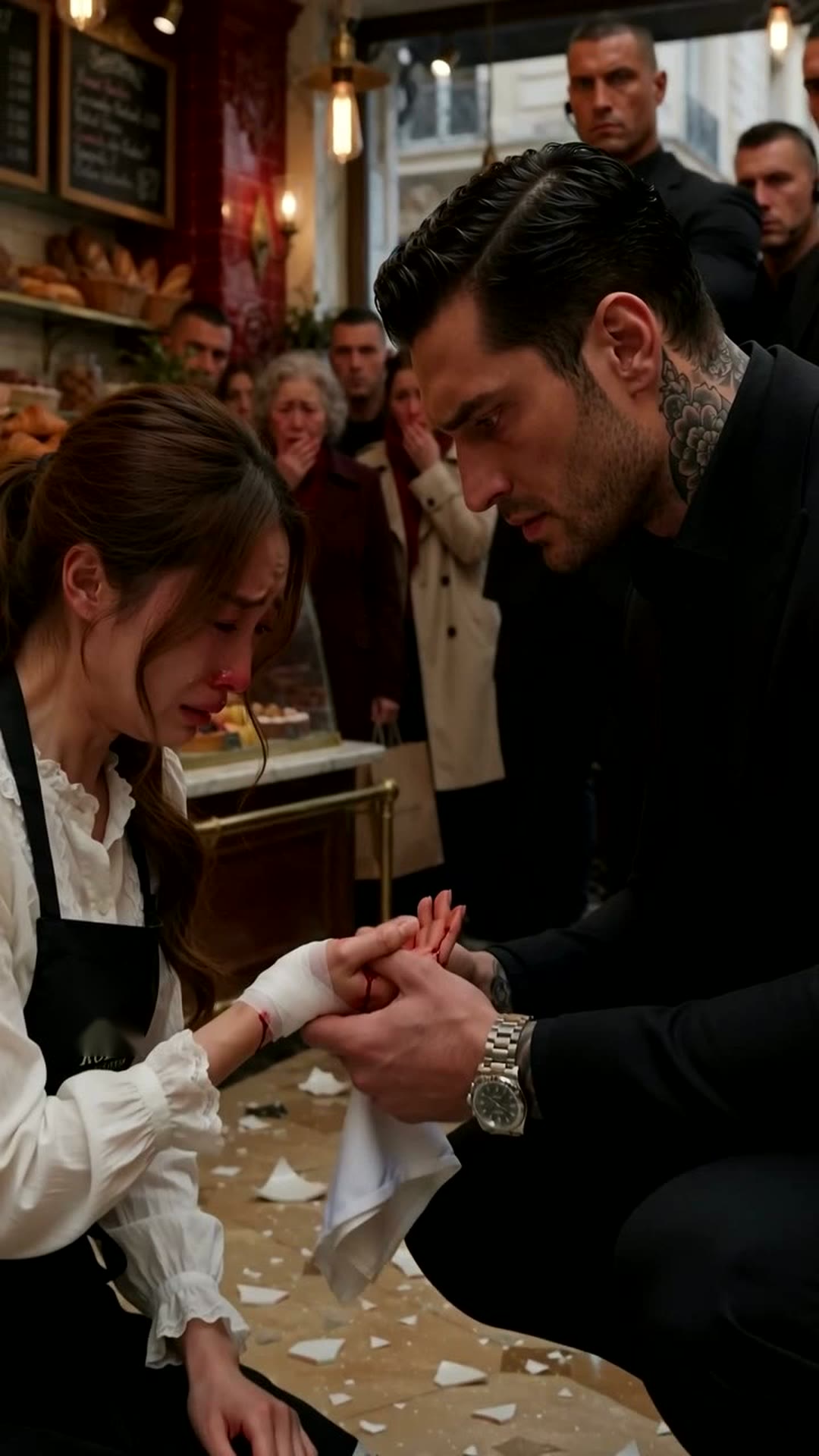
    I gathered the broken porcelain with my bare hands, the way you do when the floor is wet and the dining room is full and your manager is watching. A sharp piece sliced my palm. Blood ran down my fingers and dripped, bright and stupid, onto the wet floorboards.

    Then a man's voice cut through the bakery.

    "Stop."

    Everyone went silent.

    I looked up.

    Dark hair.

    Black suit.

    Cold gray eyes.

    My heart nearly stopped.

    Alessandro Caruso.

    Older. Broader. Even more intimidating than I remembered — the boy of twenty-six I'd married had been honed into something harder, and the tattoo at the side of his neck disappeared into his collar like a warning half-hidden on purpose. Two bodyguards stood behind him. But Alessandro wasn't looking at his ruined shoes.

    He was staring at my bleeding hand.

    "You're hurt."

    "It's nothing."

    "Look at me."

    I slowly raised my eyes.

    He studied my face, and something moved across his — something I had never once seen there in two years of marriage. Then he crouched down in front of me, heedless of the coffee soaking into the knee of a suit that cost more than my rent, took a clean handkerchief from his pocket, and wrapped it around my palm with hands that were almost — almost — not steady.

    He leaned close, and whispered my name.

    "Sophia."

    His voice did something to my chest I had not given it permission to do. He remembered me. Of course he remembered me. But I hadn't expected him to sound like seeing me hurt him.

    "I've spent four years trying to find you, Sophia."

    "This needs stitches," he said, louder, to the room, to himself.

    "I can't afford a hospital."

    His jaw tightened. He looked at one of his guards.

    "Call Dr. Rosini. Tell him to meet us at the estate."

    I pulled away.

    "I'm not going anywhere with you."

    Alessandro slowly stood. Mrs. Moretti, the bakery owner, had come hurrying out from behind the counter, wiping her hands on her apron, her face arranged into terrified welcome.

    "Mr. Caruso! I didn't realize you were coming!"

    He barely acknowledged her. Instead, he asked,

    "How much does Sophia's family owe?"

    My stomach dropped.

    "That's none of your business."

    He looked at his bodyguard.

    "Dante. Find every creditor connected to Marie Chen. I want names, amounts, and every threat they've made."

    I grabbed his sleeve.

    "No! You don't understand. Those men are dangerous."

    Alessandro looked down at me.

    "Those men answer to me."

    The entire bakery went silent.

    I stepped backward.

    "Why do you know about my aunt?"

    He didn't answer immediately. Instead, his gaze dropped to my wrist, where my sleeve had ridden up as I grabbed him, and his expression turned frighteningly cold at the sight of the bruise.

    "Who did this?"

    I pulled my sleeve down.

    "I bumped into something."

    He looked at me. He didn't believe a word.

    Then he turned toward Mrs. Moretti.

    "Prepare Sophia's final paycheck. Add twelve weeks of severance."

    I stared at him.

    "You can't just fire me!"

    "I didn't fire you."

    "You just ended my job!"

    He leaned closer.

    "I ended the part where people get to hurt you while you work for them."

    My eyes burned.

    "I don't belong to you, Alessandro."

    For a moment, something painful crossed his face. Then he said quietly,

    "No, Sophia. You never belonged to me. And that's the mistake I've spent four years trying to explain."

    Four years.

    I stopped breathing.

    "What are you talking about?"

    He glanced toward the bakery windows, where the rain was hammering the glass and the street beyond it was gray and empty.

    "We need to leave."

    "I'm not going anywhere until you tell me why you're here."

    Alessandro looked directly into my eyes.

    "Because I never agreed to let you go."

    My heart pounded. All those years, I'd believed he had abandoned me. Now he was standing in front of me like he'd been searching for me all along.

    Outside, a black SUV waited in the pouring rain. Alessandro opened the rear door and stood there getting soaked, waiting for me to decide, and I hated that even this — even now — some traitor part of me was listening to him.

    I stopped beside him.

    "Did you know where I was this whole time?"

    Before he could answer —

    BANG!

    The bakery window exploded.

    Glass scattered across the sidewalk. Someone screamed. Alessandro grabbed me and threw himself over my body, shielding me as another bullet struck the SUV with a sound like a hammer on a bell. His men drew their weapons. Dante shouted into his radio. I could barely breathe. Alessandro held me against the vehicle, one hand protecting my head, his body a wall between me and the street.

    "Stay down, Sophia."

    I looked at him.

    "Who's shooting at us?"

    Dante approached, his expression grim, rain running off him like he didn't feel it.

    "Boss, they found her sooner than expected."

    My blood turned cold.

    Found me?

    I looked at Alessandro.

    "Who found me?"

    He glanced at my bandaged hand. Then toward the shattered bakery window. And when he spoke, his voice was colder than I'd ever heard it.

    "The people who killed your father."

    I stared at him.

    My father had supposedly died in a car accident. That's what Aunt Marie had told me. That's what I'd believed for six years.

    But Alessandro wasn't finished. He reached inside his jacket and pulled out an old envelope, gone soft at the corners, kept flat against his heart like something carried a long time. On the front was my father's handwriting — I would have known it anywhere, that careful, upright script from a thousand grocery lists and birthday cards.

    FOR SOPHIA — WHEN SHE IS SAFE.

    I looked at the envelope.

    Then at the man I'd once been forced to marry.

    And suddenly, I wondered whether everything I'd been told about my father's death, my marriage, and Alessandro's disappearance had been a lie.

  • Chapter 7: The Wife He Never Let Go

    Chapter 7: The Wife He Never Let Go

    On a bright morning in late spring, Alessandro asked me to marry him.
    Not again — he was careful about that, standing in the garden with his hands conspicuously at his sides, like a man defusing something. Not again, because the first time had been arranged over my head by desperate men, and he wanted it understood, by me most of all, that everything about this was different.
    "The lawyers say the marriage was never dissolved," he said. "There were never any papers. Legally, you're my wife. You've been my wife every day for six years." A muscle worked in his jaw. "But I didn't come out here to read you the law, Sophia. The law is what was done to you. I'm asking — asking, with no family, no council, no dead father's instructions standing behind me — whether you would choose it. Choose me. And if you won't, then the lawyers will draw up whatever freedom looks like, and you will have this house or another, and money that is yours outright, and my protection for the rest of your life whether you want it or not, and no one — no one — will ever make you pay for the answer. I have spent four years learning exactly what my name cost you. I won't spend another day letting it be a debt."
    Six years earlier, a man I barely knew had stood beside me in a cathedral and looked like he'd rather face a firing squad. Now the same man stood in his garden in the spring light and offered me every exit, at ruinous cost to himself, and waited with his hands empty.
    That was when I understood what my father had seen in him. Not the power. Not the protection. The faith-keeping. A man who closes his fingers over an envelope and doesn't open it for four years, because he promised a dying man he'd wait until she asked.
    "Alessandro," I said, "I have a condition."
    He braced, visibly. "Name it."
    "The tin box in my dresser at the apartment. I need you to send someone for it. There's eleven dollars in it that's mine — the first money I ever earned that no collector ever touched, and I've been saving it for something that mattered." I took a breath. "And the ring is in it."
    He was very still.
    "You kept the ring," he said.
    "I kept the ring," I agreed. "I told myself it was evidence. Then I told myself it was an asset — silver's worth something, I could sell it if things got bad enough, and there were months, Alessandro, there were months I stood in a pawnshop doorway with it in my fist. I never went in. I told myself it was pride." I looked at him, and kept the envelope rule, one more time, the hardest time. "It wasn't pride. It was the only thing in that box that was ever really mine, and I think some part of me knew the story I'd been told about it was a lie. I just wasn't ready to be right."
    He crossed the garden in three strides and stopped — stopped, still obeying the law of his own restraint — an arm's length from me, close enough that I could see the gray of his eyes go bright at the edges.
    "Say it plainly," he said, roughly. "I've waited six years, Sophia. Say it plainly."
    "I choose you," I said. "Not the arrangement. Not the protection. Not my father's plan, God rest him, though he chose well. You. The man who held an umbrella of himself over me in the rain. The man with the drawer of dead ends. I choose you, Alessandro Caruso, with my eyes open, and I would like my ring back on my finger, and this time I want flowers I picked myself, and I want to be asked the question in the church like a person and not a policy. And I want — " my voice did something unsteady " — I want to stop being a story that was told about me. I want to be the woman it happened to, living the rest of it out loud."
    On the morning of the wedding — the real one, the chosen one — Marie came to my room with a garment bag over her arm and a face doing complicated things. She'd finished three months of treatment in the hills by then: real treatment, with doctors who treated her compulsion the way you'd treat a fire in the walls, patiently and structurally, without pretending it was a flaw that shame could solder shut. She looked older and younger at once. Her hands, I noticed, were still.
    "Your mother wore this to her wedding," she said, and unzipped the bag. "Not a gown — we weren't gown people. But your father kept it, and then I kept it, and I kept it through years when I was selling everything that wasn't nailed down, Sophia. I want you to know that. Whatever else I sold. Not this."
    It was a simple dress, ivory, older than I was, with hand-sewn lace at the sleeves gone the color of weak tea. It would never photograph like the first wedding dress — the cathedral one, with its banked roses and its politics. It fit me like it had been waiting.
    "I can't forgive all of it yet," I told her, standing in my mother's dress while her hands did up the back buttons the way they had when I was small. "I need you to hear that out loud, because we're done with scripts in this family. I love you. You're my family — the only one the fire left me, besides him. And I can't forgive all of it yet. Both of those are going to have to be true at the same table for a while."
    Her hands paused at the last button. In the mirror I watched her decide, the way I'd watched Alessandro decide things — the whole cost of a sentence, weighed in a silence.
    "I can carry both," she said at last. "I carried worse, for worse reasons, and called it love because I had nothing else to call it. This — this I can carry honestly." She finished the buttons and set her palms flat and warm between my shoulder blades, just for a second, the way she used to check me for fever. "Your father would have walked through fire to see you in that dress, choosing it yourself. Since he can't, I'll sit where he can see through me. Front pew. Hands quiet."
    She did exactly that. And so, three days after a man in a garden offered me every door out of his life, I walked into the cathedral where I'd once been a policy — wearing my mother's dress, toward the man who'd made the offer — and I have never in my life been so sure of a direction.
    He put the ring on my finger himself, in that same cathedral — and this time the flowers were daisies and white roses I'd chosen at the market that morning with my own money, and Marie sat in the front pew in a new dress with three months of treatment behind her and her hands quiet in her lap, and Mrs. Moretti was there, and Dante stood at Alessandro's shoulder wearing the expression of a man personally taking credit for the weather. This time, when I said the words, my hands didn't shake. This time, when he said them, he was looking at me — only at me, like there was nothing else in the building, or the city, or the world that had earned the right.
    Afterwards, at the estate, over a table that groaned, he gave me his wedding gift: a slim case, like the one that had held my father's ledgers. Inside were documents, stamped and sealed — the deed, transferred outright and irrevocably, to a certain property in the bakery district of Bellhaven.
    "Moretti's," he said, while I stared. "Mrs. Moretti has wanted to retire to her sister in Florida for two years. She held out for a buyer she'd trust with the place. I told her the place already had a soul and the soul's name was Sophia, and she said — " his mouth did the rare thing it did, the almost-smile " — she said it was about time somebody with sense married you, and she knocked four percent off the price for sentiment."
    I laughed, and then I cried, and then I laughed again, standing in my wedding dress holding the deed to the place where my life had broken open — because that's what it was, in the end. Not where I'd been small. Where I'd been found. By him, yes — but by myself first, kneeling in spilled coffee with a bleeding hand, telling the most feared man in the country that I didn't belong to him.
    He was right, that morning. I never had.
    I belonged to myself. And then, freely, entirely, eyes wide open — I chose to belong with him too.
    I walked through the bakery alone the week before the reopening, with the deed in my bag and the keys — my keys — cold in my hand. The staff had gone home. The ovens ticked as they cooled. I stood at the pass-through counter where I had stood for four years with my feet screaming and my stomach empty, and I put my palm flat on the marble, on the scar's side, and I made the place a promise of my own.
    The first thing I built was a shelf by the door. Oak, at waist height, with a small brass plate that says nothing at all. Every morning, what didn't sell the day before goes on that shelf, and it is free — not discounted, not charitable-looking, free, in paper bags with no names taken and no questions wearing a uniform. The staff thought it was a promotion. Mrs. Moretti, visiting from Florida planning with a tape measure and strong opinions about awnings, understood it instantly, because she had run the same shelf for years in everything but name and furniture: its stock had been broken pastry corners, fed quietly to a girl too proud to ask, by a woman too proud to offer outright.
    "I charged you nothing and you paid me in pretending not to notice," she said, when I showed her the plans over the phone. "Now you'll charge nothing and nobody has to pretend. That's not sentiment, Sophia. That's an upgrade to the system." A pause, full of Florida sunshine. "Four percent off, I gave him. The man drives a hard bargain for a romantic."
    The second thing I built was slower and had no furniture: a fund, from the bakery's profits and the forfeiture settlement both, that pays for exactly one thing — the trade-school fees and first month's rent of any girl in Bellhaven who is working a job like the one I worked, carrying debts that aren't hers. Dante's people vet the quiet part; I vet the rest myself, over coffee, at the counter, one girl at a time. My father kept books for half the families in this city, and his daughter keeps one book of her own now — a small one, in pencil, with stars beside the figures I've verified twice. There are no doors drawn in its margins. Every page of it is one.
    Moretti's Bakery reopened in June under a new sign, though I kept the name — some names deserve keeping. I work the mornings still, because the mornings are mine now and I love them: the ovens breathing warmth into the dark, the first trays, the city's earliest faces at the counter. My hands know the work the way they always did, but they work for me now. The scar on my palm has faded to a thin white seam. Some mornings I catch myself looking at it the way you look at a road on a map that you traveled a long time ago, in another life.
    On the first morning of the reopening, Alessandro came in at seven, in his black suit, with the rain threatening outside — because some things even a happy ending doesn't change, and Bellhaven weather is one of them. He sat at table seven. He ordered coffee, and a pastry, and he watched me over the rim of his cup with those cold gray eyes that aren't cold at all once you've learned the language of them.
    I carried his coffee across the bakery myself. Past the new window, past the full cases, past the little brass plaque by the door that says what the place is and whose it is.
    Halfway to his table, my fingers — trained by four years of exhaustion and one morning of fate — remembered their old trick. The cup tipped. Just a breath. Just enough.
    Alessandro's hand was there before the coffee was: steady, tattooed, unhurried, closing around the cup mid-fall with the ease of a man who has caught falling things before and intends to go on doing it. Not a drop spilled. He set it down on its saucer with great ceremony, like a man completing a ritual, and looked up at me.
    "Careful, Mrs. Caruso," he said.
    "My husband taught me," I said, "that I'm allowed to be caught."
    And he smiled — fully, helplessly, the smile nobody in Bellhaven would have believed — and pulled out the chair across from him, at table seven, in my bakery, in the morning light.
    I sat down with my husband, and I drank my coffee while it was hot, and it was the best thing I had ever tasted.

  • Chapter 6: The Fall of the House of Bellandi

    Chapter 6: The Fall of the House of Bellandi

    Enzo's threat followed us home like weather, and for two days the estate lived at the pitch of it — doubled watches, darkened windows, Marie moved to the safest interior rooms with a nurse who thought she was there for the old lady's nerves. On the second night there was a fire, small and professional, in the carriage house at the garden's edge: contained within the hour, investigated by dawn, traced to an accelerant pattern and a hired hand who was identified by noon and in police custody by dinner, singing — as hired hands do — everything he knew about the men who'd paid him.
    It was the worst mistake Enzo Bellandi ever made, and I have wondered since whether some part of him knew it. A threat at a summit table is diplomacy. A fire at a wife's home, four days into a council examination, is a confession signed in kerosene. Don Favreau, who had kept a century and a half of other men's promises, did not take kindly to being made a liar in front of the families. The council finished its examination in six days instead of the promised six weeks.
    I was not in the room for the verdict. Wives did not attend, and this time I did not ask to — some rooms I'd earned; that one I was content to let be a door I never had to open. Alessandro came home at midnight and stood in the study doorway still wearing his coat, and I set down the ledger I'd been re-reading — I'd taken to keeping the copies near me, the way other women keep photographs — and he said:
    "It's finished."
    The council stripped the Bellandi of two of their five council seats and every shipping interest north of the river, divvied the forfeitures among the families Daniel Chen's evidence had named as wronged — a list my father had made, pencil annotations and all, in the margins of a murderer's accounts. The state's prosecutors moved three days later with the synchronized tread of a machinery that has been waiting, oiled, for years: indictments for fraud, for racketeering, for the laundering my father had mapped figure by figure. Enzo Bellandi was arrested at his own breakfast table, in his dressing gown, and the newspapers — which had called him a philanthropist for forty years — printed his photograph above the fold with the word they save for the ends of empires. His sons lawyered and postured and, one by one, began quietly to cooperate. A house like that doesn't fall the way a building falls. It falls the way a reputation falls: all at once, and then forever.
    I gave my statement to the prosecutors on a Tuesday, in a government building with bad coffee and fluorescent lights, wearing my bakery blouse under a plain jacket because I had come straight from covering a shift for a girl whose child was sick — some habits of the old life I kept on purpose, like touchstones. The lead prosecutor was a woman in her fifties named Okafor who read my father's annotations with the stillness of a bomb technician and asked me, at the end of four hours, whether I understood that my testimony would put me on a stand, in public, across a room from the men who had ordered my father's car off the Mill Road.
    "I understand," I said. "I handed those men's collectors my wages for four years because I thought I was powerless and didn't know I was a witness. I'm done not knowing what I am."
    "Your husband's organization will feature in this case only as victim and evidence source," she said, watching me carefully. "You should know that not every prosecutor in this state would draw that line. Your father drew it. His books are very clear about which accounts were washed without the Carusos' knowledge — that's the only reason this conversation is happening in this room and not a harder one."
    "My father was a precise man," I said.
    "He was a brave one." She closed the folder. "There's a difference, and his books have both. We'll protect you as a witness, Mrs. Caruso, but I'll be honest: the protection that matters most, you've already got, and it isn't ours." She stood, and shook my healed hand, and looked at the thin white scar crossing my palm. "Whatever else this case does, it ends the story that Daniel Chen died in an accident. The record will say what happened to him. In the end, that's what evidence is for — so the record stops lying."
    I sat in the car afterward for a while before Dante drove me home, holding that thought like a coal that warmed instead of burned. The record would stop lying. About my father. About the marriage. About the four years. It wasn't resurrection and it wasn't revenge, and it turned out to be the thing I had actually wanted all along, under all the other wanting: an end to being the only person alive who knew the story was wrong.
    And in the middle of that same week, in a quiet office with a lawyer of Dante's finding and a pot of tea nobody touched, the Bellandi holdings that had purchased Marie Chen's debts passed — as assets in a collapsing estate pass — to a receiver. Alessandro bought the paper itself for pennies, every marker, every consolidated loan, every friendly arrangement with its teeth in my family's neck for six years.
    He brought it home in a folder. He put the folder in front of me at the kitchen table — because I had taken to eating in the kitchen, with the staff, in the mornings, in a house still learning how to have me in it — and he said, "It's yours. Not forgiven by me. Yours. There's a difference, and the difference is the whole of it. Burn it, sell it, frame it. I'll never ask which."
    I fed it into the kitchen fireplace one page at a time, that night, with Marie watching from the doorway in her good robe, neither of us saying much. Six years of my life went up that chimney in under ten minutes. Paper burns. Witnesses, as it turns out, are not so temporary after all.
    Victor Hale did not go to prison. The council's arithmetic for traitors is older than the state's and tends to be final in ways that don't involve paperwork, and I will not pretend I didn't understand that, or that I asked. What I know is what Alessandro told me, standing in this same kitchen, because we had made a rule by then — the envelope rule, we called it: nothing held back, nothing dressed up, the truth with numbers on it. Victor confessed, in the end, everything: the schedules, the safe apartment, the forty-eight hours' warning that put a shooter outside a bakery. He said the Bellandi had started with his son's debts and finished with something worse than greed — the belief, compounded over six years, that stopping would be the confession. He was exiled from the city and the families' protection with his son, stripped of the Hale name's place in the house, which I think was the sentence that actually landed; money men can rebuild money. He sent me a letter before he left — an apology with no excuses in it, which I keep, though I've never answered it. Alessandro never asked what it said.
    Marie went to a treatment residence in the hills two hours north — a real one, with gardens and doctors who specialized in the architecture of compulsion, paid for out of the forfeiture settlement in her own name, in her own right, not as anyone's dependent. I drove up with her. She held my healed hand half the way, loosely, the way she'd held it crossing streets when I was small.
    "I keep doing the arithmetic," she said at one point, to the window. "What I cost you."
    "Don't," I said. "I did that arithmetic for four years, every night, and the numbers were poisoned — somebody else was keeping the books. We're both done paying on accounts we didn't open."
    She cried a little. Then she slept, most of the rest of the way, and I watched the country unspool and thought about the fact that she had been a weapon aimed at me for six years and a mother to me for twelve before that, and that both of those were true, and that carrying both at once was simply going to be the shape of it, perhaps forever. Forgiveness wasn't a door I'd found yet. But it wasn't a wall anymore either. It was a distance — and distances can be walked.
    The bakery paid Mrs. Moretti in full for the shattered window and the lost weeks — Caruso money, delivered by Dante with an apology so formal it apparently made her cry in a good way — and the police investigation into the shooting closed with the arrested men charged and the word Bellandi nowhere in any official document, which was, I was learning, how you could tell it was in all of them.
    I went back to the bakery for the first time on a gray morning when the new window was already in — glass so clean it looked like weather hadn't been invented yet. Mrs. Moretti took one look at me in the doorway, wiped her hands on her apron twice, and then held onto me for a long time without saying anything at all, which from a woman who had narrated every working day of my life for four years was the loudest statement available to her.
    "Twelve weeks of severance," she said at last, into my shoulder, with enormous dignity. "Twelve. In forty years I have never — and the window paid before the glazier's invoice even dried, and a man in a suit apologizing to me in my own shop like I was the Queen of England. That husband of yours has a flair, Sophia. A terrifying flair, but a flair."
    "He has his moments," I said.
    She held me at arm's length and examined me the way she'd examined day-old stock — thoroughly, and with professional skepticism about the freshness of the goods. "You're eating," she announced. "You're sleeping; don't argue, I can see it. And you have — " her voice softened, and for a second the flour-and-lemon woman who had fed me broken pastry corners for four years and pretended they were policy looked out of her face " — you have the look of a person whose name is back in her own mouth. I don't know what happened, and in this city I've learned not to want to know. But I watched men take your pay packet at a door I paid the rent on, by omission, for years. That's mine to carry, and I'll carry it. You were a good girl in a bad arithmetic, Sophia Chen. Whatever you are now, you were always that."
    I cried into her shoulder, briefly, the way I had wanted to do a hundred mornings at the pass-through counter and never had. Then she made tea, and we talked about the ovens, and about Florida, and about her sister's condo with the flamingo mailbox — and about the thing she had been circling, which she finally landed on with the delicacy of a woman defusing something.
    "I'm selling, you know," she said. "Not yet. Not to just anyone. But my knees are done, and Florida isn't getting any younger, and this place — " she looked around at the cases, the marble, the old brass rail " — this place deserves hands that love it. When I go, I'll want it to go to someone who knows what the work costs. That's all I'm saying. When I go."
    I understood what she was telling me, and what she was offering, and what it would mean — and I also understood, with a clarity that felt like standing up straight after years of stooping, that it wasn't time yet. There were still prosecutors, and a summit's long shadow, and a husband I was learning how to know. Some offers are doors, my father would have said. A good accountant finds them. She doesn't have to walk through the same day.
    "I'll keep the ovens warm until you decide," I said, and she nodded as if I'd given exactly the right answer in an examination neither of us had admitted to sitting.
    And at night, in the big quiet house on the hill, Alessandro and I learned the smaller, stranger arithmetic of two people who had been married for six years and had spent perhaps eleven waking hours in each other's company. He was not an easy man. He went silent when he should have spoken and spoke in finished stone sentences when silence would have been kinder, and he had organized the entire architecture of his life around control because control had kept everyone he loved alive except, for four years, the keeping had failed at the one door that mattered most to him, and he had not forgiven himself for it in any hour of any day since.
    But he kept the envelope rule. And so did I. And somewhere in those weeks of telling each other the truth with numbers on it — about the investigators' drawer, about the anniversary he'd spent every year at the cathedral where we'd married, about my tin box with the ring and the eleven dollars, about fear, about shame, about the shape of the life that had been stolen from us and the different shape of the one that hadn't — somewhere in there, the marriage stopped being a document my father had signed over my head.
    It started, very quietly, to be a thing I was choosing. Every day. On purpose. With my eyes open.
    Which terrified me more than the shooting had, if I'm honest. The shooting was only my life at stake.