Story Genres: MAFIA BOSS

  • Chapter 1: The Price of Bread

    Chapter 1: The Price of Bread

    Nathan Harrison had closed billion-dollar deals in Dubai, New York, and London without blinking.

    In the United States, people called him the King of Concrete. Wherever Nathan Harrison signed his name, luxury towers appeared. Shopping centers rose out of empty lots. Exclusive gated communities sprang up where nothing but luxury SUVs rolled through guarded entrances, and his signature was the thing that made it happen — thirty-eight years old, dark brown hair going silver nowhere, a face that had learned, over a decade of negotiation, to give away nothing at all.

    He had not planned to be on Chicago's North Side that Friday afternoon. A site meeting had run long — a Harrison tower going up six blocks away, all glass and rebar and arguments about load-bearing steel — and when it finally broke, his driver was stuck in traffic on the far side of a jackknifed truck. Nathan did what he almost never did anymore. He walked.

    The bakery was small and old and entirely beneath his notice, the kind of place his world paved over. Russo's, said the hand-painted sign. A bell over the door. He went in for coffee because the place smelled like cinnamon and warm butter, and because for one unguarded second he was not the King of Concrete. He was just a man who had skipped lunch.

    He was standing near the pastry case, half turned toward the register, when he heard the coins.

    Not the bright ring of a card reader. Coins. The small, careful music of change being counted out onto a counter, one piece at a time, by someone who could not afford to be wrong.

    Nathan looked up.

    Emma Parker stood at the register with her back half-turned to him, and the world went very quiet.

    Five years. He had not seen her in five years — not since the week the lawyers finished with them — and his first thought, absurd and traitorous, was that she was still the most beautiful woman he had ever failed. Her long brown hair was pulled back in a simple ponytail. She wore inexpensive clothes, a plain sweater, a coat that had been good once. There was exhaustion in her eyes that no amount of sleep seemed likely to fix. She looked nothing like the woman who had once moved through charity galas at his side in designer gowns while the cameras flashed.

    She looked like a mother who had learned how to survive alone.

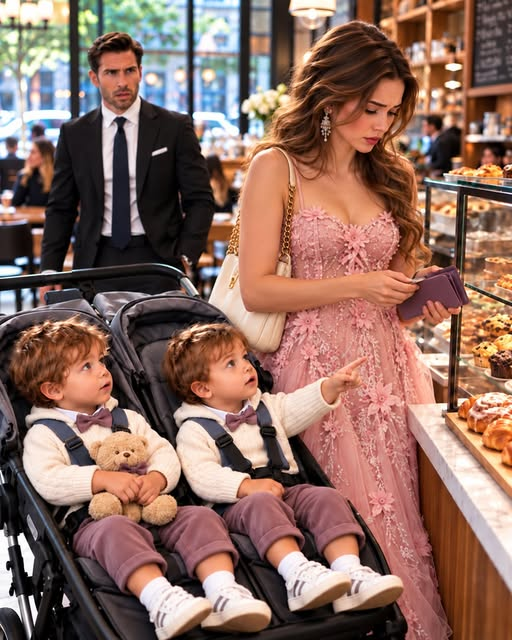
    Beside her stood two little boys. Identical. About four years old, with Emma's eyes and dark, unruly curls, dressed in matching sweaters and trousers gone soft at the knees. One of them — the bolder one, chin up — was staring through the glass of the display case at a tray of cinnamon rolls the way other men Nathan knew stared at waterfront property. As if they were treasure. As if they were the whole point of the world.

    The other boy, quieter, stood a half-step closer to his mother's side, hugging a spiral notebook to his chest. Even from where Nathan stood, he could see the drawings on the cover page: planets, rockets, a child's careful solar system in crayon.

    Nathan did not move. He was not sure he could.

    The quieter boy tugged, very gently, at nothing at all, and whispered — but a small bakery is an honest place, and whispers carry.

    "Mom," the boy said, "if there's not enough money, I don't need any bread."

    Something in Nathan's chest simply stopped.

    Emma smiled. It was the same smile he remembered from a hundred mornings in a kitchen that no longer existed — stubborn, unbending dignity dressed up as gentleness — and it undid him completely.

    "There's enough, sweetheart," she said. "We just have to count carefully."

    She went back to the coins. Nickel. Dime. Quarter. Her fingers were quick and unembarrassed. The boys watched the small pile the way congregations watch altars. Behind the counter, Mr. Russo — a broad, silver-haired man of about sixty-five, with flour on his apron and the face of someone who had decided long ago what kind of person he intended to be — packed their bread into a paper bag with the gravity of a man handling something sacred.

    Then, quietly, without comment, Russo slipped two extra pastries into the bag.

    "Go ahead and take them," he said. "Friday special."

    Emma's head came up. "No, Mr. Russo, I can't."

    "You'll hurt my feelings if you refuse."

    A beat of silence. Her pride and her arithmetic fought it out in her face, and Nathan, watching, remembered that he had once been the richest thing in her life and she had never once taken anything from him she hadn't earned.

    The boys cheered softly, the way children do when they understand that cheering too loudly might break the spell. Emma closed her eyes for one second — gratitude and humiliation in a single breath — and nodded.

    "Thank you, Mr. Russo," she said, with more formality than the moment needed, because formality was a kind of armor.

    "Friday," he said, and shrugged, flour and all, "is Friday."

    Nathan watched her gather her sons the way she did everything, efficiently and without fuss. The notebook went under Noah's arm. The paper bag went into a tote worn thin at the straps. Ethan took her free hand; Noah took the hem of her coat, not because he needed holding up but because it was where his hand lived. She had a system. She had had five years to build it, in a life with no slack in it anywhere, and it ran beautifully, and it broke Nathan's heart in a place he had genuinely believed was load-bearing concrete.

    He thought of her at twenty-six, in the emerald dress, at the Children's Hospital gala — the irony of the memory physically hurt — laughing with a glass of champagne she never finished, because Emma at a party was always halfway through three conversations about other people's work, other people's kids, other people's science fairs. She had been a teacher then, too. She had been a teacher when he married her, glowing with it, and he had loved that she was unimpressed by his money, right up until his money started being the only language he spoke at home.

    The ponytail. The plain sweater. The counted coins. None of it had diminished her. That was the unbearable part. She had not fallen. She had been left — no. He corrected himself with the precision of a man auditing his own ruin. She had left, because leaving had been the only door he hadn't blocked with a tower.

    Nathan stepped backward before she could turn around.

    He did it without deciding to. One step, then another, the bell over the door mercifully silent because he caught it with his shoulder, and then he was outside on the sidewalk in the mild Friday light with his heart pounding as if he had just lost everything.

    He stood there while his car found him. He stood there while the driver, well trained, said nothing at all. Through the bakery window, small and already far away, he could see the top of Emma's head bent over the counter, and two dark curls, and the paper bag.

    Four years old, he thought. The boys were four years old.

    He did the arithmetic all the way downtown, and the arithmetic did not care how much money he had. It just kept arriving at the same place.

    That night he sat in his glass-walled office on the forty-first floor, overlooking a downtown Chicago that glittered like something he owned, which in no small part he did. He had tried to work. There were contracts on his desk that represented nine figures, and the words had swum and reassembled themselves into a small pile of coins on a bakery counter until he gave up and stood at the glass like a man in an aquarium of his own success.

    The divorce had been five years ago. The twins — if they were twins, if the identical faces meant what identical faces meant — were four.

    Born, at the latest, seven or eight months after the papers were final.

    He remembered the week the marriage ended with terrible clarity, because his memory, traitor that it was, kept the deal and discarded the wife. A merger week. Three time zones in four days. Emma had put the papers in front of him at the kitchen island at midnight, between a term sheet and a soil report, and said — he could hear it now, which he could not have done then — *I can't keep being married to a man I have to make an appointment with, Nathan.* And he had said *not this week,* and signed, eventually, the way he signed everything that week: fast, trusting the lawyers, thinking there would be a later in which to fight for her properly.

    There had been no later. There had been a finalized decree, and her maiden name restored like a country regaining independence, and silence so complete he had eventually filed it under dignity. Hers. She was proud; she would not beg; fine. He had told himself that story for five years, and it had held, right up until a small boy in a bakery whispered that he didn't need any bread.

    His phone was in his hand for a long time before he used it. Marcus Webb had been his executive assistant for nine years. Marcus had been there for the wedding. Marcus had been there, in the outer office, for the end of it too.

    Marcus answered on the second ring. "Nathan."

    "I need information on Emma Parker."

    There was a long silence. It was not an empty silence. It was the silence of a man deciding how much of what he knew he was allowed to say.

    "Nathan…" Marcus said at last, carefully.

    "Just tell me."

    "Tell you what, exactly?"

    "Everything," Nathan said. "Start with the boys."

    The report arrived the next morning, in a plain folder, carried up by Marcus himself and set down on Nathan's desk with the care of a man delivering something explosive. Marcus did not sit. Marcus did not stay.

    Nathan read it standing up.

    Emma Parker. Thirty-one. Middle-school science teacher, Chicago's South Side. Address, a walk-up apartment. Employer, a public school with a leaking roof he could have replaced out of the petty cash of his conscience.

    And then the page he had known, since the bakery, would be there.

    Two children. Twin boys. Ethan and Noah. Age four.

    Ethan: the elder by six minutes, bold, devoted — per the preschool's notes, which Marcus had somehow obtained — to cinnamon rolls and any machinery with wheels. Noah: quieter, artistic, a notebook of planets and rockets that went everywhere he did. Mild asthma. Both boys born at thirty-two weeks.

    Born seven months after the divorce was final.

    Nathan read that line four times. Seven months after. Which meant — he had to sit down to finish the math, and he was a man who had priced out a two-billion-dollar tower in his head on an airplane — seven months after meant she had been pregnant when the ink dried. It meant that two weeks, three weeks, a month after he signed his name to the end of his marriage without reading the weather in her face, Emma Parker had learned she was carrying his sons, and she had picked up the telephone exactly zero times.

    He requested everything. Addresses. Employment records. School information. Financial history. It came through the day in tranches, the way bad news comes in hospitals, and he read all of it with the city going gold below him and none of it registering as anything but her name, her name, her name.

    Emma took two buses to work every morning. Two. An hour and twenty minutes each way, in the dark half the year, to teach other people's children about volcanoes in a classroom whose science lab had been condemned before her students were born.

    And at the bottom of the financial summary, in the same flat typeface as everything else, was the figure the whole report had been walking toward.

    The twins' premature birth — the emergency delivery at thirty-two weeks, the weeks in the neonatal unit, the follow-up care, Noah's lungs — had left Emma Parker, after insurance, with a medical debt of nearly one hundred and twenty thousand dollars. She had been paying it down for four years, in monthly installments small enough to fit between rent and groceries, and at the rate she could afford, the report noted with an accountant's neutrality, she would be paying it until the boys were in high school.

    One hundred and twenty thousand dollars.

    Nathan Harrison had spent more than that on a watch. He had spent more than that, twice over, on the dinner where he'd signed the Meridian preliminary papers. Somewhere across the city, the mother of his sons counted coins onto a bakery counter so her boys could have bread, and owed a hospital one hundred and twenty thousand dollars for the crime of bringing them into the world seven months after he had signed her away without a fight.

    He sat in the glass office long after the lights of the city came on, with the folder open and the number in front of him, and it was the first number in his entire life that he could not make smaller by looking at it.
  • Chapter 7: The Choice, Reversed

    Chapter 7: The Choice, Reversed

    He came on a Wednesday, one year later.

    Claire noticed the quiet first. It was late afternoon — she had come home from the shelter early, because the ankle was predicting rain — and the street outside the little grey house went still in the particular way it had once before, a year and a lifetime ago: no car door yet, no step on the path, just the birds stopping, and the quality of the silence changing, as if the street itself were holding something carefully.

    She went to the door before he could knock. She had decided, in the space of one breath, that she would not sit in her father's chair and let him knock twice. Whatever this was, she would meet it standing, at her own threshold, on a healed ankle, in her own house. That much of the choreography belonged to her now.

    He was alone.

    She saw it before she saw him properly, and it stopped her hand on the doorframe — stopped her entirely. There was no car at the curb but a plain one, parked like anyone's. No driver. No second man at the gate, none at the corner, none in the studied distances where Adrian Moretti's people had stood, all her life, like punctuation. Just the man himself on her path, in the late light, in a good coat, with his hands — she saw this, and it went through her like weather through an open house — his hands empty, and visible, and at his sides.

    A year had changed him in the ways years change people who are not sleeping. He was thinner. There was grey at his temples that hadn't been there on the doorstep, and the face she had loved since she was nine years old had the look of a country after a long war: everything standing, everything accounted for, nothing unscarred. He did not come up the steps. He stopped at the bottom of them, on her father's path, and left the two steps between them like a border he had no intention of crossing uninvited.

    "Hello, Claire," he said.

    "Adrian."

    A year of letters, unopened and otherwise, stood in the air between them. He looked at her — not the way he had looked on the doorstep, which had been the look of a man retrieving something. The way you look at a person whose answer you cannot predict and have finally learned not to try to. It undid her composure more than anger would have. She kept her hand on the doorframe.

    "You didn't bring anyone," she said.

    "No."

    "You always bring someone."

    "I know." A pause. "I spent a year learning not to, in your direction." He glanced, once, at the two steps, and did not take them. "I won't come up unless you ask me. I won't come in unless you ask me. I'm not here to give you anything to decide about except this." His voice was steady, and it cost him — she could see what it cost him, the man who arranged the world, standing at the bottom of two wooden steps with his hands empty, delivering the only sentence he had come with, like a man carrying water in his palms. "Everything is yours, Claire. The question is yours. The time is yours. If the answer is no — it's no, and I go, and it stays no, and nothing follows you from it. No letters. No arrangements. Nothing with my hands on it, ever again."

    "And if the answer is nothing?" she said. "If there's no answer?"

    "Then there's no answer," he said. "For as long as that's true."

    She looked at him for a long time. The street had gone gold at the edges. Somewhere a sprinkler started up, ticking, ordinary, blessed.

    "You chose in ten seconds," she said at last. It was not an accusation. She heard it come out of her almost gently, the way you read aloud a line you have finally memorized correctly. "In that room. I've thought about those ten seconds every day for a year, Adrian. I expect you have too."

    "Every day," he said. "I expect I will for the rest of my life."

    "I don't blame you for them anymore." She watched the words land; watched a year of held breath go out of him in one place, in his shoulders. "I want that said first, standing here, before anything else is said. She was dying. You did the arithmetic a decent man does. I have made my peace with your ten seconds." She shook her head, slowly. "It wasn't the ten seconds. It was the twenty years of ten seconds. It was being the one who could always hold — hold the house, hold the secret, hold the door, hold her breath in a warehouse — because I was strong, and being strong was the price of being loved. I can't go back to that house, Adrian. I won't. That woman is not available anymore. She retired."

    "I know," he said. "I'm not asking for her." He took a breath. "She kept a family. I'm asking — " He stopped, and started again, more carefully, a man laying words down one at a time like stones across a river. "I'm asking if the woman who lives in this house — who works across the river, and plants her father's garden wrong, and answers to no one's schedule — if she might ever choose a man who has learned to wait at the bottom of the steps. On her own terms. Entirely her own terms, stated by her, changeable by her, enforceable by her. That's all I came to say. It's not a proposal. It's a — " For the first time, something that was almost a smile moved at the corner of his mouth, tired and real. "It's an application. For consideration. At your convenience."

    Claire laughed.

    It came out of her before she could stop it — the struck-match laugh, the real one, the one the ward nurse had had — and standing in her doorway a year after the worst year of her life, with the most dangerous man in Chicago standing humbly at the bottom of her steps submitting an application, she laughed until her eyes were wet, and he watched her laugh like a man watching rain come to a place he had carried water to by hand.

    "Come up the steps, Adrian," she said.

    He came up the steps.

    She did not step back. That is the part she would remember, later, above everything: that she stood in her own doorway at the top of her father's steps, and Adrian Moretti came up them slowly, and stopped one step below her — so that for once in the whole architecture of their lives, she was the one looking down, slightly, into his face — and she did not move away. She chose the distance. She set it. And it was exactly the distance she wanted.

    "Here are my terms," she said.

    "I'm listening."

    "I keep the house. I keep the job. I keep my name the way it is until I decide otherwise, if I ever do. You don't protect me in secret — if there's danger, you tell me, like a partner, and we decide together, and if we disagree, you live with my decision about my own life. Nobody ranks me, ever again — not against a crisis, not against the family, not against anything. If there's ever another ten seconds, Adrian — and in your world there will be — I am not the strong one whose strength gets spent. I am your wife, or I am nothing to you. There is no third position. There used to be a third position and I lived in it for twenty years and it is demolished."

    He listened the way he had listened to Ray Doyle — entirely, without moving — except that where that listening had been a verdict, this one was a vow being received.

    "Yes," he said.

    "All of it?"

    "All of it. Stated by you. Enforceable by you." He held her eyes. "I spent six years married to a woman I thought I knew completely, and I lost her because the one thing I never knew was what it cost her. I'm not spending another year being ignorant, Claire. I'd rather be refused by you honestly every day than agreed with by you the old way even once."

    The light had gone nearly down. Her street was blue at the edges, gold at the lamps. She thought about the drawer in her kitchen — the ring on top of the unopened letters, kept within reach for a year, unanswered and kept — and about how a kept thing is not the same as a buried thing, and how she had known the difference all along and had simply been waiting, for once in her life, to be the one who was waited for, until waiting had finished its work in him.

    "I have something of yours," she said. "Wait here."

    She went inside, into the warm dark of her own house, and opened the drawer of the kitchen dresser, and took out the ring. It sat in her palm the way it had sat in his, a year before, in the lamplight of the same doorway — weighing almost nothing, weighing everything. She carried it out to the steps.

    He looked at it. He did not reach for it. That, more than the empty hands, more than the bottom step, told her the year had done its work: Adrian Moretti, not reaching.

    "This isn't going backward," she said. "I want it understood. We're not resuming anything. The marriage we had is over — I signed it over, and I meant it, and I'm not unsigning it. If we do this, it's a new thing, built by both of us, out loud, on terms I set and you keep. And it starts when I say it starts."

    "When does it start?" he asked, quietly.

    She took his hand — his right hand, the tattooed one, the hand that had signed orders and ended arguments across a whole city — and turned it over, palm up, in the last of the light. And she set the ring in it, exactly as she had on the doorstep a year before, in the same lamplight, so that the gesture was the same gesture, and everything it meant had reversed.

    "It starts," she said, "with you holding that, and asking me properly, when I tell you I'm ready to be asked. And me deciding." She closed his fingers around it herself, gently, the way she had once closed them in grief. "There's no date, Adrian. There's no schedule. You'll have to wait."

    "I know how," he said, and his voice was not steady at all, and neither of them minded. "It's the one thing I learned this year. I'm — I'm actually good at it now."

    "Don't be good at it forever," she said. "Just be good at it until I say."

    They were married again in the spring — no. Not married again; that was the old grammar. In the spring, in the back garden of the little grey house, with the tomatoes only just staked and Margaret Hale standing witness beside a registrar, and Tomas from physical therapy crying unashamedly into a handkerchief, and exactly eleven guests, every one of them chosen by her — they made their vows. New ones. Written out in advance, exchanged, argued over, agreed. His were short. He had never been a man for length. I will not rank you. I will not spend your strength. I will tell you the truth on your schedule, not mine. And if I must wait — for your answer, for your forgiveness, for your decision — then I will wait, and I will not call it loss.

    Hers were shorter. I will not disappear. I will not hold what I should say. I choose this — I choose you — with my eyes open, and I will go on choosing it or I will say so, out loud, in time.

    There was no great house, no long table, no hundred men. There was a garden, and a man standing in it with empty hands, and a woman who had taken the full length of her own time to arrive at yes — and who understood, looking at him across six feet of her father's grass, that the yes was worth more than every agreement she had ever given for free, because no one had extracted it. It had been waited for. It had been earned in the only currency that had ever been scarce in Adrian Moretti's empire: his patience, spent on her, without witnesses, without guarantee, for a year.

    He had missed her once, in ten seconds, by choosing. He had won her back in a year, by refusing to.

    She stopped waiting once — and that is why, in the end, he learned how to wait; and that is why, when the waiting was finally his to carry, she chose him.

  • Chapter 6: The Distance

    Chapter 6: The Distance

    The letters began in the fourth month.

    Claire had not expected them. That is the strange thing, and she turned it over more than once, reading the first one at her kitchen table with her coffee cooling. In six years of marriage, Adrian had never written her a letter. He was not a man for paper. He said things, or he did them, or — most often — he arranged for them to be done, and the arranged thing arrived with the force of a sentence. A letter was the tool of a man who could no longer arrange anything. A man reduced, like everyone else in the world, to asking.

    She knew his handwriting before she turned the envelope over. Of course she did.

    The first letter was four pages. She read it standing by the counter, because she had learned in physical therapy that stillness let things stiffen. It was not an apology — or rather, it was an apology in Adrian's grammar, which meant it was a report. What he had learned, and when. Ray Doyle's name, and what had been done and not done. The design of the thing, the Sartores' theatre, the choice that had been the weapon whichever way it fell. Facts she had worked out herself in a hospital bed, now set before her in his small neat hand like an account rendered. On the last page, one line that was not a fact:

    I don't write this to be forgiven. I write it because you were owed the truth and no one else was ever going to hand it to you.

    She read it twice. Then she put it in the drawer of the kitchen dresser, under the takeout menus, and went to her shift at the shelter, and answered the phones, and told a woman from Pilsen to take her time, there was no hurry here. Her hands were steady all day. She noticed that, driving home, and permitted herself a small, tired respect for her own hands.

    The second letter came three weeks later. It was shorter. It said that the divorce papers had been received by his lawyers and that he would not contest anything, ever, on any grounds; that her name stayed on nothing that could endanger her; that the grey house was hers outright now — the trust had transferred it, the papers were with Margaret Hale, and there was nothing to sign because he had made sure there was nothing to sign. He had removed himself even from the paperwork of her freedom. She read that letter sitting down.

    The third one, she didn't open.

    It was not a decision, exactly. It arrived on a Tuesday — a plain envelope, her name in his hand, thinner than the others — and she stood in the hall of the little house holding it, with the post still in her hand and the light going down outside, and she understood that she was at a fork she hadn't known was coming: that opening his letters had become a way of waiting. A smaller, quieter waiting, dressed differently — waiting for the mail, waiting for the next account of himself, arranging her heart around arrivals she didn't control. It was the old discipline in a new coat, and it fit her the way it always had, and that was exactly the problem.

    She put it in the drawer, unopened, on top of the other two.

    Others came. Not often — every few weeks, sometimes with a longer silence, as if he were testing his own restraint and mostly passing. She could chart his year by the envelopes, the way you chart weather. She opened none of them. She threw away none of them either. She was honest with herself about that much, on the nights when honesty was unavoidable: the drawer was not indifference. The drawer was a door she was not ready either to walk through or to lock. She had spent six years being the woman who always answered. She was learning, slowly and without grace, to be a woman who was allowed to not answer yet — to let a question stay open in a drawer without it costing her the whole architecture of a life.

    Her own life, meanwhile, had been acquiring furniture.

    The shelter made her full-time in the autumn, coordinating intake, and gave her a small office with a window that looked at the river she could no longer fear. The ankle healed into a scar and a weather sense: it ached before rain, faithfully, like a second, smaller clock. She finished the back bedroom. She painted it a green her mother had liked. In October she stood in the doorway of it with the brush in her hand and realized she had been working for an hour without once arranging her thoughts around Adrian Moretti, and the realization did not frighten her or exhilarate her. It was simply true, the way the tomatoes had been true. Her life had gotten bigger than the space the grief had been assigned.

    She saw Lily Monroe once, in November, in a coffee shop near the shelter — the two of them arriving at the counter from opposite directions like something out of an older, cheaper story. Lily was in the city for two days, for work with the new firm, she explained, and then stopped explaining, and they stood there with their cups while the queue re-formed around them.

    "You look well," Lily said. "I've wanted to — I didn't write. It seemed like one letter too many in your life."

    Claire surprised herself by laughing — the real thing, struck-match bright. "You could have written," she said. "Yours I might have opened."

    They sat for twenty minutes. They talked about the shelter, about Boston rent, about nothing that mattered, with the care of two people carrying something breakable between them and both, silently, agreeing to set it down gently. At the door, Lily said, "For what it's worth — he never once said a word against you. In that whole building. Men came to him, you know, with advice about it, about the divorce, about — optics." She shook her head. "He shut it down every time. 'She chose,' he'd say. Like it was weather. Like you'd done something he had to respect even while it—" She stopped. "I'm sorry. That's not mine to carry to you either."

    "Take care of your lungs," Claire said, and meant it, and watched her go.

    Adrian, across the city, had stopped hunting.

    The Sartore affair had closed the way his affairs closed: completely, without theatre, leaving the other family smaller and quieter and very certain of the lesson. Doyle was gone from Chicago. The war council had become, again, a business council. The great machine of his life ran as it had always run — and its operator, for the first time anyone could remember, had begun to keep hours like an ordinary man. He went home at night. He let Sundays exist. His captains exchanged glances and said nothing, because by then everyone in that world knew the shape of the silence around their boss, and knew better than to put a name to it in his hearing.

    He was waiting. He had never waited for anything in his life — waiting was what other people did in rooms outside his office — and he was teaching himself the discipline of it the way he taught himself everything: completely, and without witnesses. He did not drive past her street. He did not ask his people for reports on her, though three people were sworn to bring him, instantly, any word of danger, and he noticed that that instruction had become the whole of his involvement, and that he kept it like a vow. He wrote the letters and mailed them and did not follow them. He kept his phone face up on the desk some evenings, and then, catching himself, face down, and then — this took the longest — he stopped keeping it on the desk at all.

    In the drawer, under the torn report, the ring sat in the dark. He took it out sometimes. Not often. A man rehearsing something.

    The divorce became final in the ninth month.

    It arrived, like everything in her new life, without theatre: a thick envelope from Margaret Hale's office, a court stamp, a case number, a date. She read it at the kitchen table on her lunch break from the shelter, between a grocery list and a rota. Her name was her own name in print — Claire Bennett, petitioner — and beside it, Adrian's, respondent, and between the two names a legal paragraph that dissolved, in the bloodless grammar of the state of Illinois, a marriage that had begun with her whole childhood behind it.

    She had expected the day to feel like something. A door, a blow, a relief — some shape. Instead she sat for a while with her hand flat on the pages and noticed that what she felt was mostly administrative, and underneath the administrative, something smaller and much more private: grief for the exact person she had been on her wedding day, who had believed that love and endurance were the same word. She would have liked to tell that girl a few things. She suspected the girl would not have listened. The girl had been magnificent at not listening to anything that threatened the architecture.

    "Are you all right?" Margaret said on the phone that afternoon — she had called to confirm receipt, lawyer to client, and then, in the small silence after the business was done, had asked it as something else.

    "Yes," Claire said. And then, because Margaret had been the one human witness to the signing-away, and because honesty had become her whole project: "No. But the no is a normal size. It fits in the day."

    "That's how you can tell it's finished," Margaret said. "When it fits in the day."

    That night she cooked her father's soup — the one recipe she had never needed written down — and set the table the way the house had always set it, cloth napkins, the good bowls. One bowl. One napkin. She ate slowly, in the green-walled quiet, and the oneness of the setting was not lonely. It was simply accurate. She had spent six years eating at the end of a table built for twenty and being, in every way that mattered, uncounted; she preferred this small honest table, where the one person at it had been consulted about every single thing.

    Afterward she washed the bowl and put it away, and she thought — not sadly, just clearly — that if she ever set two places again, it would be because she had decided to, on a day of her choosing, for reasons that belonged to her. Not because a house expected it. Not because a man had finally arrived. Because she had chosen.

    It was, she realized, standing at the sink with the water running over her hands, the first time in her life that the future tense had belonged entirely to her.

    The last letter came in the eleventh month.

    It was not like the others. It was a padded envelope, and it was heavy, and Claire knew what was in it before she opened it — she knew it in her hands, the way you know a voice in the next room. She stood in the hall a long time, holding it. Then she went and sat in her father's chair, in the green-walled quiet of her rebuilt house, and she opened it with care.

    There was no letter. There was a small box, and in the box, on a bed of plain cotton, her wedding ring. And under the box, a single card, and on the card, in his small neat hand, one line:

    You choose first this time.

    She sat with it for a long time. Outside, her street was doing its ordinary evening — the dog, the sprinklers, a kid's ball ticking against a curb. The ring lay in her palm exactly where it had lain on the doorstep a year of her life ago, in his. Six years it had weighed almost nothing. Now it weighed everything it had ever meant, both ways: the choosing, and the not choosing. The man who had decided for her in ten seconds, and the man who had spent eleven months learning to hand the decision back and then be silent with it.

    She did not write back. She did not call. She did not drive across the city or send word through Margaret Hale or do any of the things the woman she used to be would have done before the envelope was even empty — answer, soothe, resolve, relieve him of the unbearable openness of not knowing.

    She put the ring in the drawer of the kitchen dresser, on top of the unopened letters.

    Not in the box. Not put away like a finished thing. In the drawer she opened every day for the takeout menus she never used and the batteries and the string — the drawer of things in current use, of things not yet decided about, of things kept within reach.

    And she went to bed, and slept, and the ring stayed there — unanswered, and kept.

  • Chapter 5: The Mole

    Chapter 5: The Mole

    Adrian did the investigation himself.

    That was the first thing his people noticed, and the thing that frightened them most. In twenty years he had never run an inquiry personally — he gave an order, and answers arrived, and men learned to bring him good ones. But this time he took the files home. He took the route logs, the duty rosters, the communications records, the manifests of who had known what, and when. He spread them on the long table in the study where Claire used to leave his coffee, and he went through them the way an auditor goes through a dead man's accounts — line by line, night after night, with the patience of a man who has finally understood that the truth is a kind of waiting too.

    Because someone had known.

    That was the seed of it, and it had been growing in him since the after-action report. The ambush had not been luck. Claire's SUV had been forced off the road on a route that had been changed that very morning — changed by his own office, for security, the way routes were always changed, unannounced, on a rotation known to almost no one. The Sartores had been waiting at the new route. They had known where Lily would be, too, and when. They had known the response protocols: that Alpha Team was the only unit close enough and fast enough for a first strike, that there was no second team that could reach the other location in time. They had known the exact shape of the trap because the trap had been built out of his own house's knowledge.

    Somebody inside had drawn them the map.

    He did not rage about it. Rage was for later, or for other people. He read. He compared. He made lists of names in his small, neat hand — he had always written by hand; Claire used to tease him that he was the last man in Chicago who did — and he crossed them off one at a time as the evidence cleared them, which was his way, and was why men feared him more than they feared louder bosses. A loud man forgives by forgetting. Adrian simply eliminated, until what was left was the truth.

    On the ninth night, he went himself to the first warehouse.

    He told no one. He drove his own car to the industrial road where Claire's SUV had been found, and he stood a long time outside the chain-link fence with his hands in his coat pockets while the cold came up off the river. A caretaker his people had paid let him in without questions. Inside: concrete, darkness, the smell of oil that she had described in her statement to the police — a statement he had read so many times he knew the placement of its commas.

    The chair was still there.

    It stood where the investigators' photographs said it had stood, in a cleared space under the high filmed windows. The second chair, across from it, was gone — Lily's chair, removed by police, logged, stored. But someone had overlooked Claire's, or left it as a message, or simply not cared. Two of its zip ties still hung from the back rail, cut. The marks on the floor where its feet had scraped were dark against the concrete.

    Adrian stood in the ten feet of space between where the two women had sat, and he understood, with his body and not his mind, the dimensions of what had been staged here. It was a room built for an audience of one screen. He looked up, as she must have looked up, at the windows that gave no view. He thought about the water bottle set down just out of reach of her feet — his investigators had noted it, catalogued it, the cruelty filed as an inventory item — and he thought about her sitting here in the dark after the screen went black, doing her own arithmetic about how long twenty minutes could be, and then four hours.

    He did not touch the chair. He stood there until the caretaker's torch clicked off, embarrassed, by the door, and the dark completed itself around him.

    It was in that dark, in the exact geography of her abandonment, that the investigation stopped being, for him, about the Sartores. He had been hunting a leak. He went on hunting it — he never neglected the work. But underneath the work, from that night, there was a second and quieter enquiry, which he conducted on no one and reported to no one: an audit of every year in which Claire Bennett had waited for him and he had called the waiting love. He was going to finish it. It was, he was beginning to understand, the only debt of his life that he had never once looked at directly.

    By the third week, what was left was one name.

    Ray Doyle had been the family's security captain for eleven years. He planned the routes. He held the rotations in his head the way priests hold liturgy. He had stood at the back of Adrian and Claire's wedding in a good suit, and Claire — Adrian remembered this now, and it sat in him like a stone — had danced with him, once, laughing, because Doyle had nobody to dance with and she had always had an eye for the person standing alone at the edge of a room.

    Doyle had debts. Not catastrophic ones — that was the elegance of it, Adrian saw, reading the bank records his people had quietly obtained. Not gambling, not ruin. A brother's medical bills in another state. A house underwater. A slow, ordinary drowning that a man with Doyle's pride would never mention at the long table. The Sartores had not bought him with a fortune. They had bought him with exactly enough. A first payment in the spring, small. A second in the summer. And then, in the autumn, the request: not to kill anyone. Never that. Only to share a route, once. Only to confirm a rotation. Only information — the oldest bargain there is. Doyle had told himself, probably, that it was only information, that the Morettis had an army, that nothing could really touch them.

    He had been wrong in the specific way that ruins lives: not about what would happen, but about what it would mean.

    Adrian had him brought in on a Tuesday night. Not seized — invited, in the way of the family, which was worse. Doyle came to the office at the usual hour for the weekly security review, with his folder under his arm, and he took his usual chair, and Adrian thanked the others and sent them out, one by one, until the room held two men and eleven years.

    He laid a single sheet of paper on the desk between them. The route log for that Wednesday. Doyle's initials on the change order.

    For a moment, Doyle said nothing at all. Then, to his credit — and Adrian, later, would remember this too, because he had learned finally to notice what things cost people — Doyle did not lie. He looked at the initials, and his shoulders came down, all at once, like a man setting down a weight he'd carried so long he'd mistaken it for his own body.

    "How long have you known?" he asked.

    "Three days."

    "And you've just—" Doyle glanced at the door, at the quiet corridor beyond it. "You've been having me to dinner. You've been—"

    "I wanted to be sure," Adrian said. "People deserve that much. Even now. Even you." He folded his hands. "Tell me what they wanted. Not the ambush. The whole of it. I already know the parts you think I know."

    So Doyle told him. In the lamplit office, in the flat, exhausted voice of a man reading his own obituary, he laid out the design the Sartores had built — and Adrian listened without moving, and understood, at last, the full architecture of the worst day of his life.

    The Sartores had never wanted money. They had never even wanted territory, not directly. Territory could be fought over; wars were expensive and uncertain. What they had wanted — what old Vittorio Sartore had apparently said, at his own long table, to general approval — was cheaper and better: break the Morettis from the inside, and let the pieces fall where gravity took them.

    The double kidnapping had been engineered like a piece of theatre. Two women. One screen. One choice, made in front of cameras, on a record that could be replayed. The strategist who could not breathe — a real condition, Doyle confirmed; they had researched her as carefully as surgeons, and her inhaler had been taken not to kill her but to start her clock — and the wife who everyone in that world described, Doyle said, with terrible simplicity, the same way.

    "How did they describe her?" Adrian asked.

    Doyle was quiet a moment. "The heart of the family," he said. "That's what their man said to me, when I asked why her. Why Claire. He said: you don't shoot a family in the head, Mr. Doyle. The head grows back. You take out the heart."

    Claire had been the target all along. Not Lily — Lily was the instrument, the ticking clock, chosen with the same care. Claire: the orphan the family had taken in, the wife who embodied everything the Morettis claimed to be — loyalty, memory, debt honored across generations. The woman who held the long table together without ever sitting at its head. If Adrian could be made to abandon her, publicly, by his own word — to rank her second in front of witnesses — then the myth of the Moretti family, the myth that had kept a hundred fractious men loyal for forty years, would crack from inside, and no army could shoot it back together.

    And if he had chosen Claire instead — Doyle said this part looking at the desk — it would have worked just as well. Lily dead on camera of an asthma attack while the boss saved his wife: the family that lets its own people suffocate. Either way, the choice was the weapon. The trap had never been which woman. The trap was that he had to choose at all, in front of a lens, and be seen choosing.

    "She knew," Adrian said at last, very quietly. Not a question. "In the room. Before any of us knew any of this. She said — they moved me because you chose. She worked it out in a hospital bed before my own people worked it out with a war room."

    "She always was the smartest one at the table she wasn't sitting at," Doyle said, and then, at Adrian's look, stopped.

    What happened to Ray Doyle is not a thing this story needs to describe. The Sartores learned, within the month, that their investment had been identified, and the careful, patient unravelling of their design began — the way Adrian did things, without theatre, without announcement, a pressure applied at exactly the joints where their own family was weakest. Vittorio Sartore had wanted to teach Chicago that the Morettis could be cracked. He spent the rest of that year learning the correction.

    But before any of that — the night after Doyle's confession, before the first call was made — Adrian did one other thing. He sat at the long table until the house was asleep, and he wrote a list of his own. Not enemies. Protections.

    He knew where Claire was. Of course he knew; he had known since the second day. He had not gone, and he had not called, and he had not sent one flower — the night on the doorstep had taught him what his presence was worth to her now, and for once in his life he believed someone else's arithmetic over his own. But knowing where she was meant knowing she was alone in a small house with a healing ankle, in a city that now understood exactly what she was to his family — the heart, out in the open, unguarded.

    Quietly, without a word to her, he put a perimeter around her life. Not men on her street — she would have seen them, and she had earned the right not to see them. A word in the right ears at the precinct her street belonged to, so patrols passed a little more often. A quiet arrangement with the shelter across the river, whose roof had needed repairs, so that the building she worked in was solid and its street well lit. A standing instruction, known to three people, that any threat bearing her name, from any direction, went to the top of every list in his organization, above his own security, above the business, above everything.

    He could not protect her from the thing that had already happened. He could not unsay ten seconds. He understood now that protection, like everything else he had ever offered her, had always arrived on his schedule.

    So he did the only new thing he had learned to do. He kept her safe from as far away as she needed him to be — and he said nothing, and asked for nothing, and let her believe the silence was indifference if that was what she needed to believe.

    It was the first gift he had ever given her that cost him something she would never have to repay.

  • Chapter 4: The Empty House

    Chapter 4: The Empty House

    A week later, Adrian went back near midnight.

    He told himself, driving, that he was going to reason with her. He had spent the week the way he spent every crisis: working. There had been meetings and there had been lawyers of his own — men in good suits who had explained, carefully, all the ways a divorce like this could be slowed, contested, tied in knots for years. He had listened to all of it with his hands folded. He had signed nothing and instructed nothing. The lawyers had left his office exchanging the kind of look men exchange when the client has already decided something he hasn't said aloud.

    He had not slept properly since the hospital. He had eaten what was put in front of him. He had run a war and a business and an investigation, and underneath all of it, like a second heartbeat, there had been the doorstep: her hand held out, palm up. The pale band of skin. The step back.

    He reasoned with himself, driving through the sleeping city. She had been hurt. She had been concussed, in pain, in shock. People in shock made declarations; declarations cooled. A week had passed. He would go to her house — her parents' house, the little grey house he had paid, for twenty years, to keep standing — and she would be there, with her ankle up and her color back, and they would have the real conversation, the married one, and this would begin, slowly, to be repaired.

    The house was dark.

    He registered it from half a block away, the way you register a face changed. Not one light. The porch light she had left burning the night of the doorstep — even that was off. He parked and sat a moment with his hands on the wheel, and the street was so quiet that he could hear the engine ticking as it cooled.

    The gate. The path his future father-in-law had poured. The two steps. He knocked — quietly, absurdly, a husband knocking at midnight — and the sound the door made was the sound of a door in an empty house, a hollowness that went back and back into rooms with nothing in them.

    He had a key. Of course he had a key; the trust held the house, and the trust was his, and the property managers sent reports to his office twice a year, which he had never once read. He stood on the step for a while before he used it. Using the key felt like something he should ask permission for, and there was no one left to ask, and that, he understood standing there, was rather the whole of it.

    Inside, the house smelled of lemon polish and closed air. He did not turn on the lights at first. He stood in the hall where Claire had stood a week before with her back against the door — he did not know that, but the hall seemed to him somehow the saddest part of the house, and he stayed in it longer than he meant to. Then he went through the rooms the way you go through a place after a death. Slowly. Touching nothing.

    She had not taken much. That was the thing he would remember: how little she had taken. The bedroom closet held the shape of her choosing — a winter coat gone, a few dresses, the practical shoes. The blue scarf he had given her two Christmases ago still hung on its hook. In the bathroom, one toothbrush gone, one left, as if she had packed from a life rather than out of one. In the living room, her books were still in the shelf, all but two. She had left behind, he understood, everything that belonged to the Moretti version of her. She had taken only what predated him, or could survive without him.

    The suitcase was gone from the top of the wardrobe, where the property manager's inventory said it lived. A long rectangle of darker dust marked where it had been.

    The kitchen was last. He saved it, without admitting he was saving it.

    The table was bare and wiped clean — Claire had always wiped a table before leaving a room, even a room she was leaving forever — and on it, exactly in the center, where a plate would go, there was an envelope.

    His name was on it. Her handwriting. He knew her handwriting better than his own; she wrote the family's thank-you notes, the condolence cards, the lists. ADRIAN, in her small, upright capitals, unhurried. Even this she had done carefully. Even this she had done as if it mattered to do it well.

    He sat down at the kitchen table. He turned the envelope over twice before he opened it. Some part of him — the part that had run an empire on knowing exactly how bad a thing was as fast as possible — was ashamed of that hesitation, and the rest of him was grateful for the last few seconds in which the world was still the old one.

    Inside: a sheaf of papers, clipped. The divorce filing. Her signature on every page that required one — Margaret Hale's office, he noted numbly; an ordinary lawyer, an ordinary office, nothing of his world in it at all. She had not asked for money. He read that part three times. She had not asked for anything. She had waived, with an ordinary pen in an ordinary office, every claim on twenty years of the Moretti family and six years of his life, and the waiver was total and clean and final.

    And under the papers, a single sheet, separate. One sentence, in her small upright capitals:

    THIS TIME, I'M NOT WAITING FOR YOU.

    He read it. Then he read it again, because the first time had not been believed. This time. As if there had been — and there had been, of course there had been, that was the indictment, that was the whole of it — all the other times. The hospital rooms and the late nights and the galas and the doorways. All the times she had waited, beautifully, without complaint, like a discipline, like a virtue, like a wife out of a story. And he had known. That was what he could not get past, sitting in her mother's kitchen at one in the morning. He had known that she waited, and he had built on it the way you build on bedrock. He had never once asked what the bedrock felt.

    He sat there for a long time without moving.

    The refrigerator hummed and stopped. A car passed on the street, far off. The light over the sink — he had turned that one on, eventually, without deciding to — made a small, hard pool on the table and left the rest of the room in the dark, where her sentence kept being true.

    Toward morning he got up and made coffee in her mother's kitchen, badly, in a pot he didn't know how to use, and drank it standing at the window, watching the street come back to life: a paper thrown, a sprinkler, a woman walking a dog past the house of the most powerful man in Chicago, sitting alone in the dark with his wife's divorce papers, and she did not look up, and she did not know, and for once in his life that was exactly the size Adrian Moretti wanted to be. As small as that. As ordinary, and as unregarded.

    He was still there when his phone began, at six, with the day's first demands. He let it ring, on the table, beside the envelope, until it stopped.

    That afternoon, Lily Monroe resigned.

    She came to his office in person, which no one did anymore, and she did not sit down, which no one did either. She had recovered her polish — the precise suit, the perfect hair — but her face was thinner than it had been, and there was a new inhaler clipped inside her bag, visible when she opened it to take out the letter.

    "I came to give you this myself," she said, and set the letter on his desk. "I won't be staying in Chicago. There's a firm in Boston. It's already arranged."

    "Lily—"

    "Let me say it, please. I've rehearsed it." She folded her hands, and they were steady, and he saw that this cost her, and respected it. "I have thought about that Wednesday every day since. I've thought about what I owe, and to whom. And I've come to the conclusion that the person in this I cannot face isn't you." She paused. "When I woke up in the hospital, I asked the nurse who had been brought in with me. She told me Claire's first question, when she could speak, was about me." Her voice did fray then, slightly. "The woman your men left behind asked about me first. She asked if I could breathe now. I've worked for this family for four years, Adrian. I knew her as well as anyone here knows her, which is to say I didn't know her at all. None of us did. We knew she would always be there. That's not the same thing."

    He said nothing. There was nothing in his whole arsenal that was of any use.

    "She's better than all of us," Lily said, more quietly. "And she knew it in a warehouse, tied to a chair. I wanted you to hear it from me: I am not the reason your marriage ended, and I won't be available to be the reason. Go and be worth the question she asked about me, if you can."

    She left. He stood at the window a long time, with her letter on the desk beside the report with the torn page, and the drawer open, and the ring sitting on top of both of them, where he had put it because he could not seem to put it anywhere else.

    Three miles away — as she would be, in one place or another, for the rest of that year — Claire was learning how to live in the small grey house.

    The cast came off in the sixth week, onto a boot, and then into the slow, frustrating arithmetic of physical therapy: a kind young man named Tomas who counted her repetitions and pretended not to notice when she cried at the boring, humiliating wall of them. She learned to cook small meals standing on one foot, propped against her mother's counter. She stripped the wallpaper in the back bedroom — hideous, beloved, thirty years old — an hour a day, standing when she could, sitting when she must, until the room was bare plaster and possibility. She planted tomatoes in her father's beds, badly, in the wrong month, and they grew anyway, with the insulting generosity of living things.

    And when the ankle could carry a shift, she took work — two mornings a week, then four — at a women's shelter across the river, answering phones, making intake lists, sitting with women who had left houses the way she had left hers: with what they could carry and a piece of paper in an envelope. She was good at it in a way she had never been good at galas. She knew how to listen without flinching. She knew what it cost a woman to say the first true sentence out loud. She never told any of them her story. She didn't have to. It was in her hands, in the way she set a cup of tea down in front of a stranger and said, take your time, we're not in a hurry here — we can wait as long as you need.

    She was, very slowly, and on no one's schedule but her own, becoming someone.

    She did not know that across the city, the man she had left had begun, for the first time in his life, to wait.

  • Chapter 3: The Ring

    Chapter 3: The Ring

    He came that night, as I knew he would.

    I heard the car just after nine — not the family SUV with a driver, but his own car, the one he drove himself when the thing he was going to do was not business. I heard the door of it close on the quiet street. I heard his step on the little concrete path my father had poured the summer before I was born. And I sat in my father's chair with my cast propped on the ottoman and my crutches within reach, and I listened to my husband come up the two steps to my parents' door, and I did not get up to open it before he knocked. That had never happened before. In six years — in twenty years — I had never once let Adrian Moretti knock twice.

    He knocked twice.

    I got up on the crutches. It took time. I let it take time. When I opened the door he was standing on the step with his hands in his coat pockets, in the porch light, and the sight of him — unshaven, hollowed out, the great man reduced to a husband on a doorstep with his hands in his pockets like a boy — it went through me the way weather goes through a house with the windows open. I want that on the record, whatever record this is. I loved him standing there. I have never stopped being honest about that part, even when it would have been easier.

    "Come home," he said.

    Not hello. Not how is your ankle, how is your head, did you eat. Come home. He said it the way he said everything he had already decided — not as cruelty, but as a conclusion he had reached and was now delivering, like a verdict. The last three days rearranged themselves in my mind at the sound of it: the hospital, the flowers, the four minutes in the chair. He had come late to the hospital because he was deciding. He had come tonight because he had finished deciding. The decision was that this was over now, and we would go home, and it would be absorbed, the way everything difficult in that family was absorbed — silently, permanently, by me.

    I looked at him from the doorway. I held on to the doorframe because of the crutches, and also because I wanted to be holding something that belonged to my father while I said what I said next.

    "Are you asking as my husband," I said, "or ordering me as a boss?"

    His jaw tightened. I knew that movement the way I knew my own name.

    "I came to bring my wife home," he said.

    My wife. He said it like a title. Like a deed. And something in me that had been a girl taken in out of debt, and a woman married out of a house she was raised in, and a hostage in a warehouse chosen second out of arithmetic, stood up in the middle of my chest and said, very quietly: enough.

    I set one crutch against the frame so I could have a hand free. Slowly — because my fingers were not entirely steady, and because I wanted to be careful with this, to do it right and not in anger — I took hold of my wedding ring and worked it over my knuckle.

    The ring had been on my hand for six years. It left a pale band behind, a line of skin that had never seen the sun.

    Adrian's eyes dropped to my hand. I watched the understanding arrive — watched him, for once, be the last person in a conversation to know what was happening.

    "What are you doing?" he said.

    I held my hand out, palm up, the ring sitting in it. Six years of my life, and it weighed almost nothing. That was the obscenity of it. It weighed almost nothing.

    "Take it," I said.

    "Claire—"

    "Take it, please. I don't want to drop it. It matters to me that I don't drop it."

    He took it. Slowly, as if it might be hot. He held it in his palm and looked at it, and then at me, and I stepped back into the shadow of my own doorway with the crutch in my hand, and I said the thing I had come to this house to be able to say.

    "I'm calling an attorney tomorrow."

    His face changed. Not into anger — I had expected anger, had braced all day for anger, Adrian's anger being one of the great weather systems of Chicago. It changed into something I had never seen on it at point-blank range. It changed into fear.

    "No," he said.

    "Yes."

    "We're not getting divorced."

    "That isn't your decision."

    He took a step forward — one step, onto the threshold, into the light, the beginning of the move he had made a thousand times toward me in doorways and rooms and arguments, the step that had always ended with his hand on my shoulder and the thing resolved his way. And I took one step back.

    I want to be precise about that step, because Adrian was, afterward. He told his father about it once, I learned much later, in the way men like them confess to each other — sideways, months after the fact, in a car. He said: she had never backed away from me before. Not in anger, not in play, not in twenty years. And he stood on my mother's threshold in the porch light with my ring closed in his hand, and he froze, Adrian Moretti, with all his hundreds of men and all his reach, frozen by one small step backward on a crutch.

    "I am doing exactly what you did," I said.

    "What?"

    "Choosing." My voice was almost gentle. It did not feel gentle from inside; it felt like holding a door shut against a flood with both hands. "In that warehouse, you had ten seconds, and you chose who came first. I am not angry about your ten seconds, Adrian. I want you to hear that. She was dying. I know why you did it. But you taught me something in those ten seconds, and I have been sitting in this house all day learning it. A person gets to choose who comes first in their own life. You chose. Now I am choosing. I'm doing exactly what you did."

    His mouth opened. Nothing came out.

    "Choosing myself first," I said.

    I closed the door.

    I did it slowly, because my hand was shaking and because he was standing close, and I did not slam it — I have never slammed a door in my life and I was not going to begin with the most important one. I closed it the way you close a book you have finished. Then I stood on the other side of it, in my parents' dark hallway, holding the crutch, listening.

    He didn't knock again. He didn't call my name. For a long time — I couldn't tell you how long; the hall clock ticked, and my ankle throbbed in time with it — there was only silence on the other side of my father's door, and my own breathing, and the wild, unscathed discovery that I was not crying. Then, finally, the step on the concrete path. The car door. The engine, starting, and not leaving at once — idling, out there on the dark street, for a full minute — and then pulling away, slowly, like something being towed out of deep water.

    I slid down, carefully, crutch and all, until I was sitting on the floor of the hall with my back against the door and my cast straight out in front of me on the boards my father had laid. And then, at last, I cried — not for the marriage, exactly. For the girl who had waited at windows. For how long she had waited, and how good she had been at it, and how nobody, including me, had ever once asked her what it cost.

    In the morning, I called the attorney.

    Her name was Margaret Hale. She had handled a friend's divorce — an ordinary divorce, an ordinary friend from my old life before the Morettis swallowed it, and Margaret's office was ordinary too, which was why I chose it: beige carpet, a water cooler, a plant making the best of it. She was sixty, unhurried, and she did not ask me a single question that was not necessary. She had read the newspapers' version of the week, I think. She never mentioned it.

    "You're sure," she said once. Not as a challenge. As a formality she owed me.

    "I'm sure," I said.

    She slid the paperwork across. I signed where she showed me — a woman on crutches, in a borrowed chair, signing my name out of a six-year marriage in a beige office with a humming water cooler. It was not dramatic. That is what nobody tells you. The biggest doors in a life close with almost no sound at all.

    Afterward, because the cab was late and my ankle had started its deep, warning throb, I sat a while in her waiting room and drank terrible coffee from a paper cup, and I felt — under the pain, under the fear, under the enormous ungrieved weather of it — something I had not felt in longer than I could remember. Not happiness. Lightness. The lightness of a person who has finally put down a bag she was never asked to carry and had carried anyway for twenty years.

    While I was signing my name, three miles away, Adrian sat in his office with the after-action report.

    It had taken four days to assemble — his own people were thorough; it was the one thing they were better at than speed. Every movement of that Wednesday, reconstructed. The ambush on the service road. The warehouse. The second warehouse, Lily's, across the river. The gunfire. The timeline, minute by minute, in the flat language men like his used to make horror into paperwork.

    He read it twice. The second time, he read it with a pen, and under one paragraph he drew a line so hard the paper tore.

    The kidnappers had taken Claire out of the first warehouse approximately eleven minutes after the video call ended. Not at random. Not in panic. The report pieced it together from a captured driver's statement: the order had come down a radio the moment the call cut. The wife was to be moved immediately and kept moving. Because the choice itself had told them everything they needed to know. On camera, in front of witnesses, Adrian Moretti had announced to anyone watching which woman his protection would reach first — and which woman would be waiting, undefended, in whatever time was left over.

    They had designed it that way. That was the part he read a third time, standing at the window with the report hanging from his hand. The asthma, the tied chairs, the camera, the lying timer — the whole apparatus had been built to extract one thing from him: not money. A declaration. They had made him rank his own household on a screen, and then they had simply used his ranking as a map.

    He had chosen Lily because Lily was dying. And because of that choice — the right choice, the only choice, the choice any decent man makes — Claire had spent four hours alone in the hands of men who knew, from his own mouth, that she was the one he had decided could wait.

    He stood at the window for a long time. Down in the street the city was doing its evening, indifferent, glittering. His phone was in his hand. He opened it, and closed it, and opened it again, and each time the same knowledge stopped him, complete and airless:

    If he called her now, it would not be to tell her. It would be to be forgiven for it. And she had already told him, on the doorstep, with one small step backward, exactly what she thought of being the person whose understanding he could always count on.

    He put the phone face down on the desk. He picked up the report, and the torn page, and he put them in the drawer where he kept the things he could not repair.

    On top of them, he set the ring.

  • Chapter 2: The Hospital

    Chapter 2: The Hospital

    I was found almost four hours later, unconscious, in an abandoned vehicle on a service road near the river.

    I know this the way you know things from a report — because I wasn't there for most of it, not properly. What I have of those hours is fragments. The van door opening on a wash of grey light. A man's voice saying "Jesus — " and then, to someone else, urgently, "She's burning up. Call it in." Hands that were careful. The ceiling of an ambulance, very close and very bright. And under everything, the pain in my ankle, arriving and receding like something with its own weather, and a thirst so total it had stopped feeling like thirst and become just a condition of the world.

    The vehicle I had been left in, a police report would eventually say, had been wiped clean and abandoned with the doors unlocked, in a place where a patrol car was likely to pass before morning. Whoever moved me had not wanted me dead. It is strange, the things that are supposed to comfort you. They wanted me found. They wanted me alive and telling it. I didn't understand that yet. In the hospital, in the beginning, I didn't understand anything except the ceiling tiles and the sound of the ward at night.

    Broken ankle — two fractures, they told me, clean ones, the kind that heal. A concussion. Dehydration severe enough to worry the doctor, a young woman with tired eyes who spoke to me slowly, as if I were further away than I was. A fever that climbed the first night and broke toward morning. I remember the IV going in. I remember a nurse named Dana who had a laugh like a struck match, sudden and warm, and who checked my temperature with the back of her hand on my forehead, the way a mother does, instead of always using the thermometer.

    I remember asking, the first time I was properly awake, what day it was.

    "Thursday, honey," Dana said. "You've been asleep more than you've been awake. That's good. That's your body doing its job."

    Thursday. The accident — the abduction — had been Wednesday afternoon. A whole day had folded itself away somewhere. I lay there and did the only arithmetic available to me.

    Adrian had not come.

    There were flowers — of course there were flowers; the Moretti family did things properly. There was a man from the family posted somewhere down the corridor, discreet, the way there always was. There were messages relayed through a housekeeper I had known since I was a girl: Mr. Moretti asked after me every few hours. Mr. Moretti was dealing with the police situation. Mr. Moretti was dealing with the family. Mr. Moretti sent his — the messages always stopped at the same place, like a song nobody wanted to finish.

    He was dealing with the aftermath. Of course he was. A kidnapping is not one event; it is fifty. There were police who had to be managed and fed a version of the story with no Morettis in it. There was Lily, discharged already, recovering at home with a nurse. There was a war council, probably — his father in the big chair, the captains along the table, the question of who had done this and what it would cost them. I knew that world. I had grown up in its kitchen and its hallways. I knew exactly how full his hours were.

    I lay in the bed and I waited, and I hated that I was waiting, and I waited anyway.

    He came late on the second night.

    I was awake — I was awake most of that night, because the ward was quiet and my head had finally cleared enough to think, and thinking was worse than the fever had been. I heard him before I saw him: not his voice, just the particular change in the sounds of the corridor, the nurse's station going formal, Dana's laugh switching off like a light. Then the door opened.

    He stood there in the clothes he must have been wearing for two days. I had never in my life seen Adrian look tired in front of other people — tiredness was a private thing in our marriage, something I was allowed to see at 2 a.m. and no one else ever was — and here he was letting a whole hospital corridor see it, because he didn't have anything left to arrange his face with.

    "Claire," he said.

    He crossed the room. He did not touch me at first — his hand hovered near the rail of the bed, near my hand, and stopped, and I watched my husband, who had ordered a hundred men into danger without blinking, fail to decide whether he was allowed to take my hand. That hesitation told me more than anything he said that night. He knew. Whatever he had told himself in the war council and the police interviews, standing in that doorway, he knew.

    He sat down in the chair beside the bed. After a moment, he did take my hand. Carefully, both of his around mine, the way you hold something you have already cracked.

    "How's Lily?" I asked.

    His head came up. Of all the things I might have said first — after two days, after everything — I watched him understand that I had chosen that one, and I watched it land.

    "She's fine," he said. "She was discharged yesterday. Her lungs—" He stopped. "She's fine."

    "Good," I said.

    His face tightened. "Don't do that."

    "Do what?"

    "That." His voice stayed low; we were both, by old instinct, keeping this inside the room. "Don't be gracious about it. Not about that. Say what you actually—"

    "I'm just glad the person you chose first survived," I said.

    The words came out quiet and even, and I saw them go into him like something cold and very sharp. He closed his eyes for a second. When he opened them, he was doing the thing he always did — building the case, the real one, the one that was true. Because it was true. That was the unbearable architecture of it. It was all true.

    "She couldn't breathe," he said. "Claire. She had minutes. The doctors said afterward if Alpha had been ten minutes later—"

    "And I was in enemy hands," I said.

    "You were stable. Your ankle—"

    "I had seconds to decide," he said, and the control finally cracked, just at the edge, so that the words came faster. "They gave me a screen and a countdown and two locations and not enough men for both, and one of you was dying in front of me and the other one was telling me she was all right. You told me you were all right."

    "I know what I said."

    "I had seconds."

    "And you decided," I said.

    Silence. The monitor by the bed ticked its small green line across the screen, indifferent. Somewhere down the corridor a cart went past, wheels clicking over the joins in the floor, and faded.

    He stepped closer — he had stood up at some point in the middle of that, I think, or I had pulled my hand back and he had followed it. He leaned over the rail of the bed, and his face was close to mine, and there was nothing of the boss in it at all. There was only the man, exhausted and cornered by the truth he had built, reaching for the one thing he believed might hold.

    "I knew you were stronger," he said.

    I laughed.

    It surprised both of us — a soft, short sound, not bitter exactly, more like the sound you make when something is finally said plainly after a long time of being walked around. It hurt my head. I didn't care.

    "So the stronger person gets left behind," I said.

    He flinched. Actually flinched — Adrian Moretti, who had been shot at twice that I knew of and had never once, in any story anyone told, flinched at anything.

    "That's not—"

    "It is, though," I said, and my voice stayed quiet, because I wasn't angry, and that was the thing he couldn't find a defense against. Anger he knew. Anger he could have answered, absorbed, out-waited — he had out-waited my anger before, in six years, the two or three real times. This was not anger. This was a woman reading out an inventory. "That's the rule, isn't it? It has always been the rule. Lily couldn't hold, so Lily got the team. I could hold, so I got—" I looked around the room: the flowers going brown at the edges, the water cup, the chair where he had sat for four minutes. "I got the second team, except the second team went to a warehouse I wasn't in anymore. I got found by a patrol car, Adrian. That's what the strong person gets. She gets found by strangers, four hours later, because she can survive it."

    "Claire—"

    "I'm tired," I said. It was true. It was the truest thing in the room. "The doctor said I need to rest. You should go. There's a war on, or whatever there is. Lily's fine. I'm fine. Everyone you decided about is fine."

    He stayed another moment. He looked like a man memorizing something he was about to lose the right to see. Then he straightened up. He put his hand flat on the rail of the bed, once, hard, as if he were setting down something heavy and final.

    "I'll come tomorrow," he said. "In the morning. Early. Before everything."

    "All right," I said, the way you agree to weather.

    He went. Dana came in a while later with water and found me awake, staring at the ceiling, and she didn't laugh her struck-match laugh. She adjusted the blanket over my cast with great and unnecessary care, and said, "Men," in a tone that contained entire libraries, and left me alone because I asked her to, gently, with my eyes.

    On the third day, I checked myself out of the hospital.

    Against advice — the young doctor stood at the foot of the bed with my chart and used words like risk and observation and one more night, and I listened to all of it politely, the way I had been raised to listen, and then I signed the form where she showed me. Dana got me a wheelchair and a set of crutches and showed me, with a nurse's merciless practicality, how to get up a curb and how to shower sitting down. The family car that appeared downstairs — sent, of course, instantly, the moment the hospital called the house — I did not get into. I had already called a taxi, like an ordinary person. It was the first ordinary thing I had done in twenty years, and my hands shook the whole ride with how much it cost me and how much it didn't.

    I didn't go home. Home was the Moretti house, the east wing, the rooms where Adrian's hand used to check for me in the dark.

    I went to my parents' old house — a small grey house on a quiet street on the edge of the city, which the family trust had kept, taxes paid, roof repaired, for reasons no one had ever examined too closely. Sentiment, probably. Or debt. The Morettis never sold anything that had once been theirs. A cleaner came twice a month, so the place smelled of lemon and dust instead of abandonment. My mother's curtains were still on the windows.

    I got myself up the two steps on the crutches, alone, falling once against the doorframe and standing there a while with my forehead against the wood, breathing, until I could laugh at myself a little. Then I got inside, and I sat down in my father's chair, in the quiet, in the first room I had been in for three days that contained nothing of Adrian Moretti at all.

    The ankle throbbed. The house ticked. Outside, the ordinary street went on being ordinary — a dog, a delivery truck, kids somewhere with a ball.

    He would come tonight. I knew that the way I knew weather. The husband would track the wife; the boss would retrieve what was his; Adrian would stand in this doorway and say Come home, and I would be expected — by him, by the family, by the whole architecture of my life — to understand, and forgive, and wait to be collected like a thing that had been mislaid.

    I sat in my father's chair and I looked at my hands in my lap. At the ring on my left hand, six years there, worn thin on the inside where no one sees.

    "All right," I said out loud, to the empty house, to myself, to no one. "All right."

    I already knew what I was going to do. I think I had known it in the van.

  • Chapter 1: The Choice

    Chapter 1: The Choice

    My name is Claire Bennett, and for six years I was married to Adrian Moretti.

    I had known him nearly all my life. My father was a bodyguard — the most trusted man in the Moretti household — and he died on a wet road outside Chicago, stepping between Adrian's father and the men who had come to kill him. I was nine years old. My mother lasted two more years after that, quietly, the way some people go when the person they were living for is already gone. When she died, the Morettis took me in. Not out of charity, they said. Out of debt.

    So I grew up in that house. I ate at a table long enough to seat twenty. I learned which doors stayed closed and which questions were never asked. And Adrian — Adrian was three years older than me, solemn even as a boy, and he was the one person in that whole guarded, careful house who never treated me like an obligation. He taught me to drive on the service road behind the estate. He sat with me at the kitchen table the night before my mother's funeral because I couldn't sleep and neither, it turned out, could he. When people ask how I ended up married to the most powerful man in Chicago, they expect some dramatic story. There isn't one. I grew up beside him. Loving him was just the last step in a road I had been walking since I was nine years old.

    He was not an easy man. He controlled hundreds of people and answered to almost no one, and the world he ran was not a clean one. But in six years of marriage he never once lied to me, and he never raised his voice in our house, and every night, no matter how late he came in, he put his hand on the back of my chair or my shoulder or my hair, briefly, like a man checking that the most important thing in his life was still where he had left it.

    I trusted him completely. That is not a small thing to say about anyone, and I don't say it carelessly. I trusted him the way you trust the ground.

    That changed on a Wednesday afternoon.

    It was an ordinary day, which is the part I still can't get over. I had been to a fitting for a charity gala dress — the Moretti Foundation held one every spring, and I was expected to stand beside Adrian and smile — and I was coming home in the SUV with a driver named Paul, who had driven me for four years and who asked, every time, if the temperature was all right. I remember answering him. I remember the light going yellow at an intersection I had passed a hundred times. I remember a truck coming out of the cross street too fast, and Paul saying one word — my name, I think, or maybe just "Hold on" — and then the world tipped sideways and there was a sound like the end of something.

    When I woke up, my wrists were zip-tied behind a metal chair, and my ankle was screaming.

    The pain was the first clear thing. It came in waves, hot and sickening, up my leg every time I breathed too deep. My head ached. There was a taste of copper in my mouth. The room was a warehouse, or something like one — concrete floor, high windows filmed with grime, the smell of oil and damp. The chair was cold metal and it was bolted or heavy enough not to move when I tested it, once, carefully, and then made myself stop, because the ankle answered that with a wave of pain that nearly put me under again.

    Across from me, maybe ten feet away, sat Lily Monroe.

    I knew her the way you know anyone who works close to your husband. She was Adrian's financial strategist — the person who moved his money through clean channels and made his empire look, on paper, like ordinary business. She was in her late twenties, beautiful in a precise, deliberate way, brilliant enough that older men twice her age listened when she talked. She had always been perfectly polite to me. She had also, always, been around. At dinners. At the office wing of the house. On the phone at hours when other people's staff had gone home.

    Her wrists were tied too. Her makeup was smeared from crying. When she saw my eyes open, something like relief went through her face, and then, immediately, shame — as if even here, tied to a chair, she was embarrassed to be found like this with me.

    "Claire," she said. "Oh, God. Claire. Are you hurt?"

    "My ankle," I said. My voice came out rough. "I think it's broken."

    "Mine's—" She shook her head. "I'm all right. I think I'm all right." She was trying to breathe slowly, the way people do who are fighting panic with technique. "They said— they said he's coming. Not here. On the—" She nodded toward the table between us.

    There was a laptop on the table. It was closed. Beside it, a small camera on a tripod, its red light blinking.

    I don't know how long we sat there. Time in that room didn't behave properly; it stretched and pooled. Men moved at the edges of the light — I counted three, then four — but none of them spoke to us, and none of them came close. Once, one of them set a bottle of water on the floor near Lily's chair, just out of reach of her feet, and walked away. I understood later that this was not carelessness. Everything in that room had been arranged. The chairs. The camera. The table between us, like a stage.

    Then the laptop lit up.

    The screen woke on its own, and the sound it made — that small electronic chime — was so ordinary that for a second I thought something had gone wrong with the plan, that a normal thing had intruded. The camera's red light steadied. And then the screen divided, and Adrian's face appeared.

    He was in his office. Even through the grain of the feed I could see the bookshelf behind him, the edge of the window with the city going grey in the late light. He looked the way he looked in a crisis: very still. The stillness other people mistook for calm. I had been married to him for six years and I knew it was the opposite of calm. It was a man holding himself together with both hands.

    His eyes moved over the screen, finding us. Finding me.

    Something in his face — it was only there for a fraction of a second, and I have wondered since whether I imagined it. Relief, when he saw me alive. And then the relief went away, because he understood what the camera meant, and what the laptop meant, and why we had been arranged in front of him like pieces on a board.

    "Claire," he said.

    Before I could answer, another voice came through the laptop speaker. It was distorted — flattened, stretched, a voice pushed through a machine until nothing human was left in it but the words.

    "Mr. Moretti. You have two locations. You have men enough for one first strike, not two. You only have time to hit one location first." A pause. "Choose well."

    And then, on the side of the screen — I saw it appear, and my whole body went cold in a way that had nothing to do with the room — a timer. Ten minutes. Already counting down, the numbers sliding away.

    Nine minutes, fifty-eight seconds.

    "Adrian—" I said.

    But Lily had started to gasp.

    It came on fast. One moment she was breathing in that careful, counted way; the next, the counts broke. Her chest hitched. The sound she made was thin and scraping, air pulled through a space too small for it. Her face changed — I had never seen asthma take someone, not like that, not up close, and it was nothing like embarrassment or panic. It was a body closing a door.

    "My inhaler," she managed. "My— it's in my bag, they took my bag—" The words cost her visibly. Her lips were going a color I didn't like.

    Adrian's face changed instantly. Anyone watching would have seen it. I watched it happen to my husband in real time, the calculation arriving behind his eyes — not cruelty, not preference. Arithmetic. She had minutes of air. I had a broken ankle and a chair bolted to a floor. He was doing the math that his whole life had trained him to do, and I could see the answer arrive, and I want to be honest about this, because everything after depends on it: I understood the math too.

    I looked at him through the screen. I made myself speak clearly, because I did not want my voice to shake and become part of his calculation.

    "My ankle is hurt," I said. "That's all. I'm hurt, but I'm all right. I can—" I swallowed. "I'm all right, Adrian."

    I don't know why I said it. I have turned it over a thousand times since. Maybe I was giving him permission. Maybe I was trying to be the person I had always been in that family — the steady one, the one who could be counted on to hold. Maybe I simply could not bear to be the reason he hesitated. Whatever it was, I said it, and I watched him hear it, and I watched it become one more fact on his side of the scale.

    Lily coughed — a terrible, tearing sound. Her head dropped forward and came up again slowly, the way a drowning person's does.

    The voice spoke again. "Ten," it said, although the timer on the screen said over eight minutes remained, and I understood, with a clarity that felt like falling, that the timer was a lie too, or a different truth: the real clock was Lily's lungs. "Nine."

    "Eight."

    Then Adrian spoke.

    He didn't shout. He never shouted, in a crisis. He spoke the way a man speaks when he is signing something in blood.

    "Send Alpha Team to Monroe's location."

    Everything inside me went numb.

    It was not pain. I want to describe it accurately because I have had a year to learn what it was, and it was not pain — pain came later, in the hospital, in the night hours. It was absence. Like a room in a house you have lived in all your life suddenly not being there when you reach for the door. My hands, tied behind the chair, stopped feeling tied. The ankle stopped. The warehouse went very quiet and very far away, as if I were watching it from the bottom of a well.

    "Adrian?" I said.

    His eyes found mine through the screen. Through the camera. Through whatever machinery and distance and other people's design stood between us. And I will say this for him, because it is true and because it is the worst part: he did not look away. He looked straight at me, and his face was the face of a man who knows exactly what he is doing and what it costs, and has decided to pay it, and expects to go on paying it.

    "Claire, hold on," he said.

    Then the screen went black.

    For a moment nobody moved. The laptop's little light died. The camera's red eye went out. In the sudden dark of the screen's glow vanishing, the warehouse seemed larger and colder than before. I could hear Lily fighting for air across from me, each breath a smaller thing than the last. I could hear my own heart. It sounded very loud and very calm, and I remember thinking, with a strange, floating detachment, that this must be shock.

    "I'm sorry," Lily whispered. It took her a long time to get it out. "Claire — I'm so— I'm sorry—"

    "Don't," I said. "Breathe. Just breathe. They're coming to you. Just hold on and breathe."

    I meant it. God help me, tied to that chair with my husband's choice still ringing in the air like a struck bell, I meant it. She was dying by inches in front of me; of course I meant it. That is not the part I can't forgive. I have never blamed her for breathing, and I have never blamed him for the arithmetic. What I couldn't survive was simpler and smaller than that, and I didn't have the words for it yet. I only knew that something had finished, in me, in that black-screened moment, as quietly as a candle going out in another room.

    Twenty minutes later, I heard distant gunfire.

    Not near me. That is the sentence I said to myself in the dark, and I have said it in my sleep since. Not near me. It was far away and flattened by distance — a string of hard, muffled sounds, then silence, then two more. Somewhere across the city, men were kicking in a door, and Lily Monroe was being lifted out of a chair, and an inhaler or an oxygen mask was being pressed to her face, and my husband's arithmetic was being proven right in every particular.

    Here, there was nothing. The men at the edges of my warehouse had gone still, listening the way I was listening. Then one of them — the one who had set down the water — came out of the dark and walked to my chair, unhurried, and I felt his hand on the back of it.

    "We're moving," he said. Not unkindly. That is another thing I remember: he was not unkind. He was almost apologetic. "Orders. The second team will come here. You understand. Nothing personal."

    "Where?" I said.

    He didn't answer. The chair tipped back onto some kind of dolly — the pain in my ankle detonated upward so completely that the room went white at the edges — and then there was a ramp, and cold outside air on my face for three seconds, and the inside of a van, dark, smelling of canvas. The doors closed. The engine started.

    I want to end this where it truly ended, which is not with the choice, though everyone — Adrian, the lawyers, the family, and eventually me — would come to call that Wednesday the day of the choice. It ended in the dark of that van, with my hands numb behind my back and my broken ankle knocking against the floor at every turn, listening to the city move past outside, unknown streets, unknown direction. I did the arithmetic too, in the dark. Twenty minutes to Lily. However long the fight. However long to regroup, to reach the second location — the location I was no longer at.

    I had been raised in a house that taught me one virtue above all others, and I had built my whole life on it, and my whole marriage. Wait. Be patient. Be the one who understands. He will come — he always comes — you only have to hold on.

    In the dark, for the first time in my life, the thought came to me plainly, without anger, like a fact of weather:

    What if I stopped?