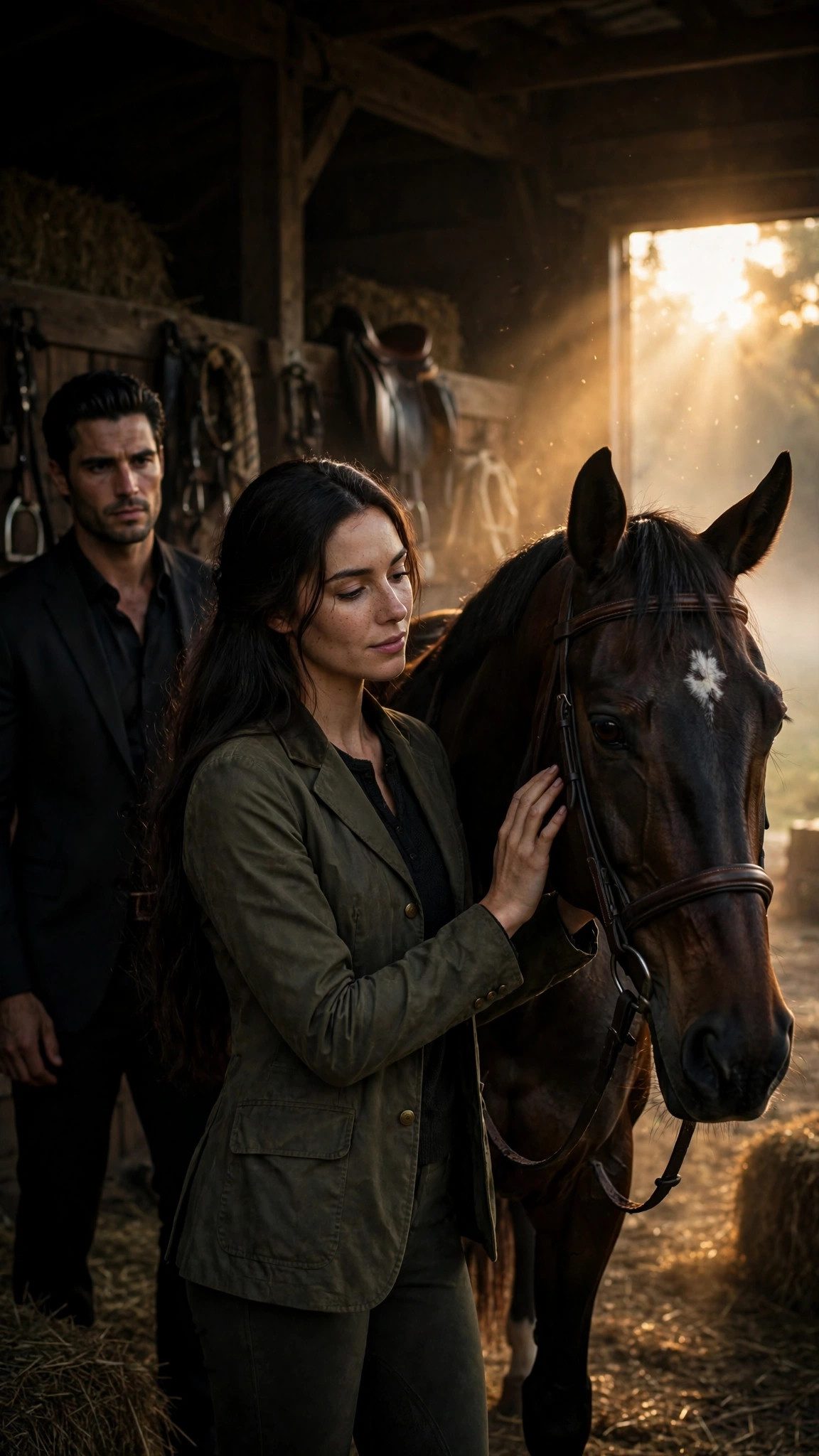
Story Genres: Western Romance

  • Chapter 7: His

    Chapter 7: His

    The morning of the ride dawned cold and gold, the kind of autumn morning that makes the whole world look newly washed. I was in the yard before six, saddling Sovereign myself, checking his girth twice, running my hand down his left shoulder and feeling the way the muscle moved freely under my fingers now, loose and warm and strong.

    He was ready. Two weeks of walking, cold water, and patience had done what I had promised Roman they would do. The shoulder was sound. The colt was sound. And this morning, for the first time, he was going to run.

    Roman came out of the main house as the sun was coming up over the maple trees. He was dressed for riding: dark trousers, boots, a black sweater, no suit, no tie. He looked younger in the morning light, and happier, too, in a quiet way, the way a man looks when he has slept well for the first time in years.

    He had a horse waiting for him, a tall dark gelding named Onyx, and he mounted easily, without gripping the saddle, without shifting his weight, without the careful bracing I had watched him do for four months. He settled into the saddle like a man who had been riding all his life, which he had, and then he looked down at me, and he smiled.

    "Are you ready, Hannah?"

    "I've been ready for weeks," I said, and I mounted Sovereign, and the colt danced sideways with excitement, and I laughed, and Roman laughed too, and we rode out together toward the training track, the grooms watching from the fence, Ellis leaning on his pitchfork with a smile on his weathered face.

    We walked the horses around the track once, slowly, letting them warm up, letting them feel the morning. Sovereign was eager, his ears pricked, his neck arched, his feet light on the ground. Onyx was steady beside him, calm and strong, the way a good horse is when it knows its rider trusts it.

    "Let him go," Roman said when we reached the far turn. "Let him run."

    I loosened the reins, and Sovereign took off like a released arrow.

    The wind hit my face, and the world blurred into green and gold, and I felt the colt's stride lengthen underneath me, smooth and powerful, his shoulder moving freely, his whole body working the way a healthy horse's body works when nothing hurts. He ran the way he was born to run, and I rode him the way I had dreamed of riding him since the first day I had put my hands on his shoulder and told Ellis he needed rest.

    We came around the far turn and down the straight, and I could hear Roman behind me, laughing, and I could hear Ellis shouting from the fence, and I could feel Sovereign's heart beating through the saddle, strong and steady, and I thought about my father, and about the notebook, and about the mare Clover, and about the five days, and I thought: this is what it was all for. Not the debt. Not the money. This. A sound horse, running free, on a cold gold morning.

    When we pulled up at the finish, Sovereign was barely breathing hard, his ears still pricked, his eyes bright. Roman rode up beside me, and he was grinning, actually grinning, the way I had never seen him grin before.

    "He's ready," Roman said. "He's ready to win. The autumn races are in three weeks, and Sovereign is going to win them."

    "He is," I agreed. "He's sound, and he's fast, and he knows it."

    We walked the horses back to the yard side by side, and the grooms took them, and Ellis gave Sovereign an extra handful of oats, and Roman and I stood together in the yard, watching the sun climb higher over the maple trees.

    "Hannah," Roman said, and his voice was different from the voice I had first heard in his office four months ago. That voice had been deep and calm and controlled. This voice was deep and calm too, but underneath it there was something else, something warm and unguarded, something I had only heard once before, in the back room of the barn, when he had said my name for the first time.

    "When I offered you the arrangement," he said, "I told you that you would manage my horses and pay off your father's debt. That was a contract. It was fair, and it was clear, and it is finished now. The debt is burned. You owe me nothing. You can leave tomorrow, and no one will stop you, and no one will think less of you for it."

    He paused, and he looked at me, and his eyes were very dark and very steady.

    "But I am asking you to stay. Not as my employee. Not as my trainer. Not because you owe me anything. I am asking you to stay because in five days, you did something no one else in my life has ever done. You saw me weak, and you did not use it. You saw me in pain, and you did not pity me. You put your hands on the one thing I have hidden from the world for eight years, and you treated it gently, and you gave it back to me."

    He took a step closer, and his voice dropped, and he said the words slowly, carefully, the way a man says words he has rehearsed a hundred times and is still afraid of getting wrong.

    "Hannah Peyton, I am not asking you to marry me because I need a wife, or because I need an heir, or because it would be convenient. I am asking you because in five days, you became the person I trust most in the world, and I do not want to live the rest of my life without you beside me. I am asking you because I love you. I think I started loving you the day you stood on that gravel path and told me my doctor was wrong, and I have loved you more every day since."

    He stopped, and he waited, and the yard was very quiet, and the only sound was Sovereign munching oats in his stall and the wind in the maple trees.

    I thought about the four months since I had arrived at Bellori Ridge with a duffel bag and a dead father's debt. I thought about the dining room, and the chair Garrett had kicked, and the way Roman had said "Put the chair back." I thought about the gravel path, and the examination, and the five days, and the crack in the barn, and the twelve armed men, and the burning papers. I thought about the man who had stood for eight years because sitting hurt, and who had sat down in a chair in front of me and said it didn't hurt anymore.

    And I thought about the question he had asked me, and I knew that it was not a contract, and it was not a deal, and it was not an arrangement. It was a choice. He was giving me a choice, the way no one had ever given me a choice before. Stay or go. Yes or no. His or free.

    "Yes," I said.

    It came out simply, without flourish, the way the truest things always come out.

    "Yes," I said again, louder, laughing a little because I could not help it. "Yes, Roman. I will stay. I will marry you. Not because I owe you anything. Because I love you too. I think I started loving you the day you made Garrett Sloan pick up that chair, and I have loved you more every day since."

    He stared at me for a moment, as if he could not quite believe what he had heard, and then he did something I had never seen him do. He laughed. Not a small, controlled laugh. A real laugh, loud and surprised and joyful, the laugh of a man who has just been given something he did not dare to ask for.

    And then he took my hands in his, and he kissed them, one at a time, gently, the way a man kisses the hands that have healed him.

    We were married three weeks later, on the same day Sovereign won his first race.

    It was a small wedding, in the chapel on the estate, with Ellis and Raphael and the grooms and the horses watching from the yard outside. I wore a simple white dress, and Roman wore a black suit, and when the priest asked me if I would take this man, I said yes, and when he asked Roman, Roman said yes, and when we walked out into the autumn sunlight, Sovereign was waiting at the fence, his dark head over the rail, his white star bright in the sun, as if he had come to see it for himself.

    That evening, after the guests had gone, Roman and I sat on the porch of the main house, in two chairs side by side, watching the sun go down over the pastures. He sat all the way back in his chair, his feet flat on the floor, his hands resting on his knees, and I sat beside him, and I thought about how strange and wonderful it was that a dead father's debt had led me here, to this house, to this man, to this life.

    "You know," Roman said, reaching over to take my hand, "my father used to say that a man who cannot sit down cannot think clearly. He said a man needs to sit to make decisions, to listen, to be still. I spent eight years making every decision standing up, in a hurry, with one foot already out the door. And then you came, and you taught me to sit down, and the first clear decision I ever made sitting down was to ask you to marry me."

    "And the second?" I asked, smiling.

    "The second," he said, squeezing my hand, "is that I will never make another important decision without you beside me. That is a promise, Hannah Bellori. Not a contract. A promise."

    I leaned my head against his shoulder, and we sat there together as the light faded, and the horses settled in their stalls, and the maple trees turned black against the sky, and I thought about the five days.

    Five days of showing up. Five days of gentle hands and patient work. Five days of a guarded joint learning to trust again, and a guarded man learning the same thing.

    Five days that made her his. And five days that made him hers.

    And sometimes, on quiet evenings, when the wind moves through the maple trees and the horses are sleeping in their stalls, I think about a gravel path, and a notebook, and a horse trainer who owed a dead man's debt, and a mafia boss who had not sat down in eight years, and I think about how the most important things in life are never the things you plan for.

    They are the things you notice, if you know how to watch. And the things you heal, if you know how to listen. And the people you love, if you are brave enough to stay for five days, and then for the rest of your life.

    The race itself was everything I had hoped it would be, and more than I had dared to expect.

    We drove to the track on a bright October morning, Roman and I in the back of the black sedan, Ellis and Raphael in front, Sovereign in the horse trailer behind us, calm and ready. When we arrived, the grandstand was already full, and the air smelled of autumn and excitement, and I could feel my heart beating in my throat the way it had beaten on the morning of the fifth day.

    Sovereign walked into the paddock like he owned it. He was dark and gleaming, his white star bright, his shoulder moving freely, his whole body loose and strong. The other trainers looked at him, and then they looked at me, and I could see them wondering who this woman was and where this horse had come from.

    "He's ready," Ellis said, squeezing my shoulder. "Whatever happens, he's ready."

    The race was a mile and an eighth, and Sovereign broke cleanly from the gate, and settled in third, and waited, the way I had taught him to wait, patient and calm, saving his strength. Around the far turn he began to move, picking off one horse and then another, and down the stretch he opened up, his stride lengthening, his shoulder free, his whole body doing exactly what it was born to do.

    He won by two lengths.

    I screamed. I actually screamed, right there in the grandstand, in front of everyone, and Roman laughed and picked me up off my feet and spun me around, and Ellis was shouting, and Raphael was clapping, and Sovereign was dancing in the winner's circle with a blanket of flowers around his neck, looking for all the world like he had known all along that he was going to win.

    That night, after the celebrations were over, I sat at the desk in our cottage — our cottage now, not just mine — and I opened my father's leather notebook to a fresh page. I wrote down the date, and I wrote down Sovereign's name, and I wrote down the time of the race, and underneath it all, in my own handwriting, I wrote the words my father had written about the mare Clover, all those years ago.

    "The back takes the blame for the hip. Always check the hip first."

    And underneath that, I wrote something of my own.

    "Five days. That is how long it takes a guarded joint to trust again. And five days is how long it takes a guarded heart to do the same. Show up every day. Do the work gently. Don't force it. And when it is ready, it will let go, and everything will change."

    I closed the notebook and went to the window, and I looked out at the dark pastures, and I thought about my father, and about the debt, and about the man sleeping in the next room, the man who had not sat down in eight years and who now sat beside me every evening without even thinking about it.

    My father had been a good horseman and a bad gambler, and he had left me a debt and a notebook. The debt was burned. The notebook was mine now, filled with his wisdom and my own, and it would go on my desk for the rest of my life, a reminder of everything he had taught me and everything I had learned since.

    Horses don't lie. People lie. Horses just move the way the pain tells them to.

    And if you know how to watch, and you know how to listen, and you are brave enough to stay for five days, you might just find that the pain was never the whole story. The whole story is what comes after the pain lets go.

    The End.

    THE END

  • Chapter 6: What the Pain Was Hiding

    Chapter 6: What the Pain Was Hiding

    The first dinner was the strangest and the most wonderful thing I had ever seen.

    Roman sat down at the head of the great oak table, in his own chair, the chair no one had ever seen him use, and he sat all the way back in it, and he picked up his knife and fork, and he ate his dinner sitting down, like an ordinary man. The twelve men at the table tried very hard not to stare. They failed. Every few minutes one of them would glance at him, and then look away quickly, as if he had caught himself looking at something private.

    Halfway through the meal, Roman set down his fork and looked around the table.

    "I have been standing for eight years," he said, "because I believed my spine was broken and could not be fixed. I was wrong. My hip was injured in the accident, and no one ever examined it. Miss Peyton examined it. She treated it for five days. And now I can sit."

    He looked at me, across the long table, and he said, "Thank you, Hannah. In front of all of them. Thank you."

    Nobody laughed. Nobody said anything. Garrett Sloan stared down at his plate, his face red.

    After dinner, Dr. Avery arrived.

    He came in his black sedan, carrying his leather bag, and he went straight to the study, where Roman was waiting. I was not invited. But Ellis told me later what happened, because Ellis hears everything in that house, and Ellis told me the way he tells everyone everything: slowly, and only when he thinks you need to know.

    Avery had brought the surgical team with him, or so he said. He had brought papers for Roman to sign. He had brought a schedule, and a hospital, and a date: Friday, three days away. He spoke for twenty minutes about the nerve, and the disc, and the risk of permanent damage, and then Roman asked him one question.

    "Doctor," Roman said, "in the original accident report, did it mention my hip?"

    Avery went still. Ellis said the silence in that study was the longest silence he had ever heard.

    "What do you mean?" Avery asked.

    "I mean that Miss Peyton asked me whether anyone had examined my hip after the crash. I told her I didn't think so. But this morning I had Raphael pull the original hospital file. The emergency report from the night of the accident lists a hip contusion and a suspected labral tear. It recommends a follow-up examination of the hip joint within two weeks. That examination never happened. Do you know why?"

    Avery's face, Ellis said, went the color of old paper.

    "I don't recall that report," Avery said.

    "You were the attending physician," Roman said. "It was your report."

    "I may have missed it. There was a great deal going on that night. Your father was dying. The focus was on his condition."

    "My father died," Roman said, his voice very quiet, "and my hip was forgotten. And for eight years, you treated my spine, and you never once looked at the report that said to look at my hip. Eight years of injections. Eight years of steroids. Eight years of telling me surgery was the only answer."

    "Roman," Avery said, "I have served your family for twenty years—"

    "And you will continue to serve it," Roman interrupted. "But not as my doctor. You are finished here, Doctor. You will send me your files, all of them, and you will not come back to this estate."

    Ellis said Avery left without another word, his bag in his hand, his face grey, and that was the last anyone at Bellori Ridge ever saw of him.

    I do not know whether Avery buried that report on purpose or whether he simply missed it in the chaos of that terrible night. I have thought about it many times since. A doctor who is certain is a dangerous doctor, because certainty stops you from looking again. Avery was certain it was the spine. He was certain for eight years. And certainty, I have learned, is just another way of not listening.

    But Avery was not the only one who had been hiding something. The pain had been hiding something else, too, and it took Garrett Sloan to show me what it was.

    Three nights after the dinner, I was working late in the stable when I heard a car on the gravel drive, too late for a delivery, too fast for a guest. I stepped to the door and saw headlights sweeping across the yard, and then I saw men moving in the dark between the barns, men I did not recognize, moving the way men move when they do not want to be seen.

    I ran to the main house. Roman was in the study, sitting at his desk, reading. Sitting. The sight of him sitting down still surprised me every time.

    "Men in the yard," I said, breathless. "Strangers. Four of them, maybe five, coming from the south gate."

    He was on his feet in an instant, and he was not the man on the treatment table anymore. He was the head of the Bellori family, and he moved like it, fast and sure, his hand already on his phone.

    "Raphael," he said. "South gate. Now."

    The attack, when it came, was fast and ugly. The strangers were Castellano men, from the rival family that had been waiting for years for Roman to show weakness. They had heard, somehow, that Roman was receiving treatment in his barn, that he was lying down, that he was vulnerable. They had come to finish what the truck had started eight years ago.

    But they had come too late. They had come for a man who could not sit down, a man in pain, a man who moved like a wounded animal. They found a man who could move freely for the first time in eight years.

    Roman met them in the yard, and his men met them beside him, and the fight was short and brutal and over before I could even get to the window. When it was done, two of the Castellano men were on the ground, and the others were running for the gate, and Roman was standing in the middle of the yard, breathing hard, his suit torn at the shoulder, his hands steady.

    And then Raphael came to him with a phone, and the phone belonged to one of the Castellano men, and on it was a message, sent three days earlier, from a number Raphael recognized.

    It was Garrett Sloan's number.

    Garrett had told the Castellanos about the treatments. He had told them Roman was lying down in a barn every morning at six o'clock, unguarded, vulnerable. He had sold his boss for money, or for revenge, or for the simple pleasure of watching a man who had once made him pick up a chair fall down at last.

    Roman found Garrett in the tack room, packing a bag.

    "How long?" Roman asked.

    Garrett did not pretend he didn't understand. "Six months. The Castellanos approached me after the winter meeting. They said you were weak, and that weak men lose their empires, and that I should think about my future."

    "And you believed them."

    "I believed what I saw," Garrett said. "A boss who couldn't sit down. A boss who was in pain. A boss who let a stable girl put her hands on him. I thought you were finished, Roman. I thought I was getting out before the fall."

    Roman looked at him for a long moment. Then he said, "You are finished here, Garrett. You will leave Bellori Ridge tonight, and you will not come back. If I ever see you again, I will not be as generous as I am being now."

    Garrett left without another word. I watched his car disappear down the gravel drive, and I thought about the chair he had kicked across the dining room floor, and about the way he had looked at me in the yard, and about how a man who mocks a woman for her weight will sell his boss for money without a second thought.

    That night, Roman came to my cottage. He knocked, and when I opened the door, he was holding a folder. It was the folder from my first morning, the one with my father's debts in it, the markers and the promises added up in neat columns.

    "I have been thinking about your father's debt," he said.

    My stomach tightened. "I know. I still owe—"

    "No," he said. "You don't."

    He opened the folder, and he took out a lighter, and right there on my doorstep, in the cold night air, he set fire to the papers. They burned quickly, the neat columns curling into ash, the numbers disappearing into smoke.

    "Your father owed me money," Roman said, watching the papers burn. "But you saved me from eight years of pain, and you saved my life from the Castellanos, because you were the one who saw the men in the yard. A debt like that cannot be measured in dollars, Hannah. It is paid. It is finished. You owe me nothing."

    He dropped the last burning corner of paper into the dirt and ground it out with his heel.

    "From now on," he said, "you stay at Bellori Ridge because you choose to, not because you owe me anything. Do you understand?"

    I understood. And for the first time since my father's funeral, I felt the weight I had been carrying lift off my shoulders, the way the pain had lifted off Roman's hip. It was gone. It was finished. I was free.

    "Thank you," I said, and my voice broke a little. "Thank you, Roman."

    He nodded, and he turned to go, and then he stopped, and he looked back at me, and he said the words that changed everything that came after.

    "Hannah," he said, "tomorrow morning, will you ride with me? Not as my trainer. Not as my employee. As my guest. Sovereign is ready, and I would like to see him run. And I would like you beside me when he does."

    The next morning I woke up before dawn, the way I always did, and for a moment I did not remember. I lay in bed listening to the wind in the maple trees, and then it came back to me all at once: the burning papers, the ash in the dirt, the words "you owe me nothing," and I sat up in bed and laughed out loud, alone in my cottage, because for the first time in three years, I was free.

    I went to the stables early, before anyone else, and I found Ellis already there, mucking out Bishop's stall, his movements slow and steady in the lamplight.

    "Morning, Miss Peyton," he said, without looking up. "You look different today."

    "Do I?" I asked.

    "Lighter," he said. "Like someone took a saddle off you that you'd been wearing so long you'd forgotten it was there."

    I laughed. "Something like that."

    Ellis leaned on his pitchfork and looked at me for a long moment, his weathered face thoughtful. "Can I tell you something? I've been at Bellori Ridge for twenty years. I've seen that man stand through dinners and meetings and funerals, standing because he thought sitting down was weakness. Yesterday, for the first time, I saw him sit down at his own table and eat a meal like a human being. And do you know what I thought? I thought, that girl did that. That horse trainer with the notebooks did what eight years of doctors couldn't do."

    "I just watched him move," I said. "That's all I did. I watched the way his body moved, and I listened to what it was telling me."

    "That's what your father used to say," Ellis said. "Horses don't lie. People lie. Horses just move the way the pain tells them to. Your father said that to me once, years ago, when he was working on a mare of ours. He was a good man, your father. A foolish man with money, but a good man with horses. And you're your father's daughter, Miss Peyton. Don't ever forget that."

    "I won't," I said, and my throat tightened, because no one had said anything kind about my father in three years, and hearing it from Ellis, in the lamplight of the stable, felt like a gift I hadn't expected.

    Later that morning, I watched from the yard as Roman came out of the main house and walked to the training track. He walked the way he had walked on Day Four, his pelvis level, his stride even, and when he reached the fence, he did something I had never seen him do: he leaned on it, casually, with one elbow, like a man with all the time in the world, and he watched the horses work.

    I thought about the five days then, and about the man I had met on my first morning, the man who had stood behind a desk with all his weight on one leg and told me I owed him a hundred and eighty thousand dollars. That man had been a stranger, and a frightening one. The man leaning on the fence was someone else entirely: a man who could sit down, a man who could lean, a man who had been given back something he thought he had lost forever.

    And I thought about the way he had looked at me across the dinner table when he said thank you in front of all his men, and the way he had called me Hannah for the first time, and the way he had asked me to ride with him tomorrow morning, not as his trainer, not as his employee, but as his guest.

    I had come to Bellori Ridge to pay off a dead man's debt. I had stayed because I had nowhere else to go. But somewhere in those five days, between the liniment and the exercises and the crack in the barn, something had changed, and I was no longer sure what I was staying for.

    I only knew that when I thought about leaving, about packing my duffel bag and driving away down the gravel drive, the thought felt wrong, the way a wrong stride feels wrong to a horse. It felt like walking away from something unfinished.

    So I went back to Sovereign's stall, and I checked his shoulder, and I wrote in my notebook, and I waited for tomorrow morning, and for the ride, and for whatever came next.

  • Chapter 5: Five Days

    Chapter 5: Five Days

    Day Two began the same way: six o'clock, the back room of the barn, the door closed, the lamplight warm on the blanket-covered table. Roman was already there when I arrived, standing by the window with his hands clasped behind his back, looking out at the yard where the grooms were beginning their morning work.

    "You came," I said.

    "I said I would," he replied. "I keep my word, Miss Peyton. Even when I am not sure it is wise."

    He lay down on the table without being asked this time, and I noticed the difference immediately. Yesterday he had lain down like a man surrendering. Today he lay down like a man who had decided to cooperate. It was a small change, but it mattered. A guarded body does not heal. Only a body that trusts, even a little, can let go.

    Day Two was deeper work. I pressed into the hip flexors, the thick bands of muscle at the front of the hip that had been shortened and tightened for eight years, and I felt them resist me, hard as rope. I worked slowly, breathing with him, waiting for each muscle to decide I was not a threat. Twice his breath caught and his hands clenched, and twice I stopped and waited, my hands still, until the pain passed and he nodded for me to go on.

    "Tell me about the horses," he said at one point, his voice tight. "Talk about something else. It helps."

    So I talked. I told him about Sovereign, about the way his shoulder was loosening, about the morning I had watched him trot in the round pen and seen his stride lengthen for the first time in weeks. I told him about Bishop, the old gelding, and the way he still thought he was a racehorse every time the saddle came out. I told him about my father, about the mare Clover, about the five days it had taken her hip to trust again.

    "Your father sounds like a wise man," Roman said.

    "He was wise about horses," I said. "He was a fool about everything else. But about horses, he was wise."

    When I finished, Roman sat up, and this time he swung his legs over the side of the table and stood without bracing himself on it first. He took a few steps across the room, and his right stride was still short, but it was a fraction longer than it had been the day before, and he knew it. I could see it in his face.

    "Day Three," he said, and left without another word.

    Day Three was the hardest day.

    I had planned to begin the gentle mobilization of the joint itself, moving the hip through its range a little at a time, asking it to remember how it used to move. But when I put my hands on him that morning, I could feel that his body was fighting me harder than it had on Day Two. The muscles were tighter. The guarding was stronger. It was as if his body had decided overnight that it had given enough, and it was not giving any more.

    "You're tense," I said.

    "I didn't sleep," he admitted. "Avery called last night. He wants to come on Friday with the surgical team. He says the injections are failing, and if I don't agree to the operation soon, the nerve damage could become permanent."

    "And what did you tell him?" I asked.

    "I told him I would think about it." He looked up at the ceiling. "He has been my doctor for eight years, Miss Peyton. He has watched me suffer for eight years. If you are wrong, and I turn him away, I am choosing a horse trainer over a surgeon."

    "Then don't turn him away yet," I said. "Give me the five days. That's all I asked for. On the fifth day, you'll know. Your body will tell you, one way or the other."

    He was quiet for a long moment. Then he nodded, and I went to work, and the work was slow and difficult, and twice I had to stop because the pain was too much, and twice he told me to go on, and by the end of the hour his hip was moving a few degrees further than it had the day before, and that was enough. That was what Day Three was for: not a breakthrough, but a few more degrees. A little more trust.

    Afterward, as he was buttoning his shirt, he said something I did not expect.

    "My father used to say that a man who cannot sit down cannot think clearly," he said. "He said a man needs to sit to make decisions, to listen, to be still. I have not sat still in eight years. I have made every decision standing up, in a hurry, with one foot already out the door. I wonder how many of those decisions I would have made differently if I could have sat down first."

    I did not know what to say to that, so I said nothing. I just folded the blanket and put away the oils, and he left, and I stood alone in the back room of the barn, thinking about a man who had run an empire for eight years without ever once sitting down to think.

    Day Four was different. Day Four was the day the exercises began.

    I taught him to stand with his feet level and shift his weight slowly from side to side, feeling the pelvis stay even. I taught him to lie on his back and lift his right knee toward his chest, a few inches at a time, breathing out as the hip opened. I taught him to walk the length of the barn with his hands on his hips, feeling for the tilt, correcting it, step by step.

    He was a terrible patient and a wonderful student. He hated every exercise. He did every one of them twice.

    "Again," he would say, his jaw tight, sweat on his forehead. "Show me again."

    And I would show him again, and he would do it again, and by the end of the hour he could walk the length of the barn with his pelvis almost level, his right stride almost as long as his left, and when he stopped at the far end and turned around, he was smiling. Not a big smile. A small, surprised smile, the smile of a man who has just discovered that his body can do something he thought it had forgotten how to do.

    "Tomorrow," he said. "Day Five."

    "Tomorrow," I agreed. "And Mr. Bellori, tomorrow I will ask the joint to do something it hasn't done in eight years. If it isn't ready, I will stop. I promise you that."

    "I know," he said. And then, quietly, "Thank you, Hannah."

    It was the first time he had called me by my first name.

    That night I barely slept. I lay awake going over every detail in my mind: the range of motion I had measured, the resistance I had felt, the way the joint had moved on Day Three and the way it had moved on Day Four. I thought about the mare Clover, and the sound her hip had made on the fifth day, like a knuckle cracking, and the way she had walked out of the stall sound for the first time in a year.

    I thought about the twelve armed men who followed Roman everywhere, and about Garrett Sloan, who had been watching the back room door, and about what would happen if the adjustment went wrong in front of them.

    And I thought about Roman's face when he had smiled at the end of Day Four, and I thought about the five days, and about the title I did not yet know someone would give this story, and I understood, for the first time, that the five days were not just about his hip.

    They were about trust. Five days of showing up. Five days of a man letting a woman put her hands on the one place he had never let anyone touch. Five days of a horse trainer and a mafia boss learning that the other one could be trusted.

    Day Five dawned cold and clear. I was in the back room by five-thirty, and Roman arrived at six, and this time he was not alone.

    Garrett Sloan was with him, and eleven other men, and they filled the doorway of the back room, their shoulders blocking the light, their faces hard.

    "What's this?" I asked, my voice sharper than I intended.

    "Garrett insisted on coming," Roman said. His face was calm, but I could see the tension in his jaw. "He told the men that something strange is happening in this barn. He told them you have been meeting me here in secret. He told them you might be hurting me."

    "I have not been hurting you," I said.

    "I know that," Roman said. "But they don't. And in my world, Miss Peyton, when twelve armed men think someone is hurting their boss, they do not ask questions first."

    Garrett stepped forward, his hand resting on his holster. "Boss, with respect, we don't know what she's doing to you in here. We don't know what she's putting in those oils. For all we know, she's working for someone else. The Castellanos would pay a fortune to get to you through a stable girl."

    "Garrett," Roman said, his voice low and dangerous. "I told you to put the chair back once. I will not tell you again."

    "I'm just trying to protect you," Garrett said.

    "Then protect me by standing over there and keeping your mouth shut," Roman said. "Miss Peyton is going to do her work. You are going to watch. And if you reach for your weapon, I will deal with you myself."

    The men moved back, reluctantly, to the edges of the room. Garrett took a position by the door, his arms crossed, his eyes on me.

    Roman lay down on the table.

    "Do it," he said quietly. "Whatever you were going to do today, do it now. They're watching, so do it well."

    My hands were shaking. I pressed them flat against the table for a moment, breathing slowly, the way I had taught Roman to breathe. Then I put my hands on his hip, and I felt for the joint, and I felt for the resistance, and I felt for the place where eight years of guarding had built a wall around the thing that needed to move.

    It was ready. I could feel it. The muscles had let go. The scar tissue had softened. The joint was waiting, like a door that has been stuck for years and is finally loose in its frame.

    "I'm going to move it now," I said softly, for Roman and for no one else. "One slow movement. Breathe out with me. Now."

    I moved his leg the way I had moved it a hundred times in practice, gently, steadily, guiding the hip through its arc, and for a moment there was resistance, and then there was a sickening crack that echoed through the barn like a gunshot.

    Twelve armed men reached for their guns.

    Roman went rigid beneath my hands.

    I froze, my hands still pressed against his hip, my heart hammering, certain that I had broken him, certain that Garrett Sloan was going to kill me where I stood.

    "Don't," Roman said.

    It was barely louder than a breath, but twelve hands stopped halfway to twelve holsters.

    And then Roman exhaled, long and ragged, and the rigidity melted out of him, and he sat up, and he stood up, and he took a step, and then another, and he turned in a slow circle in the middle of the barn, and he looked down at his feet like they belonged to a stranger.

    "Eight years," he said quietly.

    Then he did something no one in that barn had seen him do in eight years.

    He pulled a chair out from the wall, and he sat down in it.

    He sat down all the way, his back against the chair, his feet flat on the floor, his hands resting on his knees, and he looked up at me, and his eyes were wet.

    "It doesn't hurt," he said. "Sitting doesn't hurt."

    Garrett Sloan's hand fell away from his holster. One by one, the twelve men lowered their arms. The barn was silent except for the horses shifting in their stalls and the wind in the maple trees outside.

    And in that silence, I understood what the five days had done. Not just to his hip. To everything.

    Roman stayed in the chair for a long time. He sat there with his hands on his knees, breathing slowly, as if he were learning how to sit all over again, as if his body needed time to believe what had just happened. The twelve men watched him, and I watched them watching him, and I could see the disbelief on their faces turning slowly into something else, something like awe.

    Finally Roman stood up again, and this time he did not do it carefully. He stood up the way a man stands up when standing does not hurt, and he walked to the door of the back room, and he turned to face his men.

    "What happened in this room stays in this room," he said. His voice was calm, but there was iron under it. "Miss Peyton has done something no doctor in eight years could do. She has my gratitude, and she has my protection. Any man who speaks of this outside these walls will answer to me. Is that understood?"

    Twelve heads nodded.

    "Garrett," Roman said. "Walk with me."

    Garrett followed him out into the yard, and I stood alone in the back room with my hands still smelling of liniment and my heart still hammering, and I listened to the horses and the wind, and I thought about the sound the crack had made, and about the way twelve hands had stopped in midair at a single word from a man who had just learned how to sit down.

    A few minutes later, Ellis came to the door with a bucket of water for Sovereign's shoulder, and he looked at me, and then he looked at the chair still sitting in the middle of the room, and then he looked back at me, and he smiled, a slow, knowing smile.

    "Well," he said. "I always said that girl knew horses."

    I laughed, and the laugh came out shaky, and Ellis pretended not to notice, and went back to his work.

    I stayed in the back room for a while longer, folding the blanket, putting away the oils, cleaning the table the way my father had taught me to clean up after a treatment: everything in its place, everything ready for next time. Because there would be a next time. The hip was free, but eight years of bad habits would not disappear in one morning. There would be exercises. There would be check-ins. There would be mornings when it was stiff again, and mornings when it moved freely.

    But the hardest part was over. The joint had trusted me. The man had trusted me. And in the silence of the barn, with the chair still sitting in the middle of the floor where a man who had not sat down in eight years had just sat, I understood that the five days had made something that could not be undone.

    Not just a healed hip. A beginning.

  • Chapter 4: The Examination

    Chapter 4: The Examination

    I woke before dawn and dressed in the dark, my hands steady even though my stomach was not. By five-thirty I was in the back room of the main barn, the room Ellis used for storing harness and medicine, the room Roman had chosen because no one went there before seven. I had cleaned it the night before, swept the floor, laid a folded blanket over the old wooden treatment table, and set out my oils and towels in a neat row. The air smelled of leather and hay and cold morning.

    At six o'clock exactly, the door opened, and Roman came in.

    He was dressed simply, for him: dark trousers, a black shirt with the sleeves rolled to the elbows, no tie, no jacket. He looked younger without the suit, and more tired, too. The lines around his eyes were deeper in the lamplight. He closed the door behind him and stood there for a moment, looking at the table the way a man looks at a dentist's chair.

    "Six o'clock," he said. "You are punctual, Miss Peyton."

    "My father used to say that horses don't wait for people who are late, and neither does pain," I said.

    A flicker of something crossed his face. It might have been a smile. It was gone before I could be sure.

    "Tell me what to do," he said.

    "First, I watch you walk," I said. "Walk to the door and back, slowly, the way you normally walk. Don't try to walk well. Walk the way you always walk."

    He did. I watched from the side, the way I had watched a hundred horses, counting the rhythm. Left, right. Left, right. The right step was shorter. The right foot turned outward. The pelvis tilted. When he reached the door and turned, his right leg hesitated for a fraction of a second before it took his weight, as if it were asking permission.

    "Now sit," I said, pointing at a chair I had set by the wall. "Sit the way you normally sit."

    He sat down slowly, lowering himself with his arms braced on the chair, his face tightening as his hips bent. He perched on the edge of the seat rather than sitting back, his weight forward, his right leg extended slightly in front of him.

    "You don't sit," I said. "You perch. You've been perching for eight years."

    "I stand because it hurts less," he said. "Sitting is worse. Sitting puts pressure on the nerve, or so Avery says."

    "Or sitting puts pressure on a hip that hasn't moved properly in eight years," I said. "Lie down on the table. On your back."

    He hesitated. I could see it in his shoulders, the tension that came from lying down in front of another person, from being vulnerable, from giving up control. Roman Bellori did not lie down in front of people. He stood. He always stood.

    "I won't do anything without telling you first," I said quietly. "And if you say stop, I stop. That's the rule. You are in charge of this, Mr. Bellori. Not me."

    He looked at me for a long moment, and then, slowly, he lay down on the table.

    I started the way my father had taught me: with my eyes, not my hands. I looked at the way he lay, at the tilt of his pelvis against the blanket, at the way his right leg fell outward naturally while his left leg stayed straight. I looked at the muscles of his thighs and his lower back, at the places where the body had built itself up to compensate and the places where it had wasted away from disuse.

    Then I put my hands on him.

    I started at his feet, feeling the warmth of his skin, the tension in his calves. His right calf was tighter than his left, the muscle hard and corded, as if it had been bracing itself for years. I moved up to his knees, his thighs, and then, carefully, to his hips.

    The difference was there the moment my hands found it.

    His right hip was higher than his left, and the muscles around it were locked tight, a wall of tension that had been holding the joint in place for eight years. When I pressed gently on the front of the joint, his whole body flinched, and his breath caught.

    "Here?" I asked.

    "Yes," he said through clenched teeth. "There. That's where it lives."

    I moved my hands to his lower back, feeling the muscles there, and they were tight too, but it was a different kind of tight. The back was tight because it was working too hard. The hip was tight because it was protecting something.

    "Mr. Bellori," I said, keeping my voice calm and steady, the way I would talk to a frightened horse, "I need you to tell me about the accident again. Not the crash. The hospital. After the crash. What did they do to your hip?"

    "Nothing," he said. "They didn't do anything to my hip. They set my collarbone. They took pictures of my spine. My hip wasn't broken. It wasn't even bruised, as far as I remember. The pain was in my back."

    "Your hip wasn't broken," I repeated. "But was it examined? Did anyone move it? Did anyone test it?"

    He was quiet for a moment, staring up at the rafters. "I don't think so. I was in a neck brace. They were worried about my spine. Nobody touched my hip."

    I nodded, and I put my hands back on his hip, and I moved his right leg very gently, just a few inches, feeling for the place where the joint stopped moving freely. It stopped early. Much earlier than it should have. A healthy hip moves smoothly through a wide arc. His hip hit a wall halfway through, and behind that wall I could feel the resistance, the scar tissue, the joint that had been guarding itself for eight years.

    "Your hip was injured in the crash," I said. "Not broken. But injured. The joint was wrenched, the tissues around it were torn, and because nobody ever examined it, nobody ever treated it. So it healed wrong. The scar tissue formed, the muscles locked down to protect it, and your body learned to move around it instead of through it. And for eight years, your back has been doing the work your hip was supposed to do, and that's why your back hurts."

    Roman was silent. I could feel his breathing under my hands, slow and controlled, the breathing of a man who is trying very hard not to hope.

    "Can you fix it?" he asked at last.

    "I don't know," I said honestly. "I know how to treat a hip like this in a horse. I know the work is slow, and gentle, and it takes days, not minutes. I know that if I force it, I could make it worse. And I know that your hip has been guarding itself for eight years, and it won't trust me in one morning."

    "Five days," he said. "You said five days."

    "Five days," I agreed. "Today is Day One. Today I only release the muscles. I don't touch the joint itself. I warm the tissues, I loosen the guarding, I teach your body that my hands are not a threat. Tomorrow I do a little more. Each day a little more. On the fifth day, if the joint is ready, I ask it to move the way it used to move. And then we find out."

    "And if it isn't ready on the fifth day?"

    "Then we wait," I said. "We don't force it. We give it another day, or another week. The joint decides, Mr. Bellori. Not me. Not you. The joint."

    He exhaled slowly, and some of the tension went out of his shoulders. "You sound like my father," he said quietly. "He used to say that a man can't force a horse to trust him. He can only show up every day until the horse decides."

    "Your father was right," I said.

    I worked on him for an hour that first morning. I warmed the muscles around his hip with my hands and with the liniment, slow circles, patient pressure, never forcing, never rushing. I worked on his lower back too, releasing the muscles that had been overworking for years, and I could feel them letting go under my hands, a little at a time, like a fist unclenching.

    When I finished, he sat up slowly, and then he stood, and he took a step, and then another, and his face changed. It was a small change. His stride was not suddenly normal. His hip was not suddenly healed. But the tightness in his jaw was gone, and his shoulders had dropped half an inch, and he stood there in the middle of the barn looking down at his own feet with an expression I had never seen on his face before.

    "It feels different," he said. "Lighter. Like something loosened."

    "That's Day One," I said. "That's all Day One does. It loosens."

    He nodded, and he reached for his shirt, and as he buttoned it, he said, "Same time tomorrow. And Miss Peyton, remember the conditions. No one knows."

    "No one knows," I agreed.

    But someone did know, or someone suspected. That afternoon, as I was leading Sovereign back from the round pen, I saw Garrett Sloan standing at the corner of the barn, watching the back room door. He had been there a while, I could tell, because there were two cigarette butts on the ground by his boots, and he was looking at the door the way a man looks at a door he wants to open.

    He saw me, and he straightened up, and he gave me a slow smile that did not reach his eyes.

    "Morning, sweetheart," he said. "You look busy. What were you doing in the back room so early?"

    "Sovereign's treatments," I said, the lie coming out smoothly because I had rehearsed it. "Cold water on his shoulder. It has to be done before the sun is up."

    "For an hour?" Garrett asked. "With the door closed?"

    "With the door closed because the cold air makes it worse," I said. "Horses don't like drafts on a sore shoulder. You'd know that if you spent any time with them."

    He laughed, but his eyes stayed narrow. "You know, I asked around about you. Your father owed the boss a lot of money. A lot of money for a horse trainer's daughter to pay off. I'd hate to see you lose this job because you got ideas above your station."

    "I don't have ideas, Mr. Sloan," I said. "I have horses. And right now I have a colt that needs his cold water, so if you'll excuse me."

    I walked past him, and I felt his eyes on my back all the way to the stable, and I knew that Garrett Sloan was going to be a problem. I just didn't know yet how big a problem.

    That night, Roman sent a message through Ellis: same time tomorrow, and bring the notebook. He wanted to know what I had written about his hip.

    I sat up late in my cottage, writing it all down: the measurements, the observations, the plan for five days. Day One: release the muscles. Day Two: deeper work on the hip flexors and the scar tissue. Day Three: gentle mobilization of the joint itself. Day Four: exercises to retrain the pelvis. Day Five: the full adjustment, if the joint was ready.

    I wrote it all down in my father's notebook, on the page after the entry about the mare Clover, and underneath the plan I wrote the words my father had underlined twice.

    Five days was how long it took a guarded joint to trust again.

    I just hoped five days would be enough for a guarded man, too.

    After I finished writing, I could not sit still. I put on my coat and walked out into the dark yard, past the silent barns, to Sovereign's stall. He was dozing, his head low, one hind leg cocked in sleep, and when I slipped inside and laid my hand on his neck, he woke just enough to blow warm air across my face and go back to sleep.

    I stayed there for a while, listening to him breathe, thinking about the difference between what Dr. Avery did and what I did. Avery looked at pictures. He looked at scans and numbers and images on a screen, and the pictures told him the spine was the problem, so he treated the spine. I looked at a body moving through space, at the way weight shifted and strides shortened, and the movement told me the hip was the problem.

    Neither of us was guessing. We were just listening to different things. But a body is not a picture. A body is a thing that moves, and if you want to know what is wrong with it, you have to watch it move.

    As I walked back to my cottage, I glanced up at the main house. A light was still burning in the study on the second floor. Roman was awake, too. I wondered if he was standing at the window, the way he always stood, or if he was sitting down, testing the loosened muscles, feeling the difference the way I had seen him feel it that morning.

    I wondered if he was afraid to hope, the way I had been afraid to hope when my father died and the debt came due and I thought my life was over. Hope had felt like a luxury then, something for people whose lives were not already decided for them. But here I was, at Bellori Ridge, with my hands on the most feared man in Chicago, and hope was the only thing I had to offer him.

    I went inside and locked my door, and I lay down in the dark, and I thought about Day Two. Deeper work on the hip flexors. The scar tissue around the joint. The exercises to retrain the pelvis. Each day a little more. Each day a little closer to the moment when the joint would either let go or refuse.

    And I thought about Garrett Sloan, standing at the corner of the barn with two cigarette butts at his feet, and I thought about Dr. Avery, who had been certain for eight years, and I thought about the twelve armed men who followed Roman everywhere, and I understood something I had not understood that morning.

    I was not just treating a hip. I was touching the one thing Roman Bellori had never let anyone touch: his weakness. And in his world, weakness was the most dangerous thing a man could show.

    If I was right, I would give him back something he had lost eight years ago. If I was wrong, I would have seen him weak for nothing, and a man like Roman does not forget being seen weak.

    There was no going back now. There had been no going back since the moment on the gravel path when I had said the words out loud. All I could do was show up every morning at six o'clock, the way my father's notebook said to do, and do the work, one day at a time, and trust that the body would tell me the truth.

    Five days. That was the plan. Four more to go.

  • Chapter 3: The Wrong Diagnosis

    Chapter 3: The Wrong Diagnosis

    For a long moment Roman did not answer. We stood on the gravel path behind the barns, and the morning sun was warm on my face, and the mares grazed in the paddock beyond the fence, and nothing moved except the wind in the maple trees. I could feel my heart beating in my throat. I had said the most dangerous thing I had ever said to anyone, and now I had to wait to find out what it would cost me.

    "You want to know about the accident," Roman said at last. It was not a question.

    "If you'll tell me," I said.

    He looked away, toward the track, and for a moment he was not the head of the Bellori family. He was a man remembering the worst day of his life.

    "I was twenty-six," he said. "My father was still alive then. We were coming back from a meeting in the city, late at night, in the rain. A truck came through a red light and hit the side of our car. The car spun. It hit a barrier. I remember the sound of the metal folding, and I remember my father's hand on my shoulder, and then I remember waking up in a hospital with a broken collarbone and a pain in my back that never went away."

    He paused, and his jaw tightened.

    "My father died in that hospital three days later. Not from the crash. From the anesthesia, during a surgery to repair his leg. He went under and he never woke up. The doctors said it was a complication. They said it was rare. They said it was nobody's fault."

    "I am sorry," I said quietly.

    Roman shook his head, as if brushing away something he did not want to feel. "After the funeral, the pain in my back got worse. Avery ran tests. He found a disc pressing on a nerve. He said the crash had damaged my spine. He gave me injections. He gave me steroids. He told me surgery would fix it. I told him no. I have told him no for eight years."

    "Did anyone examine your hip?" I asked again. "After the crash? Did anyone look at it at all?"

    Roman was silent for a moment. Then he said, slowly, "They took X-rays of my chest and my spine and my collarbone. I don't remember anyone looking at my hip. The pain was in my back. Everyone assumed the back was the problem."

    "Everyone assumed," I repeated. "But your body doesn't assume. Your body just moves the way the pain tells it to."

    I took a breath and told him what I had seen, the way I would have told a trainer about a lame horse: plainly, without guessing, only what my eyes had observed. The shortened right stride. The pelvis tilted higher on the right. The foot turned outward. The way he shifted his weight to the left every time he stood still. The way his right calf trembled when he reached for something, as if the leg did not trust itself to hold him.

    "A horse with a bad hip moves exactly like that," I said. "It shortens the stride on the sore side. It rotates the leg outward to avoid loading the joint. It shifts its weight to the other side. And because it moves wrong for years, the back starts to hurt too, because the back is doing work the hip is supposed to do. The back takes the blame for the hip. That's what my father used to say. Always check the hip first."

    Roman listened without interrupting. His face gave nothing away. When I finished, he said, "You are a horse trainer."

    "Yes," I said.

    "And you think you know more than a doctor with thirty years of experience."

    "I think I know how to watch a body move," I said. "That's all I'm claiming. I watched you walk, Mr. Bellori. Your hip is not moving the way a healthy hip moves. Your spine might be part of it. But it is not all of it. And if nobody has ever examined your hip, then nobody actually knows."

    He stared at me for a long time. I could see the war going on behind his eyes: the man who trusted no one against the man who had lived in pain for eight years and was tired of it. The man who had been told by every expert that surgery was the only answer, and who would rather live in pain than go under anesthesia like his father. The man who had just been told, by a twenty-nine-year-old horse trainer who owed him a hundred and eighty thousand dollars, that the answer might be something else entirely.

    "Come with me," he said at last, and turned back toward the house.

    I followed him, my legs unsteady, my notebook clutched against my chest. We went into the main house, through the great hall with its stone fireplace and its portraits of Bellori men going back a hundred years, and into a study lined with books. Roman closed the door behind us and stood behind his desk, the same desk where he had offered me the arrangement four days earlier.

    "Tell me exactly what you would do," he said. "If I let you look. If I let you try."

    I had rehearsed this in my head all night, and it came out in a rush.

    "First I would examine you. Not a doctor's examination. A movement examination. I would watch you walk, sit, stand, and lie down. I would feel the muscles around the hip and the pelvis, and I would find where it is tight and where it is weak. Then I would tell you honestly what I find, and if I find nothing, I will say so, and we will never speak of this again."

    "And if you find something?"

    "Then I would treat it the way I treat a horse with a hip injury. Five days. Gentle work, not force. Massage to release the muscles that have been guarding the joint for eight years. Careful manipulation to free the joint itself. Exercises to retrain the muscles to hold the pelvis level. Walking, not running. And at the end of five days, we would know whether it helped or not."

    "Five days," Roman repeated. He sounded almost amused, as if I had proposed something absurd. "Eight years of pain, and you want five days."

    "Five days to find out if I'm right," I said. "If I'm wrong, you've lost five days. If I'm right, you've lost eight years to the wrong answer. That's the trade."

    He was quiet for a moment. Then he said, "Avery will say this is madness. He will say you are a horse trainer playing doctor, and that you could make it worse."

    "He might be right," I admitted. "That's why I won't do anything forceful. No hard manipulation. No sudden movements. If something hurts, I stop. If you tell me to stop, I stop. That's the rule."

    Roman walked to the window and looked out over the estate, his hands clasped behind his back. I watched his reflection in the glass, the tilt of his pelvis, the weight on his left leg, and I thought about how long he had been standing like that, how many years of mornings he had woken up and chosen to stand rather than sit because sitting hurt too much.

    "There are conditions," he said finally, without turning around. "First: no one knows. Not Avery. Not Garrett. Not anyone. If word gets out that I am letting a horse trainer treat me, my enemies will hear about it, and my enemies would very much like to know that I am weak. Second: you do this in the barn, in the back room, where no one can see. Third: if you hurt me, if you make it worse, this arrangement ends, and so does your employment. Do you understand?"

    "I understand," I said.

    "And fourth." He turned around, and his eyes were very dark. "If you are wrong, Miss Peyton, I will not punish you for trying. But I will not forget that you tried. I do not like hope, Miss Peyton. Hope is a dangerous thing to give a man who has learned to live without it."

    "I won't give you hope," I said. "I'll give you five days. That's all."

    He studied me for a long moment. Then he nodded once, the same sharp nod he had given me on my first morning.

    "Tomorrow morning," he said. "Six o'clock. The back room of the main barn. Tell Ellis you need the room for Sovereign's treatments. He will not ask questions. Ellis never asks questions."

    I left the study with my heart pounding so hard I thought everyone in the house could hear it. I went back to my cottage and sat down at my desk, and I opened my notebooks, and I began to plan.

    I wrote down everything I knew about hip injuries in horses: the signs, the treatments, the mistakes to avoid. I wrote down the muscles that guard a sore hip, and the way scar tissue forms around an old injury, and the way a joint that has not moved properly in years will fight you when you try to move it again. I wrote down the exercises that retrain the pelvis, and the stretches that release the hip flexors, and the slow, patient work of teaching a body to trust itself again.

    And then, on a fresh page, I wrote down everything I knew about Roman Bellori: thirty-four years old, strong, proud, afraid of anesthesia, afraid of weakness, living in pain for eight years, standing because sitting hurt. A man who had been told by every expert that there was only one answer, and who had refused that answer because it meant trusting the same kind of room where his father had died.

    I did not sleep that night. I lay awake listening to the wind in the maple trees, and I thought about the five days ahead, and about the crack I did not yet know was coming, and about the twelve armed men who did not yet know they would be reaching for their guns in a barn while a horse trainer's hands were on their boss's hip.

    But that night, all I knew was this: tomorrow morning at six o'clock, I was going to put my hands on the most feared man in Chicago, and I was going to find out whether eleven years of listening to pain had taught me enough to save him.

    That evening, as I was crossing the yard with a bucket of feed, Garrett Sloan stepped out of the shadow of the main barn and blocked my path.

    "What did you say to him?" he asked.

    I kept walking. "I don't know what you mean."

    "Don't play stupid with me, sweetheart." He fell into step beside me, too close, his shoulder nearly brushing mine. "I saw you two on the gravel path this morning. I saw his face. He hasn't looked like that since before the accident, and I want to know what you said to him."

    "Mr. Bellori asked me about Sovereign," I said. "That's all."

    Garrett laughed, a short, ugly sound. "Sovereign. Right. You've been here four days and suddenly you're his confidante. Let me give you some advice, since you're new. Men like Roman don't have confidantes. They have employees, and they have enemies, and the line between the two is thinner than you think. Don't get ideas."

    "I'm a horse trainer," I said. "I don't have ideas. I have horses."

    He stopped walking and grabbed my arm, not hard enough to hurt, but hard enough to make his point. "You listen to me. Whatever you think you saw, whatever you think you know, you keep it to yourself. The boss has enough problems without a stable girl poking at them."

    I looked down at his hand on my arm, and then I looked up at his face, and I thought about the chair he had kicked across the dining room floor, and the way Roman had made him pick it up again with three words.

    "Let go of me, Mr. Sloan," I said quietly.

    Something in my voice must have surprised him, because he let go. I picked up my bucket and walked on toward the stables, and I did not look back, but I could feel his eyes on me all the way across the yard.

    Inside the stable, I went to Sovereign's stall and leaned my forehead against his warm neck, breathing in the smell of hay and horse and liniment. He stood perfectly still for me, the way horses do when they know you need a minute.

    "He's afraid," I whispered to him. "Not of me. Of hoping. I know what that looks like. I saw it in my father every time he sat down at a card table and told himself this time would be different."

    Sovereign blew softly through his nose and nudged my shoulder with his head, as if to say he understood, or as if to say he didn't, but he was here anyway.

    I spent the rest of that evening in the tack room, preparing. I mixed liniment the way my father had taught me, warming the oil between my hands before I touched a sore muscle, because cold hands on a guarded muscle only make it guard harder. I laid out clean towels and a folded blanket for the treatment table. I read my father's notebook entry about the mare Clover three times, until I could recite it from memory: the way her hip had locked after a fall, the way every vet had blamed her back, the way my father had worked on her for five days, gently, patiently, a little more each day, until on the fifth day something inside her had let go with a sound like a knuckle cracking, and she had walked out of the stall sound for the first time in a year.

    Five days. That was the number my father had written in the margin, underlined twice. Five days was how long it took a guarded joint to trust again.

    I closed the notebook and sat there in the lamplight for a long time, listening to the horses settle for the night, and I thought about the man I would be treating in the morning, and about the twelve armed men who watched his every step, and about Garrett Sloan, who had already decided I was a problem.

    I was afraid. I would be lying if I said I wasn't. But underneath the fear there was something else, something steadier: the same feeling I used to get when I put my hand on a sore horse and knew, before anyone else did, exactly where it hurt and exactly what it needed.

    Tomorrow morning at six o'clock, I would find out whether I was right. And whether I was right or wrong, there would be no going back to being just the horse trainer who owed a dead man's debt. After tomorrow, I would be the woman who had either helped Roman Bellori or failed him, and either way, nothing at Bellori Ridge would ever be the same.

  • Chapter 2: Eleven Years of Listening

    Chapter 2: Eleven Years of Listening

    My father did not teach me about horses with books. He taught me with his hands.

    I was six years old the first time he put my palm flat against a horse's shoulder and told me to close my eyes. "Feel it," he said. "Don't look. Looking is for people who want to be fooled. Feel where it's hot. Feel where it's tight. Feel where the horse is holding itself back."

    The horse was an old mare named June, and under my hand her shoulder was warm on one side and cool on the other, and the muscle on the warm side jumped a little when I pressed it. My father nodded like I had just read a sentence out loud correctly.

    "She's sore," he said. "She won't tell you. She'll just walk a little shorter on that side and hope you don't notice. But you noticed, didn't you?"

    I nodded, and he smiled, and that was the first lesson. There were eleven years of lessons after that, one for every year I spent following him around racetracks and stables and paddocks, watching the way he watched horses, learning to see what other people walked straight past.

    He taught me that a horse with a sore hoof will put its weight on the other three feet and pretend nothing is wrong. He taught me that a horse with a bad back will hollow itself away from the saddle and pin its ears when you tighten the girth. He taught me that the most dangerous horses are not the angry ones but the quiet ones, the ones that have learned to endure pain without complaining, because by the time they finally complain, the damage is already deep.

    He also taught me that people are not so different from horses. "People lie, Hannah," he said once, when I was fourteen and a trainer at the track had told us a lame horse was just lazy. "People lie about pain more than horses do. A horse will at least limp. A man will stand up straight and smile while his leg is killing him, because he thinks pain is weakness. Watch how they move, not what they say."

    My father was a good horseman and a bad gambler. The two things lived side by side in him for as long as I could remember, like a good horse and a bad habit sharing the same stable. He could look at a colt and tell you in five minutes whether it would win or break down, and he could sit at a card table and lose a month's wages in one night and come home smiling like he had done something clever.

    My mother died when I was eleven. After that, it was just the two of us, and the horses, and the debts that grew quietly in the background like weeds. He never talked about the money. He talked about horses. He talked about the way Sovereign's grandsire used to move, about the filly that won at Saratoga with a cracked hoof because nobody believed she was hurt, about the old gelding that taught him everything he knew about patience.

    When he died, three years ago, he left me a house with a leaking roof, a truck with a hundred and ninety thousand miles on it, a leather notebook full of horse notes, and a debt of one hundred and eighty thousand dollars to a man I had never met.

    I sold the truck. I sold the tools. I kept the notebook. I kept my own notebooks too, eleven years of observations written in a cramped, hurried hand: which horses went short on the left, which ones flinched at the girth, which ones needed rest and which ones needed work. I did not know then that those notebooks would become the most valuable thing I owned.

    The morning after my first dinner at Bellori Ridge, I went to the stables before dawn. The air was cold and clean, the way it gets in upstate New York in the fall, and the horses were still sleepy in their stalls, shifting and sighing. I started with Sovereign.

    He was waiting at the front of his stall, his dark head over the door, his ears pricked forward. He was a beautiful animal, dark bay, almost black, with a white star on his forehead and a neck like a drawn bow. He was also, I could already tell, a horse that did not trust easily. He watched me the way Roman had watched me: carefully, measuring, deciding whether I was a threat.

    "Easy," I said softly, and held out my hand. He sniffed it, blew warm air across my palm, and then, very deliberately, turned his head away.

    I laughed. "Fair enough," I said. "We'll earn each other."

    I led him out to the yard and walked him in a slow circle on the gravel, watching his feet. His left shoulder was still tight, the muscle bunched under my hand when I ran my fingers over it, but the rest of him moved well. He was strong. He was sound everywhere else. The shoulder was the only problem, and the shoulder was a problem because someone had kept running him through it.

    "Two weeks of walking," I told Ellis, the head groom, when he came over with a bucket. "No gallops. No breezing. Walking only, and cold water on that shoulder twice a day, morning and night. If he rests now, he'll be faster in a month than he is today. If you run him now, you'll lose him for a year."

    Ellis was a wiry man in his sixties with hands like knotted rope and a face that had spent forty years in the sun. He looked at Sovereign, then at me, then back at Sovereign.

    "Mr. Bellori doesn't like resting horses," he said. "He likes winning horses."

    "Then he should like resting this one," I said. "A winning horse is a sound horse. You can't win on three legs."

    Ellis grunted, which I took for agreement, and went back to his work.

    I spent the rest of that morning going through the other horses, one by one. Most of them were sound. A few had small problems: a mare with a tender mouth who needed a different bit, a gelding with a stiff hock who needed more warm-up time, a two-year-old who was growing too fast and needed his feed cut back. I wrote it all down in my notebook, the way my father had taught me, and by lunchtime I had a list of twenty-three horses and what each one needed.

    That afternoon, Roman sent for me again.

    I found him in the yard, standing beside the training track, watching two horses work. He did not turn when I approached. He kept his eyes on the track, his hands clasped behind his back, his weight on his left leg. From behind, the tilt was even clearer. His right hip sat higher than his left. His right shoulder dropped a fraction to compensate. It was the posture of a body that had been protecting itself for a very long time.

    "Miss Peyton," he said, without turning. "Ellis tells me you want to rest Sovereign for two weeks."

    "Yes," I said.

    "Two weeks is a long time. The autumn races are coming."

    "Two weeks now saves you a year later," I said. "His shoulder is guarding. If you push him through it, the muscle will tear. Then you'll have a horse that can't run at all."

    He was quiet for a moment, watching the horses come around the far turn. Then he said, "Do it. But I want a report every morning. If he is not improving in a week, we will have a different conversation."

    "Understood," I said.

    He turned then, and looked at me, and for a moment his eyes dropped to my hands. I was holding my notebook, and my fingers were stained with liniment from Sovereign's shoulder. He looked at my hands the way he had looked at the folder on his desk that first morning: carefully, measuring.

    "Your father," he said. "He was a good horseman."

    "He was," I said. My throat tightened. "He was a better horseman than he was anything else."

    Roman nodded once, slowly. "I know. That is why I am giving you this chance, Miss Peyton. Your father owed me money, but he also once saved a horse of mine from a bad trainer's hands. I do not forget debts, but I do not forget favors either. Do the work well, and we will have no problems."

    He turned back to the track. The conversation was over.

    That night, I was working late in the stable, checking Sovereign's legs by lamplight, when I heard voices outside. I stepped to the door and saw Roman walking across the yard toward the main house, with Dr. Malcolm Avery beside him.

    Avery was a tall, thin man in his fifties with silver hair and a doctor's calm, practiced voice. I had seen him arrive that afternoon in a black sedan, carrying a leather bag. I had heard the grooms talking about him. He had been Roman's physician for years.

    "Eight years," Roman was saying, his voice bitter in a way I had not heard before. "Three MRIs. Four rounds of steroids. And I'm still in pain."

    "Spinal compression," Avery said, in the tone of a man who has said the same thing many times. "The imaging is clear, Roman. The disc is pressing on the nerve. Surgery is the answer. I have told you this for two years."

    "My father died under anesthesia," Roman said. "I will not go under a knife and wake up vulnerable to my enemies. Find another way."

    "There is no other way. The injections will only hold it for so long."

    They went inside. The door closed. The yard went quiet again.

    I stood in the stable doorway for a long time, thinking about what I had heard. Three MRIs. Four rounds of steroids. Eight years of pain. And a doctor who was certain it was the spine.

    But I had watched Roman walk, and I had seen horses move that way after injuries around the hip. The shortened right stride. The uneven pelvis. The weight shifted strangely. The way he barely put weight on his right leg and rotated it outward when he walked.

    Everyone was treating his back. Nobody was looking at his hip.

    I went back to Sovereign's stall and sat down on a hay bale, and I opened my father's notebook to a page I had read a hundred times. It was about a mare named Clover who had gone lame in her hind end, and every vet had said it was her back, and my father had watched her walk for ten minutes and said it was her hip, and he had been right. Underneath the entry, in his cramped handwriting, he had written: "The back takes the blame for the hip. Always check the hip first."

    I closed the notebook and sat there in the lamplight, listening to the horses breathe, and I thought about the man who owned this estate, the man who could destroy my life with a single order, and the thing I had seen that his doctors had missed.

    I knew I should stay quiet. I knew that noticing things about Roman Bellori was dangerous. I knew that a horse trainer with a dead father's debt had no business telling a mafia boss that his doctors were wrong.

    But I also knew what I had seen. And eleven years of listening to pain had taught me one thing above all else: pain does not care who you are. It does not care how feared you are. It just moves the way it moves, and if you know how to watch, it will tell you the truth.

    The next morning, I was exercising Sovereign in the round pen when Roman appeared at the fence.

    "Walk with me," he ordered.

    We followed the gravel path behind the barns, past the paddocks where the mares grazed in the morning sun. I watched his shortened right stride out of the corner of my eye, counting the rhythm of it the way I would count a horse's gait. Left, right. Left, right. The right step was always a fraction shorter, a fraction lighter.

    Then Roman spoke, and his voice was quiet and hard.

    "You were watching last night."

    My stomach tightened. "I noticed something."

    His eyes hardened. "I don't appreciate pity."

    "It's not pity." My mouth was dry. "Then what?"

    I swallowed, and I said the thing I had been rehearsing all night, the thing that could get me thrown off this estate or worse.

    "Confusion. Your doctor says your spine is causing the pain, but your right leg isn't moving the way I'd expect."

    Roman stopped walking. The gravel crunched under his shoes as he turned to face me, and for a moment the morning seemed very still, and I could hear my own heartbeat in my ears.

    "Your pelvis is uneven," I went on, because stopping now would be worse than finishing. "You barely put weight on your right leg, and you rotate it outward when you walk. I've seen horses move that way after injuries around the hip. Yet everyone is treating your back."

    "Be careful, Hannah," he said. His voice was low, and there was something in it I had not heard before, something that was not anger, or not only anger.

    My hands trembled inside my jacket pockets. I knew this man could destroy my life with a single order. But I also knew what I had seen, and eleven years of listening had taught me that the truth does not get less true just because it is dangerous to say.

    "Mr. Bellori," I said, "after your accident eight years ago, did anyone actually examine your hip?"

    His expression changed. The hardness in his eyes cracked, just a little, and underneath it I saw something I had never expected to see in the face of Chicago's most feared mafia boss.

    Hope. Frightened, stubborn, exhausted hope. The look of a man who has been told for eight years that nothing can be done, and who has just heard someone say, for the first time, that maybe everyone has been looking in the wrong place.

    And for the first time, the man everyone feared looked at me as though I might know something that could change his life.

  • Chapter 1: The Crack in the Barn

    Chapter 1: The Crack in the Barn

    Twelve armed men reached for their guns when a sickening crack echoed through the barn, and Chicago's most feared mafia boss went rigid beneath my hands.

    I felt it happen through my palms before I heard it. One moment Roman Bellori was lying on the old treatment table in the back of the stable, his breath slow and controlled, his body finally trusting me enough to let go. The next moment something deep inside his hip gave way with a sound like a green branch snapping, and every man in the barn moved at once.

    "Don't," Roman said.

    It was not a shout. It was barely louder than a breath. But twelve hands stopped halfway to twelve holsters, and twelve men froze where they stood, staring at me the way men stare at someone who has just done something unforgivable in front of them.

    I did not move. I could not move. My hands were still pressed against Roman's hip, and beneath them his whole body had gone rigid, every muscle locked, his jaw clenched so hard I thought his teeth might crack next. His eyes were open and fixed on the rafters above us, and for one terrible second I was certain I had killed him. I had killed Chicago's most feared mafia boss on a treatment table in his own barn, and these twelve men were going to put me in the ground beside the horses.

    Then Roman exhaled.

    It was a long, ragged breath, the kind of breath a man takes when he has been holding something inside for a very long time and it finally lets go. The rigidity melted out of him all at once, like ice giving way in a river. His head fell back against the folded blanket. His hands, which had been curled into fists at his sides, opened slowly, finger by finger.

    "Put them away," he said to the room, and his voice sounded different. Lighter. Younger, almost. "All of you. Put them away."

    Nobody moved for a heartbeat. Then Garrett Sloan, who had been the first to reach for his gun, let his hand fall back to his side, his face white under his tan.

    Roman sat up.

    He did it slowly, carefully, the way a man does when he expects pain to stop him halfway. But there was no halfway. He swung his legs over the edge of the table and sat there, both feet flat on the straw-covered floor, his hands resting on his knees, staring down at his own legs like he had never seen them before.

    Then he stood up.

    He stood up without gripping the table. He stood up without shifting his weight to his left side first. He stood up the way other men stand up, the way men who have never been in pain stand up, and he took one step, and then another, and then he turned in a slow circle in the middle of the barn, looking down at his feet as if they belonged to a stranger.

    "Eight years," he said quietly. "Eight years."

    That was the moment I understood what the five days had done. Not just to his hip. To everything.

    But to understand how I ended up with my hands on the hip of the most feared man in Chicago, you have to go back four months, to the day I arrived at Bellori Ridge with a duffel bag, a dead father's debt, and eleven years of learning how to listen to pain in animals that cannot tell you where it hurts.

    My name is Hannah Peyton. I am twenty-nine years old, and I have spent eleven years learning to understand pain in animals that cannot tell me where it hurts.

    My father taught me. He was a racetrack groom and a farrier's apprentice and, in the last years of his life, a gambler who could not stop. He taught me to watch a horse's ears before its eyes, to read the way it shifted its weight, to notice the stride that was half an inch shorter on one side. "Horses don't lie, Hannah," he used to say, wiping his hands on a rag that was never clean. "People lie. Horses just move the way the pain tells them to."

    He died owing Roman Bellori one hundred and eighty thousand dollars.

    I found out three days after the funeral, when a man in a suit I could not afford came to the little house outside Saratoga Springs and laid a folder on my kitchen table. Inside were my father's markers, his debts, his promises, all added up in neat columns. The man did not threaten me. He did not have to. He simply told me that Mr. Bellori would see me at Bellori Ridge on Monday, and that Mr. Bellori was a reasonable man, and that reasonable men preferred arrangements to unpleasantness.

    I spent that weekend packing. I sold my father's truck. I gave his tools to a neighbor. I kept his old leather notebook, the one where he had written down every horse he ever worked on and what each one had taught him, and I kept my own notebooks, eleven years of observations about gaits and shoulders and hips and the small, stubborn ways a body protects itself from pain.

    On Monday morning I drove to Bellori Ridge.

    The estate sat outside Saratoga Springs, New York, behind iron gates and a long gravel drive lined with maple trees. The barns were white and immaculate. The pastures rolled away green and gold. The main house was a great grey stone pile with chimneys and ivy, and behind it I could see the training track, a dark oval against the morning light. It was beautiful in the way that only money can make a place beautiful, and it was terrifying in the way that only a man like Roman Bellori can make a place terrifying.

    A groom met me at the yard and led me to the office. Roman was waiting.

    He was thirty-four years old, and he was the most feared mafia boss in Chicago, and the first thing I noticed about him was that he never sat down.

    He stood behind a desk the size of a small boat, his hands resting lightly on its edge, and he looked at me the way a man looks at a horse he is thinking of buying: carefully, without hurry, measuring everything. He was tall, dark-haired, with a strong jaw and eyes that did not blink often enough. He wore a black suit that fit him like it had been sewn onto him, a white shirt, a black tie. Everything about him was controlled and precise, except for one thing I noticed in the first ten seconds and did not understand for another month.

    His weight was all on his left leg.

    It was subtle. Most people would never have seen it. But I had spent eleven years watching horses shift their weight away from a sore leg, and a man is not so different from a horse when he is in pain. Roman's right foot was turned slightly outward. His right knee barely bent when he moved. When he walked around the desk toward me, his right stride was shorter than his left, and his pelvis tilted, just a fraction, like a table with one short leg.

    "Miss Peyton," he said. His voice was deep and calm, the kind of voice that does not need to be loud to be obeyed. "Your father owed me one hundred and eighty thousand dollars. I am told you know horses."

    "I do," I said. My voice came out steadier than I felt. "I know horses better than I know people."

    "Good. Then we can make an arrangement." He picked up a folder from the desk and held it out to me. "You will manage my horses. You will train them, care for them, and keep them sound. Every month, a portion of your wages will go against the debt. If you do the work well, the debt will be gone in three years. If you do it badly, it will not be gone at all. Do you understand?"

    "I understand," I said.

    "One more thing." He set the folder down and looked at me for a long moment. "You will live here, on the estate. You will eat in the staff dining room. You will not ask questions about my business, and you will not repeat anything you hear. The men who work for me are not your concern. My guests are not your concern. Is that clear?"

    "Clear," I said.

    He nodded once, as if a contract had been signed, and then he did something that surprised me. He walked me to the door himself, and when he reached for the handle, his hand stopped halfway, and his fingers tightened on the brass for just a second, and a flicker of something crossed his face so fast I almost missed it.

    Pain. I knew pain when I saw it. I had seen it in a hundred horses.

    But I said nothing. I had been at Bellori Ridge for eleven minutes, and I already knew that noticing things about Roman Bellori was dangerous.

    The groom showed me to a small cottage near the stables, clean and plain, with a bed and a desk and a window that looked out over the paddocks. That afternoon I walked the barns and met the horses. There were twenty-three of them, most of them thoroughbreds in training, a few broodmares, one old gelding named Bishop who had been retired after a tendon injury and now spent his days dozing in the sun.

    And there was Sovereign.

    Sovereign was a three-year-old colt, dark bay, almost black, with a white star on his forehead and a temper that had already earned him a reputation. He was fast, the grooms told me, fast enough to win, but he had been favoring his left shoulder for two weeks, and nobody could agree on why.

    I spent an hour with him that first afternoon. I watched him walk. I watched him trot. I ran my hands down his legs and over his shoulders, feeling for heat, for swelling, for the small flinch that tells you where it hurts. His left shoulder was tight, the muscle bunched and guarded, but the real problem was lower, in the way he loaded his front feet. He was protecting the shoulder by changing how he moved, and the change was making everything else worse.

    "Rest," I told the head groom, a wiry man named Ellis who had been at Bellori Ridge for twenty years. "No gallops for two weeks. Walking only, and cold water on that shoulder twice a day. If you keep running him, you'll turn a sore shoulder into a ruined horse."

    Ellis looked at me for a long moment, then nodded. "We'll see what Mr. Bellori says."

    That evening I ate in the staff dining room and went to bed early, exhausted. But I did not sleep well. I kept thinking about the way Roman had stood behind his desk, all his weight on one leg, and the way his hand had tightened on the door handle, and the flicker of pain on his face.

    Horses don't lie, Hannah. People lie. Horses just move the way the pain tells them to.

    The next morning, Roman sent for me.

    I found him in the dining room of the main house, a vast room with a massive oak table and windows that looked out over the gardens. Twelve men in expensive suits sat around the table, eating breakfast, talking in low voices. At the head of the table stood Roman.

    He always stood. That was the first thing everyone told me about him, as if it were a choice, as if it were a habit, as if it meant something about his character. People claimed it was because he never showed weakness. People claimed it was because a man who sits down can be cornered. People claimed a dozen things, and none of them were true.

    I entered carrying a training report, and the room went quiet in the way rooms go quiet when a stranger walks in.

    One of his men, a broad man with a heavy jaw named Garrett Sloan, looked me over slowly, from my boots to my hair, and then kicked a chair away from the table with his foot. The chair scraped across the floor and toppled over.

    "Careful, sweetheart," Garrett said, loud enough for everyone to hear. "Those antiques probably have weight limits."

    A few men laughed. My cheeks burned. I felt the report shake in my hands, and I hated that they could see it.

    Before I could answer, Roman set down his knife. The sound was not loud, but the room went silent again, completely silent, the way a forest goes silent when a predator walks through it.

    "Garrett," Roman said. "Put the chair back."

    The laughter stopped. Garrett's face went stiff. He stood up, righted the chair, and pushed it back under the table without a word.

    Roman turned to me. "The colt?"

    I opened my folder and explained, as steadily as I could, that Sovereign's training was improving but his left shoulder needed rest. I told him about the two weeks of walking, the cold water, the risk of running him too soon. Roman listened carefully, his eyes on my face the whole time, not on the paper.

    "Do it," he said.

    As I turned to leave, he reached for his wineglass. His hand gripped the table instead. His right calf trembled, just once, a small shudder under his trouser leg. For one brief second, pain drained the color from his face.

    Nobody reacted. Nobody else even noticed. But I noticed.

    Roman wasn't standing because he wanted to intimidate people. He was standing because sitting hurt.

    That night, I lay awake in my cottage and thought about what I had seen. A man who had not sat down in eight years. A man whose doctors said his spine was the problem. A man who walked like a horse with a sore hip.

    And I thought about my father's notebook, and about the eleven years I had spent learning to see what other people missed, and about the debt that kept me at Bellori Ridge whether I liked it or not.

    I did not know then that I was about to spend five days changing that man's life, and that those five days would change mine even more.