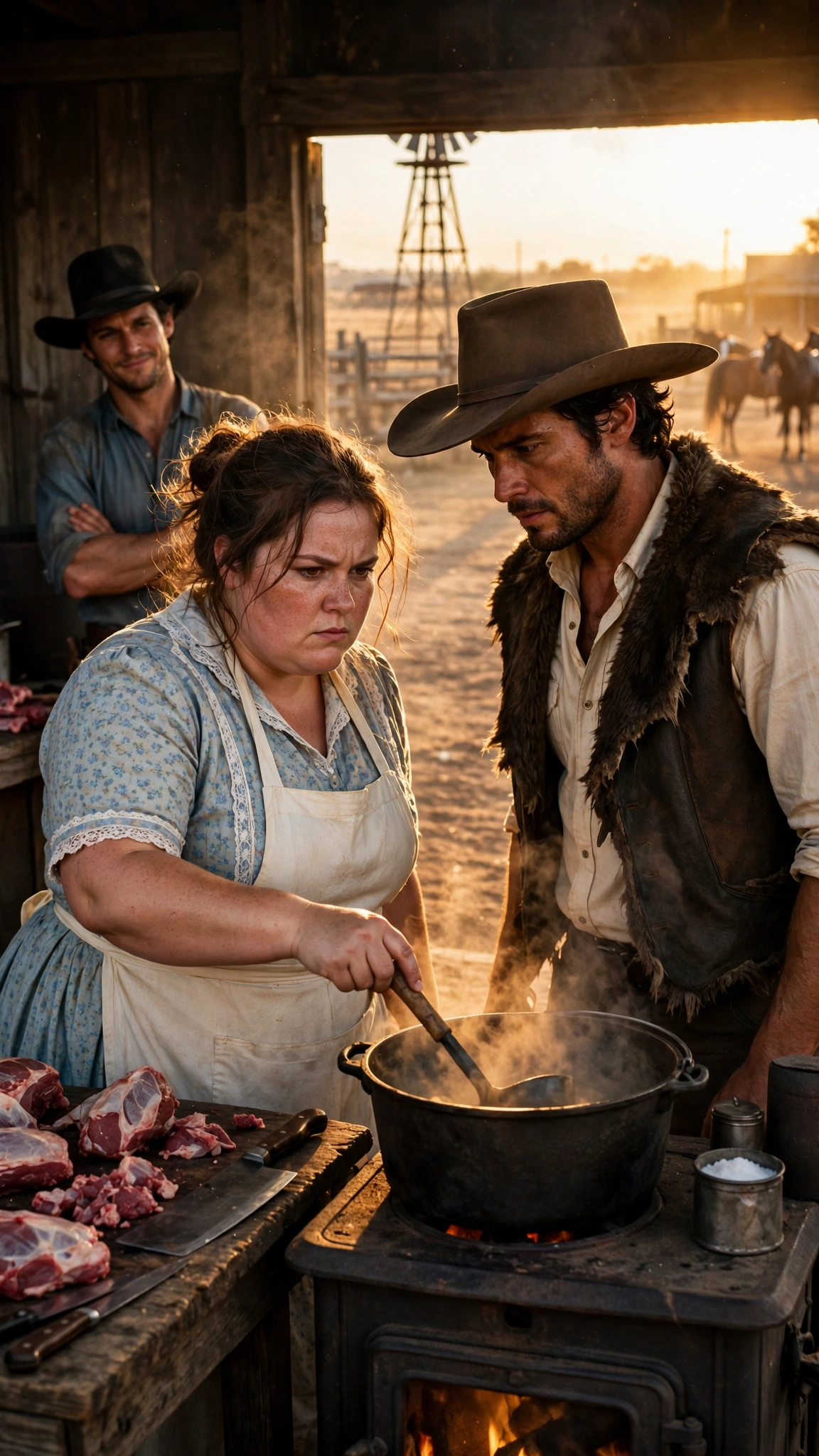
The night before the spring drive, the ranch went to bed early, because the drive began at dawn, and a man who is going to ride all day needs his sleep. The bunkhouse went dark by nine o'clock. The yard went quiet. The windmill turned slow against a sky full of stars. And Abigail Thornton sat in the cookhouse long after supper, packing the food for the drive — hard bread wrapped in cloth, dried beef, coffee, sugar, salt, all measured out and tied up in canvas sacks — because the men would eat on the trail for ten days, and a cook who sends hungry men onto the trail has failed them before they ever leave the yard.
She worked by lamplight, steady and unhurried, and the cookhouse was warm from the banked stove, and the smell of bread and coffee hung in the air, and she thought about the drive, and about the ten days the men would be gone, and about the quiet the ranch would have without them. She thought about Caleb, who would ride at the head of the drive, and about the way he had looked at her in the cookhouse on the night of the tasting — not mocking, not suspicious, but something softer, something she did not yet have a name for. She thought about the silver dollar in his pocket, and the ledger in hers, and the fact that Wyatt Granger was still on this ranch, and that a man like Wyatt does not stop because he has been embarrassed in front of thirty men. A man like Wyatt stops when he is made to stop. And nobody had made him stop yet.
She finished the packing at half past ten. She banked the stove. She blew out the lamp. She went to the door — and she stopped, because she smelled something.
Smoke.
Not wood smoke. Not the clean, honest smoke of a banked stove. Kerosene. Sharp and chemical, cutting through the night air, coming from the back of the cookhouse, from the woodpile, from the place where the spare canvas and the kindling were stacked against the wall.
She did not think. She did not hesitate. She ran to the back of the cookhouse, and she saw it — a dark shape moving away from the woodpile, low and fast, and a thin line of liquid shining on the ground in the moonlight, and the smell of kerosene so strong it made her eyes water. And then, with a sound like a match being struck, the woodpile caught.
The fire went up fast. Too fast. Kerosene does not burn the way wood burns — it runs, it spreads, it finds every crack and every dry board, and in a minute the whole back wall of the cookhouse was alight, and the flames were climbing toward the roof, and the heat was already so strong that Abigail had to shield her face with her arm.
She screamed. She screamed for the men, for Caleb, for anybody, and her voice went out across the dark yard, and then she did the thing she had been taught to do when there is a fire — she did not run away. She ran inside.
The cookhouse was filling with smoke. The flames were at the back wall, and they were coming toward the stove, and toward the table where the food for the drive was packed, and toward the shelf where her mother's recipe book lay wrapped in oilcloth. She grabbed the book first — she did not think about it, her hands simply went to it, because it was her mother, and it was the one thing in the world that could not be replaced. She wrapped it in her apron and tucked it against her chest. Then she grabbed the pot — the heavy cast-iron pot, still warm from the stove — and she dragged it toward the door, because a cook without a pot is a cook without a trade, and then she went back for the sacks of food, one at a time, dragging them out into the yard, coughing, her eyes streaming, her dress soaked with sweat, until the men came running.
They came from the bunkhouse in their nightshirts, barefoot, shouting, and Caleb was first among them, and he took one look at the fire and he shouted, "Water! Buckets! Form a line!" and the men formed a line from the well to the cookhouse, and the buckets went hand to hand, and the water flew, and Abigail stood in the yard with her mother's recipe book clutched to her chest and the soot on her face, and she watched her cookhouse burn, and she did not cry, because there was no time to cry, and because crying would not put out the fire.
It took an hour to beat the fire down. An hour of water and shouting and men with wet blankets beating at the flames. When it was done, the back wall of the cookhouse was gone, and the roof was half gone, and the woodpile was ash, and the yard was full of steam and smoke and exhausted men. But the stove stood. The table stood. The pot stood in the yard, black and whole. And the food for the drive — the bread, the coffee, the sugar, the salt — sat in its canvas sacks in the yard, safe, because Abigail Thornton had carried it out one sack at a time while the fire was still burning.
Caleb found her sitting on the well curb with the recipe book in her lap. He sat down beside her. He did not say anything for a long time. Then he said, "Are you hurt?"
"No," Abigail said. Her voice was hoarse from the smoke. "I am not hurt."
"Did you see who did it?"
"I saw a shape," Abigail said. "Low and fast, going away from the woodpile. I did not see his face. But I smelled kerosene, and I saw the line of it on the ground, and whoever poured it came from the direction of the bunkhouse, and went back that way."
Caleb nodded. He stood up. He walked to the back of the cookhouse, and he looked at the ground where the fire had started, and he looked at the line of kerosene, and he followed it with his eyes, and he found what he was looking for — a tin can, kicked aside in the dark, still smelling of kerosene, with a dent in one side. And beside it, in the soft earth, a boot print. Long and narrow. Heel worn down on the outside edge.
He picked up the can. He looked at the boot print. He looked at the bunkhouse, where the men were standing in the yard in their nightshirts, watching him. And his face went cold — colder than Abigail had ever seen it, colder than it had been in the yard on the day of the goat meat, colder than it had been when he had gripped Wyatt's wrist over the pot.
"Wyatt Granger," Caleb said. His voice was not loud. It was quiet, and it was terrible, and every man in the yard heard it. "Come here."
Wyatt came. He came slow, the way a man walks when he knows what is coming and cannot stop it, and he stopped in front of Caleb, and his black hat was in his hands, and his face was white, and for the first time since Abigail had known him, there was no smile on it at all.
Caleb held up the kerosene can. "Is this yours?"
Wyatt looked at the can. He looked at the boot print. He looked at the burned wall of the cookhouse. He looked at Abigail, sitting on the well curb with her mother's recipe book in her lap and soot on her face. And he said, in a voice that was barely a whisper, "I did not mean for it to go so far. I only meant to scare her. I only meant —"
"You meant to burn down my cookhouse," Caleb said. "You meant to destroy the food for the drive. You meant to drive off the woman who feeds thirty men, because you could not stand the fact that she is better at her job than you are at yours. And you have been stealing from my store for months, and you planted a stolen coin on her, and you opened the gate and drove off my goats, and you tried to poison her stew with salt. Is there anything else, Wyatt? Have I missed anything?"
Wyatt said nothing. The yard was silent. The men stood in a ring, the way they had stood in a ring on the day of the goat meat, and this time nobody was smiling, and nobody was nudging anybody, and nobody looked at the sky. They looked at Wyatt Granger, and they waited.
Caleb was quiet for a long moment. Then he said, "You are my cousin. My mother's sister's son. And because of that, I am not going to do what the law would do. I am not going to hang you, and I am not going to hand you to the sheriff. I am going to give you a horse, and a canteen, and twenty dollars, and you are going to ride out of this ranch at dawn, and you are never going to come back. If I ever see your face on my land again, I will shoot you on sight, and I will not warn you first. Do you understand me?"
Wyatt nodded. He could not speak. He turned, and he walked back to the bunkhouse, and the men parted to let him through, and nobody said a word, and Abigail sat on the well curb and watched him go, and she felt something inside her chest loosen — something that had been tight since the day she had walked into the cookhouse at dawn, something that had been tight for a year, since the day they had brought Thomas's hat back to the cabin.
Caleb sat down beside her again. He looked at the burned wall. He looked at the pot in the yard. He looked at the recipe book in her lap.
"You saved the pot," he said.
"I saved the book first," Abigail said.
"And the food," Caleb said. "You saved the food for the drive. Ten days of food, carried out one sack at a time, while the fire was burning."
Abigail looked at him. "A cook feeds people, Mr. Reynolds. That is the whole of it."
Caleb was quiet for a moment. Then he said, very quietly, "Abigail." He had never called her by her given name before. "When I come back from the drive — in ten days — I would like to talk to you. About the cookhouse. About the ranch. About… things."
She looked at him, and she saw something in his face that she had seen once before, on the night of the tasting, and she thought she knew what it was now, and her heart beat hard, and she said, "I will be here, Mr. Reynolds. I will be here when you come back."
He nodded. He stood up. He went to organize the men, and to count the damage, and to make sure the drive could still go out at dawn. And Abigail sat on the well curb a little longer, with her mother's recipe book in her lap and the soot on her face and the stars overhead, and she thought about the fire, and about the man who had set it, and about the man who had stopped him, and she thought about the fact that, for the first time in a year, she was not afraid of the morning.
She thought about Thomas, too. She thought about the stampede, and about the way the herd had gone over him like a river going over a rock, and about the fact that she had not been there, and that there had been nothing she could do, and that she had carried that helplessness with her for a year like a stone in her pocket. But tonight, when the fire had come, she had not been helpless. She had run toward it. She had carried out the book, and the pot, and the food, one sack at a time, while the flames were still burning, and she had saved the things that mattered. She could not save Thomas. She had saved everything else. And that, she understood now, was enough. It had to be enough. Because a woman cannot spend her whole life mourning what she could not save. Sooner or later, she has to turn around and save what is still standing.
At dawn, the drive went out. Abigail stood in the yard with a bundle of food in her arms — bread, coffee, dried beef, wrapped tight in canvas — and she handed it up to Caleb where he sat on his horse, and their hands touched for a moment, and neither of them said anything about the night before, and neither of them needed to. He tucked the bundle behind his saddle, and he looked down at her, and he said, "Ten days, Mrs. Thornton. Keep the cookhouse standing."
"I will," Abigail said. "And Mr. Reynolds — come back hungry."
He smiled then. A real smile, not the cold one, not the mocking one — a real smile, small and tired and true. "I will," he said. And he rode out, and she stood in the yard until he was gone, and the cookhouse stood behind her with its new wall and its patched roof, and the morning sun came up over the prairie, and she was not afraid of it.