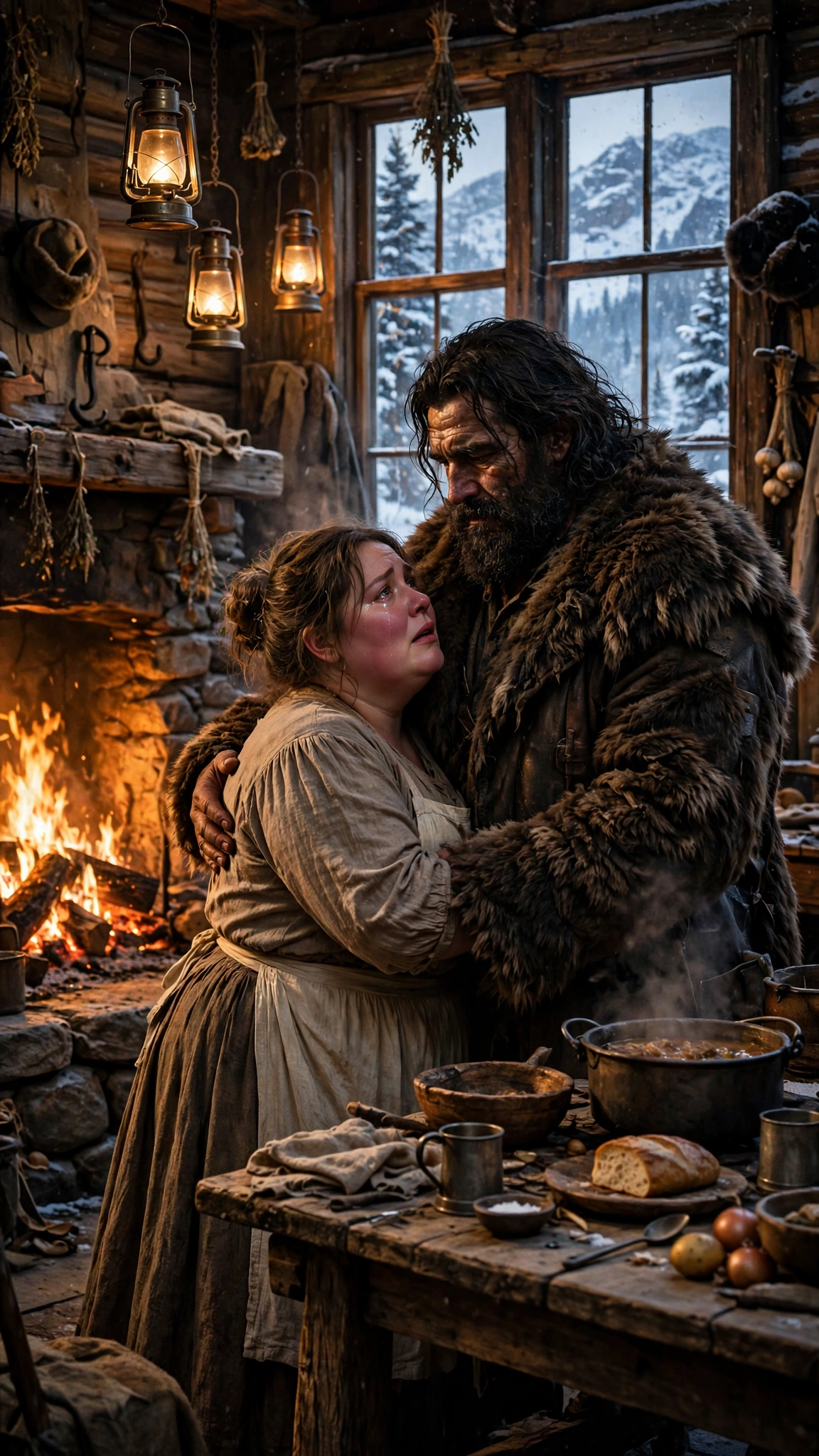
The next day, the sun stayed out, and the snow began to settle, and the mountain was so quiet that Matilda could hear the creek running under the ice, far below the house.
Jedodiah spent the morning mending the barn door, and Matilda spent it baking — bread, and a pan of apple cake from the last of the dried apples, because Tom Ellery had asked for something sweet, and because baking was the one thing that made her hands stop shaking. At noon, when the men had eaten and gone back out to the road, Jedodiah came into the kitchen and stood by the stove, warming his hands, and he said, "Show me the book."
Matilda looked up from the dishwater. "What book?"
"Your mother's book. The recipe book. Thomas told me about it, on the river. He said his wife carried it everywhere, and that it was worth more to her than gold."
Matilda dried her hands on her apron, and she went to her room, and she came back with the cracked red leather book, and she laid it on the work table between them, and she opened it, carefully, the way one opens something sacred.
The pages were soft as cloth, stained with butter and gravy and years of use, and the handwriting was small and neat and slanting — her mother's hand, from a kitchen in St. Louis, a lifetime ago. Recipes for bread and stew and pie, for pickles and preserves, for cough syrup and poultices, for everything a woman might need to keep a family fed and alive. And between the pages, pressed flat, were small things: a dried flower, a lock of hair tied with thread, a newspaper clipping about a flood, a letter from a sister in Ohio who had died before Matilda was born.
"This is my mother," Matilda said, touching the pages with one fingertip. "Eliza Hart. She cooked for a rich family in St. Louis, and she taught me everything. She used to say, 'A good stew can hold a family together, Matty.' And when she died, this was all I had left of her. Thomas said I should keep it close, and I have. I have kept it close through everything."
Jedodiah turned the pages slowly, with great care, his huge hands gentle on the fragile paper, and he stopped at the venison stew — the page stained dark with gravy, the handwriting a little larger there, as though her mother had been proud of it — and he read the last line aloud, in his deep, slow voice: "'And at the end, a spoonful of chokecherry jam, to give the broth its depth. Do not skip this. The jam is the secret.'"
"That is how he knew," Matilda said softly. "Thomas. He ate my stew on our wedding day, and he said he had never tasted anything like it, and I told him about the jam, and he laughed, and he said, 'Then I will marry the jam, too.'"
Jedodiah closed the book, and he set it back in her hands, and he said, "Your mother was a wise woman."
They sat by the fire that evening, after supper, when the men had gone to their rooms — Matilda in the warm chair, Jedodiah on a stool by the hearth, the firelight playing across their faces — and for the first time, Jedodiah told her about Sarah.
He told it plainly, the way a man tells a thing he has carried too long to dress up. Sarah had been the daughter of a preacher in Golden, and she had laughed easily, and she had loved the mountains, and she had married him in the spring of 1869, and she had died in the winter of 1871, giving birth to a child who had never drawn breath. He had been sixty miles away, checking his traps. He had come home to two graves in the frozen ground.
"I never forgave myself," he said, looking into the fire. "I told myself I would never love anyone again, because loving someone means being there, and I was not there. So I went up the mountain, and I stayed there, and I told myself the mountain was enough."
He was quiet for a moment, and then, to Matilda's surprise, he went on — slowly, the way a man speaks of something he has not spoken of in years.
"I met her in Golden, in the spring of 1868. She was the preacher's daughter, and she laughed — Lord, how she laughed. She laughed at my size, the first time she saw me, and then she laughed at herself for laughing, and then she invited me to supper, and I went, and I never really left. We married in the spring of 1869, in her father's church, and we built a cabin together, with our own hands, on a creek where the trout ran thick, and she planted a garden, and she sang while she worked, and she used to say that the mountains were God's own church, and that she had never been so happy in her life. She was carrying our child when the winter came, and the snow came early that year, and I went out to check the traps, because we needed the money, and I told myself I would only be gone a week. I was gone nine days. The storm —" His voice caught, just once, and he stopped, and looked into the fire, and when he spoke again his voice was steady. "The storm kept me on the mountain. By the time I got home, the neighbor woman had already dug the graves."
Matilda reached out, very slowly, and laid her hand on his arm — his great, scarred forearm, resting on his knee — and she left it there, and neither of them moved, and the fire crackled between them.
"It is not enough," Matilda said quietly. "A mountain cannot cook for you. A mountain cannot ask you how your day was."
"No," Jedodiah said. "It cannot."
They sat in silence for a while, and the fire popped, and the wind moved softly around the eaves, and Matilda thought about Thomas, and about the wagon, and about the pine tree beside the creek, and she said, "I used to think that grief was like a wound — that it would heal, and there would be a scar, and that would be the end of it. But it is not like a wound. It is like a room in your house. You learn to live with the room. You learn to walk past it without going in every time. But the room is always there."
She thought, too, about her mother's kitchen in St. Louis — about standing on a stool beside the stove, so small she could barely see over the pot, while her mother guided her hands on the spoon and said, "Slow, Matty. A stew cannot be hurried. A stew takes its own time, like a good life." She thought about her mother's hands, floury and strong, and about the way the kitchen had smelled on baking days, and about how she had believed, when she was a girl, that her mother would live forever, and that the kitchen would always be warm, and that nothing would ever change. And then her mother had died, of a cough that would not leave her chest, and Matilda had married Thomas, and Thomas had died, and the kitchen in St. Louis was gone, and all she had left of any of it was the book.
"This book," she said, touching the red leather cover, "is my mother. And Thomas is in it, too — in the margins, where he wrote little notes. See? Here, beside the bread recipe: 'Too much salt, Matty!' And here, beside the stew: 'Best stew in the territory. Do not tell Silas.' He wrote in my book as though it were his, too. As though we were —" Her voice broke, just a little. "As though we were a family. And we were. For a little while, we were."
Jedodiah nodded, and he looked at her, and in his icy-blue eyes there was something she had never seen there before — not pity, but recognition. The recognition of one person who had lost everything, looking at another person who had lost everything, and finding that the losses were the same shape.
"Thomas saved my life," he said. "On the river. I owe him a debt, and I mean to pay it. Not because he asked me to. Because it is the only way I know to honor him."
"You are paying it already," Matilda said. "You stood up for me. You gave me your coat. That is more than anyone has done for me since Thomas died."
"It is not enough," Jedodiah said. "Not yet."
The next morning, Mr. Pritchard came up the mountain from Leadville.
He arrived in a sleigh with two horses, wrapped in a fine wool coat and a fur hat, with a leather case full of papers, and he asked for Mrs. Thatcher, and Abigail received him in her parlor with the door closed, and they talked for an hour. When Pritchard left, his sleigh bells jingling down the road, Abigail came out of the parlor with a face like stone, and she went into the kitchen, and she looked at Matilda, and she said, "Mr. Vane will come himself, before the next storm. He will bring the papers. You would do well to be gone before he arrives."
Matilda said nothing. She went on kneading bread. But that night, when the house was quiet, she went up to the attic — the cold, dark attic where the old things were kept, where she had cleaned and swept three weeks before, when Abigail had asked her to make room for the winter stores — and she stood among the trunks and the broken chairs and the boxes of Edmund Thatcher's books, and she thought about what Jedodiah had said: that a house does not turn on its cook for nothing, and that there is always something underneath.
She did not know what she was looking for. She only knew that the attic was where the past was kept, and that the past was where the truth lived. She moved a trunk. She opened a box of books. She found Edmund Thatcher's Bible — a big, heavy book with a leather cover gone soft with use — and she opened it, and inside the front cover, folded small, was a piece of paper.
She took it out. She unfolded it. She held it up to the lantern light, and she read it, slowly, twice, because she did not understand it the first time.
It was a receipt. A receipt for money paid — a large sum, in full — against the mortgage on the Thatcher Boarding House, signed by Cornelius Vane himself, and dated three weeks before Edmund Thatcher died. The mortgage, the debt that Abigail believed would take her house, had been paid in full. Edmund had paid it. He had paid it before he died, and he had folded the receipt inside his Bible, and no one had ever known.
Matilda's hands began to shake. She folded the paper again, very carefully, and she did not put it back in the Bible. She slipped it inside her mother's recipe book, between the page for venison stew and the page for chokecherry jam, where it would be safe, where no one would ever think to look, and she put the Bible back in its box, and she went downstairs to her small room, and she sat on her bed with the recipe book in her lap, and she thought, very hard, about what she had found, and about what it meant, and about what she would do with it.
She did not tell Jedodiah. Not yet. She needed to be sure. She needed to understand exactly what the paper said, and what it meant for the house, and for Abigail, and for Mr. Vane.
She stood a moment longer in the attic, among the dust and the old trunks, and she thought about Edmund Thatcher — a man she had never met, who had borrowed too much and dreamed too big, and who had, in the end, quietly done the one right thing that mattered, and then folded the proof inside his Bible and told no one. She thought about how a house could be saved by a single piece of paper, and how a man's whole life could come down to one honest act that no one ever saw. The lantern light flickered on the boxes, and the wind moved softly against the roof, and she pressed the recipe book a little tighter against her chest, because it held two truths now — her mother's stew, and a dead man's receipt — and both of them were worth keeping safe.
But she slept that night with the recipe book pressed against her chest, and in the morning she got up before dawn, and she lit the stove, and she began her day, and she waited for the storm that was coming — not the storm in the sky, but the storm that was coming up the mountain road from Leadville, in a sleigh with two horses, carrying a man who believed he owned her home.
=== STEP 5 — APPEND Chapter 5 ===