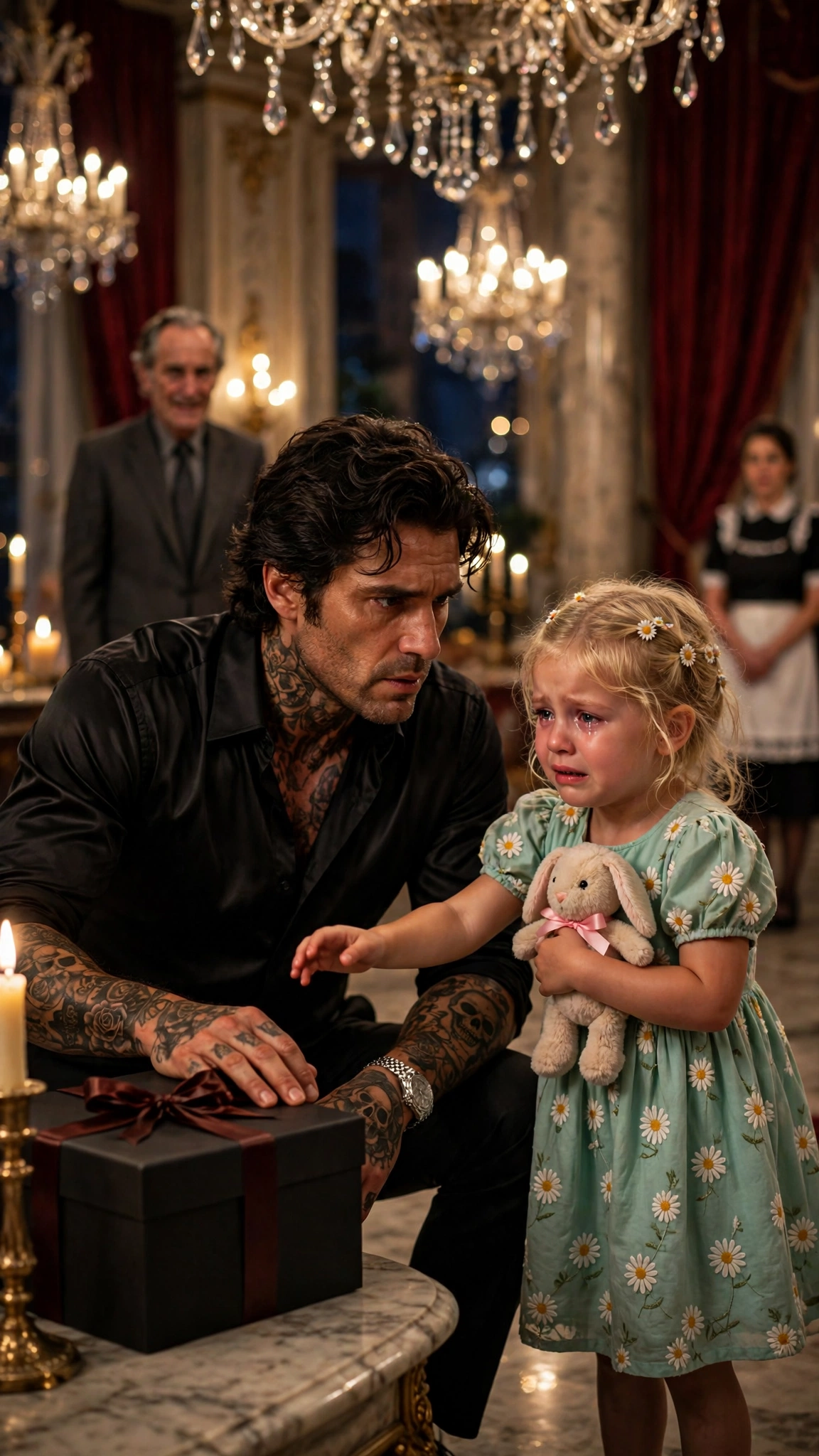
Two days before the party, Mia Moretti was playing hide-and-seek, and she was very good at it.
The game had started after lunch, when Rosa was in the kitchen and her father was out at the docks, and the house was quiet in the way it only got quiet on rainy afternoons. Mia had counted to fifty with her face pressed against the wall of the nursery — she had counted fast, the way she always did, skipping the numbers she did not like — and then she had gone looking for Rosa. She had looked in the kitchen, and in the pantry, and behind the curtains in the library. She had not found her. So she had gone to the study, her father's study, because the study had the best hiding places in the whole house, and she was certain Rosa was hiding there, waiting to jump out and scare her.
The study was dark and warm and smelled of her father's cologne and old books. The heavy curtains were drawn against the rain, and the desk lamp was off, and the big leather chair sat empty behind the desk. Mia stood in the doorway for a moment, listening. The house was silent. The rain tapped softly against the windows.
She decided to hide first and wait. It was a brilliant plan. Rosa would come looking for her, and she would not find her, and then Mia would jump out from behind the curtain and win the game forever.
She slipped behind the heavy velvet curtain beside the bookshelf, pulling it closed around her, and she crouched down small, hugging her knees, holding Mr. Buttons tight against her chest, trying not to giggle. The curtain smelled of dust and her father's cologne. Through the small gap where the curtain did not quite meet the wall, she could see the study: the desk, the chair, the door.
She waited. She counted to twenty in her head. She was very patient. She was the best hider in the whole world.
Then the study door opened, and her godfather walked in.
Marcus Bellini did not see her. He closed the door behind him, quietly, and he stood for a moment with his back to the room, his hand on the door, as if he were listening to make sure no one had followed him. Then he took his phone out of his pocket, and he dialed a number, and he waited, and when someone answered, his voice changed.
Mia had never heard her godfather's voice sound like that. It was low and fast and afraid. It was the voice of a man who was trying not to be heard, and trying not to cry, at the same time.
"I can't do this," he said. "Please. You have my son. I will do what you ask, but you have to promise me — you have to promise me Marco comes home."
There was a pause. Mia held her breath. Mr. Buttons' ear was pressed against her cheek.
"I understand," Marcus said. "The box comes in the morning. I will make sure he opens it at the table. In front of everyone. Yes. Yes, I understand what happens if I don't."
Another pause. Longer this time. Marcus put his free hand over his eyes. His shoulders shook once, like a man trying not to sob.
"Just don't hurt him," he whispered. "He's nineteen. He doesn't know anything. Please. I'll do it. I'll do it."
He ended the call. He stood in the middle of the study for a long time, staring at the phone in his hand as if it had bitten him. Then he went to the desk, and he opened the top drawer, and he took out a small matte-black voice recorder — a little thing, no bigger than a matchbox, with a single red light on its side — and he looked at it the way a man looks at something that might explode. He pressed a button on it. The red light blinked. He spoke into it, very quietly, in a voice that was not his own, a voice that was flat and slow, as if he were reading words someone else had written for him.
"Happy birthday, Lorenzo," he said, and then he stopped, and he pressed the button again, and the light went out.
Then he walked to the bookshelf, and he reached behind the books on the second shelf, and he took down a gift box that Mia had never seen before — a large black box, tied with a dark red ribbon — and he lifted the lid, and he slid the little black recorder inside it, under the tissue paper, and he closed the lid, and he put the box back behind the books.
Then he stood there, with his hands on the box, and he said, very quietly, to no one, "God forgive me."
And then he left, closing the door softly behind him, and Mia sat behind the curtain for a long time, hugging Mr. Buttons, trying to understand what she had seen.
She did not understand the words. She was five. She did not know who "Marco" was, though she knew her godfather had a son with that name, a big boy who used to play with her in the garden. She did not know what "the box" was, though she had seen it, black paper and dark red ribbon, hidden behind the books. She did not know what "I will make sure he opens it at the table" meant.
But she understood the fear in his voice. She had never heard her godfather afraid before. Marcus was the man who swung her up into the air and brought her candy and told her she was the smartest girl in the world. He was not supposed to be afraid. Grown-ups were not supposed to sound like that — like a child trying not to cry in the dark.
And she understood one more thing, the way children understand things without words: whatever was in that box, it was not a present. A present does not make a grown man whisper, "God forgive me."
She stayed behind the curtain until her legs went numb. Then she crept out, very quietly, and she went to find Rosa, because Rosa was the person you went to when something was wrong, and something was very wrong.
She found Rosa in the kitchen, peeling potatoes, humming an old song under her breath. Rosa looked up and smiled, and then she saw Mia's face, and she put the knife down.
"Mia?" she said. "What is it, sweetheart?"
Mia climbed onto the chair beside her and leaned close, the way she did when she had a secret, and she whispered, "Rosa, Uncle Marcus was in Daddy's study, and he was talking on the phone, and he sounded scared, and he put a little black box in a big box with a red ribbon, and he hid the big box behind the books."
Rosa went very still. Her hands stopped moving. The kitchen was quiet except for the rain on the windows.
"What did he say, Mia?" Rosa asked, very gently. "Tell me exactly what he said."
Mia told her. She told her about the phone call, and about Marco, and about the box coming in the morning, and about her godfather opening it at the table. She told her about the little black recorder, and about the words "Happy birthday, Lorenzo," and about the words "God forgive me." She told it the way a child tells a story — in pieces, out of order, going back to add the parts she had forgotten — and Rosa listened to every word, her face growing more serious with each one, her hand resting on Mia's shoulder, steady and warm.
When Mia had finished, Rosa was quiet for a long moment. Then she said, "You did the right thing, telling me. You are a very brave girl, Mia."
"Is Uncle Marcus in trouble?" Mia asked.
"I don't know," Rosa said, and it was the truth. "But I am going to find out. And I want you to promise me something. If you see that box again — the black one with the red ribbon — you stay away from it, and you come and find me. Do you understand?"
Mia nodded. "I promise."
"Good girl." Rosa kissed the top of her head. "Now, go and play. And Mia — don't tell your father yet. Not until I know more. All right?"
"All right," Mia said. But she did not go and play. She went to the window and looked out at the rain, and she thought about her godfather's voice, and she felt the small cold feeling in her chest that she did not have a name for yet, the feeling that something bad was coming, and that nobody else knew.
Rosa did not go and play either. She stood in the kitchen for a long time after Mia had gone, staring at nothing, her hands flat on the counter. Then she went to the study.
The box was not there. She looked behind the books on the second shelf, where Mia had said it was, and the shelf was empty. The gift box was gone.
Rosa checked the library. She checked the ballroom. She checked the hall closet. The box was nowhere in the house. Which meant that Marcus had moved it — or that it had never been meant to stay in the study at all. Which meant that whatever was happening, it was already in motion, and she was already behind it.
She thought about calling Lorenzo. He was at the docks. She could have called him. But what would she have said? That a five-year-old had overheard a phone call she did not understand, and seen a box that was no longer there? Lorenzo would have listened — he always listened to Rosa — but he would have wanted proof, and she had none. And Marcus was his oldest friend, Mia's godfather, the man he trusted with his life. Rosa knew what that trust was worth, and she knew what it would cost to break it on a child's word alone.
So she waited. She watched. And she told herself that she would keep Mia close, and that she would watch Marcus, and that if the box came back, she would know what to do.
The box came back the next morning, at noon, in a black car with no plates, delivered to the gate by a man no one had seen before.
Rosa was in the kitchen when the guard brought it in. She took one look at it — the black box, the dark red ribbon, the bow so perfect it looked tied by a machine — and her blood went cold. It was the same box. She was sure of it. The same box Mia had seen her godfather hide behind the books.
She went to find Mia. Mia was upstairs, in her room, drawing a picture of the family for her father's birthday. Rosa sat down beside her on the bed.
"Mia," she said quietly. "Do you remember the box you saw in the study? The black one with the red ribbon?"
Mia nodded, her eyes wide.
"It came to the house today," Rosa said. "A man brought it to the gate. Your godfather said to put it in the ballroom, on the marble table, in the center, where everyone can see it."
Mia put her crayon down. "Is it bad, Rosa?"
"I don't know, sweetheart," Rosa said. "But I want you to remember your promise. Stay away from it. And if your father is about to open it — if you think something is wrong — you tell him. You tell him right away. Do you understand? You are the only one who saw. You are the only one who knows."
Mia nodded again. She picked up her crayon. She went back to her drawing — the three of them, herself and her father and Rosa, standing in front of the house, all of them smiling, the sun yellow and enormous in the corner. But her hand was shaking, just a little, and the sun came out crooked.
That evening, the guests began to arrive. One by one, in evening dress, shaking the rain off their coats, laughing too loudly, filling the ballroom with noise and music and the clink of champagne glasses. The tables were set with white linen and the good crystal, and the candles were lit, and the chandeliers threw golden light over everything, and in the center of the main table sat the box, black paper and dark red ribbon, waiting.
Marcus arrived last. He came in through the kitchen door, the way he always did, and he kissed Rosa on the cheek, and he swung Mia up into the air, and she shrieked with delight, and for a moment everything was exactly as it had always been. But Mia, who was five years old and could always tell, felt his hands shaking as he held her, and she saw the tired lines around his eyes, and she saw the way he looked at the box on the table — quickly, and then away, as if it might burn him.
She was not afraid of the box. She was afraid for him. Because whatever her godfather had done, he had done it with that frightened voice, the voice of a man who was trying not to cry. And Mia, who loved him, understood something that the grown-ups in the room did not: her godfather was not the danger. Her godfather was in danger too.
The party went on. The guests drank. The roast was served. Lorenzo laughed, and told stories, and raised his glass, and for a while it was a birthday like any other, warm and loud and golden. Mia sat in her chair, swinging her legs, eating her cake in small careful bites, watching the box out of the corner of her eye. Rosa stood near the red curtains with a serving tray, watching Mia, watching Marcus, watching the box, her silver cross catching the light every time she moved.
And then Lorenzo stood up, and the room went quiet, and he reached for the ribbon.
Mia did not think. She did not plan it. She simply did what Rosa had told her to do, what her own small heart had been telling her to do for two days.
She stood up. She stepped forward. She put her small hand on her father's wrist.
"Don't open it!" she cried. "He put something inside!"