The house on the hill had not always been a fortress.
When Lorenzo was a boy, it had been his grandmother's house, a white clapboard place with a garden full of roses and a kitchen that always smelled of garlic and bread. His grandmother had been a small, fierce woman from Naples who had come to America with nothing and built a family out of stubbornness and Sunday dinners. She had taught Lorenzo to read the newspaper at the kitchen table and to never trust a man who smiled too quickly. She had died when he was nineteen, the same year his father had handed him the family business and told him, in the quiet way his father had of saying the most important things, that a man who could not protect his own house did not deserve to own one.
Lorenzo had spent the next seventeen years turning the white clapboard house into something else. He had bought the land around it, acre by acre, until the house stood alone on its hill above the water, surrounded by lawns and old trees and a stone wall that was higher than it looked from the road. He had rebuilt it in stone and dark wood, with tall windows, a grand ballroom that could hold a hundred guests, a library, and a study with a locked drawer, and a nursery on the second floor with a window that looked out over the water. He had done it because he believed, the way his father had believed, that a house was a promise: as long as the house stood, the family stood.
But a house is only as safe as the people inside it. Lorenzo had learned that the hard way, three years ago, when Elena had died.
Elena Moretti had been the best thing that had ever happened to him. She had been a schoolteacher when he met her, a woman with dark hair and a quick laugh who had no idea who he was and did not care when she found out. She had married him in a small church with fifty guests, and she had given him Mia, and she had made the house on the hill into a home in a way that all his money and all his men never could. She had a way of seeing straight through people — through their noise and their performance, to the small true thing underneath — and she had taught Mia to do the same, without ever meaning to. It was in the blood, Rosa said. The child saw what she saw.
Elena had died on a Tuesday night in November, of a fever that came on fast and did not leave. Lorenzo had sat beside her bed all night, holding her hand, calling every doctor he knew, offering money that no one could take because there was nothing left to buy. She had died just before dawn, with the rain falling outside, and she had looked at him with clear eyes and said, "Take care of our girl. She sees everything. Don't let the world teach her to stop."
He had promised. He had kept the promise the only way he knew how: by working harder, by making the family stronger, by making sure no one would ever dare to touch what was his. He had thrown himself into the business — the docks, the restaurants, the construction contracts, the quiet arrangements that kept the Moretti name at the top of the city — and he had told himself that he was protecting Mia. It had taken him three years to understand that a little girl does not need a fortress. She needs her father at the dinner table.
Rosa had understood it before he did. Rosa had been in the house for twenty years, since she was a girl of twenty-eight hired to help Lorenzo's mother. She had been Elena's friend first — they had cooked together, and laughed together, and Rosa had been the first person Elena had called when she found out she was pregnant. When Elena died, Rosa had not asked Lorenzo what to do. She had simply moved her things into the small room next to the nursery, and she had taken Mia's hand, and she had become the person Mia ran to first. She dressed her in the morning. She read to her at night. She knew that Mia liked her toast cut in triangles, and that she was afraid of thunder, and that she had a stuffed rabbit named Mr. Buttons who had to be in the bed or she could not sleep.
Rosa was not Mia's mother. She would never claim to be. But in the only sense that mattered to a five-year-old — the person who is there, every day, when you wake up and when you fall asleep — Rosa was Mia's mother now. And Lorenzo, who had lost his wife and nearly lost himself, had learned to be grateful for it, and to trust Rosa with the one thing in the world he could not afford to lose.
"Mr. Moretti," Rosa had said to him once, in the kitchen, in the second year after Elena's death, when he had come home at three in the morning and found her sitting at the table waiting for him, "your daughter asked me today where you go at night. I told her you go to work. She said, 'Daddy's work is very far away.' I did not know what to tell her."
He had not known what to tell her either. He had gone upstairs and stood in the doorway of the nursery and watched Mia sleep, her blonde hair spread on the pillow, Mr. Buttons tucked under her arm, and he had felt the weight of the promise he had made to Elena like a stone in his chest.
That was when he had started coming home earlier. That was when he had started eating dinner at the table instead of in the car. That was when he had decided that his thirty-sixth birthday would be different — that he would be home all day, that there would be a party, that Mia would wear her princess dress and he would be there to see it.
It was also when Marcus Bellini had started to change.
Lorenzo had known Marcus since they were boys on the same street in Bensonhurst, stealing peaches from the market and running from the shopkeeper, two skinny kids with nothing who had decided, the way boys decide, that they would have everything one day. They had come up together through the family, shoulder to shoulder, and when Lorenzo had inherited the top, Marcus had taken the place at his right hand without a word of complaint. He was the only man Lorenzo trusted completely. He was Mia's godfather. He had held her at the christening, in the church with the candles, and he had cried, and Lorenzo had never forgotten it and had never mentioned it.
But in the last few months, Marcus had changed. He had lost weight. He had stopped laughing the way he used to laugh. He came to meetings late, and he left early, and when Lorenzo asked him what was wrong, he said, "Nothing, Lorenzo. I am fine. You worry too much." He said it the way a man says it when he is not fine at all.
Lorenzo had told himself it was the pressure. The business had been hard that year. The De Luca family — the Morettis' oldest enemy, led by Vincent De Luca, a man who had wanted the Moretti docks and the Moretti name erased for a decade — had been pushing on every front: undercutting prices at the docks, leaning on the restaurant owners, sending men to stand outside the construction sites and stare. It was the kind of slow, patient pressure that wore men down. Lorenzo had assumed Marcus was worn down. He had assumed that was all it was.
He had not asked the right questions. He had not asked where Marcus went on the nights he left early. He had not asked why Marcus had stopped bringing his son Marco around the house. He had not asked why, when the phone rang, Marcus now went into the other room to answer it.
Marco was nineteen, Marcus's only son, a tall, earnest boy who had grown up in the house on the hill almost as much as Mia had, playing in the garden, eating Rosa's cooking, calling Lorenzo "Uncle." Lorenzo had watched him grow from a child into a young man, and he had been proud of him the way a man is proud of his best friend's son. But Marco had not been around in months. When Lorenzo asked about him, Marcus said, "He is busy. He is young. He has his own life." And Lorenzo, who had his own daughter to worry about and his own business to run, had let it go.
That was his second mistake. He would remember that too, later, in the ballroom, with the candles burning down and his daughter's hand on his wrist.
The house on the hill was beautiful that October day. The rain fell soft on the lawns, and the trees were turning gold and red, and the stone wall stood solid around the garden, and the windows glowed warm against the gray sky. From the road, it looked like the safest place in the world. From the nursery window, where Mia stood that afternoon looking out at the water, it looked like a castle.
Mia liked the house. She liked her room, and the garden, and Rosa's kitchen, and the library where her father let her sit on his lap and turn the pages of the big books. She liked the ballroom best of all, because it was where the family came together, and because the chandeliers made the light dance on the marble tables like stars. She did not know what her father did for work. She knew that he was important, and that men came to the house and called him "boss," and that sometimes he came home late and tired. She knew that Rosa loved her, and that her godfather Marcus brought her candy, and that her mother was in heaven, watching her, which Rosa had told her, and which she believed completely.
She did not know that the house had enemies. She did not know that there were men in the city who wanted her father dead, and who had been patient enough to wait for the right day to try. She did not know that her godfather had been given a choice no man should ever have to make.
She only knew what she had seen, two days earlier, in the study, when she had been playing hide-and-seek and had hidden behind the heavy curtain and had watched her godfather take a phone call he did not know she could hear.
She had not understood the words. She had understood the fear in his voice.
And she had carried it inside her small chest for two days, waiting, the way children wait, for the moment when someone would ask her, and she could tell the truth.
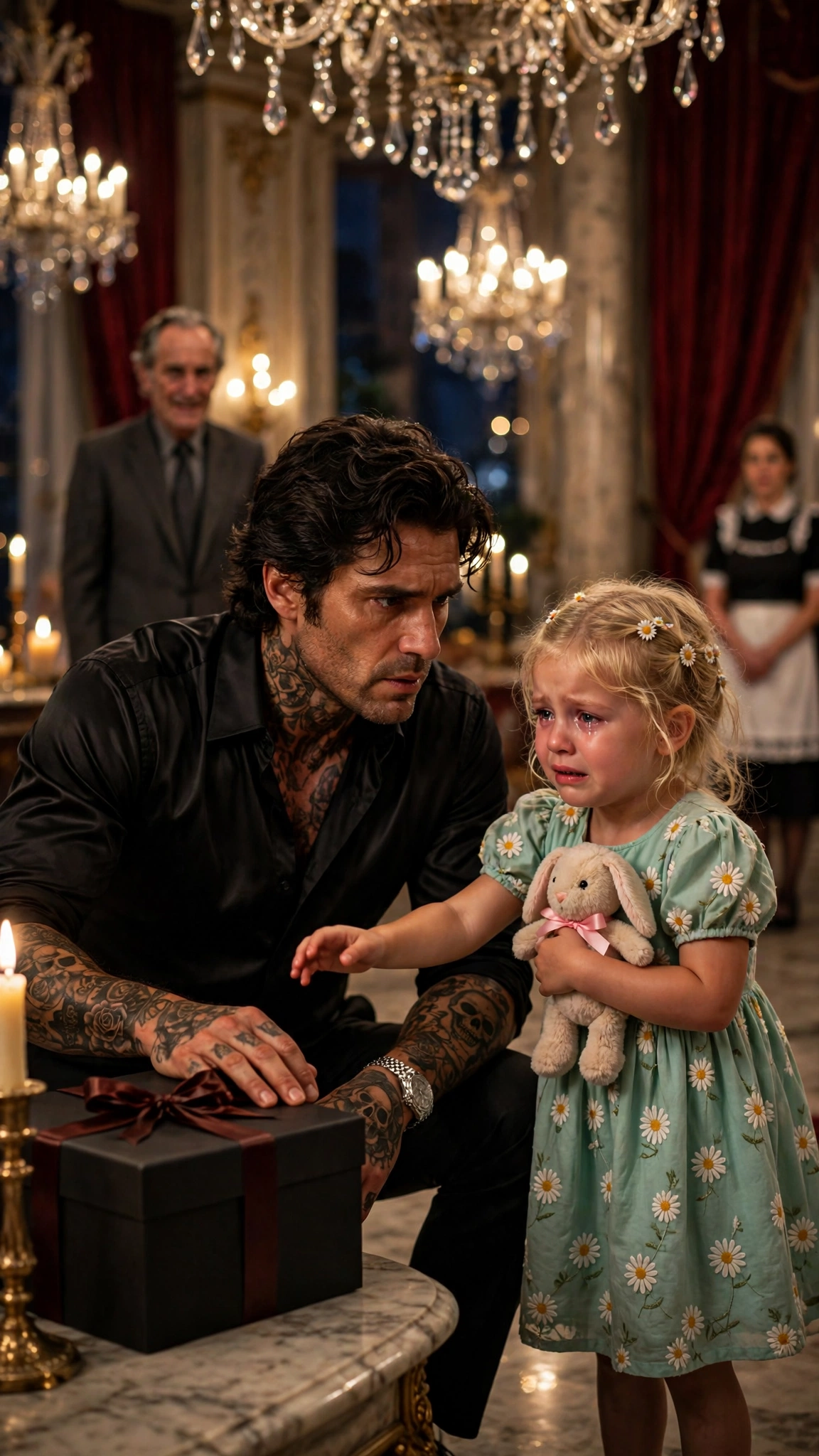
That moment was coming. It would come in the ballroom, in front of a hundred guests, with the candles burning down and the rain falling outside and a black gift box with a dark red ribbon sitting on the marble table like a heart.
The ballroom had been Elena's idea. When Lorenzo rebuilt the house, she had asked for one room that belonged to joy alone — no business, no guards at the door, just music and light. He had given her high ceilings and red curtains and a floor of pale marble, and on their wedding night they had danced there until the candles burned down. After she died, he had kept the room locked for a year. Then Mia had found the key, and she had opened the doors, and she had twirled across the empty floor in her socks, and Lorenzo had understood that a room built for joy should not be allowed to grieve forever.
And when it came, Mia Moretti — five years old, in a mint-green daisy dress, with an daisy clip in her hair — would not hesitate. She would step forward, and she would put her small hand on her father's wrist, and she would say the words that would save his life.
She did not know that yet. That afternoon, she was only a little girl in a castle on a hill, looking out at the rain, waiting for her birthday party to begin.