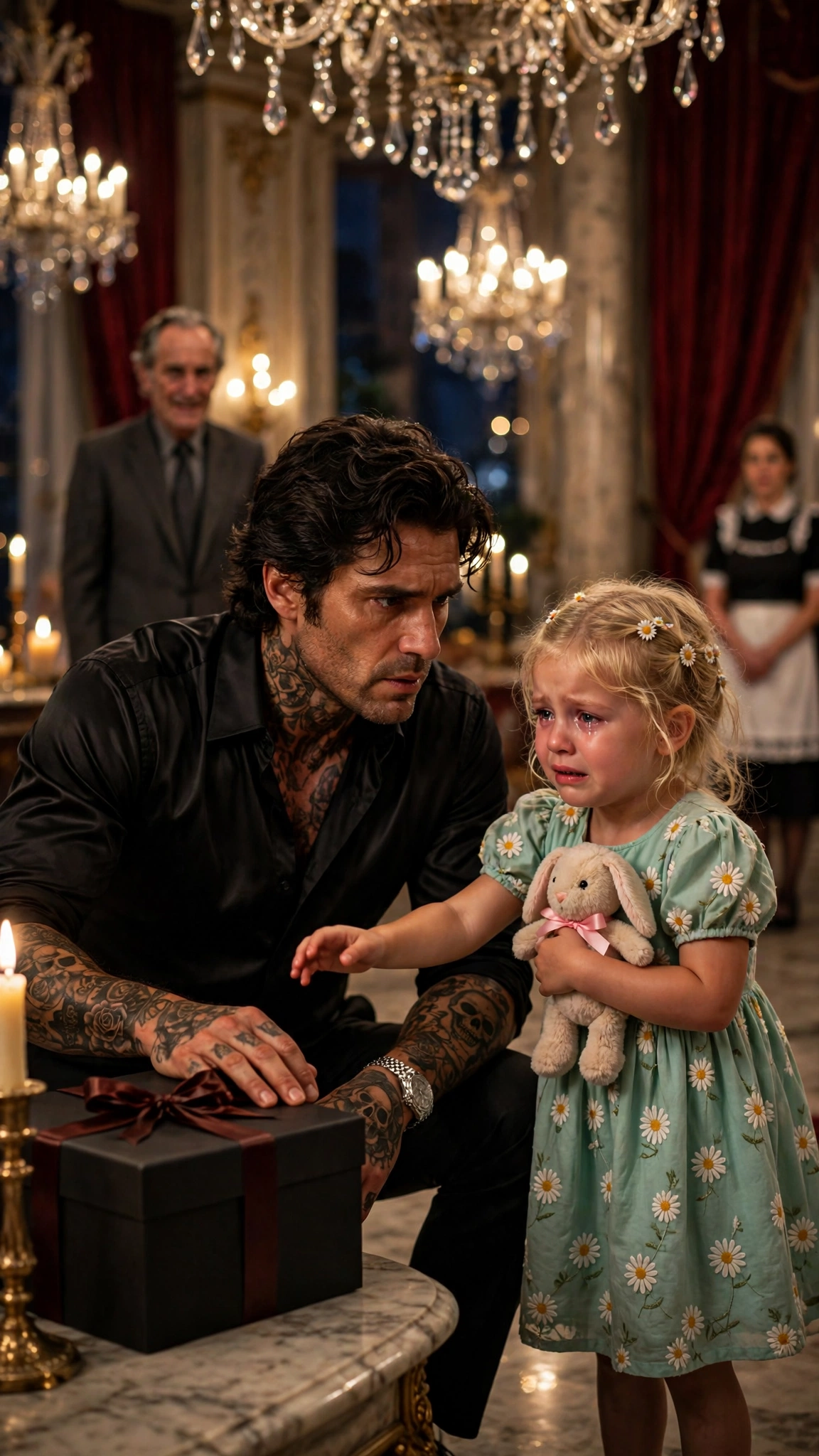
Lorenzo Moretti did not open the gift. Not then. Not in front of a hundred guests with his daughter's hand on his wrist and the whole room holding its breath.
He did something else. He did the thing that had kept him alive for fifteen years at the top of a business that killed most men before thirty. He stopped. He looked. And he waited.
The guests went home. Rosa took Mia upstairs, and the little girl went without a sound, her eyes wide, Mr. Buttons clutched tight to her chest, her small white shoes silent on the stairs. She looked back once, over Rosa's shoulder, at her father. He looked back at her. He nodded, just once. It was enough.
Within ten minutes the ballroom was empty except for two men: Lorenzo Moretti and Marcus Bellini, who had not moved from his place by the red curtains. And between them, on the marble table, the black box, its lid closed again, its dark red ribbon untied and lying loose across the black paper.
Marcus stood with his hands flat on the table, his charcoal suit immaculate, his graying hair slicked back, his face a careful mask. But Lorenzo could see the truth now, the way he had seen it in flashes all day — the tired lines around the eyes, the hands that trembled when they thought no one was looking, the smile that never reached the eyes. Marcus looked like a man who had been waiting for this moment for a very long time, and who was terrified of it now that it had arrived.
"Marcus," Lorenzo said. He did not raise his voice. He did not need to. "You knew about this, didn't you?"
Marcus's smile froze. He opened his mouth. He closed it. He looked at the box, sitting untouched in the center of the table, the dark red ribbon still untied, and he looked at the stairs where Mia had gone, and he looked at Lorenzo, and something in his face broke — not all at once, but the way a dam breaks, a small crack first, and then everything behind it.
"Lorenzo," he said. His voice was hoarse. "I can explain."
"Then explain," Lorenzo said. "But first — the box."
He reached for the lid. This time, no small hand stopped him. This time, the room was quiet, and the candles were burning low, and the rain was falling outside, and Lorenzo Moretti lifted the lid of the box.
Inside, nestled in white tissue paper, there was a small matte-black voice recorder, no bigger than a matchbox, with a single red light blinking on its side.
Lorenzo stared at it. He had expected something terrible. He had expected the worst thing he could imagine. And what he found was a little black machine — a small, ordinary, silent machine, the kind of thing that could hold a voice, or a threat, or a secret.
He picked it up. It was light. Too light to be dangerous. And yet his hands were steady, and his breathing had slowed, the way it always slowed when he was about to do something that could not be undone.
He pressed play.
A voice came out of the little machine — flat, amused, unmistakable, a voice Lorenzo had heard a hundred times across a table, a voice that belonged to Vincent De Luca.
"Happy birthday, Lorenzo," the voice said. "The man standing beside you sold you for his son. He put this little machine in the box, and he made sure you would open it in front of everyone you love. Play this where your guests can hear it, and your most trusted man dies tonight — your own men will do it for you, and they'll do it in front of your little girl. Destroy it, and the boy dies instead. Your choice, boss. The same choice I gave him."
The voice stopped. The red light went out. The ballroom was silent except for the rain on the windows and the slow, ragged breathing of the man across the table.
Lorenzo put the recorder down on the marble table, very carefully, as if it might explode, and he looked at Marcus.
"Three weeks," he said. His voice was low. It was dangerous. "You've been carrying this for three weeks. Tell me why."
Marcus did not answer. He sat with his hands flat on the table, and he stared at the recorder, and his face was gray, and his breathing was shallow, and for a moment Lorenzo thought he might faint. Then Marcus spoke, and his voice was the voice Mia had heard in the study two days earlier — low and fast and afraid, the voice of a man trying not to cry.
"They have Marco," he said.
Lorenzo went still. "What?"
"They have my son." Marcus's hands were shaking now, openly, and he did not try to hide it. "Three weeks ago. Marco was at the De Luca casino — he went there with friends, he was stupid, he was nineteen and stupid — and he took money. Not much. Not enough to matter. But they caught him. And De Luca's men took him. They have had him for three weeks, Lorenzo. Three weeks. And they told me — they told me that if I wanted him back alive, I had to do one thing. One thing."
"The box," Lorenzo said.
"The box." Marcus nodded. "They gave me the recorder. They told me to put it in the gift, and to make sure you opened it at the table, in front of your guests. They said — they said that if you played it in front of everyone, your guests would hear De Luca's voice, and they would know I had betrayed you, and they would kill me on the spot. And if I warned you, if I told you first, they would kill Marco. And if you destroyed it — " He stopped. He swallowed. "They said the boy dies instead."
He could not finish. He put his face in his hands.
Lorenzo stood very still. He looked at the recorder. He looked at the box. He looked at the man who had been his best friend for twenty-five years, who had held his daughter at her christening, who had cried, and he felt something inside him crack — not anger, not yet, but something colder and deeper: the feeling of a man who has just understood that the world he thought he lived in was not the world he actually lived in.
"Marcus," he said, and his voice was so quiet it was almost a whisper. "You were supposed to protect this family."
"I know," Marcus said, and his voice broke. "God forgive me. I know. But he is my son, Lorenzo. He is my only son. What was I supposed to do?"
Lorenzo did not answer. He did not know the answer. He stood in the ballroom with the candles burning low and the rain falling outside, holding a little black machine that proved his oldest friend had betrayed him, and he thought about Mia upstairs, and about Rosa, and about Elena, who had told him to take care of their girl, and he thought about the trap that had been laid for him so carefully — a trap in which whatever he did, someone he loved would die.
And then he did the thing that no one in that room, and no one in the city, would have expected him to do.
He put the recorder back in the box. He closed the lid. He retied the ribbon.
"Here's what is going to happen," he said, and his voice was calm, and it was cold, and it was the voice of a man who had just made a decision that could not be unmade. "You are going to tell me everything. Every word they said. Every place you met. Every name. And then you are going to help me turn this trap around on the men who built it. Because they made one mistake, Marcus. They thought the weapon was the box. It was never the box. The weapon was what the box would make me do. And I am not going to do it."
Marcus looked up at him, his face wet, his eyes red. "What are you going to do?"
"I am going to get your son back," Lorenzo said. "And then I am going to make Vincent De Luca regret the day he ever heard the name Moretti."
Outside, the rain fell on the roof of the house on the hill. Upstairs, a five-year-old girl lay awake in her bed, holding Mr. Buttons tight, listening to the silence below, wondering if her father was safe.
And downstairs, in the ballroom, with the candles burning down to stubs, Lorenzo Moretti began to plan.
He sat down slowly, in the chair at the head of the table, and he looked at the box for a long time without touching it. The dark red ribbon was still tied. The bow was still perfect. It looked like any birthday gift in the world, and it was the most dangerous thing he had ever held in his hands.
He thought about all the gifts he had received in his life. As a boy, his grandmother had given him a pocketknife, and taught him to whittle, and told him that a knife was a tool before it was a weapon, and that the difference was in the hand that held it. As a young man, his father had given him a watch — not this one, an older one, a simple one — and told him that a man who was late was a man who did not respect other people's time. Elena had given him books, and sweaters, and once, for his thirtieth birthday, a photograph of the two of them on their wedding day, in a silver frame, which still sat on his desk in the study. And Mia — Mia gave him drawings, every year, drawn in crayon, of the family, of the house, of the sun yellow and enormous in the corner. Those were the only gifts that had ever mattered.
This box was different. This box had been given to him by a man who wanted him dead. It had been delivered by a stranger, carried by his oldest friend, and placed in the center of his own table, in his own house, in front of his own daughter. It was not a gift. It was a message. And the message was: nowhere is safe. Not your house. Not your table. Not your birthday. Not the people you love.
Lorenzo had received messages like that before. He had received them in the form of burned warehouses, and stolen shipments, and men who did not come home. He had always answered them the same way: quickly, and without mercy, and in a way that made sure the message was never sent twice. That was the world he lived in. That was the price of the name Moretti.
But tonight was different. Tonight, his five-year-old daughter had stood up in front of a hundred guests and told him the truth, and the truth had not been that someone wanted to kill him. The truth had been that someone he loved was afraid. And that changed everything. Because you could answer a threat with violence, and Lorenzo had done that a hundred times, but you could not answer fear with violence. Fear had to be answered with something else. With patience. With listening. With the willingness to sit in a quiet room at midnight, with a little black recorder on the table, and ask the question that no one in his world ever asked: why?
Why would Marcus do this? Why would a man who had stood at his right hand for twenty-five years, who had held his daughter at her christening, who had cried in a church full of candles, why would that man put a recorder in a box and hide it behind the books? Lorenzo knew the answer before he asked the question. He knew it the way he had known, at ten o'clock that morning, that something was wrong. A man does not betray his best friend for money. He does it for love. He does it for his son. He does it because someone has put a gun to the thing he loves most, and told him to choose.
And that was the trap. Not the recorder. Not the box. The choice. De Luca had given Marcus a choice no man should ever have to make, and he had counted on Lorenzo giving him the same choice in return: your friend, or your family. Kill him, or let him destroy you.
Lorenzo was not going to make that choice. He was going to make a different one. He was going to refuse the trap, and he was going to find a third way, the way his grandmother had taught him when he was a boy with a pocketknife: a knife is a tool before it is a weapon, and the difference is in the hand that holds it. The recorder was a tool. The voice inside it was a tool. And Lorenzo Moretti was going to use them — not to kill his best friend, but to save his best friend's son, and to make the man who had built the trap regret ever building it.
He stood up. He went to the window, and he looked out at the rain, and at the dark lawn, and at the stone wall, and at the road beyond it, where a black car with no plates had driven away that morning. He was not afraid. He had not been afraid in a very long time. But he was careful, and he was patient, and he was angry in the cold, clear way that had always made him dangerous.
Then he went to his study, and he locked the door, and he began to plan.