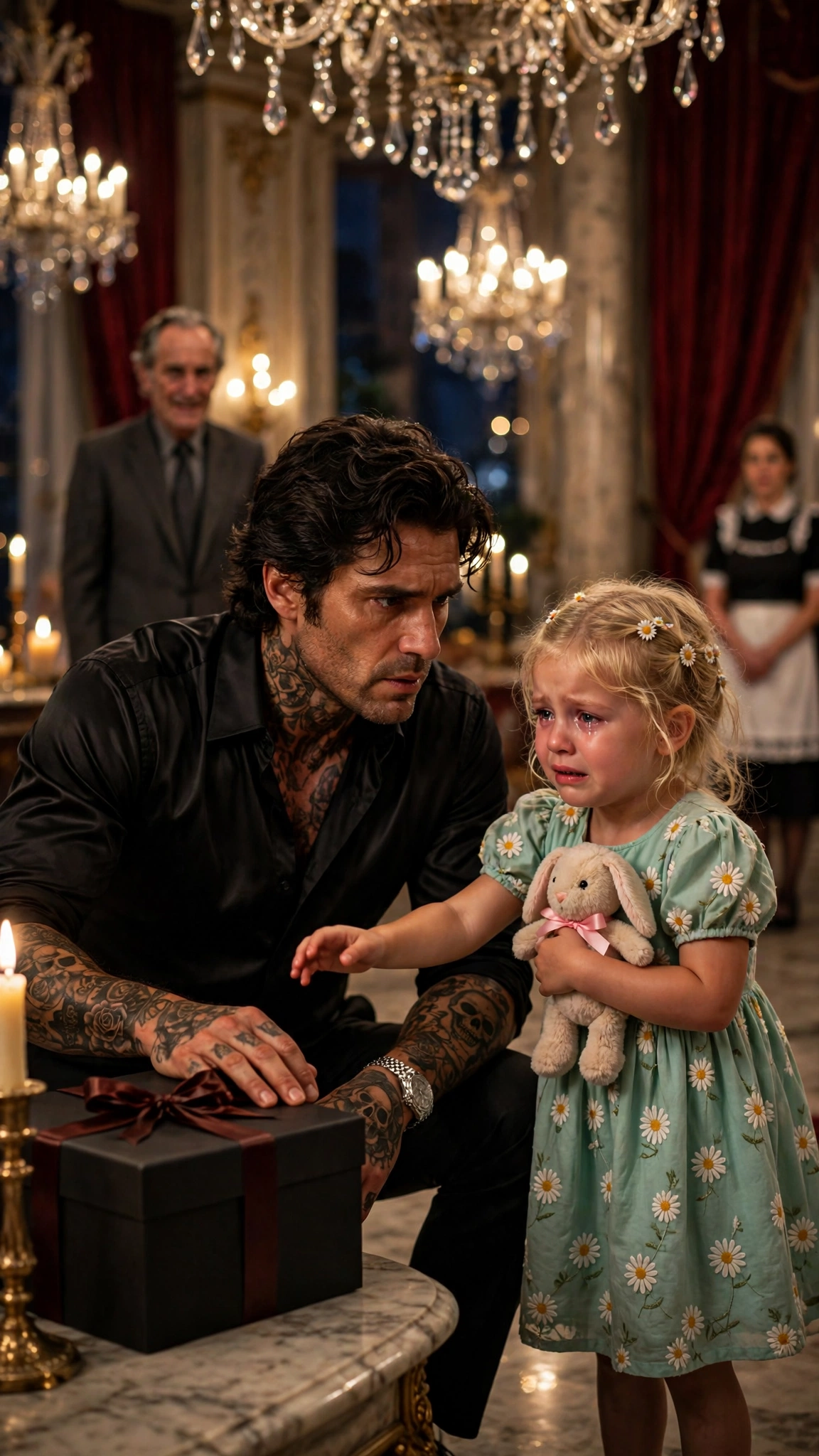
The meeting was set for the following night, at the old warehouse on the waterfront, the neutral ground where the families had met for fifty years when they needed to talk without killing each other.
Lorenzo did not go alone. He never went alone. But he went quiet — only four men, his best, his most trusted, the ones who had been with him the longest and who knew, without being told, that something important was happening. He did not tell them the whole story. He told them only what they needed to know: that Marcus had made a mistake, that the mistake was being fixed, and that tonight they were going to bring a boy home.
Marcus went with him. He had not wanted to go. He had argued, in the study, in a low voice, that De Luca would kill him the moment he walked through the door, that it was a trap, that Lorenzo was walking into the same trap De Luca had built for him at the birthday table. Lorenzo had listened, and then he had said, "That's the point, Marcus. It is a trap. And we are going to walk into it — because we know it is a trap, and he doesn't know that we know."
That was the whole plan. It was simple. It was dangerous. And it was the only plan they had.
The warehouse was cold and dark and smelled of salt water and old wood. The rain had started again, drumming on the metal roof, and the lights were low, and the shadows were long. Vincent De Luca was already there when they arrived, sitting at a table in the center of the room, flanked by six of his own men, his heavy shoulders hunched, his scarred knuckles flat on the table, his cold eyes fixed on the door.
He was a big man, De Luca, bigger than Lorenzo, with a face that had been broken more than once and put back together badly. He had wanted the Moretti docks for a decade, and he had wanted the Moretti name erased for just as long, and he had spent ten years being patient, waiting for the right moment, building his trap piece by piece. He thought tonight was that moment. He thought he had already won.
"Lorenzo," he said, as Lorenzo walked in. "You came. I wasn't sure you would."
"I came," Lorenzo said. He did not sit down. He stood at the end of the table, tall and calm in his dark suit, his watch catching the dim light, his gray-brown eyes steady. "Where is the boy?"
De Luca smiled. It was a slow, satisfied smile, the smile of a man who has just bought something expensive. "The boy is safe. The boy is comfortable. The boy will stay safe and comfortable — as long as we can come to an understanding."
"What kind of understanding?"
"The kind where you give me the docks," De Luca said. "The Moretti docks. All of them. The contracts, the warehouses, the men. You sign them over to me, tonight, and your friend's son goes home. You refuse, and — " He shrugged. "Well. You know what happens if you refuse."
Lorenzo looked at him for a long moment. Then he did something De Luca did not expect. He laughed.
It was a short, quiet laugh, the kind of laugh a man makes when he has just heard something so stupid he cannot help himself. De Luca's smile faltered.
"What's funny?" De Luca said.
"You are," Lorenzo said. "You think you've won. You think your trap worked. You think I played that recording at the table, in front of my guests, and I heard your voice, and I threw my best friend out of my house, and now here I am, crawling to you, ready to give you everything. Is that what you think?"
De Luca's eyes narrowed. "That's what happened."
"No," Lorenzo said. "That's what you wanted to happen. What actually happened is this: my five-year-old daughter warned me not to open the gift. My housekeeper believed her. I sent my men home. I played the recording alone, with Marcus sitting across from me, and I heard your little message — 'Play this in front of your guests, and your most trusted man dies tonight. Destroy it, and the boy dies instead.' — and I understood exactly what you were trying to do. You weren't trying to kill me with a box, Vincent. You were trying to make me kill my own best friend. You were trying to make me do your work for you."
He took the small black recorder out of his jacket pocket. He held it up, and he pressed play. De Luca's voice filled the warehouse — flat, amused, unmistakable. "Play this in front of your guests, and your most trusted man dies tonight. Destroy it, and the boy dies instead." Lorenzo let the words hang in the cold air for a moment. Then he pressed stop.
"And here's the thing you didn't think about," Lorenzo said. "Your voice is on this little machine, Vincent. You, admitting it. You took a nineteen-year-old boy hostage and used him to blackmail his father. And do you know what happens in our world when a man takes a child hostage?"
De Luca's face had gone very still. His men had stopped moving. The rain drummed on the roof.
"Every family in this city hears about it," Lorenzo said, and his voice was calm, and it was cold, and it filled the warehouse the way it always filled a room. "Every family. The Castellanos. The Romanos. The Bellinis. All of them. And they all understand one thing: a man who takes a child hostage is a man who cannot be trusted. A man who cannot be trusted is a man who cannot do business. And a man who cannot do business is a man who is finished."
He set the recorder down on the table, between them, so that De Luca had to look at it.
"So here's my offer, Vincent," Lorenzo said. "You give me Marco back. Tonight. Right now. Unharmed. And you leave the docks alone. You leave my family alone. You leave my daughter alone. And in return, I don't play this recording for every family in New York. I don't tell them what you did. I let you walk out of here with your reputation intact, and we forget this ever happened."
De Luca stared at the recorder. He stared at Lorenzo. His jaw worked. His scarred knuckles tightened on the table.
"And if I refuse?" he said.
"Then I walk out of here," Lorenzo said, "and by tomorrow morning, every family in the city will have heard this recording, and they will all know what you did. And you will have no friends left, Vincent. Not one. And a man with no friends in this city does not last long."
There was a long silence. The rain fell on the roof. The men on both sides stood very still, their hands near their jackets, waiting to see what would happen.
Then De Luca laughed. It was a short, bitter laugh, the laugh of a man who has just realized he has been outplayed and hates it.
"You're a clever bastard, Lorenzo," he said. "You always were. Your father was the same way."
"My father taught me to never trust a man who smiles too quickly," Lorenzo said. "You smiled too quickly, Vincent. That was your mistake."
De Luca stood up. He nodded to one of his men, a tall, thin man with a scar over his eye, and the man left the room without a word. A few minutes later, he came back, and behind him, blinking in the dim light, was a boy.
Marco Bellini was nineteen years old, tall and thin, with dark hair and his father's sharp features, and he looked like a boy who had not slept properly in three weeks. He was pale. His clothes were wrinkled. His hands were shaking. But he was alive. He was whole. He was unharmed.
Marcus made a sound — a small, broken sound, like a man who has been holding his breath for three weeks and has finally been allowed to breathe — and he stepped forward, and Marco saw him, and the boy's face crumpled, and he ran to his father, and Marcus caught him in his arms, and held him tight, and did not let go.
"Marco," Marcus whispered. "Marco, I'm here. I'm here. You're safe. You're safe now."
Lorenzo watched them, and he felt something in his chest loosen — a knot he had not known was there, loosening, letting go. He looked at De Luca, and he nodded, once, the way men nod when a deal is done.
"Good," he said. "Now get out of my city, Vincent. And don't come back."
De Luca looked at him for a long moment. Then he turned, and he walked out of the warehouse with his men behind him, into the rain, into the dark, and he did not look back.
Lorenzo stood in the warehouse with the rain drumming on the roof, and he watched Marcus hold his son, and he thought about the recorder on the table, and about the box with the dark red ribbon, and about the trap that had been built so carefully and had failed so completely — because a five-year-old girl, playing hide-and-seek behind a curtain, had seen through it.
He picked up the recorder and put it in his pocket. He would keep it. Not as a weapon — he had promised De Luca he would not use it, and Lorenzo Moretti kept his promises — but as a reminder. A reminder that the most dangerous thing in the world was not a bomb, or a gun, or a rival family. The most dangerous thing in the world was a man who thought he could use a child to hurt a family.
He turned to Marcus. "It's done," he said. "Your son is home. Now we go home too."
They drove back through the rain, in silence, the city sliding past the windows, dark and wet and beautiful. Marcus sat in the back seat with his arm around Marco, who had fallen asleep against his father's shoulder, exhausted, safe at last. Lorenzo sat in the front, looking out at the water, thinking about the house on the hill, and about Rosa, and about Mia, who was asleep in her bed with Mr. Buttons tucked under her arm, dreaming whatever five-year-old girls dream about.
He thought about what he had promised Marcus. Exile. Not death. Exile.
He would keep that promise too. In the morning, he would give Marcus money — enough to start over, enough to live on — and he would put him and Marco on a plane to somewhere far away, somewhere warm, somewhere no one knew their names. And Marcus would go, because he had agreed, and because it was the right punishment, and because it was also a mercy: a chance to be a father to his son, without the weight of what he had done hanging over him.
It was not forgiveness. Lorenzo did not forgive — not easily, not completely, not ever. But it was something close to it. It was the understanding that a man who had been given an impossible choice, and who had chosen his son, was not a monster. He was a father. And Lorenzo, who was also a father, understood that in a way no one else in the city ever would.
The car turned up the hill, toward the house, toward the warm windows, toward home. And Lorenzo Moretti — thirty-six years old, a mafia boss, a widower, a father — sat in the dark and felt, for the first time in three weeks, that the world was right again.
In the morning, Lorenzo drove Marcus and Marco to the airport himself. He did not send a driver. He did not send a man. He drove the car, and Marcus sat in the back with his son, and they did not talk much, because there was not much left to say.
At the terminal, Lorenzo gave Marcus a thick packet, full of cash, and a letter with the name of a man in Florida who owed Lorenzo a favor and who would give Marcus work, and a house, and a fresh start. Marcus took it with both hands, and he looked at Lorenzo, and he said, "I don't know how to thank you."
"Don't thank me," Lorenzo said. "Take care of your son. That's all I ask. Take care of Marco, and don't ever come back. Not because I hate you, Marcus. Because I love you. And because the only way this works — the only way any of us survives this — is if you disappear, and you stay disappeared, and you build a new life where no one knows your name."
Marcus nodded. He hugged Lorenzo then, hard, the way men hug when they know they will never see each other again, and Marco shook Lorenzo's hand, and said, "Thank you, Uncle Lorenzo," and Lorenzo said, "Take care of your father, Marco. He's a good man. He made a terrible choice, but he made it for you, and that counts for something."
Then they walked through the doors, and they were gone, and Lorenzo stood in the airport for a long moment, watching the planes take off, thinking about twenty-five years of friendship, and about the price of loyalty, and about the fact that the hardest thing he had ever done was not killing a man. It was letting one live.
He drove home through the morning traffic, and when he got to the house on the hill, Rosa was in the kitchen, and Mia was at the table, eating her toast in triangles, and the sun was coming through the windows, and for a moment, everything felt almost normal. Almost.
Rosa looked up when he came in. She saw his face. She put down the knife.
"Is it done?" she asked.
"It's done," Lorenzo said. "Marco is home. Marcus is gone. De Luca is finished. The house is safe."
Rosa nodded. She did not ask for details. She had known Lorenzo for twenty years, and she knew that some things were better left unsaid. She poured him a cup of coffee, and she set it in front of him, and she said, "Your daughter asked about Uncle Marcus this morning. She wanted to know where he went."
"What did you tell her?"
"I told her he went away on a long trip," Rosa said. "And that he loves her very much. And that he will always love her, no matter how far away he goes."
Lorenzo nodded. "That's the truth," he said. "All of it."
"Yes," Rosa said. "It is."