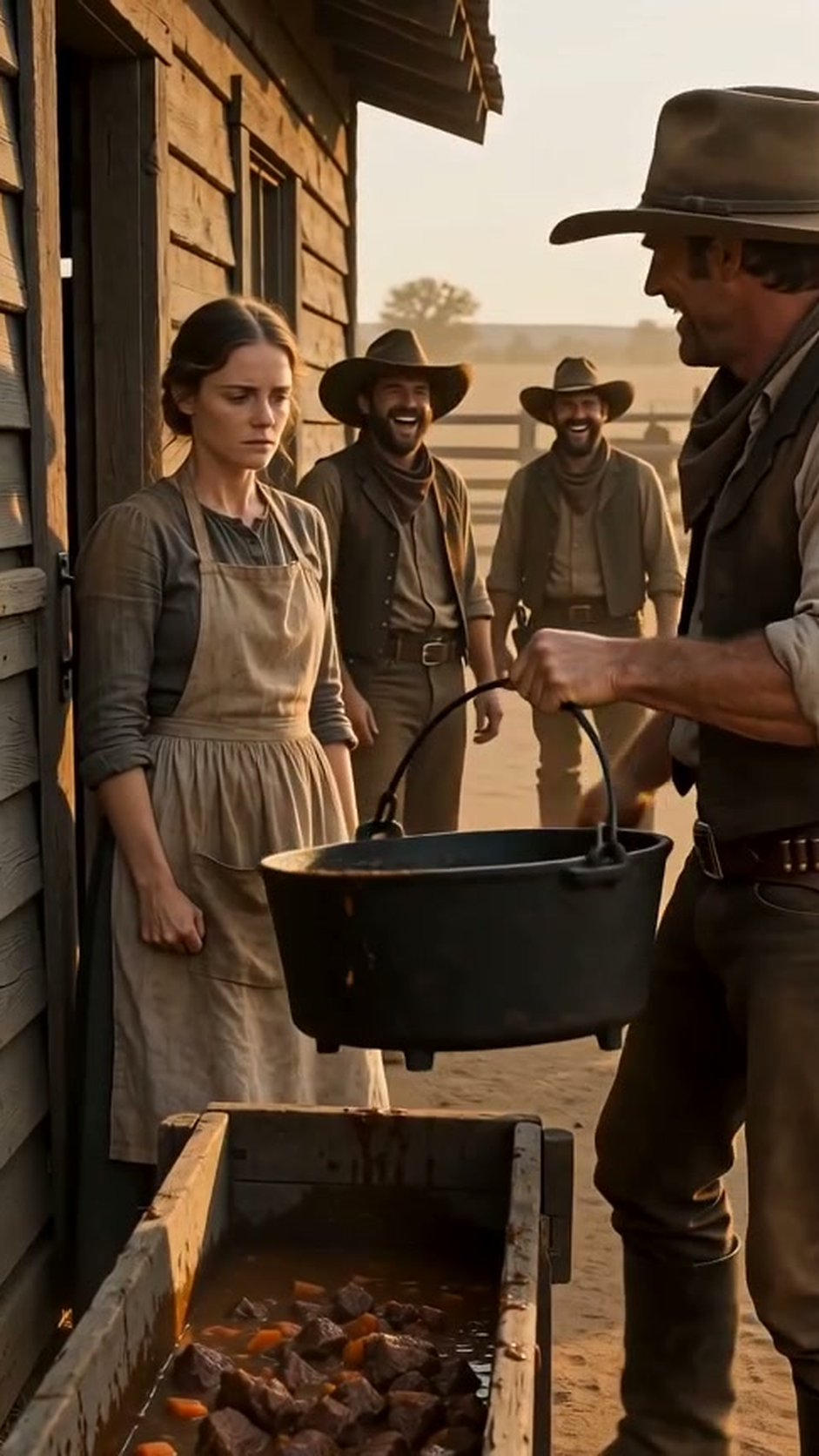
A few of the men began to come back.
It started the way rain starts in a dry country — a drop here, a drop there, nothing you'd swear to. Four nights after the second setting of the table, Gus Henley came into the cookhouse at five-thirty with his hat in his hand and announced to the room at large that a man his age was a fool to ride four miles for a hotel steak he could get et tuffer at home, and sat down at the far end of the table, and ate two helpings and a piece of pie, and left a nickel by his plate like it was a restaurant. The next night there were three men. The night after, five — Andrew among them, and Lonnie, wrist healed, eating left-handed around his grin — and the rest of the crew still rode to town with Buck, but they rode slower now, and some of them looked back at the lamplit cookhouse windows as they went.
Buck noticed. Of course Buck noticed. Buck noticed everything on the Bar Seven the way a hawk notices a field.
He said nothing to the men. That wasn't his way. Instead, the cook's life got smaller. Her supply orders came back from the Dryfork store cut in half — the foreman's countersignature required, the storekeeper apologetic and evasive. The woodpile by the cookhouse, which the yard hand kept filled, stood empty two mornings running, so Bertha split her own wood at dawn with her skirts pinned up. The boy who helped her with the heavy water hauling was reassigned to fence work twelve miles out. Every burden landed soft and deniable and exactly where it would do the most work, and every evening Bertha set the table anyway — some nights for thirty, which was a statement; and the men who came ate like men making a statement back.
And the shortages went on — but now she watched them with new eyes.
Because if Lester Oler paid Buck to bring men to town, then Lester Oler's saloon kitchen fed thirty men most nights of the week, and a saloon kitchen needs beef, and flour, and coffee — and where would a saloon keeper get beef cheap and quiet, without invoices, without questions? From a foreman who trimmed rounds off ranch steers in the night and blamed coyotes with a knife. The stolen stores weren't waste. They were cargo. The Bar Seven was feeding the Gilded Steer at both ends — paying for the food twice, once when it vanished and once when its own men bought it back in town with their wages, at hotel prices, with three dollars a week changing hands for the privilege of the arrangement.
It was, Bertha thought, the neatest piece of thievery she had ever heard of. It only had one flaw.
It had to be written down somewhere. Men like Lester Oler, who ran a book on everything — "the book being square," he'd said, laughing, behind his own saloon — men like that kept books. And men like Buck, who had an auditor coming in June, kept count of what they were owed.
Bertha found the ledger on the second Saturday of June, and she found it the way she found everything on the Bar Seven: by doing the job nobody else would do.
Saturday was her cleaning day for the ranch house and the little lean-to office off the tack room that Buck used for the crew accounts. She had cleaned that office six Saturdays running without seeing anything but tally books and dust. But this Saturday Buck was two days gone on the north fence line, and the tack room was empty, and a drawer of his desk — the deep bottom drawer — stood open an inch on a swollen runner, the way drawers do in a Texas June.
She told herself she was closing it so the dust wouldn't get in. Her hand was honest even if her reason wasn't; she pulled it open instead.
The tally books were on top. Under them, wrapped in a square of oiled cloth like something a man meant to keep dry on a river crossing, was a book bound in dark leather, small enough to fit a coat pocket, and Bertha Platt knew what it was before she ever opened it, the way you know a snake is a snake before it moves.
Dates. In a cramped, careful hand — Buck's hand; she knew it from the supply orders. Dates down the left, week by week, going back eleven months — back before her time, back through old Jory's drunken tenure, back to a winter when her mother was still alive and cooking and Buck was already at his trade.
*Apr 6 — crew in, 28 — L.O. — 3.00*
*Apr 13 — crew in, 30 — L.O. — 3.00*
*May 4 — beef, 2 rounds, coffee 10 — L.O. — 14.50*
*May 25 — crew in, 30 — L.O. — 3.00*
Page after page. Three dollars a week for the crew, steady as rent, and alongside it the quiet commerce of her vanishing pantry — beef rounds, coffee, flour, sugar — sold to L.O. at prices that would make a storekeeper weep with joy, and every line of it in the foreman's own hand, in the foreman's own book, wrapped in oiled cloth in the foreman's own desk.
She turned back to the beginning of it, the way you turn back to the first page of a letter you can't believe you're reading. The earliest entries were in a slightly different ink, and they were dated the October before last — and the left-hand column, where Buck noted the crew count, told the story Lonnie had guessed at, in numbers.
*Oct 12 — crew in, 19 — L.O. — 3.00*
*Oct 19 — crew in, 24 — L.O. — 3.00*
*Nov 2 — crew in, 29 — L.O. — 3.00*
Nineteen. Twenty-four. Twenty-nine. It had grown the way mold grows in a damp cellar, a few men at a time. October of the year her mother took sick — the autumn Martha Platt's cough settled in her chest like a lodger, when the suppers came late and thin because the cook was cooking on willpower and the master was in Fort Worth begging his bankers not to call the note. Buck hadn't invented the town habit. He had found it, the way a man finds a calf caught in a fence, and instead of freeing it he had put a price on it, and then — this was the part that made her hands cold around the little book — he had *husbanded* it. Fed it. Kept the kitchen weak after her mother died, hired a drunk to follow a saint, fought every honest plate that threatened his market, so that the accident of one bad year became the annuity of the next.
There was a line in December, in the different ink, underlined once:
*Dec 7 — M.P. gone to San Tomas. Crew in, 30. Full count.*
M.P. Her mother, gone to San Tomas to her sister's house to rest, the trip from which she had come home only to die. *Full count.* He had written it like a man recording a fair day's work. Thirty men in the Gilded Steer on the week Martha Platt left her kitchen for the last time, and three dollars in Buck Thorp's pocket, and the sum of it set down in a cramped, careful hand, as if it were fencing he had mended.
Bertha closed the book on that page for a moment and stood with her palm flat on the leather cover, breathing the way her mother had taught her to breathe through bad news: in slow, out slower, and no decisions till the third breath.
Then she opened it again and read every page through, start to finish, a second time — memorizing. Dates. Counts. The beef entries. Because a book you do not take is a book you must carry in your head, and she wanted it carried right: if the day ever came when that ledger lay open on a table between Buck Thorp and the truth, she meant to be able to say *turn to the second week of April* before any man could turn the page for her.
Three dollars. She turned the pages slowly, standing in the dusty light of the tack room with the smell of leather and horse all around her, and she thought the figure was almost worse than a big one would have been. A man who steals a thousand dollars has at least stolen something. Buck Thorp had sold thirty men's suppers and her mother's memory and the good name of the Bar Seven table, week by week by week, for three dollars — less than the price of the stew he had poured into the hog trough, which had been worth, at store prices, about five.
She did not take the ledger. That was the hardest thing she had done since February, harder than watching the stew pour — to close that book, wrap it in its cloth, and lay it back in the drawer with the tally books squared on top, her hands steady, her breathing steadier. Because a missing ledger is a warning. A missing ledger is a man burning his other evidence, moving his money, and making sure the word of a cook and a seventeen-year-old boy stands alone against his in June, in an office, in front of an auditor from Fort Worth.
No. The book would stay where its owner kept it, safe and smug and fatal — until the day it was needed, in front of the one man whose saying-so could end this.
But knowledge is a weight that changes how a person walks, and she must have walked different, because that evening at supper — eleven men at the table now, and the coffee strong, and a cobbler Gus Henley pronounced fit for a hanging judge — Buck came in with the returning crew's dust still on him, and he stood in the cookhouse doorway a long moment, and he looked at her the way a man looks at a door he left locked and finds standing open.
"You're looking pleased with yourself, Miss Platt," he said.
"I'm a cook with men at her table, Mr. Thorp," Bertha said. "It's the natural condition of my employment."
"Eleven men." His eyes went down the table, counting — she watched him do it, the way he had counted the plates — and something moved behind his eyes that she had put there, and both of them knew it. "Eleven men eating here is eleven men not eating in town."
"Is it?" she said, mild as milk. "I wouldn't know about town. I keep to my kitchen."
His hand found his belt, that slow tightening she'd seen the night of the thirty plates, and then — what frightened her — he smiled, and it was almost his natural face, almost a man at ease.
"June's coming on fast," he said. "You keep to your kitchen, Miss Platt. You just be sure you keep to it."
He went out into the dark, and Bertha stood at her stove and listened to the men laugh at something Gus said, and thought about a deep drawer standing open one inch on a swollen runner, and wondered, with a chill that had nothing to do with the evening, whether Buck Thorp had left it open by accident at all.
Drawers in a foreman's desk do not swell by accident the week before the man goes on a two-day fence ride. Not when the man is Buck Thorp, who oiled his own saddle weekly and kept his rope like a religion. He had wanted the book found — or wanted to learn whether it would be. And a man who tests his cook with a fortune in evidence is a man who has begun to feel the ground move and is counting his exits, and counting hers.
Bertha washed the supper dishes, and banked the stove, and copied the store tally from her cottage door onto a clean sheet in her ruled book, fair and complete, in case doors — or the things written on them — should ever go missing. Then she set her mother's pot on the front burner, where anyone coming into the cookhouse would see it first thing, black and ordinary and innocent, and she blew out the lamp.
Whatever Buck Thorp was planning for June, she would meet it the way she had met everything since April: standing at her own table, with her accounts straight and her hands steady.