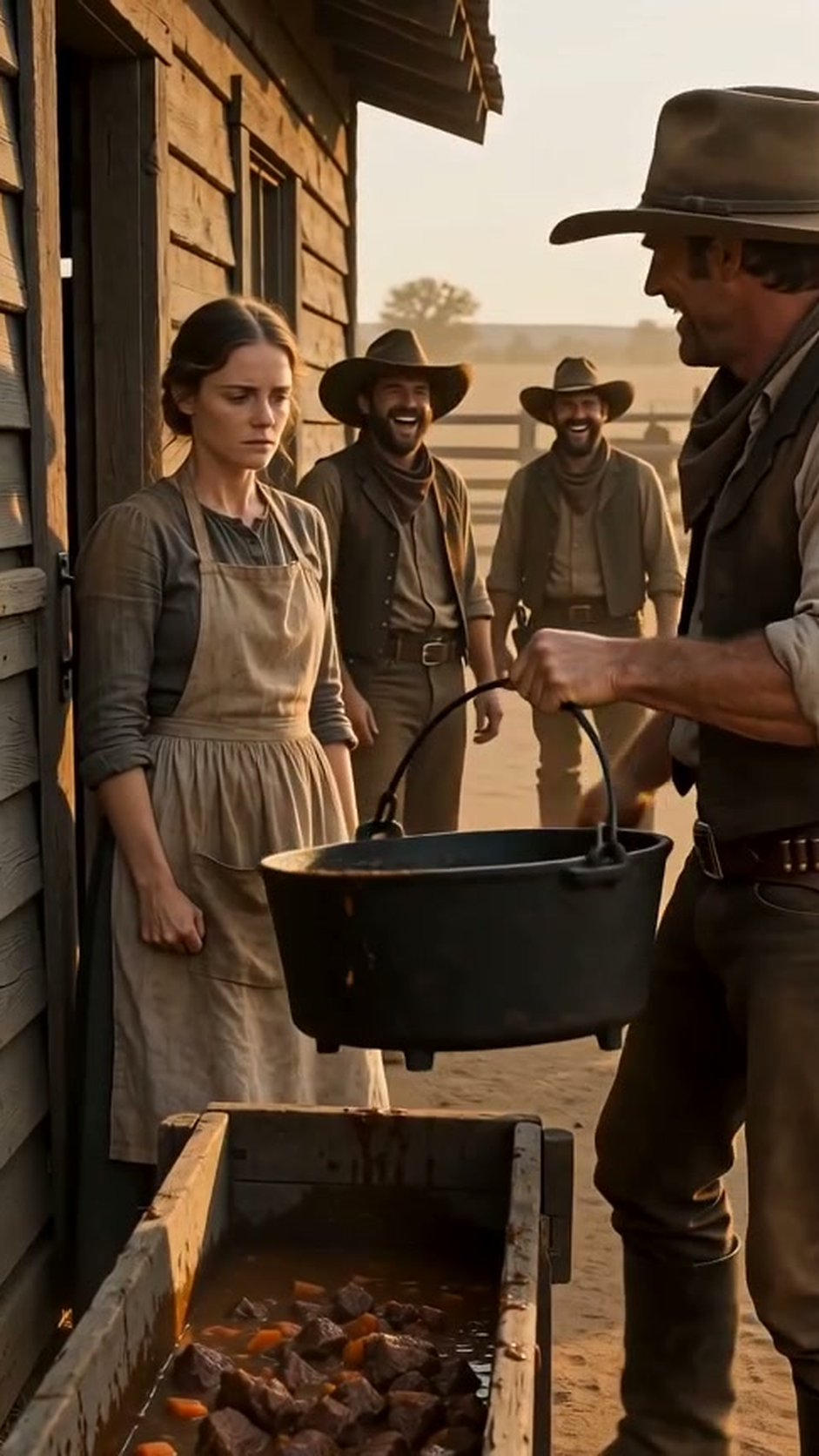
Silas Merritt offered Bertha the cookhouse, the cottage, a raise to thirty-five dollars a month, a helper on Saturdays, and an apology — the apology delivered standing in her kitchen with his hat in both hands, which for Silas Merritt was a form of kneeling.
"The apology isn't necessary, sir," she said.
"It is to me. Martha Platt fed this ranch fifteen years and I let her daughter be hunted through her own kitchen by a thief I was paying to supervise her. Your mother would have had words about my judgment, Bertha. She generally did." The old man looked around the cookhouse — at the stove blacked and shining, at the pot on its burner, at the long table bare and scrubbed in the morning light. "I'll say one more thing and then I'll stop spending your morning. He told me, when I hired you — Buck did — that it wouldn't work out. That you were a girl in a man's job and the men would never eat at your table. I want you to know I remember him saying it, and I remember what it cost me to half-believe him, and I am sorry."
Bertha accepted the apology the way her mother would have: with coffee, poured strong, and no fuss made over it. Some things are served and some things are set down, and a wise woman knows which is which.
The auditor came in the last week of June, exactly as promised — a dry little man named Eakins with ink on his cuffs and a valise full of columned paper — and Bertha spread her tally before him on the cookhouse table: the cottage-door pencil marks, transcribed fair into a ruled book, every sack and side and tin accounted for in her small, square, schoolgirl hand. He worked two days. He worked in the office, in the store room, in the spring house, with the concentration of a man defusing something. On the third morning he asked, without looking up from his columns, who kept the crew accounts, and Merritt said, "My foreman did," in the past tense, which told Bertha everything about how the figures were falling out.
Eakins's report, when it was read aloud in the ranch house office to Merritt and Bertha and Deputy Bledsoe — Buck being, by then, a guest of the county and represented by an empty chair — ran to eleven pages, and the heart of it could be said in one sentence, which Eakins did, in his dry voice, with his eyes on the last column: "The Bar Seven's kitchen lost, in eleven months, goods to the value of four hundred and twelve dollars, and every ounce of it walked out under the foreman's authority and into the Gilded Steer's accounts, less the three dollars a week that walked back the other way." He closed the book. "Miss Platt's tally is the cleanest set of kitchen accounts I have examined in nineteen years of examining them. I have told Mr. Merritt he should have her teach his clerks."
Buck Thorp was tried in the fall, in a courthouse with the windows open, and the leather book sat on the prosecutor's table through the whole of it, wrapped in its oiled cloth when it wasn't being read from. It convicted him more thoroughly than any witness could have — his own cramped, careful hand, week by week, three dollars by three dollars, a whole year of smallness set down like fence posts. He got three years in the state penitentiary and the judge's opinion, delivered from the bench in a voice meant to carry, that a man who'd steal a crew's supper to sell it back to them had stolen something meaner than money. Bertha did not attend the sentencing. She sent, instead — and it took her a week to decide, and she was never sure afterward whether it was kindness or its opposite — a parcel to the county jail the day before he was transferred: a loaf of bread, still warm when she wrapped it, and no note at all. She had been hired to feed the men of the Bar Seven. Some habits a woman keeps even when the man has done his best to starve them out of her, because they are hers, and not his, and he has taken enough things that were hers already.
The Bar Seven settled into its new shape the way a house settles after a storm — a few creaks, a few retold stories, and then the ordinary miracle of supper at six.
She rose at four by the clock her mother had kept in her bones, and the cookhouse woke around her in its order: fire coaxed up in the stove, coffee on before the first boot hit the yard, dough set to rise under a cloth while the bacon went into the long pan. She liked the hour before the men — the blue quiet of it, the tin and iron all where her hands expected them, the day still hers to arrange.
And the men came. Lord, how they came. The story of the hog trough and the planted flour and the leather book rode the county faster than any horse in the remuda, and it arrived back at the Bar Seven somewhat improved, the way stories do — in the county's version, Bertha had faced down Buck with a skillet in each hand, and one version had her chasing Lester Oler out of his own saloon with a rolling pin. She denied all of it to anyone who asked, which did her denials no good whatsoever. Ranch hands who had laughed at the trough in May now took their hats off in her cookhouse doorway in July without knowing they were doing it. Gus Henley pronounced her beef stew — her mother's beef stew, the same recipe, the same pot — to be a religious experience, and demanded to know what she had done to improve it, and Bertha told him the truth, which was the only thing she had ever done to it: "I cook it for men who show up."
Lonnie Pruitt got a two-dollar raise and a story he would tell, with improvements of his own, for the rest of his life. Andrew Coburn got — well.
Andrew got a habit, in the cool of the evenings after supper, of washing dishes.
It was not ranch custom for a top hand to wash dishes. It scandalized Gus, who said so, weekly, to the ceiling. Andrew washed them anyway, sleeves rolled, standing beside her at the basin with the easy silence of a man who has found where he intends to be and is in no hurry about the rest of it, and on the last Sunday of July, drying her mother's pot with more care than any object on the ranch had ever been handled with, he said, "Bertha, I'd like to speak to your — " and stopped, because a woman's mother is usually the door a man knocks on, and hers was in the ground at San Tomas, and his face did the arithmetic of that and went red as a stove lid.
"You'd like to speak," Bertha said, not helping him at all, out of pure enjoyment, which her mother would have called unkind and her mother would also have done, "to my mother."
"I'd like to speak to whoever's got the right to be asked," he said, recovering with dignity. "And as that's you, near as I can figure — Bertha Platt, I'm asking. Not for an answer today. For the right to keep asking, regular, till you've got one."
"That," she said, "is the first sensible proposal I've heard on this ranch from anybody but Mr. Merritt." She took the pot from his hands and set it on the stove where it belonged. "You may keep asking, Andrew Coburn. I'll keep cooking. We'll see which of us wears out first."
Her money was on neither of them.
He asked for the second time on the first Sunday of August, at the church social at San Tomas, with the whole county spread out on blankets under the cottonwoods and Bertha's two pies — dried apple, from her mother's recipe, the first thing of her mother's she had ever made for a crowd that wasn't paying her — sitting in state on the long table like visiting royalty. He did not make a speech. He waited until she had served the last slice, and then he walked her, in full view of forty witnesses and Gus Henley, who was watching with the open delight of a man at a horse race, down to the creek where it was cooler, and he said, "I've kept asking regular, like I was licensed. I'm asking again, with an addition. The addition is: Merritt's giving me the river pasture to run on shares come spring, and a man on shares can build a house, and a house ought to have somebody's name on the door besides his own. I ain't asking for the answer today either. But I wanted you to know the asking has a foundation under it now, and it ain't just dishes."
Bertha looked at the creek a moment, at the cottonwood light moving on the water, at the whole long road of the year behind her — the freight wagon, the trough, the thirty plates standing white in the lamplight, the little leather book, the flour sacks by her bed — and she thought about how her mother used to say that a woman knows a good man the way she knows a good stove: by whether the fire in him draws steady and warms the whole room and never once tries to burn the house down.
"Andrew," she said, "you may stop asking."
His face fell about a foot, and it was the most satisfying thing she had seen since Lester Oler's smile died, and she let it fall for exactly two seconds — she was her mother's daughter, not a saint — before she took pity on him.
"You may stop asking," she said, "because the answer's yes. It was yes at the dishes, if you want the truth, but a woman likes to see whether a man asks the same in public as he does in a kitchen. You do. So yes. Court me proper till Christmas, and at Christmas you can ask the last question, and we'll see if the answer's still yes."
"It'll be yes," Andrew said, with the confidence of a man stating the weather. "I'll see to the cooking of it."
"You'll see to the asking," Bertha said. "The cooking is spoken for. For the next fifty years, the cooking is spoken for — and don't you forget which of us is in charge of the table."
Gus Henley, informed of developments within the hour by channels no one ever traced, announced to the cottonwoods at large that it was about time and he'd known it since the nickel — though which nickel, and how it had told him, he declined, then and forever, to explain.
On the first Monday of August, the Bar Seven butchered a steer, and on Tuesday Bertha Platt cooked her mother's stew — beef cut big, potatoes, carrots, onions sweet as apples, the last of the dried thyme and then a fresh bundle hung by the stove for the years to come — and at six o'clock, thirty men came in out of the yard dust, washed at the trough by the door, and sat down the length of the long table, every plate of thirty filled, every cup poured, Gus Henley at the far end lifting his fork like a conductor and announcing to the room that they were, once again and permanently, in groceries.
She stood by the stove a moment before she sat down with them — at the head of the table, in the seat the crew had taken to leaving empty for her, which still embarrassed her and which she had stopped fighting some weeks back. The lamplight ran down the long table. The steam rose off thirty plates. Somebody laughed at something — kindly, the way men laugh at a table they're grateful for — and Bertha Platt looked at her mother's black pot on the back burner, empty and gleaming, fairly emptied by honest appetites, and thought that a table is a small thing to have fought a war over, and worth every inch of it.
She had been hired to feed thirty men.
She fed thirty men.
THE END