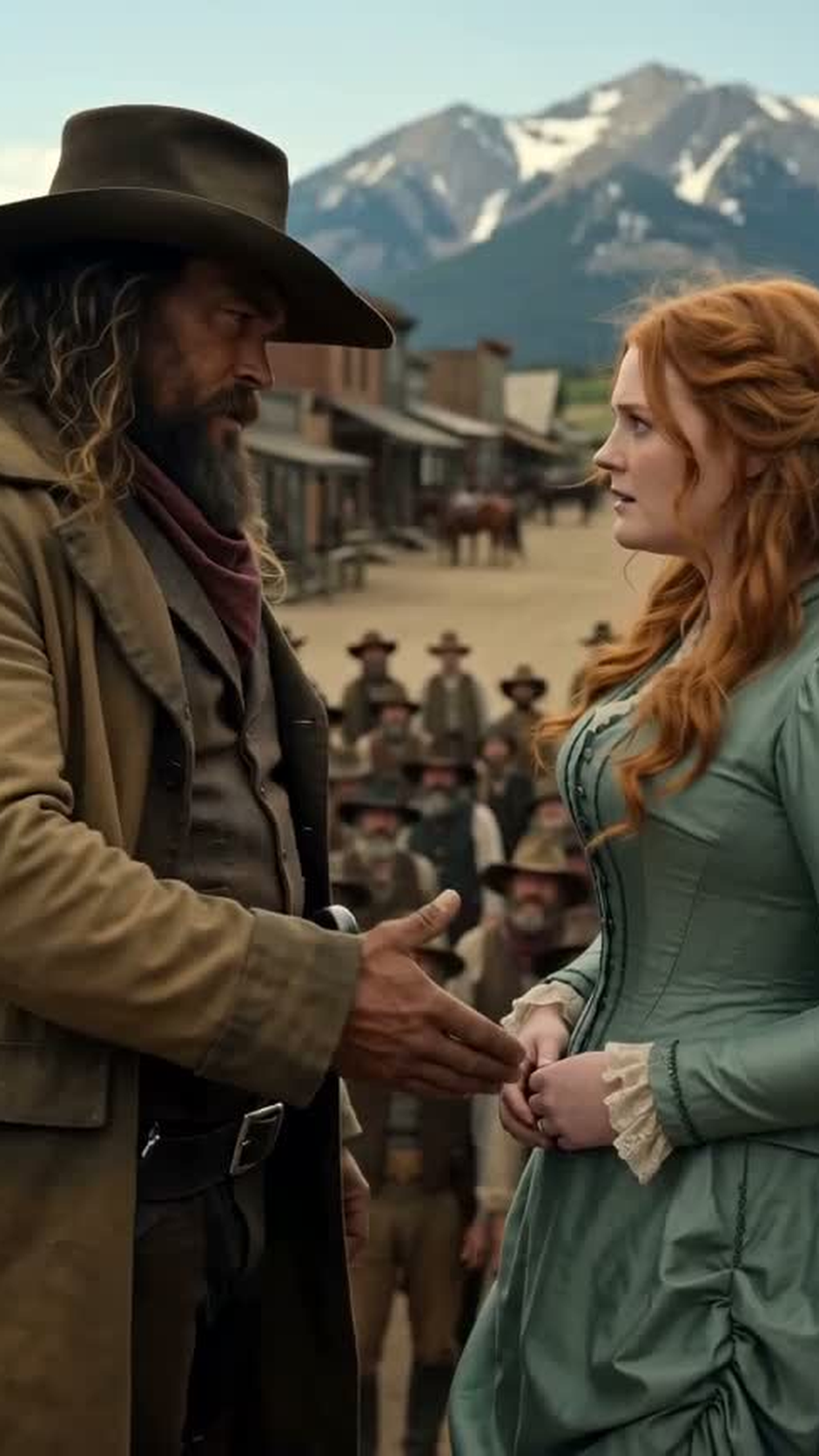
He showed her the whole valley the next day, as promised, and it undid the last of her caution in a way his hat coming off had only begun.
He showed her the creek where the water ran over stones flecked faintly with color she pretended not to recognize, though she had kept a blacksmith's books and knew exactly what she was looking at. He showed her the garden, the root cellar stocked like a ship's hold, the barn with its four stalls and its tack repaired to a standard that would have shamed her father's forge. He showed her the high meadow where a dozen cattle grazed fat on grass no brand inspector had ever counted, and the cold spring boxed in cedar that kept milk sweet in August. Everywhere the same story: a place built to hold life, holding it, waiting.
And he showed her — last, and without words, standing back at a distance that told its own story — the small grave again, in the daylight, so that she would not stumble on it unknowing a second time.
"You keep it tended," she said.
"It's mine to tend," he said, and that was all.
They were coming down from the meadow in the long gold light of the afternoon when he stopped his horse so suddenly that hers nearly walked into him, and she saw his whole body change — the stillness going out of him and a different stillness coming in, the kind that lives in the moment before lightning.
"Smoke," he said. "Low in the defile. Somebody's lit a fire in the crack to wait out the dark."
"Travelers?" she said.
"There are no travelers." He turned the gray in a circle, and his rifle was out of its scabbard in the same motion, as if it had grown there. "Ride for the cabin, Natalie. Bar the door — there's a bar, it's the beam by the hinges. Lamp out. If I'm not back by full dark, take the gray and the mule up the north gully; it comes out above the snow line trail, a horse can make it if it's life or death. Do you understand me?"
"I understand you," she said. "I'm not doing it."
The look he gave her then was the first truly unguarded expression she had seen on him: astonishment, and something under it that in another man would have been fear.
"This ain't Missouri," he said. "Those'll be Pruitt's men—"
"Mr. Pruitt bid thirty dollars for me on Tuesday," Natalie said, in the voice she had used for correcting Tobias Crane's ledgers, "in the tone of a man buying a fence post. I have not forgotten it, even if he has. If he has sent men into your valley to steal your gold and your good name, Dominic, I decline to hide under a table for it." She gathered her reins. "I shoot. My father put a rifle in my hands at twelve and I shot our meat for six years. Tell me where to stand and what to watch, and stop wasting the light arguing with a woman who is not going to obey you in this one particular."
For a moment the mountain stood still. Then Dominic Brennan — who had not laughed, so far as Willow Ford knew, in five years — made a sound so brief and so surprised that it might have been the beginning of one.
"Top of the defile," he said. "East shoulder, there's a rock shaped like a pulpit. You'll see the whole crack and the valley mouth both. Fire only if they fire, or if a man comes through the crack at a run and I don't."
She was in position above the defile as the light failed, lying behind the pulpit rock with her father's rifle — no. It was his spare rifle, a Henry, heavy and true, and her own long body fitted to the stone as if the mountain had measured her for the place. Below her, the crack in the rock ran down into blue shadow, and in the shadow, low and smug, the little fire of men who believed they were hunting a recluse and his stolen gold.
There were two of them. She could hear them before the dark swallowed the sight of them, and their talk carried the way talk carries in stone places — every word a gift to the listener above.
"—say he's got a whole creek of it. Pruitt says the woman's half the payment. We take the dust, we take the—" A laugh. "Pruitt says bring her back down, he's got the contract annulled at the courthouse, says Brennan never registered the claim on this valley, so it's open land and she's—"
"Shoot low if he comes," the other voice said. "Pruitt wants him breathing. A dead man can't sign a bill of sale."
Natalie lay in the cold with the words settling into her like shot, and understood the whole shape of it: not robbery, or not robbery only. An annulment drafted by a bought clerk. A valley claimed as open land. A woman carried back down the mountain and sold a second time to the man whose thirty-dollar bid had been laughed out of the square — because that was the true wound, she understood it now as clearly as she had understood Crane's ledgers. It was never the gold. It was that the whole territory had watched Harlan Pruitt be refused by a fence post of a girl, in public, at noon.
Below, in the defile, a boot scraped on stone.
Dominic's voice came out of the dark of the crack, unhurried as Sunday.
"That's far enough into my house, boys."
What happened next took perhaps four seconds, and Natalie would remember it in pieces for the rest of her life, the way you remember lightning. A man's shout. The crack of a pistol, flat and stupid in the stone throat. The deeper answer of Dominic's rifle. Then running feet, and a shape coming through the last of the crack at a dead run, straight at the dark where the valley opened — a man with a revolver in his hand, raising it toward the cabin light that wasn't lit, running exactly as Dominic had said a man would run.
Natalie's whole life arrived at the trigger in one motion: her father's patience, six years of meat shooting, her mother's voice saying do not make yourself small, and the memory of a bar-room tone saying thirty, like a fence post.
She fired.
The man went down in the mouth of the defile with his leg folded under him, screaming, his revolver spinning away into the stones. And the valley went silent in a way that rang.
She was down the shoulder of the rock with the rifle still in her hands before she knew she had moved, and then Dominic was there, out of the dark, with his own rifle lowered and one hand pressed hard against his side high up, near the shoulder, where the front of his buckskin coat was dark and getting darker.
"You shot," he said, with an wonder in it that frightened her worse than the blood.
"I told you I shoot."
"You shot the right man," he said, and then, with great care and dignity, sat down in the grass of his own valley like a tree deciding to fall.
The second man had run for it at her shot — they heard his horse going down the creek bed like the devil was collecting a debt. The wounded one, a coward named Jessup with a hole through the meat of his thigh that had missed every important thing by margins Natalie chose to credit to Providence rather than her aim, talked without stopping while she bound his leg — he talked all through Dominic's jaw going gray and tight, talked while she got her shoulder under two hundred and eighty pounds of mountain man and walked him, step by negotiated step, to the cabin. Pruitt. The courthouse clerk. The annulment paper already drawn. The plan to take the gold dust, the valley, and the woman, in that order, and let Brennan live to sign — because a dead man's claim could be jumped by anyone, but a living man frightened properly signs his own name.
"Shut up," Natalie said, at the cabin door, with a gentleness more frightening than shouting, "or I shall let him bleed on you."
She got Dominic onto the table built for four — there was nowhere else in the cabin long enough — and she cut the buckskin away from the wound with her sewing scissors, and found what she had prayed for on the walk up the valley: the ball had gone through the muscle high in the chest, below the collarbone, in one side and out the other, taking no bone and no great vessel with it. A wound to kill a man by bleeding and fever if it was neglected, and a wound a man could live through if it was cleaned and kept and fought for.
She fought for it. She fought for it with boiled water and clean linen and her father's steadiness, and then she fought the fever that came on the second day, and the third, sitting up in the chair beside him through two whole nights in her sage-green dress gone stiff with other people's blood, reading aloud from the white-spined Dickens when he raved — because his raving, when it came, broke her heart into pieces small enough to see through. He spoke to Mary. He spoke to the boy who had no name. And once, in the worst hour before dawn on the third night, he caught at Natalie's wrist with a hand hot as forge iron and held on, and said, quite clearly, to someone she could not see:
"I stood up. This one stands up. I saw her stand—" His eyes opened, and for a moment they were clear, and they were on her face, and she understood he was seeing her after all. "Don't let them make you small," Dominic Brennan said. "It's the one thing I can't abide. There's no room in this valley for it."
It was her mother's sentence. It was her father's sentence. It had traveled eight years in the keeping of a silent man in a hidden valley, and it had arrived at her bedside in the dark like a letter forwarded across the world.
"Then live," Natalie told him, fiercely, holding his hand down against the quilts with both of hers, "and see that I don't."
The fever broke toward morning.
Weak as a kitten, white as the linen she'd boiled, Dominic lay in his own bed — she'd moved him at dawn, with the mule and a travois and more engineering than the Panama crossing — and watched her bring him broth, and when she set the bowl down he caught her hand, gently this time, the way you catch something you're afraid of startling.
"Pruitt's paper," he said. "The annulment. Jessup'll swear to the plan, if he's handled right. But the claim— I never did register this valley. It was the hiding of it. Secrecy's been my fence for eight years, and Pruitt's lawyer's gone and found the gate in it." He looked up at her from eight years of solitude, and twenty years of standing straight looked back down at him. "The preacher comes through Willow Ford Thursday week," he said. "I aim to be on my feet by then. A wife's claim travels with a husband's, and a wedding witnessed in the town square is a hard thing for a clerk to annul. That's the practical of it." A pause, in which a man who spoke fifty words in five years spent several of them like gold. "It ain't all of it. You know it ain't all of it. But I'll say the practical first, because I'm better at it."
"Dominic Brennan," said Natalie, sitting down on the edge of the bed with her bowl of broth and her whole heart in her throat, "are you asking me to marry you to defeat a land claim?"
"I am asking you to marry me," he said, "because you stood on my table's side for three nights and read to me out of my own books. The land claim is just the reason it has to be Thursday week, instead of spring, like a man ought to court." His hand tightened on hers, weak and entirely certain. "Say it plain, though. I won't have a wife in this valley who was ever again not given the choosing of it. Yes or no, free as the first time. Say it plain."
Outside the window, his valley lay in the morning light — the gold meadow, the bright creek, the tended graves in the pines, the whole hidden world he had built alone and offered her twice. Natalie thought of a hotel window, and a platform by moonlight, and a hand held out in the dust, patient as a table, waiting.
"Yes," she said. "Plainly. Yes."
She did not know, bending to kiss his forehead with a care that shook her, that Harlan Pruitt had ridden out of Willow Ford at first light with four men and a piece of courthouse paper — or that the wounded Jessup, left bound in Dominic's barn with water and a blanket, had worked one hand free in the night, and was even now writing his own account of things, in pencil, on the back of Pruitt's annulment draft, which he had carried in his coat all along.