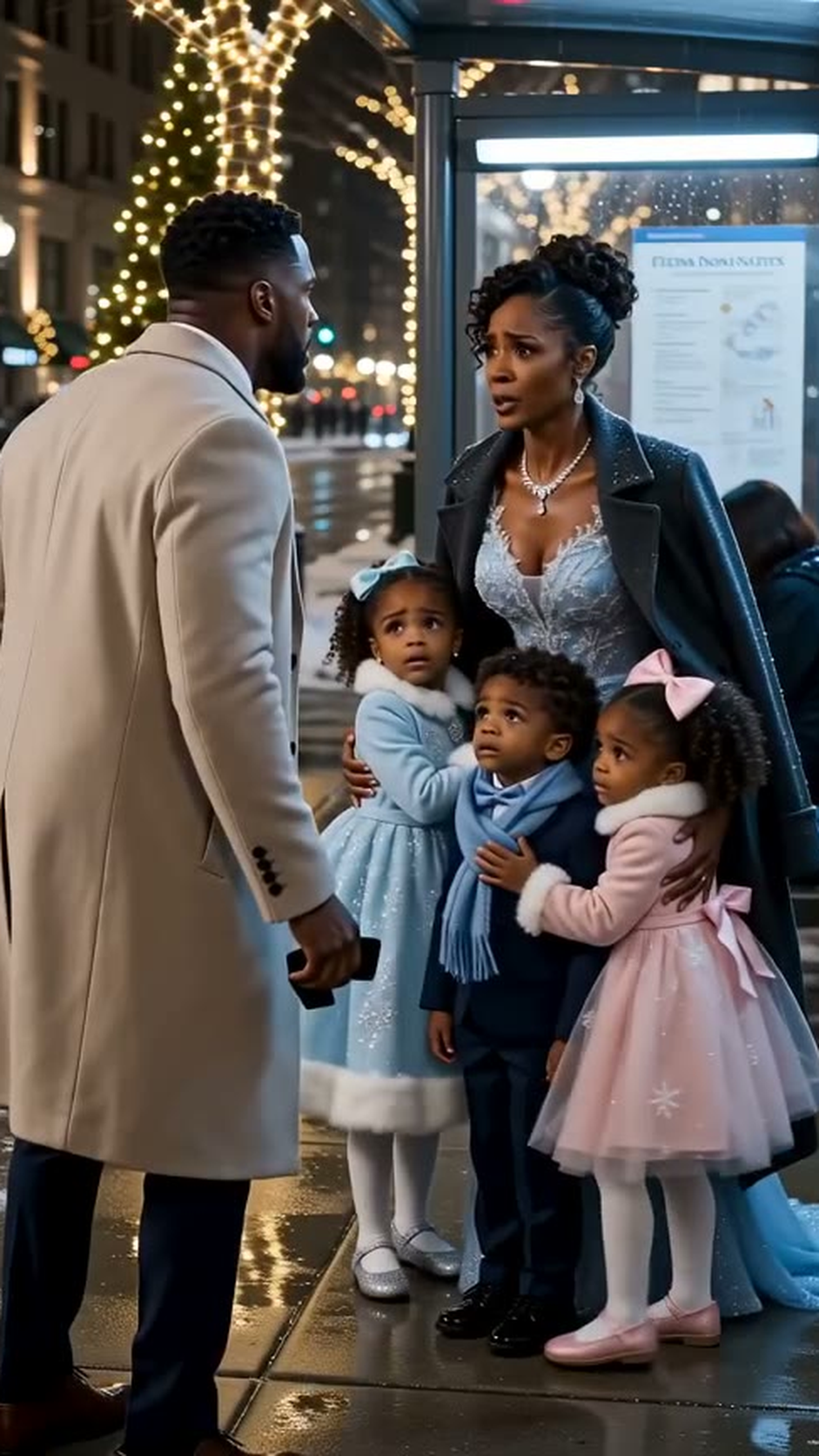
There are exactly four photographs of the triplets' first year, and Grace took all four of them on a phone with a cracked screen, in a one-bedroom apartment in Indianapolis where the radiator clanked like a man clearing his throat all winter.
Nicholas arrived first, furious and loud, with a head of dark curls and eyes that opened gray-blue and stayed that way. Noelle came two minutes later, calm as a judge, and studied the ceiling lights with an expression of mild professional interest. Holly came last and smallest, and did not cry at all until Grace held her against her heart — and then, having confirmed the address, settled.
Three. Grace lay in the hospital bed with a baby on each arm and one on her chest, and laughed until she cried, and cried until the nurse pretended to be very busy with a chart so as not to embarrass either of them.
She named them with her mouth close to their ears, one by one, like posting letters. Nicholas, for the saint who leaves gifts in the dark for children who have nothing. Noelle and Holly, because they had been conceived in one winter and born into another, and Grace was determined that Christmas would belong to them and not to her grief.
For eighteen months, it worked. Not easily — nothing about three babies and one pair of hands is easy — but it worked. Mrs. Alvarez from downstairs, a widow with eleven grandchildren and strong opinions, adopted them all without paperwork. Grace cleaned offices at night with the triplets asleep in a row of car seats by the supply closet, translated documents at dawn, sewed bows onto other children's Christmas dresses at a kitchen table while her own slept. She was tired in a way that lived in her bones. She was also, in the small hours, feeding three laughing babies mashed banana off one spoon in rotation, happier than she had ever been in a penthouse.
The bruises were the first thing.
Toddlers bruise; three toddlers in a one-bedroom apartment bruise like a basket of dropped fruit, and Grace, who had been raised by a nurse, catalogued Nick's without panic — until the morning she found them blooming along his ribs where no furniture had touched him, purple-black and clustered, and Nick, her loud one, her furious first-born, lay in her arms too tired to finish his bottle, with a fever that had no weather behind it.
The local hospital kept him four days. On the fifth, a hematologist with kind eyes and a terrible poker face sat Grace down in a family room with a box of tissues placed precisely within reach, and used the words aplastic anemia, and bone marrow, and failure, in an order that rearranged the furniture of Grace's life.
Nick's marrow was emptying. His body had stopped reliably making the blood he needed. The treatment that worked — the one that cured — was a stem cell transplant. The search for a matched donor would begin immediately.
"What about me?" Grace said. "I'm his mother. Take mine. Take whatever—"
"A parent is a half match, Mrs. Ellis. We can work with that if we must — it's done, and it saves lives — but a full match is better. The registry has millions of donors. We'll search. And his sisters will be typed too. Full siblings are the best odds of all."
The registry searched. For eleven months, the registry searched, through millions of strangers who had swabbed their cheeks in shopping malls and college gyms, and found no one. Noelle and Holly were typed with a lollipop afterward each, and were not matches — close, the doctors said, with the special cruelty of the word, but not close enough. Grace typed herself and was filed where half-matches live, in the drawer marked if we must.
If we must began to fill the apartment like a fourth child.
Grace kept a notebook — a spiral one, from the dollar store, with a unicorn on the cover that Noelle had chosen with great seriousness — and in it she kept the arithmetic of her son's body. Bruises, mapped like weather on a drawn outline of a little boy: left shin, Tuesday, playground-shaped, fine. Ribs, Thursday, no cause, not fine. Temperatures at 2 a.m. and 4 a.m. What he ate. What he couldn't finish. The exact shade of his tiredness, recorded in a private shorthand of her own devising: T1 meant tired like other children; T2 meant tired like a phone at ten percent; T3 meant carry him, and check the notebook, and call the clinic in the morning, and do not sleep too deeply tonight.
She became fluent in a language no mother should have to speak. She could say aplastic the way other women said the names of wines. She knew the platelet counts that meant the playground and the counts that meant the couch, the fevers that meant a phone call and the one that would mean the emergency room at a run. She hung the clinic's magnet on the refrigerator at the height of her own eyes, where it lived between a drawing of a bus and Noelle's first written word, which was BUS, because Nick had dictated the household's priorities.
And threaded through the medical arithmetic, ordinary life insisted on itself, gloriously. There were the three of them in a bathtub like a regatta. There was Holly's phase of hiding inside the laundry hamper and leaping out at Mrs. Alvarez, who screamed with professional enthusiasm every single time, as a courtesy. There was the evening the power went out on the whole block and Grace lit candles and told them the story of a queen with three knights, and Nick — T2 that day, couch-bound, furious at the injustice — demanded the queen be given a sword, and then, after consideration, a second sword, "for the other hand, Mommy, she has two hands."
"She does," Grace said. "She uses them both."
"Like you," Nick said, and fell asleep against her arm before she could answer.
She worked. She worked the way water works on stone. A foundation in Indianapolis took pity — no, she corrected herself whenever she thought it, took notice — of the woman who had once run the Mercer Foundation's galas, and gave her contract work she could do from the kitchen table: donor letters, seating plans, the invisible engineering of other people's generosity. At night, when all three were asleep, she sat at that table in the cone of a cheap lamp with the notebook beside the laptop — bruises on one page, ballrooms on the other — and she did not think about Chicago. She was very careful about the not-thinking. It was load-bearing. The one time she failed — the night Nick, feverish at 3 a.m., whimpered in his sleep for a person he had never met, "Daddy fix it," parroting some phrase from a cartoon, some other child's ordinary magic words — she sat on the bathroom floor with her back against the tub until her legs went numb, and then she got up, and checked his temperature, and wrote it in the notebook in handwriting that shook only a little.
Chicago's doctors could give Nick his best chance. That was the whole equation. Grace Ellis had survived being called a fortune hunter by a family of hoteliers; she could survive being unknown in the city that had misnamed her. She packed the notebook, the outfits, the bear book with the spine taped twice, and three small suitcases, and she took her children home to the best hospital in America — which stood, with an almost personal insolence, directly across the street from the Mercer Grand.
Platelet transfusions when the bruises came in constellations. A port in her son's small chest, which he called his button and showed to the mailman. Nights Grace spent learning the exact sound of his breathing through a baby monitor, the way she had once learned it for joy and now learned it for war. Twice, infections put him in isolation, behind glass, and Grace read The Night Before Christmas through a telephone handset to a little boy in a paper gown who pressed his palm to the window side of the glass and slept with it there.
The transplant team in Indianapolis was honest with her, in the end. For a case like Nick's — a toddler, a rare profile, a family with no full match — the best program in the country for children was in Chicago. At the Children's Medical Center. Where the haploidentical unit — the unit that transplants from a parent — was doing work that read like rumor.
Grace stood in her kitchen a long time with the referral letter in her hand.
Chicago was a door she had sworn never to knock on again. Chicago had marble benches and private elevators and Amelia Brooks's gentle smile. Chicago had Eleanor Mercer, who had called her a fortune hunter in a room full of lawyers. Chicago had Ryan.
But Chicago had the doctors who could save her son, and so Grace did what she had done every day since the ultrasound technician's careful smile: she chose the children over her pride, and she went home to the city that had thrown her away.
She told herself she would be invisible. Chicago was enormous; the Mercers moved in a Chicago of glass towers and charity boards, and she would live in the Chicago of bus routes and hospital family housing and night shifts. The hospital's family-support office found her work she could do with a monitor in her pocket — coordinating volunteers, and then, because the foundation director had once seen her run a gala in another life, helping plan the Snowflake Gala, the Medical Center's Christmas fundraiser, where patient families were honored and the children lit the great tree in the lobby.
She bought the triplets their outfits at a resale shop and sewed the bows herself. Nick's navy suit. Noelle's blue dress. Holly's pink one, with the fur trim. They would stand in golden light for one evening, all three of them, like children in a story where nobody is sick.
And if her hands shook when she thought that across the street from the Medical Center stood the Mercer Grand — where she had once danced at her own wedding reception, in another woman's lifetime — she told herself that fate was not so theatrical. Fate did not arrange encounters at bus shelters in the rain.
Fate, that December, was extremely theatrical.
– – –
Three miles and one entire world away, Ryan Mercer stood in the master suite of his family's flagship hotel on the evening of December twenty-first, and looked at the man in the mirror, and the man in the mirror looked like a groom in the way a photograph of a fire looks warm.
"You look," said his best friend Daniel from the doorway, with the delicacy of a man removing a splinter, "like you're about to sign a merger."
"It is a merger," Ryan said.
"That's my point, brother."
It was, on paper, a perfect match. Amelia Brooks, whose family's hotel group fit the Mercer Group like a key cut for the lock. Amelia, who had been orbiting his life since prep school, who had been — everyone agreed — so supportive during the divorce. Amelia, who had never once, in three years, made his chest hurt the way a song could, or a smell of rain on wool, or the back of a stranger's head in an airport with dark curly hair.
His mother approved. The board approved. The ring had been approved by a committee of jewelers. The only person who had never been consulted was Ryan, and Ryan had made a career of that, too, since the Tuesday an envelope of photographs emptied his marriage like a drawer tipped out a window.
He had never looked at them again. He kept that from everyone, including himself: he had never once, in three years, been able to make himself look at the photographs a second time. The first look had been enough to burn. What he did not know — what he would give the flagship hotel to have known — was that the burning was the tell. A man who has truly been betrayed feels cold. Ryan had felt, every day since, like a house the fire had never actually left.
Downstairs, the private dining room was filling with two families and a string quartet. Amelia was upstairs in the bridal suite his mother maintained for occasions, though the wedding was months away, because Eleanor Mercer believed in dressing for the ending you wanted.
"Ten minutes," Daniel said. "Anything you want to do first? Pray? Flee?"
"Get some air," Ryan said. "One minute. Then I'll come up and do it properly."
He took the ring box from the dresser — three carats, flawless, approved by committee — and went down the service stairs and out under the awning, into the rain, the way a man walks to the rail of a ship.
He opened the box and looked at the diamond catching the Christmas lights, and he was reaching, with something that felt almost like grief, for the words he would say on one knee upstairs —
— when a small voice, high and clear, cut through the sound of the rain across the wet pavement, from the decorated bus shelter on the avenue.
"Mommy… who's that man?"
Ryan raised his eyes.