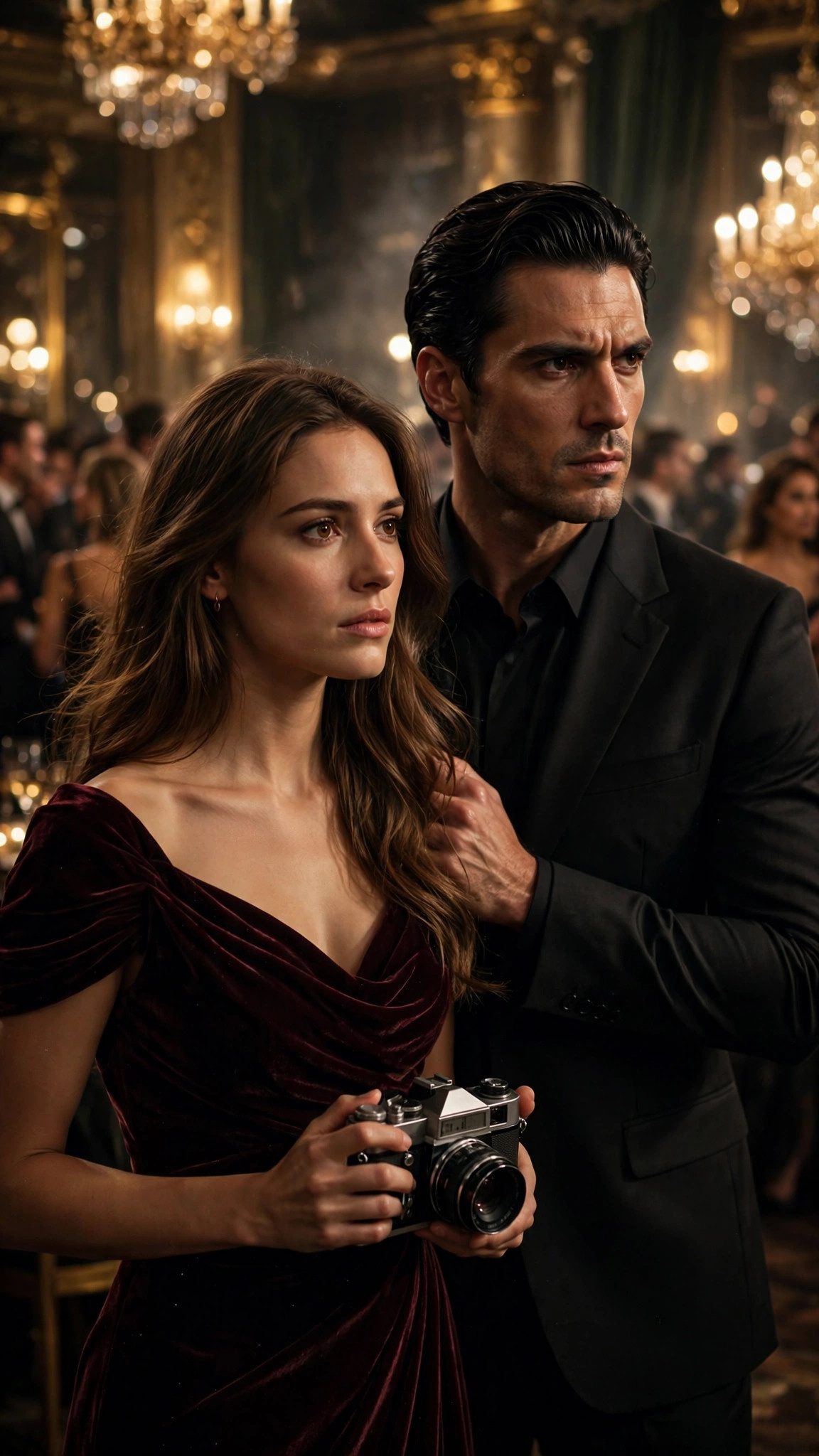
The industrial district by the river smelled like rust and rain and diesel, and the warehouses stood in long gray rows like tired giants, their windows broken, their painted numbers faded by decades of weather. Warehouse seventy-three was at the end of a dead-end street, its big sliding door half open, a dark van parked outside it with no license plate, the same van from the photograph.
Sal stopped our car two blocks away, in the shadow of a grain silo, and he turned around in his seat to look at me.
"Stay in the car," he said. "Enzo and I will go in first. If anything goes wrong, you drive. Do you understand? The keys are in the ignition. If you hear shooting, you do not wait for us. You drive."
I nodded, because I knew he needed me to nod, but we both knew I was not going to stay in the car. I had not come this far to sit in the back seat while other people risked their lives for the man who had stood up for me.
Sal and Enzo got out, and four more men got out of the other cars, and they moved toward the warehouse the way men move when they have done this before, spread out, quiet, watching the windows and the roofline. I waited until they were almost at the door, and then I got out of the car, and I followed them, my camera in my hand, my heart beating so hard I was sure they could hear it.
The inside of the warehouse was dark and cold, and it smelled like oil and old rope. Sunlight came through the broken windows in long dusty bars, and for a moment, I could not see anything at all. Then my eyes adjusted, and I saw the van, parked inside, its back doors open, and I saw a chair in the middle of the floor, a wooden chair with rope on it, and I saw blood on the concrete, not much, a few drops, dark and old.
King was not there.
"He was here," Enzo said, kneeling beside the chair. "The rope is still warm. They moved him. Recently. Within the hour."
Sal was looking at the ground, at the tire tracks in the dust, at the footprints. "Three men," he said. "And King. They took him out the back. There is a second van. The tracks go that way, toward the service road."
I was standing by the van, and I saw something on the floor of the van, something small and red, and I bent down and picked it up. It was a phone case. A red phone case. Derek's phone case. But the phone was not in it.
"Derek was here," I said, and my voice sounded strange in the empty warehouse, too loud, too certain. "This is his. He was here, in this van, with King."
Enzo took the case from me and turned it over in his hands. "Then he dropped it when they moved in a hurry," he said. "Or he left it on purpose."
"On purpose?" I asked.
"As a message," Sal said. "Or as a mistake. Either way, it tells us he was here, and it tells us they left in a hurry, and people in a hurry make mistakes."
We followed the tire tracks out the back of the warehouse, to a service road that ran along the river, and there, in the mud by the side of the road, I saw something else. A footprint, clear and fresh, and beside it, the print of a watch. No, not a watch. A bracelet. A thin silver bracelet, pressed into the mud, as if someone had dropped it and stepped on it.
I bent down and picked it up. It was a woman's bracelet, delicate, with a small charm on it, a tiny camera. I had never seen it before. But I knew, with a certainty that made my hands shake, that it belonged to someone who had been here, someone who had fought, someone who had tried to leave a sign.
"Sal," I said. "This isn't Derek's. This is a woman's bracelet. With a camera charm. Someone else was here. A woman."
Sal took the bracelet and looked at it for a long time. "King's sister," he said quietly. "Vera. She has a bracelet like this. She wears it every day. If Vera was here, then she came looking for him too, and they took her as well, or she followed them."
"Then we have two people to find," I said.
Enzo was already on the phone, calling the house, and his face went pale as he listened. He lowered the phone and looked at Sal.
"Vera is gone," he said. "She left the house an hour ago. She told Rosa she was going to the store. She never came back."
The warehouse went very quiet. Outside, a barge sounded its horn on the river, long and low, and a flock of pigeons burst out of the broken windows and scattered across the gray sky.
"Blake has them both," Sal said. "He has King, and now he has Vera. He is going to use them to get what he wants."
"What does he want?" I asked.
"Your photograph," Sal said. "And your silence. He wants the proof destroyed, and he wants you to disappear. He thinks that if he has King and Vera, you will give him what he wants."
I looked at the red phone case in Enzo's hand, and the silver bracelet in Sal's hand, and the blood on the concrete floor, and I thought about the night in the Velvet Room, and the man who had stood up and said, "She's with me," and I thought about Vera, a woman I had never met, who had gone looking for her brother and been taken, and I understood something.
Blake did not just want my photograph. He wanted me afraid. He wanted me to run, the way I had run from the alley behind the hotel, the way I had run from Detroit. He was counting on it. He was counting on me being the woman who ran.
I was not going to run. Not this time.
"We need to find Derek," I said. "He is the weak link. Blake's other men are professionals. Derek is not. Derek is a coward who cheated on his girlfriend and blamed her for it. He is the one who will make a mistake. He is the one who will talk."
Sal looked at me, and for the first time, I saw something in his eyes that had not been there before. Respect. Real respect, not the polite kind.
"How do you want to find him?" he asked.
"His phone is still on," I said. "You said you were tracking it. Where is it now?"
Enzo checked his own phone. "It stopped moving twenty minutes ago," he said. "It is at a motel on the south side. The Blue Star Motel. Room twelve."
"Then that's where we go," I said.
Sal shook his head. "It could be a trap. Blake could be waiting there with ten men."
"Then we don't walk in the front door," I said. "We watch. We wait. Derek will come out eventually. Men like Derek always come out eventually, because they get hungry, or they get scared, or they get bored. And when he comes out, I will be the one to talk to him."
"Absolutely not," Sal said.
"Yes," I said. "Because Derek knows me. He knows my face, my voice, the way I talk. He will not shoot a woman he used to live with. He will talk to me. And when he talks, he will tell me where King and Vera are, because Derek has never been able to keep a secret in his life. He told Tessa about our anniversary plans before I even knew them. He told his friends about my photographs before I had shown them to anyone. He will tell me where they are."
Sal and Enzo looked at each other, and I could see them deciding, and I could see that neither of them liked it, and neither of them could think of a better plan.
"One hour," Sal said finally. "We watch the motel for one hour. If Derek comes out, you talk to him, and we are right behind you, and if he so much as raises his voice, we take him. If he doesn't come out, we go in together, and you stay in the car."
"Deal," I said.
The Blue Star Motel was the kind of place that rented rooms by the hour and did not ask questions. The paint was peeling, the sign buzzed, and the parking lot was full of cars that had seen better decades. We parked across the street, in the lot of a closed laundromat, and we waited.
For forty minutes, nothing happened. A man came out of room nine with a duffel bag and drove away. A woman came out of room four and smoked a cigarette and went back inside. The door of room twelve stayed shut.
And then, at exactly forty-three minutes, the door of room twelve opened, and Derek Lawson walked out.
He looked terrible. He had not shaved in days. His shirt was wrinkled. He kept looking over his shoulder, the way a man looks when he is afraid of being followed. He walked to the vending machine at the end of the walkway, and he put coins in, and he stared at the machine like he had forgotten what he was doing.
I got out of the car before Sal could stop me. I crossed the street. I walked up behind him, and I said his name, the way I used to say it in the morning, when we were still pretending to be happy.
"Derek."
He turned around, and his face went white. The coins fell out of his hand and scattered across the concrete.
"Harper," he said. "Harper, what are you doing here? How did you find me?"
"I found your phone case," I said. "In the warehouse. With the blood on the floor. You left it behind, Derek. You always did leave things behind."
He looked around wildly, and I could see him calculating, the way he always calculated, whether to run, whether to lie, whether to beg.
"Harper, you don't understand," he said. "Blake made me do it. He said he would pay me fifty thousand dollars. Fifty thousand. I needed the money. I lost my job. Tessa left me. I had nothing. He said all I had to do was watch you and tell him where you went. I didn't know he was going to take King. I didn't know about Vera. Harper, I swear, I didn't know."
"Where are they?" I asked. I did not raise my voice. I did not need to raise my voice. I had learned that from King. "Where are King and Vera, Derek?"
He looked at the ground. "There's a place," he said. "An old bottling plant, on the south side, by the canal. Blake owns it through a shell company. He took them there this morning. He is going to call you tonight. He is going to tell you to bring the camera and the photograph, and if you don't, he is going to hurt them. Harper, I'm sorry. I'm so sorry. I never meant for any of this to happen."
I looked at him, at the man I had once loved, at the man who had destroyed my life in Detroit and then followed me to Chicago to destroy it again, and I felt something I had not expected to feel.
Pity. Not love. Not hate. Pity. Because he was small, and he was afraid, and he had sold everything he had for fifty thousand dollars, and he had still ended up here, in a motel parking lot, shaking in front of the woman he had betrayed.
"Derek," I said. "You are going to help us now. You are going to tell Sal everything. Every address, every name, every phone number. And then you are going to turn yourself in to the police, and you are going to tell them what Blake did. Because that is the only way you are ever going to be free of him."
He nodded, and he started to cry, and Sal and Enzo came across the street, and they took him by the arms, gently, the way you take a man who has already surrendered.
As they put him in the car, Derek turned back to me, and he said the last thing I ever expected him to say.
"Harper," he said. "The photograph. The one of Blake taking the cash. I saw it. On your camera, at the dinner. It wasn't just cash. There was a ledger. In the background, on the table behind him. A black ledger with the Moretti crest on it. Blake's records. Everything he stole, written down. If you have that photograph, you have everything."
I stood in the motel parking lot, holding my camera, and I thought about the photograph I had taken without thinking, the photograph that had started all of this, and I understood, finally, what King had seen in it.
It was not just proof. It was everything.
I lifted the camera to my eye, right there in the parking lot, with Sal watching me and the motel sign buzzing overhead, and I scrolled back through the photographs to the one of Marcus Blake in the alley behind the hotel. I had looked at that photograph a dozen times since I took it. I had seen the cash, the envelope, the restaurant employee's frightened face. But I had never looked at the background. I had never looked at the table behind him.
I zoomed in, as far as the camera would go, and there it was. On a small metal table behind Blake's left shoulder, half hidden by a stack of boxes, sat a black ledger, thick and worn, with a gold crest stamped on the cover. Even at that distance, even through the grain of the zoom, I could make out the shape of the crest. A crown. The Moretti crown.
"Derek was right," I said, and I showed the screen to Sal. "There it is. The ledger. Blake's records. Every dollar he stole, written down in his own hand."
Sal looked at the screen for a long time, and then he looked at me, and he said, "Miss Bennett, do you understand what you have? With that ledger, we don't just free Mr. Moretti. We destroy Blake. Completely. The police, the FBI, the tax people, all of them will want that book. Blake has been stealing from this family for twenty years, and he wrote it all down, because men like Blake always write it down. They can't help themselves. They want a record of how clever they were."
I lowered the camera, and I felt the weight of it in my hands, the familiar weight, the weight I had carried through Detroit and Chicago and every street in between, and I understood something I had never understood before. My camera had never just been a way of seeing the world. It had always been a way of telling the truth. And the truth, it turned out, was the most dangerous thing I owned.