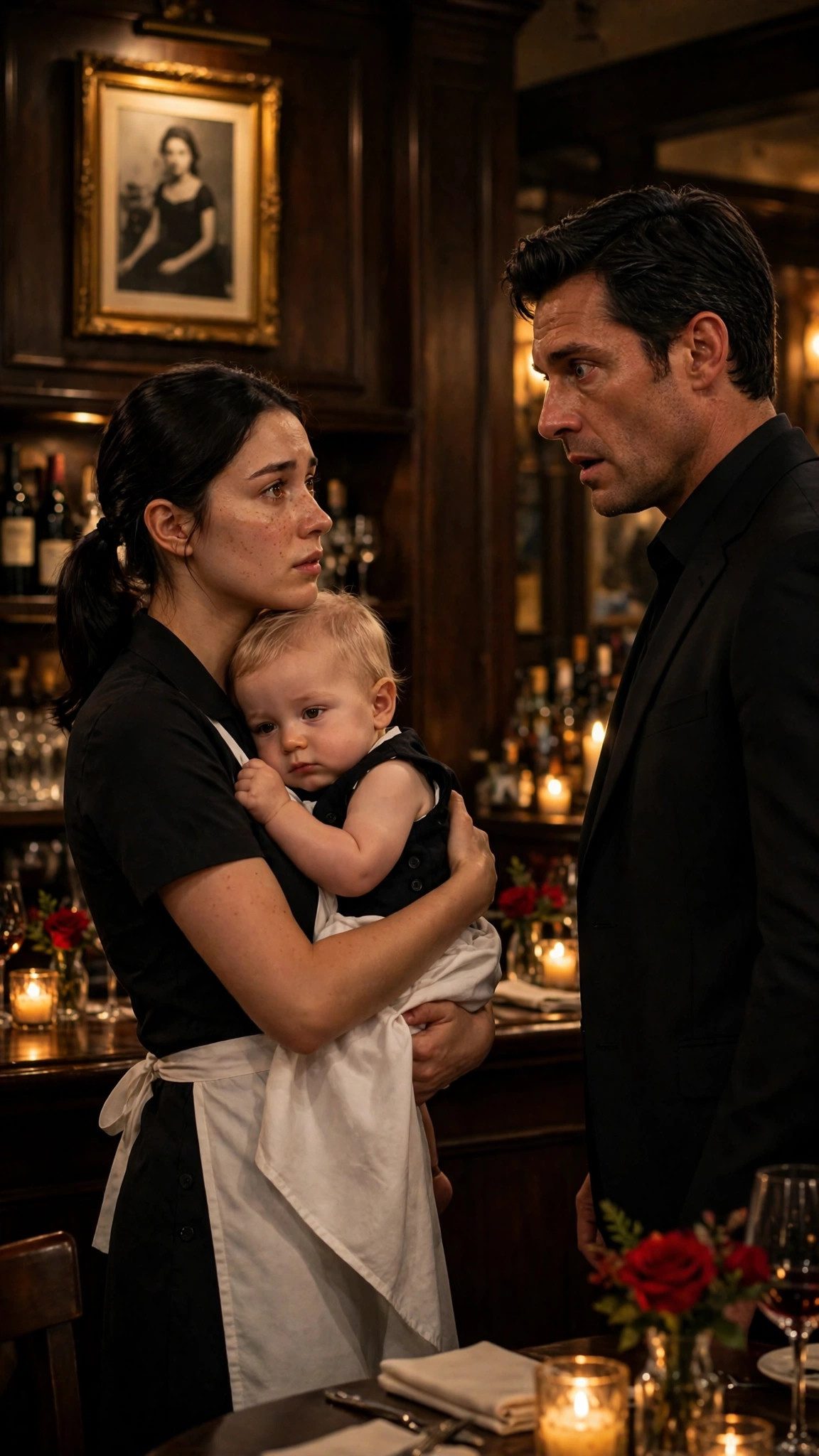
In the morning, I did something I should have done two years ago. I went back to my apartment, climbed onto a chair, and took Rosa's shoebox down from the top of the closet.
It was an ordinary shoebox, soft with age, held shut with a rubber band that crumbled when I touched it. Inside were letters, tied in bundles with string. Dozens of them. Some in Rosa's handwriting. Some in a hand I did not recognize, neat and careful, the same hand I had seen on the white card Adrian had given me in the restaurant.
No. Not the same hand. Similar. The card had been written by Adrian, or by someone in his office. These letters were written by a woman.
I sat on my bed and untied the first bundle with shaking hands.
The first letter was dated twenty-three years ago, three months after my mother died. It was from a woman named Agnes DeLuca, and it was addressed to Rosa.
"Dear Rosa," it read. "I am writing to tell you that Sofia is well. She is growing fast, and she is beautiful, and she asks about you sometimes, though she does not remember. I have told her that her mother loved her very much. I have not told her about Elina. I think it is better this way. Two girls, torn apart by grief, would only hurt each other. One day, when they are grown, perhaps they will find each other. Until then, I will keep her safe, and I know you will do the same for Elina. Please do not write back. It is safer for both of them if we do not know each other."
I read it three times. Sofia is well. She asks about you sometimes. I have not told her about Elina.
My twin sister had been alive all along. She had grown up three neighborhoods away, raised by a wealthy godmother, while I grew up in Rosa's small apartment, believing I was alone in the world.
The second bundle was newer. The letters were dated seven and eight months ago. They were from Sofia herself, addressed to Rosa, though Rosa had died two years before Sofia wrote them. Sofia had not known Rosa was dead. She had been writing to an address she found in her godmother's papers, hoping someone would answer.
"Dear Grandmother," the first one began, in Sofia's neat hand. "My name is Sofia Romano. I believe you are my grandmother, and I believe I have a twin sister named Elina. I found out a month ago, from a private investigator my husband hired to look into a threat against our family. The investigator found my birth records. There were two of us. Two girls, born on the same night, to the same mother. I have spent a month trying to understand how this could be true, and I have spent a month trying to find you. If you are reading this, please write back. I want to meet my sister. I want to know her. I have a son, Matteo, nine weeks old, and I want him to know his aunt. Please. I am enclosing a photograph of myself, so you will know I am telling the truth."
I opened the envelope. Inside was a photograph of Sofia, the same woman from the restaurant wall, smiling in a garden in a white dress. And on the back, in her handwriting, were the words: "For my sister, Elina. I hope we meet soon. I have so much to tell you."
I sat on my bed and cried until my throat was raw. My sister had been looking for me. She had found me, or almost found me, and then she had died, seven months ago, in a car that was not meant for her, killed by a bomb that was meant for her husband.
And I had never known she existed.
I wiped my eyes and picked up the second letter from Agnes DeLuca, the one Rosa had kept at the bottom of the bundle, the one with the oldest date and the most careful handwriting. It was the letter that explained everything, the letter Rosa must have read a hundred times.
"Dear Rosa," Agnes had written. "I am sorry to write this, but there is no other way. You are old, and you are poor, and you cannot raise two girls alone. I can raise one. I have money, and I have a house, and I have no children of my own. Let me take Sofia. She is the stronger one. She will do well with me. You keep Elina. She is small and sickly, and she needs you more. We will not tell them. They are three years old. They will forget each other. It is kinder this way. It is the only way. Forgive me. Forgive yourself. We are doing what we must."
I read it twice, and then I understood. Rosa had not lost a daughter. She had given one away. She had chosen, because she had no choice, and she had carried that choice for twenty-three years, and she had never told me, because telling me would have meant admitting that my sister had been alive all along, three neighborhoods away, living a life I could not imagine.
I thought about Rosa then, not with anger, but with a sadness so deep it felt like grief all over again. She had raised me alone, in a small apartment, on a laundry worker's wages, and she had done it with love, and she had done it while carrying a secret that must have weighed more than anything else in her life.
She had kept Sofia's letters. She had kept them in a shoebox on top of the closet, tied in bundles with string, and she had never opened the ones Sofia wrote, because opening them would have meant knowing that her granddaughter had grown up and married and had a baby, and that she had never gotten to meet any of them.
I held the shoebox against my chest, and I whispered, "It's all right, Rosa. I understand. I forgive you. I found her. I found her, even though it took twenty-six years."
There were more letters in the bundle. A birthday card Agnes had sent when Sofia turned ten, with a photograph of a little girl in a white dress, holding a doll, smiling with a dimple in her left cheek. My dimple. A school report, sent when Sofia was sixteen, with grades Rosa must have stared at for hours. A newspaper clipping, yellowed with age, about a young singer at Ristorante Orelio, a girl with a voice like warm honey, who sang on Friday nights and brought the whole room to silence.
Sofia had been singing at the restaurant where I worked. The same restaurant. The same stage. The same room. For two years, I had carried trays past the wall where her photograph hung, and I had never known she was my sister, and she had never known I was hers.
I put the letters back in the box, one by one, in the order I had found them, and I tied the string around each bundle the way Rosa had tied it, and I put the box on my bed, and I sat next to it for a long time, just looking at it, trying to hold twenty-six years of missing in my hands all at once.
There were more letters. Sofia had written four in total, each one more desperate than the last. In the last one, dated two weeks before she died, she wrote: "I am afraid. Someone is threatening my husband. There have been calls, cars outside the house, a man following me. Adrian says it is business, but I am frightened for Matteo. If something happens to me, please find Elina. Please tell her she has a nephew who will need her. Please tell her the river song. It is the only thing our mother left us both."
The river song. She knew the river song. She had sung it to Matteo, the same way Rosa had sung it to me, the same way our mother had sung it to us both on the night we were born.
I put the letters back in the box with hands that would not stop shaking, and I went back to the house on the hill, and I found Adrian Romano in his office.
He looked up when I came in, and his face told me he already knew something had changed.
"I found my sister's letters," I said. "Sofia wrote to my grandmother. She knew about me. She was looking for me when she died."
Adrian stood slowly. "What letters?"
"Rosa kept them. My grandmother. Sofia's godmother wrote to her when we were babies. Sofia was taken in by the DeLucas. I stayed with Rosa. Neither of us knew." I held out the photograph. "She left this for me. She wanted to meet me. She wanted Matteo to know his aunt."
Adrian took the photograph with both hands, like it might break. He looked at it for a long time, and when he looked up, his eyes were wet.
"She told me," he said quietly. "A month before she died. She told me she had found out she had a twin. She was so happy, Elina. I have never seen her so happy. She said she was going to find you, and she was going to bring you into our lives, and Matteo was going to have an aunt, and our family was going to be bigger than it had ever been."
"Why didn't she find me?" I asked. My voice was barely a whisper.
"Because she ran out of time." His voice cracked. "Because someone put a bomb under my car, and she took the car to pick up medicine for Matteo, and I was in a meeting, and I was not there to stop her."
He told me everything then. The threats. The calls. The cars outside the house. The war with Vincent Castellano, who wanted the docks and the shipping routes and would kill to get them. The bomb that the police called a gas leak. The seven months of grief that had turned his house into a tomb.
"Your brother blames me," he said. "He is right to blame me. Sofia died because of my life. Because of who I am. Because of the enemies I made. If she had married a baker, or a teacher, or anyone else in the world, she would still be alive."
"My brother is going to kill you," I said. "He told me last night. He's working with the Castellanos. He thinks you're the reason she's dead, and he doesn't know Castellano ordered the bomb."
Adrian's face went very still. "Did he say that? Did he say he is working with the Castellanos?"
"Yes."
"Then your brother is walking into a trap," Adrian said. "Castellano ordered the bomb. Castellano killed Sofia. And now Castellano is using your brother's grief to get to me. Marco is not Castellano's partner, Elina. He is Castellano's weapon. And when Castellano is done with him, he will throw him away."
He came around the desk and stood in front of me. "I need you to do something for me. I need you to call your brother. I need you to tell him to meet me. Not to fight. To talk. I can show him the proof. Rocco has a man in custody, a man who worked for Castellano, a man who knows who planted that bomb. I can prove to your brother that the man he is working for is the man who killed his sister."
"And if he won't come?" I asked.
"Then I will go to him," Adrian said. "And I will tell him myself. Because I owe it to Sofia. I owe it to you. And I owe it to Matteo, who deserves to grow up in a world where his family is not killing each other."
That evening, I went to the restaurant. I needed to see Mr. Orelio. I needed to see the photograph. I needed to stand in the place where my sister had sung and try to understand how two girls born on the same night could live twenty-six years without ever knowing the other existed.
Mr. Orelio was waiting for me. He had a key in his hand, and he led me into his office, and he opened the safe in the wall behind his desk.
Inside the safe was a leather folder. Inside the folder were more letters from Sofia, letters she had left at the restaurant for safekeeping, letters she had written in the last weeks of her life.
"I told her to leave them here," Mr. Orelio said. "She was afraid. She said if anything happened to her, someone should know the truth. She said the girl with her face would come one day, and when she did, I should give her these."
He handed me the folder. On top was a letter addressed to me. Not to Rosa. To me.
Mr. Orelio cleared his throat. "She came here three weeks before she died," he said. "It was a Friday night. She sang, the way she always did, and afterward she sat at the bar, right where you are standing, and she told me she had found out she had a sister. She said she had hired a man to find you, and the man had found you, and you worked in a restaurant, and she was going to come and meet you the next week."
He paused, and his old eyes filled with tears. "She said she was afraid. She said there were men watching her house, and she did not know why, and she wanted to leave the letters here, in case something happened. She said, 'If the girl with my face comes here one day, give her these, and tell her I was looking for her, and tell her I loved her, even though we never met.'"
He put his hand over his heart. "I told her nothing would happen. I told her she was being foolish. I have regretted those words every day since."
I did not say anything. I could not say anything. I opened the letter on top of the folder, and I began to read.
"Dear Elina," it began. "If you are reading this, then I am gone, and you have found your way to the place where I used to sing. I am sorry we never met. I am sorry I ran out of time. But I want you to know something. I want you to know that Matteo will know you when he sees you. Babies know these things. They know the sound of a voice they heard before they were born. They know the smell of family. They know the song. If he reaches for you, do not be afraid. He is not reaching for a stranger. He is reaching for his aunt. He is reaching for the other half of his mother. Please take care of him. Please sing him the river song. And please, if you can, forgive Adrian. He loved me. He did everything he could. He is a good man living in a bad world, and he needs you more than he knows."
I folded the letter and put it in my pocket, next to my heart.
And behind my left ear, where my hair had fallen back, Mr. Orelio saw what Adrian had seen the day before, what Giulia had seen in the nursery.
A small crescent birthmark, the exact shape of a tiny moon.
"The same," Mr. Orelio whispered. "Sofia had the same mark, in the same place. I saw it once, when she was fixing her hair before a performance."
I touched the birthmark with my fingertips. I had known it was there my whole life. I had never thought it meant anything.
Now I knew. It meant I was not alone. It meant I had a sister. It meant the baby who had reached for me in a restaurant had reached for family.
And it meant the war my brother was about to start was a war against the wrong man.