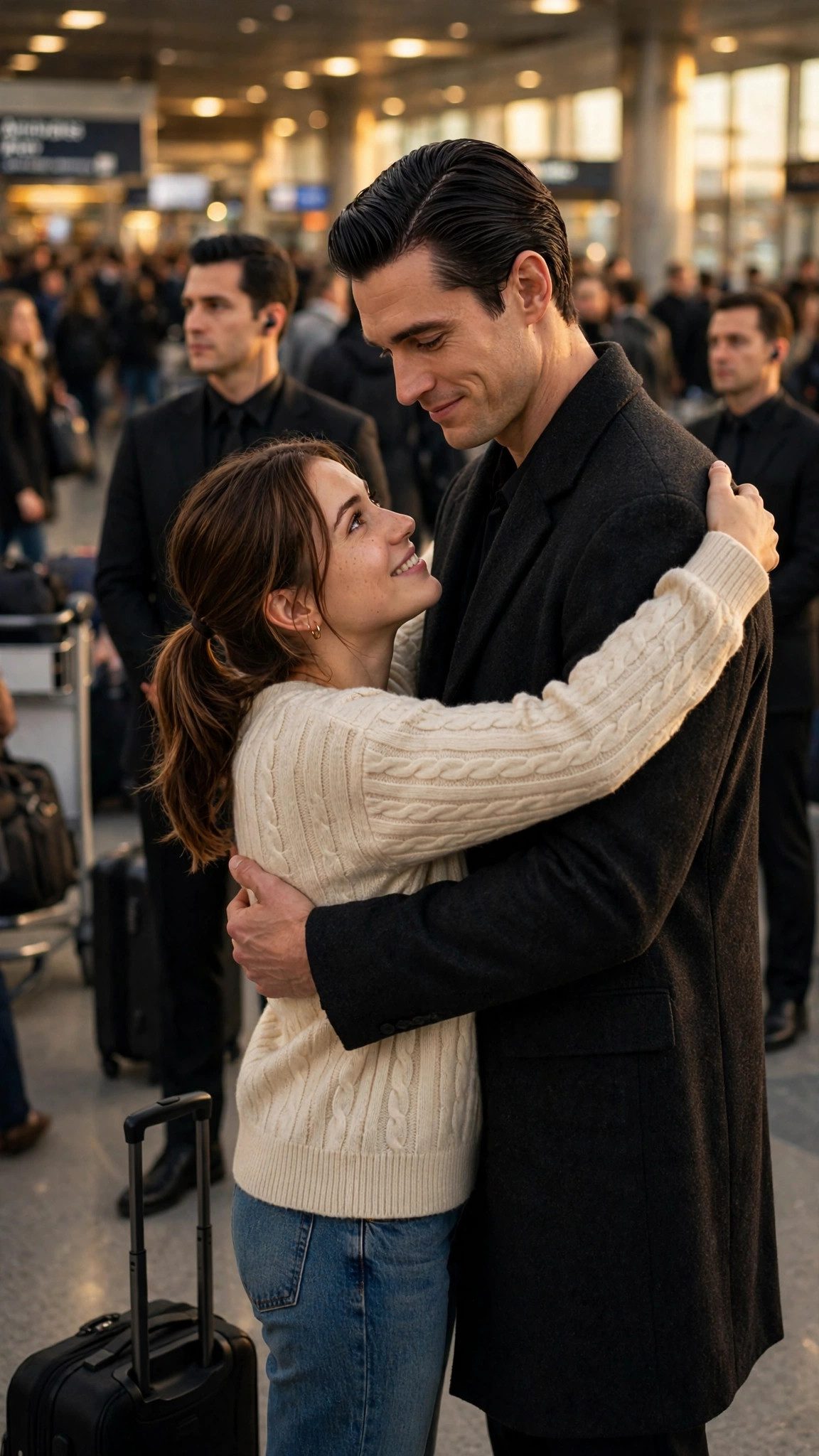
The next morning, Luke called me before my shift.
"Meet me at the diner on Milwaukee Avenue," he said. "Nine o'clock. Bring nothing. Tell no one."
The diner was the kind of place that had been there forever — cracked vinyl booths, a waitress named Dot who had worked there for thirty years and remembered everyone's order. Luke was already there when I arrived, sitting in the back booth with his back to the wall, a manila folder on the table in front of him and a cup of coffee gone cold beside it. He looked like he hadn't slept.
"Sit down," he said. "And whatever I show you, you don't tell Ethan Caldwell. You understand me? Not a word."
"Luke, I already told you—"
"I know what you told me," he said. "And I know you've been meeting him at table twelve every day at four o'clock. Priya told me. Don't look at me like that — she was worried about you, and she should be worried. Hannah, do you have any idea what you're doing?"
"I'm trying to keep you alive," I said.
He opened the folder. Inside were photocopies — a police report, a shipping manifest, a page of text messages printed from a phone I recognized as Marcus's old one, the one Luke had kept after the funeral.
"Read," Luke said.
The police report was short. Two pages. The hijacking on I-90, October 14th, three years ago. Four armed men. One driver dead. The manifest listed the cargo as consumer electronics — televisions, forty-two crates. The investigating officer's name was at the bottom, and next to it, in a different handwriting, someone had written: *Case closed. No further action. — D.V.*
"D.V.," I said. "Dominic Voss."
"Dominic Voss," Luke agreed. "He signed off on the closure. A lieutenant in Caldwell's organization signed off on a police investigation into one of Caldwell's own trucks. Does that sound normal to you?"
I turned to the manifest. It was the same route, the same date, the same truck. But the weight was wrong. Forty-two crates of televisions should have weighed a certain amount, and the manifest listed a weight that was almost double. Someone had written a number in the margin in pencil: *2M cash?*
"Marcus figured it out," Luke said quietly. "The night before he died, he called me. He said, 'Luke, the manifest is wrong. This truck isn't carrying TVs. It's carrying money, and somebody changed the paperwork, and I don't think the boss knows.' He said if anything happened to him, I should look at Meridian. Not at the hijackers. At Meridian."
"And then he died," I said.
"And then he died," Luke said. "And the next morning, Voss himself came to the yard and told everyone to go home, and the police file went quiet in two weeks, and the company sent flowers, and that was the end of it. Except it wasn't the end of it, because Marcus was right. The truck was carrying two million dollars in cash from the gambling rooms, and somebody sold the route to the Castellano family, and the Castellanos sent their men, and Marcus got in the way."
I looked at the text messages. The last one from Marcus, sent at 11:47 p.m. the night before he died: *If anything happens, look at Voss. He signs everything. He knows everything.*
"Luke," I said slowly, "Ethan already knows this."
Luke went very still. "What?"
"He showed me the police report. He showed me the same note — 'Buried. Voss.' He's been investigating Voss for three years, Luke. He didn't order it. He was in New York the night Marcus died. He's trying to find the proof, and he's trying to do it without getting you killed."
Luke stared at me. "You believe him?"
"I believe the paper," I said. "And I believe the way he looked when he showed it to me. Luke, he could have buried this. He could have had you buried. Instead he's sitting at table twelve in my coffee shop asking a barista for help. Does that sound like a man who ordered a murder?"
Luke was quiet for a long time. Dot came by with more coffee, and neither of us spoke until she left.
"If Ethan didn't order it," Luke said at last, "then Voss did it alone. And if Voss did it alone, he's been stealing from Ethan for three years, and he's been covering it up with dead drivers and closed files. And that means Voss is going to notice that someone is looking at him. He already has."
"What do you mean?"
"I mean someone followed me home last night," Luke said. "A black sedan, no plates, two men. They sat outside my building for an hour. And this morning, when I went to the yard, my locker had been opened. Someone went through my things."
My stomach dropped. "Luke—"
"I'm not afraid," he said, but his hands were shaking around his coffee cup, and I knew he was lying. "I've been careful. But Voss is careful too, and he's been at this longer than I have."
That afternoon, at four o'clock, Ethan sat down at table twelve, and I told him everything Luke had shown me. I told him about the manifest and the weight and the two million dollars and the text message and the black sedan outside Luke's building. I broke my promise to my brother, and I did it without hesitating, because my brother was being followed by men in a black sedan with no plates, and promises did not matter anymore.
Ethan listened without interrupting. When I finished, he was quiet for a long time, and then he said, "Thank you. Now I know how deep it goes."
"How deep?" I asked.
"Deep enough that Voss has been skimming from the gambling rooms for three years," Ethan said. "Deep enough that he sold a route to the Castellanos and got a driver killed to cover it. Deep enough that he has someone inside the police department closing files for him. And now he knows your brother is looking, which means he will try to stop him."
"Then stop him first," I said.
"I intend to," Ethan said. "But I need proof that will hold up — not just with the police, but with my own people. In my world, you don't move against a lieutenant on a suspicion. You move on proof, or you start a war."
"So what do we do?"
"We wait," Ethan said. "Voss is careful, but careful men make mistakes when they think nobody is watching. And now he thinks your brother is the only one watching. He doesn't know I'm watching too. That is our advantage. We let him make his move, and when he does, we catch him in it."
"And if his move is against Luke?" I said.
Ethan looked at me, and his gray eyes were cold in a way I had never seen before — not cold like a stranger, but cold like a man who had just decided something.
"Then," he said, "he will learn what happens to men who touch my family."
"Your family?" I said. "Luke isn't your family."
Ethan picked up his coffee. "He is now," he said. "Because his sister hugged me in an airport and told me she'd missed me, and nobody has ever done that before, and I am not a man who forgets a thing like that."
He left a twenty on the table and walked out, and I sat at table twelve with my hands shaking, and I thought about what he had just said, and about the fact that the most feared man in Chicago had just called my brother family.
And I thought about Dominic Voss, sitting somewhere in this city, realizing that the walls were closing in — and I prayed, for the first time in my life, that a mafia boss would be faster than a traitor.
The next day, at four o'clock, Ethan came to table twelve with a folder of his own.
"I went to the yard last night," he said, without preamble. "I pulled every manifest Voss has signed in three years. I pulled the gambling-room ledgers. I pulled the bank records for Meridian Freight."
"And?" I said.
"And your brother is right," Ethan said. "The weight was wrong on that truck, and it was wrong on eleven other trucks. Eleven shipments in three years where the manifest said electronics and the weight said cash. Every single one signed by Voss. Every single one routed through the same corridor on I-90, past the same exit near Rockford."
He opened the folder. Inside were copies of manifests, each one with Voss's signature at the bottom, each one with the same small discrepancy in the weight column — a number that was just a little too high, the kind of thing nobody would notice unless they were looking for it.
"Two million dollars on Marcus's truck," Ethan said. "Probably more across the others. Voss has been skimming from the gambling rooms, laundering it through Meridian Freight, and selling the routes to the Castellanos so they could hit the trucks and take the cash, and he split it with them. Marcus Doyle wasn't supposed to die. He was supposed to hand over the truck and walk away. But Marcus was Marcus. He fought. And Voss let him die, and then he buried the file, because a dead driver was cheaper than a live witness."
I stared at the manifests. "How did nobody see this?"
"Because nobody was looking," Ethan said. "Voss is my right hand. He has been my right hand for twelve years. When he signs a manifest, nobody checks it. When he closes a file, nobody reopens it. That is how trust works in my world, Hannah — and that is how it gets used against you."
"So what happens now?"
"Now," Ethan said, "I need one more thing. The police contact. Somebody inside the department has been closing files for Voss for three years. If I find that name, I have everything — the manifests, the money, the contact, the pattern. Voss will have nowhere left to hide."
"And how do you find that name?"
Ethan smiled, and it was not a warm smile. "I ask," he said. "Politely, at first."
That evening I went to Luke's apartment. He was sitting at his desk with the notebook open, and the locked box was on the floor beside him, open for the first time I had ever seen it. Inside were more photocopies, more dates, more license plate numbers — three years of quiet, patient, furious work.
"You told him," Luke said, without looking up. It wasn't a question.
"I told him," I said. "Luke, I'm sorry. But you're being followed. Your locker was opened. Voss knows you're looking. I had to tell someone who could actually do something about it."
Luke was quiet for a long time. Then he closed the notebook and looked at me, and his face was tired in a way I had never seen before — not angry, just tired, like a man who had been carrying something heavy for a very long time and had finally decided to set it down.
"Do you trust him?" Luke asked.
I thought about it. I thought about table twelve, and the twenty-dollar bills, and the rain, and the way Ethan had said my brother's name like it mattered, and the way he had shown me the police report with his own lieutenant's name written on it in red ink.
"Yes," I said. "I trust him. I know how that sounds. I know who he is. But yes, Luke — I trust him."
Luke nodded slowly. "Then I'll trust him too," he said. "But Hannah — if he's lying, if any of this is a trap, you run. You run and you don't look back. Promise me."
"I promise," I said, and this time I meant it.
He reached into the locked box and took out a small envelope. Inside was a photograph — Marcus Doyle, laughing, holding a fish, his arm around Luke's shoulders. The same photograph from the desk. Luke turned it over. On the back, in Marcus's handwriting, were three words: *Look at Voss.*
"He knew," Luke said softly. "He knew the night before he died. He wrote it on the back of a photograph and put it in my locker the next morning, and he never got to tell me himself."
I took the photograph and held it, and I thought about Marcus Doyle, and about the two million dollars, and about the eleven trucks, and about the man at table twelve who had just told me he would find the truth or die trying.
"We're going to get him, Luke," I said. "Whoever did this. We're going to get him."
Luke looked at me, and for the first time in three years, he smiled — a real smile, the big stupid whole-body laugh's smaller cousin, the first crack of light in a very long darkness.
"Yeah," he said. "Yeah, we are."
That night, my father called — Sunday, right on schedule, even though it was a Wednesday. He always seemed to know when something was wrong.
"Hannah," he said, "you sound tired. Are you eating properly?"
"I'm eating, Dad," I said, and I almost laughed, because the world was on fire and my father was asking about my meals.
"Is Luke behaving himself?" he asked.
I thought about Luke's desk, and the locked box, and the photograph with three words on the back. I thought about Ethan Caldwell at table twelve, and the eleven trucks, and the two million dollars.
"He's trying to do the right thing, Dad," I said. "That's all I can tell you right now. But he's not alone anymore."
There was a pause on the other end of the line, and then my father said, in the same steady voice he had used to teach me history and to hold our family together after Mom died, "Then you stay with him, Hannah. Whatever it is — you stay with your brother. That's what family does."
"I will, Dad," I said. "I promise."
I hung up and stood at my kitchen window, looking out at the rain over Logan Square, and I thought about my mother, who had taught me that kindness was a kind of courage, and about my brother, who had taught me that falling was just flying with a bad ending, and about a man named Ethan Caldwell who had taught me that even the most feared man in Chicago could be afraid of losing the people he loved.
Tomorrow, Voss would make his move. I could feel it coming, the way you feel a storm coming in your bones. And when he did, we would be ready.