The next morning, I woke up to the smell of coffee and the sound of piano music drifting up from the music room.
I followed the sound down the hallway in my bare feet, my hair loose around my shoulders, and I found Carmine sitting at my father's old upright piano, playing with one finger, slowly and terribly, the way a man plays when he has never learned but wants to try anyway.
"What are you doing?" I asked, laughing.
"Trying to learn your song," he said. "The folk tune. Your father's song. I've been practicing for an hour, and I still sound like a man strangling a cat."
"You sound like a man who loves someone enough to embarrass himself," I said, and I sat down beside him on the wobbling bench. "Here. Like this."
I guided his hands to the keys, showing him the simple melody, note by note, and he followed my lead, clumsy and determined, and we laughed together, and the morning sun came through the windows, and for a moment, the world was only the two of us and an old piano and a song my father used to play.
Then Carmine stopped playing. He turned to me, and his face was serious, and he took both my hands in his.
"Josephine," he said. "Last night I told you I had something to ask you. I'm asking it now."
He slid off the bench and knelt on the floor of the music room — Carmine Valenti, the most feared man in New York, on his knees for the second time in his life, in front of a woman in her bare feet with her hair loose around her shoulders — and he took a small box from his pocket. Not the black velvet box from the morning after the gala. A different box. Plain, worn, the kind of box that has been carried in a pocket for a long time.
"I bought this ring the day after our wedding," he said. "I have carried it with me every day since, waiting for the right moment. This is not a contract, Josephine. This is not a charter, or a trust, or a bargain. This is a man asking a woman to marry him because he loves her, and because he cannot imagine his life without her in it."
He opened the box. Inside was a simple gold band with a single small diamond — nothing like the flame-sized stone from the first ring. This one was modest, and warm, and it looked like it belonged on a real person's hand.
"The first ring was a promise I made to a room full of people," he said. "This ring is a promise I am making to you, alone, with no one watching. Marry me, Josephine. Not for a year. Not for a contract. For the rest of our lives. Marry me because you love me, the way I love you."
I looked down at him, at the man who had crossed a ballroom to ask a piano girl to dance, who had knelt on a dining room floor, who had walked into a trap to save my brother, who had found my father's piano and brought it home. And I thought about everything that had happened since that night at the Pierre Hotel — the fear, and the danger, and the music, and the way he listened in the dark while I played.
"Yes," I said, and my voice was steady and clear. "Yes, Carmine. I will marry you. For the rest of our lives."
He slid the ring onto my finger, beside the diamond, and he stood up, and he kissed me, and the old piano stood beside us, and the morning sun poured through the windows, and I thought about my father, who had always said that a person's true character shows not in what they take, but in what they protect. Carmine had protected me. He had protected my brother. And now, I would spend the rest of my life protecting him, too.
We tore up the contract that afternoon. Carmine built a small fire in the library fireplace, and we fed the papers to the flames, page by page, watching the words curl and blacken and turn to ash. Two million dollars. One year. An exit clause. All of it gone, turned to smoke, because neither of us needed it anymore.
"That was the best two million dollars I ever spent," Carmine said, watching the last page burn.
"You didn't spend it," I said. "You never had to. I was never going to leave."
"I know," he said. "But I liked having the papers. They made me feel like I had a reason to keep you. Now I know the reason is just you."
Rosa cried when we told her. She took my face in her hands and said, "I told you, child. Love can be learned. And you learned it faster than anyone I have ever known." She gave me her blessing, and her mother's wedding veil, yellowed with age and smelling faintly of lavender, and she told me to wear it at our second wedding.
Our second wedding was small, like the first one, but different in every way that mattered. There was no contract. There was no charter. There was no deadline. There was only a chapel in Brooklyn, and a priest, and Rosa in the front row, and Liam standing beside me, and Lorenzo wiping his eyes and pretending he wasn't, and Carmine waiting at the altar in a black suit, his eyes wet, his hands steady.
I wore a white dress this time — not faded, not borrowed, not black velvet, but white, simple and clean, with Rosa's veil over my hair and the little gold piano charm at my throat. I walked down the aisle on Liam's arm, and my brother whispered, "You look beautiful, Jo," and I whispered back, "I am beautiful, Liam. For the first time in my life, I actually believe it."
Carmine took my hands at the altar, and the priest spoke the words, and this time, when I said "I do," I meant it differently. The first time, I had said it because I had no choice. This time, I said it because I had every choice in the world, and I chose him.
After the ceremony, we went back to the estate, and the whole family was there — not just the Valenti family, but my family, too. Liam, sober and smiling, telling stories about the pianos he was restoring. Rosa, dancing with Lorenzo in the great hall, laughing like a girl. Marco Valenti, who had come to make peace, raising a glass to his cousin and his cousin's wife. And Carmine, holding my hand, never letting go, not even for a moment.
The months that followed were the happiest of my life, and they were ordinary, which made them extraordinary.
I started teaching piano to the neighborhood children on Saturday mornings, in the music room, on my father's old upright. At first there were three of them — a girl with braids who wanted to play like a princess, a boy with a chipped tooth who banged the keys like drums, and a shy little girl who had never touched a piano before and cried the first time she played a whole scale. By spring, there were twelve of them, and the music room rang with scales and laughter every Saturday, and Carmine would stand in the doorway and listen, the way he used to listen in the dark, and his face would go soft in a way I had never seen before.
Liam thrived. The piano shop made him a partner within six months, and he started a program to restore old pianos and donate them to schools in Queens — the same schools that had once lent me sheet music when I couldn't afford my own. He met a woman named Grace, a teacher at one of those schools, and he courted her the old-fashioned way, with flowers and patience, and when he told me about her, his face lit up like it had when we were children and our mother was still alive.
Carmine changed, too. Slowly, the way a river changes its course — not all at once, but surely. He began legitimizing the family businesses, one by one, selling off the pieces that could not be made clean and keeping the ones that could. He told me it was for the baby we would have one day, for the family we were building, and I believed him, because I could see it in the way he worked — not with fear, but with hope.
Rosa became my closest friend. She taught me to make her husband's favorite pasta, and I taught her the folk tune my father used to play, and on Sunday afternoons, we would sit in the garden with tea, and she would tell me stories about Roberto when he was young — how he had courted her with flowers stolen from a neighbor's garden, how he had cried at their wedding, how he had once tried to learn the piano for her and given up after a week.
"He was a terrible pianist," Rosa said, laughing. "But he was a wonderful husband. And Carmine is his father's son. Remember that, child, when he is stubborn. He is stubborn because he loves you. Roberto was the same."
And Carmine — my husband, my devil, my love — he learned the folk tune. Slowly, note by note, on my father's old piano, until one evening in late spring, he played it all the way through without a single mistake, and I cried, and he pretended not to notice, and he said, "Your father would be proud of me, wouldn't he?"
"He would be proud of both of us," I said.
One year later, on December 14, 2019, the Valenti family held its charity gala at the Pierre Hotel again.
I sat at the grand piano in the same faded black velvet dress — no, not faded anymore. Carmine had it cleaned and mended, and it hung in my closet beside a dozen other dresses, but I chose the black velvet, because it was the dress I had worn the night he asked me to dance, and some things deserve to be remembered.
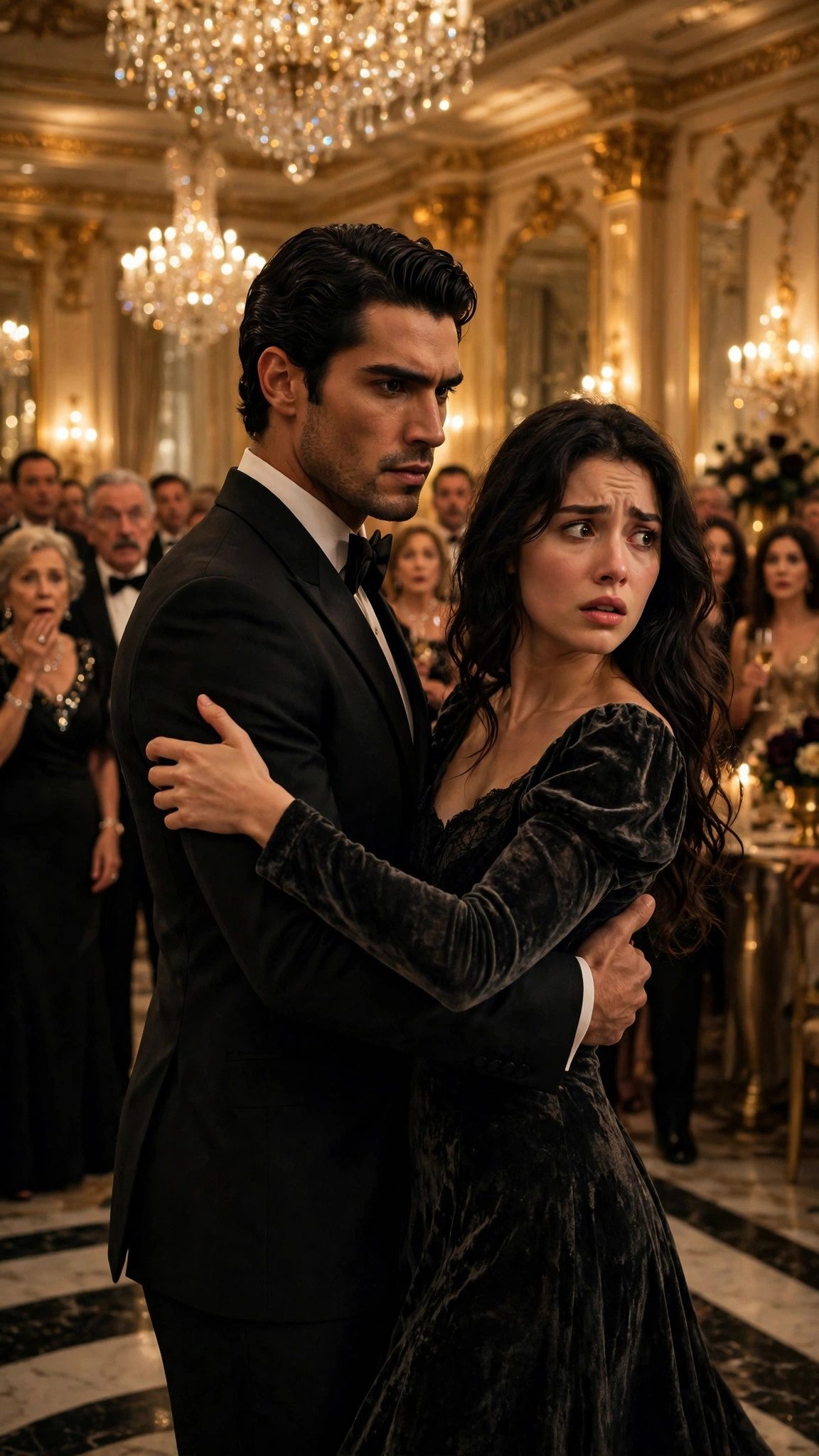
The ballroom was full of the same faces, the same chandeliers, the same white roses. But this time, when Carmine left his circle of men and walked toward my piano, nobody laughed. Nobody whispered. The room fell silent, the way it had a year before, but this time, the silence was different. This time, it was respect.
"Chopin is too depressing for a party, don't you think, Mrs. Valenti?" he asked, and his eyes were shining.
"What would you prefer, Mr. Valenti?" I asked, and my voice was steady, and my hands were steady, and my heart was full.
"Play a waltz," he said. "And dance it with me."
I stood, and I stepped onto the marble floor, and Shostakovich's Waltz No. 2 filled the ballroom, and Carmine took my hand and pulled me close, and we moved beneath the chandeliers while everyone watched. To them, it looked romantic. To me, it felt like coming home.
"You're not shaking anymore," he whispered near my ear.
"No," I said. "I'm not afraid anymore."
"Good," he said. "Because I have something to tell you. Well — we have something to tell you. Or rather, you have something to tell me."
I laughed, and I leaned close, and I whispered the secret I had been carrying for three weeks, the secret I had been saving for this exact moment, in this exact room, where it had all begun.
"I'm pregnant, Carmine. We're going to have a baby."
He stopped dancing. Right there, in the middle of the ballroom, in front of four hundred people, Carmine Valenti stopped moving, and he stared at me, and his eyes filled with tears, and he laughed — a real laugh, loud and joyful, the laugh of a man who had forgotten how to laugh and had just remembered.
Then he picked me up and spun me around, and the ballroom erupted in applause, and Lorenzo was crying, and Rosa was crying, and Liam was cheering from the back of the room, and the music played on, and the chandeliers threw light across the marble floor like diamonds.
When the music ended, Carmine set me down gently and bowed, the way he had a year before. But this time, when he spoke, his voice was not a dare. It was a promise.
"A deal is a deal," he said, loud enough for everyone to hear. "She danced with the devil. And the devil is the luckiest man alive."
I took his hand, and I looked out at the ballroom — at the faces, at the lights, at the life I had never expected and could not imagine living without — and I thought about my mother, who had wanted me to play concert halls, and my father, who had wanted me to be brave, and I knew, wherever they were, they could see me.
I was Josephine Valenti. I was a wife. I was a mother-to-be. I was a pianist who had danced with the devil and found, to her everlasting surprise, that the devil had a heart — and that he had given it to her, whole and unguarded, on a winter night in a ballroom full of strangers.
And as the music faded and the applause rolled over us like a wave, I closed my eyes and I listened, the way my father had taught me to listen, and I heard it — the song underneath all the other songs, the one I had been playing my whole life without knowing it.
It was the sound of coming home.
And as I opened my eyes and looked at Carmine — at the man who had asked a frightened piano girl to dance, and had kept every promise he ever made her — I knew that the waltz would never truly end. It would play on, through the years, through the laughter of our children and the music in our house, a song that had begun in a ballroom full of strangers and would last, God willing, for the rest of our lives.
The End.
THE END