My father built our house the way other men built boats or cathedrals — slowly, stubbornly, and as if the work itself were a kind of prayer.
I was four years old when he started. I remember the lot on Linden Lane before there was a house on it at all: a patch of muddy ground with a For Sale sign leaning crooked in the weeds, and my father standing in the middle of it in his work boots with his hands on his hips, looking at that empty lot the way other men look at a woman they intend to marry.
"Right here, Clara-bear," he said, picking me up and setting me on his shoulders so I could see the whole street. "Right here is where we're going to live. I'm going to build it with my own two hands, and one day it's going to be yours."
He was a carpenter, my father. Thomas Bennett. Not a rich man, not a famous man, but a man whose hands could make a straight line out of a crooked board and a home out of an empty lot. He worked for other people all day — kitchens in Winnetka, bookcases in Lake Forest, a staircase once for a family on the Gold Coast that paid him enough to buy the lot — and then he came home and worked on our house half the night, by the light of a single bulb strung from a pole, while my mother sat on an overturned bucket with a thermos of coffee and told him he was crazy and wonderful in the same breath.
It took him two years. Two years of weekends and evenings and frozen fingers in the winter and sunburn in the summer. He laid every floorboard himself. He sanded the banister until it was smooth as glass, because he said a little girl would be running her hand down that banister for the next twenty years and he did not want her to ever get a splinter. He built the window seat in the living room because my mother loved to read in the afternoon light. He built the kitchen table out of oak, thick and heavy, because he said a family needed a table that would not wobble, a table that would still be standing when his grandchildren were sitting at it.
When I was six, he carved my name into the beam above the front door. CLARA, in crooked capital letters, because he was a carpenter and not a calligrapher, and he laughed when my mother pointed out that the R was backwards.
"It's not backwards," he said. "It's rustic. There's a difference."
My mother rolled her eyes and kissed his cheek, and the R stayed backwards for the next thirty years, and every time I walked through that front door I touched it with my fingertips, the way other people touch a lucky charm.
"One day this will be yours, Clara-bear," my father told me a hundred times, in a hundred different ways, while he was teaching me to hammer a nail straight, while he was showing me how to tell oak from pine by the smell of the sawdust, while we sat on the porch steps on summer evenings watching the fireflies. "A house your father built with his own hands — nobody can ever take that away from you. Do you understand? It's yours. It's for you and for your babies, one day. That's what a house is for. It's for the people you love."
I understood. Or I thought I did. I was a child. I thought he meant the walls and the roof. It took me thirty years to understand that he meant something else. He meant that a house built by hand, board by board, with love in every joint, was a promise. And a promise, once made, does not belong to anyone else.
My father died when I was twenty-four. A heart attack, sudden, on a Tuesday morning, while he was carrying lumber into a job site in Evanston. He was fifty-nine years old. He had never been sick a day in his life, and then one morning his heart simply stopped, the way a clock stops when the spring breaks, and there was nothing anyone could do.
My mother called me at the hospital — I was already a nurse by then, already working nights at Chicago General — and she said, "Clara, your father's gone," and I remember thinking that she had to be wrong, that my father was too strong, too solid, too much like the oak table he had built, to just be gone.
But he was gone. And the house on Linden Lane became my mother's house, and then, years later, after the will was read and the papers were signed, it became mine. Not in the way Marc thought. In the way my father had always intended. The will was simple and clear, the way my father was simple and clear: the house and everything in it went to me, Clara Bennett, and after me to my son Jason. My mother had her own will, and it said the same thing, in her own neat handwriting: everything to Clara and Jason.
Marc knew that. He had been there when Mr. Doyle read my father's will. He had sat in Mr. Doyle's office and listened and nodded, and he had said all the right things about what a wonderful man my father was, and then he had gone home and never mentioned the will again. Not once in twelve years. Not until my mother died.
I married Marc Johnson when I was twenty-five, a year after my father died. I think now that I married him because I was lonely and grieving and he was handsome and funny and he knew how to make me laugh when I had forgotten how. He was a real estate agent then — a good one, charming, quick with a joke, always with a new listing, always with a new plan. He told me he loved the house on Linden Lane. He told me it was the most beautiful house he had ever seen. He told me my father had been a genius.
For the first few years, it was good. Or good enough. We lived in the house with my mother — she insisted, she said the house was too big for one old woman, and she liked having us there — and Jason was born, and for a while it felt like the family my father had imagined when he built that table. Sunday dinners. Jason's first steps on the hardwood floor. Christmas mornings with the tree in front of the window seat.
But slowly, the way a roof leaks slowly before it collapses, things changed. Marc started coming home late. Then later. Then not at all, some nights, with a text about a client dinner or a showing that ran long. Money got tight, and then tighter, and Marc started talking about the house differently — not as a home, but as an asset. As equity. As something we were sitting on.
"Do you know what this place is worth now, Clara?" he said one night, scrolling through his phone at the kitchen table. "Three times what your father paid for the lot. Three times. We could sell and buy something smaller and have enough left over to start a business. I've been thinking about it."
"It's my father's house," I said. "It's not for sale."
"Everything's for sale, Clara. That's the first rule of real estate."
He laughed when he said it. I did not laugh.
The fights started after that. Small ones at first — about money, about his hours, about the way he never seemed to be home for Jason's bedtime anymore — and then bigger ones. I found receipts for restaurants I had never been to. I found a second phone charger in his car, for a phone I had never seen. I asked him about it, and he told me I was being paranoid, that I was imagining things, that grief had made me suspicious. He said it so smoothly, so reasonably, that for a while I believed him. I wanted to believe him. I had a seven-year-old son and a dying mother and a job that kept me on my feet for twelve hours at a time, and I did not have the energy to believe that my husband was lying to me.
I should have believed myself. That is the thing I have learned, and I have learned it the hard way: when a woman's gut tells her something is wrong, she should listen the first time. Not the tenth time. Not after the will is challenged and the house is listed and the other woman is texting about Miami. The first time.
The night I met Alexander Moretti was the worst night of my nursing career, and also, in a strange way, the night that saved my family — though I did not know it then.
It was twelve years ago. I was twenty-four years old, three months out of nursing school, working the night shift in the emergency room at Chicago General. It was a Friday night in November, cold and raining, the kind of night when the ER fills up with car accidents and bar fights and people who have nowhere else to go.
At 2:47 in the morning, they brought in a young man with a gunshot wound to the abdomen. Nineteen years old. Dark hair, dark eyes, beautiful in the way Italian boys are beautiful, and bleeding so fast that the trauma bay floor looked like someone had spilled a bucket of red paint across it.
His name was Enzo Moretti. I did not know that then. I did not know who he was. I only knew that he was dying, and that he was nineteen, and that his hands were shaking, and that he kept saying, "Don't let me die. Please. Don't let me die. My brother will kill whoever did this, but please don't let me die."
I stayed with him. That is what nurses do — we stay. I held pressure on the wound while the surgeons worked. I talked to him while they put in lines and hung blood. I told him my name. I told him he was in a good hospital. I told him he was going to be all right, even though I was not sure it was true.
At one point, in the middle of the worst of it, he grabbed my hand with a bloody fist and said, "If I die, tell my brother — tell Alexander — tell him I wasn't scared. Tell him I wasn't scared."
"You won't die," I said. "You're not going to die. Do you hear me? You're going to live, and you're going to tell him yourself."
He lived. It was close — so close that the surgeon came out afterward with his scrubs soaked through and said, "Another ten minutes and we would have lost him" — but he lived. And I sat with him through the rest of the night, long after my shift ended, because he was scared and alone and nineteen years old, and because somebody had to sit with him.
At four in the morning, the doors at the end of the hallway opened, and a man walked in.
I knew immediately that he was dangerous. Not because he was shouting or threatening anyone — he was not. He was very calm. Very still. Very quiet. He was tall, with dark hair going grey at the temples and eyes the color of a winter sky, and he wore a black suit that cost more than I made in a month, and he walked down that hallway like he owned the hospital, the city, and the night itself.
Behind him came two more men, just as still, just as quiet, and behind them came my father.
My father. Thomas Bennett. In his work boots and his flannel shirt, carrying a paper bag with a sandwich in it, because my mother had sent him to bring me dinner on my night shift, the way she always did on Fridays.
My father took one look at the man in the black suit, and then he looked at me, and then he looked at the young man sleeping in the bed behind the glass, and he understood something I did not understand yet.
"Mr. Moretti," my father said.
The man in the black suit stopped. He looked at my father. "You know who I am."
"I read the papers," my father said. "And my daughter just spent six hours saving your brother's life. So I know who you are, and I know what you owe her."
Alexander Moretti looked at me then. Really looked at me, the way a man looks at someone he intends to remember. "Is that true?" he asked me. "You stayed with him?"
"He was scared," I said. "He's nineteen. Somebody had to stay."
Alexander nodded slowly. He reached into his jacket and took out a card — plain, white, with a phone number written on it in black ink, no name — and he held it out to me.
"Miss Bennett," he said. "My name is Alexander Moretti. My brother is alive because of you. I do not forget a debt like that. If you ever need anything — anything at all — you call this number. Day or night. I will come."
I took the card because it seemed rude not to. I put it in my scrub pocket and forgot about it by the end of the week.
But my father did not forget. On the drive home that morning, he said to me, "Clara-bear, that man meant what he said. Men like that — they don't make promises they don't intend to keep. If you ever need him, you call him. Do you understand?"
"Dad, I don't need a mafia boss," I said, laughing. "I need sleep."
"I'm serious, Clara," he said, and his voice was so grave that I stopped laughing. "I saw the way he looked at you. Like you mattered. Men like that don't look at many people that way. Remember this night. Remember his name. One day you might need him."
I remembered his name. I kept the card in my jewelry box for twelve years, through my wedding, through Jason's birth, through my father's funeral. I never called the number. I never needed to. I had a husband, a house, a job, a family. I had everything I needed.
Until the week my mother died, and my husband tried to steal my father's house, and I understood, finally, what my father had been trying to tell me on that drive home twelve years ago.
Some promises are not made to be used. They are made to be kept. And some men keep them, even when twelve years have passed, even when the woman who saved their brother has forgotten they exist.
My father had understood that. He had looked at Alexander Moretti in a hospital hallway at four in the morning and seen something I was too young to see: a man who kept his word.
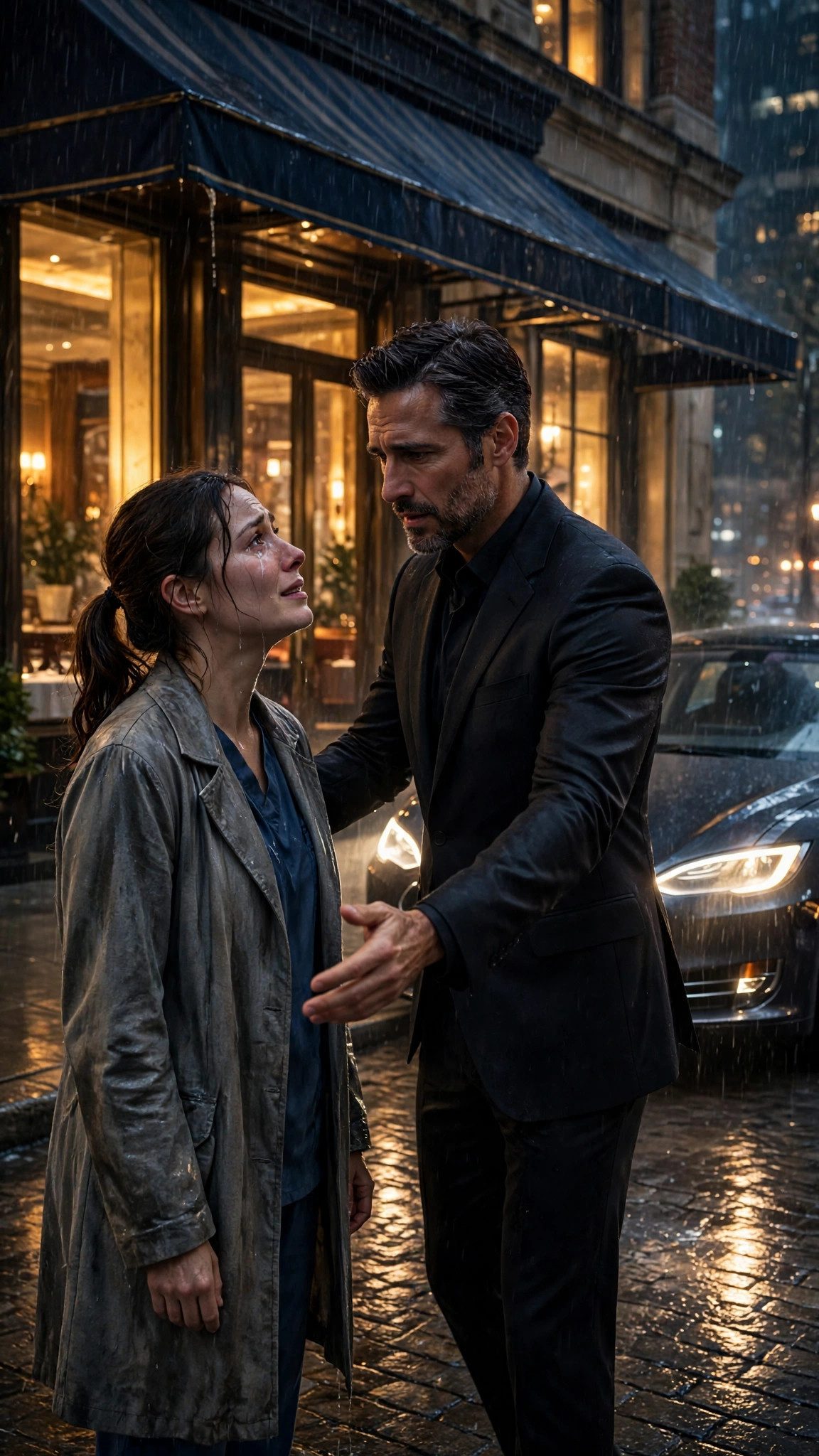
And now, on a wet Chicago night, with my mother's will in my bag and my son asleep twenty miles away, I was about to find out whether my father had been right.