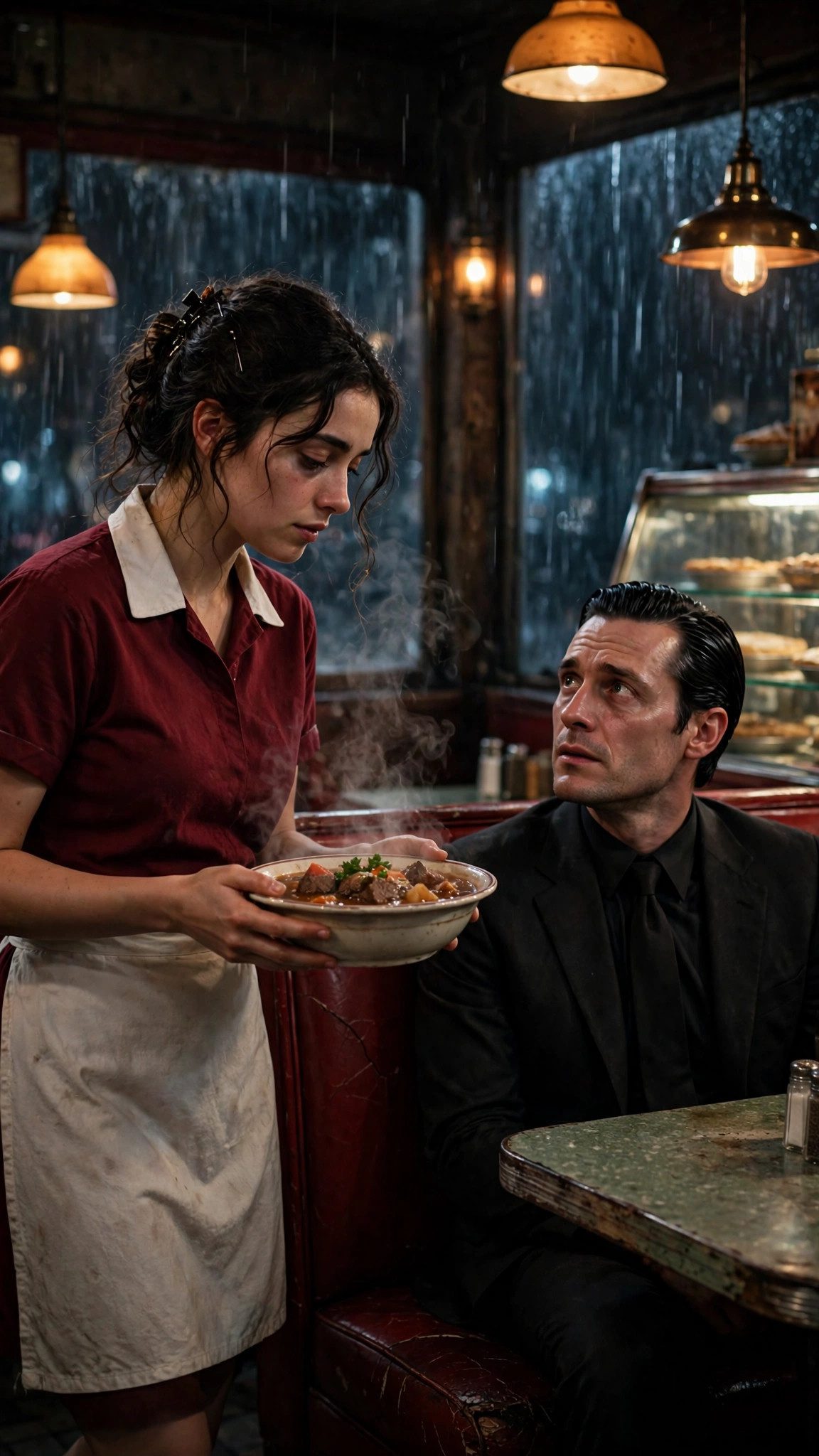
Gabriel Hayes came back the next night, and the night after that, and the night after that.
He came at nine o'clock, always at nine, when the dinner rush was over and the diner was quiet. He sat in the same cracked red booth. He ordered the same thing. And every night, I cooked the stracotto in the kitchen with the door open so Leo could watch, and I carried the bowl out myself, and Gabriel ate it slowly, the way a man eats when he is afraid the food will disappear.
On the third night, he brought something with him. A small wooden box, old and worn, with a brass clasp that had gone green with age. He set it on the table between us, and he looked at it the way a man looks at something he has been carrying for a very long time.
"Open it," he said.
I opened the clasp. Inside, wrapped in a piece of faded blue cloth, was a photograph. It showed a kitchen — a small, warm kitchen with yellow curtains — and a woman standing at the stove, singing, with a wooden spoon in her hand. She had dark hair pulled back in a bun, and a smile that made the whole photograph feel warm. Beside her, half hidden behind her skirt, was a small boy with dark hair and serious eyes.
"That's my mother," Gabriel said. "Elena Hayes. And that's me, when I was seven. And that —" he pointed to a figure at the edge of the photograph, a woman in an apron with flour on her hands, half out of the frame, like she had not wanted to be photographed at all — "that's Rosa."
I stared at the photograph. Rosa looked younger than I had ever known her, but it was her. The same patient eyes. The same flour on her hands. The same way of standing slightly behind everyone else, like she was making sure the room was all right before she worried about herself.
"Where did you get this?" I asked.
"It was in my mother's things," Gabriel said. "After she died, I kept everything. I have boxes of it in the penthouse. Photographs. Letters. Her recipe book. I haven't opened any of it in twenty-six years."
"Why not?"
"Because every time I opened a box, I could smell her kitchen. And I couldn't stand it." He was quiet for a moment. "Until three nights ago. Until I tasted your stew, and I realized that the smell was still out there in the world, and that I had been starving for it without even knowing."
I looked at the photograph again. At the little boy half hidden behind his mother's skirt. At the woman at the edge of the frame.
"Rosa never talked about your family," I said. "But she kept a box too. Under her bed. I found it after she died."
Gabriel looked up sharply. "What was in it?"
"Letters. Photographs. And a recipe card." I reached into my apron pocket and took out the card — the same card I carried every shift, folded and refolded until the edges were soft. I laid it on the table between us. "This is it. This is the recipe. She wrote it in her own hand."
Gabriel picked up the card carefully, like it might break. The handwriting was Rosa's — neat, slanted, careful. At the top, in faded ink, it said: STRACOTTO — FOR ELENA'S BOY. And underneath, the ingredients. Chuck roast. Potatoes. Carrots. Garlic. Red wine. Broth. Thyme. Cinnamon. Black pepper. And at the bottom, in smaller writing: "The secret is the dirt and the spice. Thyme for the earth. Cinnamon for the soul. Make it slow. Make it with love. He is always hungry, and nobody feeds him except you."
Gabriel read the card twice. Then he put it down, very gently, and he put his face in his hands, and his shoulders shook. Leo, standing by the door, turned away and pretended to look out the window.
"She knew," Gabriel said, his voice muffled by his hands. "She knew I was hungry. All those years, she knew, and she fed me anyway, even when nobody else would. And when my mother died, she left. And I never knew why."
"Maybe she left because it hurt too much to stay," I said. "Maybe she left because the house without your mother wasn't a home anymore. Maybe she left because she couldn't watch what happened to you next."
Gabriel lifted his head. "What happened to me next?"
"You went into the streets," I said. "You became who you are. And Rosa — Rosa went to Apartment 4B, and she watched me, and she taught me the same recipe, and she told me there was a boy in that house who never got enough to eat. Not food. Love."
We sat in silence for a while. The diner was quiet. Benny was wiping down the counter, pretending not to listen. The rain had stopped, and the broken neon sign buzzed outside, and the smell of the stew was still in the air.
"Norah," Gabriel said at last, "I need to ask you something, and I need you to tell me the truth. Did Rosa ever say anything about my mother's death? Anything at all? Did she ever say it wasn't natural?"
I stared at him. "What do you mean?"
"My mother died of a heart problem. That's what the doctor said. But she was thirty-four years old. She was healthy. She sang while she cooked. And then one winter she got sick, and she got sicker, and she died. And Rosa left the week after." He leaned forward. "I've spent twenty-six years telling myself it was natural. But since I tasted your stew, I've been thinking about it. And I keep coming back to the same question: why did Rosa leave so fast? Why didn't she stay for the boy?"
I thought about it. I thought about all the stories Rosa had told me, and all the things she had never said. And I remembered something — something small, something I had forgotten until that moment.
"She used to say," I said slowly, "'Some houses are poisoned, Norah. Not the food. The house. The people in it. And when a house is poisoned, the only thing you can do is leave, and take the recipe with you, so the poison doesn't get that too.'"
Gabriel went very still. "She said that? Those words?"
"Yes. When I was about twelve. I asked her why she left the big house, and she said that. I thought she meant it as a metaphor."
"It wasn't a metaphor," Gabriel said, and his voice had gone cold and hard, the way it had been the first night, when he had threatened Benny's hands. "Norah, I think my mother was poisoned. I think someone in that house poisoned her, slowly, over weeks. And I think Rosa knew. And I think that's why she left."
My blood went cold. "Gabriel, that's — that's a terrible thing to think."
"It's a terrible thing to know," Gabriel said. "And I think Paulie was poisoned by the same kind of person. Someone inside. Someone patient. Someone who knows how to wait."
He stood up, and the boss was fully back in his eyes now — not the broken man in the booth, not the little boy in the photograph, but the head of the city's criminal underworld, a man who had survived bullets and federal investigations and was now hunting something he could not yet see.
"Leo," he said, "I want Marcus Hale watched. I want to know where he goes, who he calls, who he meets. I want to know what he was doing the night before Paulie died, and I want to know what he was doing the night my mother died — no, that's too long ago. Just Paulie. Start with Paulie."
Leo nodded. "Already started, boss. Marcus was at Paulie's house the night before. Said he was dropping off paperwork. But the paperwork was already there. Paulie's wife told me Marcus left an envelope on the table. She didn't open it. It's still there."
"Get it," Gabriel said. "And Norah —" he turned to me — "I need you to be careful. If someone poisoned my mother, and someone poisoned Paulie, then someone is very good at this, and someone is very patient. And now that person knows I can eat again. And they know why."
"Because of me," I said.
"Because of you," Gabriel said. "Which means you are in danger. And I will not let anything happen to you. Do you understand?"
I nodded, but my hands were shaking. I had spent my whole life trying to be invisible — a tired waitress in a burgundy uniform, studying for her nursing exams, going home to a small apartment and a mother who worked double shifts. And now, because of a bowl of stew, I was standing in the middle of something I did not understand, something that had started twenty-six years ago in a kitchen that smelled like thyme and cinnamon.
Gabriel reached across the table and took my hand. His hand was warm, and steady, and it did not tremble at all.
"Norah," he said, "Rosa fed me when nobody else would. And now you have fed me when nobody else could. I owe your family a debt. And Gabriel Hayes always pays his debts."
He let go of my hand, and he walked out into the night, and Leo followed him, and the three black SUVs pulled away from the curb.
I stood in the empty diner, holding Rosa's recipe card, and I looked at the photograph Gabriel had left on the table — the kitchen with the yellow curtains, the woman singing at the stove, the little boy half hidden behind her skirt, and Rosa at the edge of the frame, with flour on her hands, watching over all of them.
And I thought about what Rosa had said: "Some houses are poisoned, Norah. Not the food. The house."
I folded the recipe card and put it back in my apron pocket. I picked up the photograph and put it in my bag, because Gabriel had left it behind, and I knew he would want it back.
And I went home through the quiet streets, and I did not know that Marcus Hale was already watching the diner from a car two blocks away, and that he had already made a phone call, and that the man on the other end of that phone call was Vincent Castellano, the oldest enemy Gabriel Hayes had, and that the two of them had just decided that the waitress in the burgundy uniform had to disappear.
I did not know any of that. I only knew that I had cooked dinner for a ghost, and the ghost had turned out to be a man, and the man had turned out to be hungry — not just for food, but for the truth.
And the truth, I was about to learn, was the most dangerous thing in the city.
The next afternoon, Gabriel took me to see the street where the Hayes house had once stood. It was not a house anymore. It was a parking garage, gray and concrete, with a faded sign that said MONTHLY RATES, and cars going in and out, and nobody remembering that a family had once lived there, or that a kitchen had once smelled like thyme and cinnamon.
Gabriel stood on the sidewalk across the street, staring at the garage, and he did not speak for a long time. Then he said, "My mother's bedroom was on the second floor. The window faced the street. She used to wave at me from that window when I walked home from school. And the kitchen was at the back, with the yellow curtains. Rosa's room was above the kitchen. She used to leave her window open at night so she could hear me if I had a nightmare."
"What happened after your mother died?" I asked. "After Rosa left?"
"My father drank," Gabriel said. "He drank, and he shouted, and he broke things, and then he drank more. He stopped going to work. He stopped eating at the table. He ate standing up in the kitchen, or not at all. When I was fourteen, I came home one night and found him passed out on the floor, and I packed a bag — my mother's photograph, two shirts, the little money I had saved — and I walked out the door, and I never went back. Not once. Not even when he died. I sent flowers to the funeral, and I did not attend."
"Do you regret that?" I asked.
"Every day," Gabriel said. "But I was fourteen, and I was angry, and I thought leaving was the same as surviving. It took me twenty-four years to learn that leaving is just another way of starving."
We walked to a small park two blocks away, and we sat on a bench under a tree, and Gabriel reached into his jacket and took out a small gold locket. He opened it. Inside was a tiny photograph of Elena Hayes — the woman from the kitchen photograph, smiling, with her dark hair pulled back in a bun.
"My mother gave me this when I was ten," he said. "She told me to keep it close to my heart, and I would never be alone. I lost it when I was sixteen, in a fight. A man in my crew found it in the gutter the next morning and brought it back to me. I've carried it ever since."
He closed the locket and put it back in his jacket, and he looked at me, and his eyes were clear and steady.
"Norah, I want you to know something. When I was a boy, the only person who ever asked me if I was hungry was Rosa. Not my father. Not my teachers. Rosa. She would put a plate in front of me and say, 'Eat, Gabriel. A growing boy needs his strength.' And now you do the same thing. You put a plate in front of me and you don't ask me who I am or what I've done. You just feed me. And that is the kindest thing anyone has done for me in twenty-six years."
I took his hand. It was warm, and steady, and it did not tremble at all.
"Then let me keep doing it," I said. "Let me keep feeding you. For as long as you want."
And Gabriel Hayes — the most feared man in the city — smiled, and he squeezed my hand, and we sat on that bench under that tree for a long time, not saying anything, just sitting together in the place where a house had once stood, and a kitchen had once smelled like home.