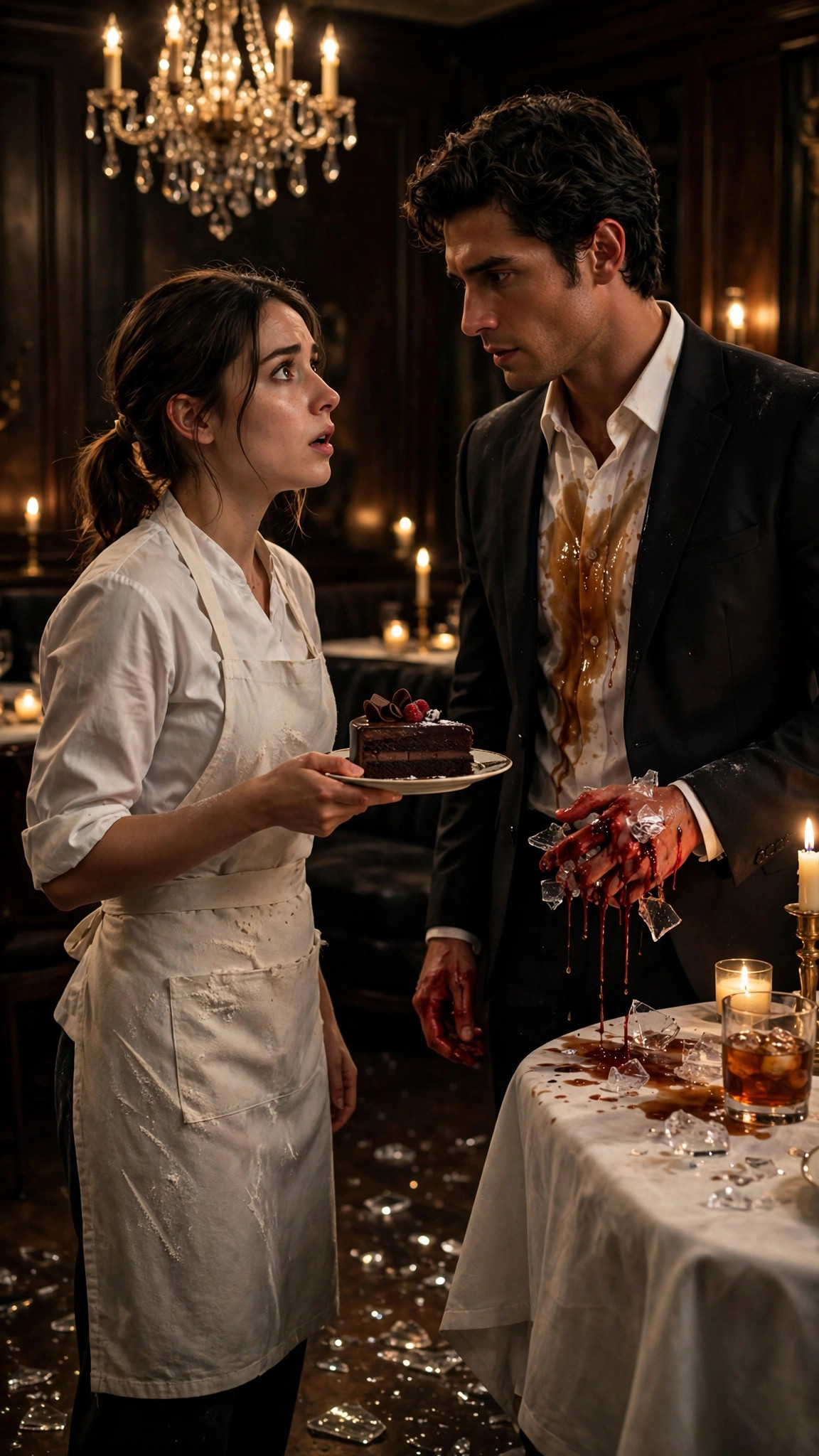
I did not sleep that night. I sat at my kitchen table until the sky over Pilsen turned gray, and then I got up, washed my face, and went to work, because that was what I did. I baked. It was the only thing I knew how to do when the world stopped making sense.
The kitchen at the Imperial was quiet at five in the morning. I started the ovens, tied my hair back, and reached for Rosa's notebook, the one with the cracked leather cover and the pages stained with butter and chocolate. I had read it so many times I knew it by heart, but I opened it anyway, because opening it felt like having her in the room with me.
My grandmother Rosa Williams had come to Chicago from a small town in Jalisco when she was nineteen, with nothing but a suitcase and her mother's recipes. She worked as a cleaning lady, then as a cook in a diner, then, when she had saved enough, she opened a tiny bakery on 18th Street with a secondhand oven and a sign she painted herself. She married a quiet man named Tomas, who fixed her oven when it broke and held her hand when their daughter, my mother Grace, was born.
My father, Daniel Williams, drove a delivery truck for a bakery supply company. He died in a highway accident when I was eight years old. I remember very little about him, only that he smelled like flour and diesel, and that he used to lift me onto his shoulders so I could see the tops of the shelves in Rosa's bakery.
My mother died when I was twelve. A sudden illness, the doctors said, something in her heart that no one had caught in time. After that, it was just Rosa and me and my little sister Sofia, who was only two years old and did not understand why Mama was not coming home.
Rosa raised us in the back rooms of that little bakery. Sofia and I grew up with flour on our hands and the smell of cinnamon in our clothes. Rosa taught me to measure by feel, to listen to the oven, to know when bread was done by the sound it made when you tapped it. "A recipe is a map, Camila," she used to say, "but your hands are the ones who have to walk the road."
When I was sixteen, Rosa let me bake my first cake alone. It was a chocolate cake, dark and dense, with a filling I invented myself because we could not afford the imported chocolate the recipe called for. I used espresso instead, strong and bitter, and a pinch of sea salt on top, because Rosa always said salt was what made sweet things taste like themselves. When Rosa tasted it, she closed her eyes and was quiet for a long time.
"Where did you learn that?" she asked.
"From you," I said.
She smiled then, the way she always smiled when she was proud of me. "Then it is yours now," she said. "Not mine. Yours. And one day, Camila, you will make that cake for someone who needs it, and it will change everything."
I did not understand what she meant. I was sixteen. I thought she meant a customer, or a judge at a baking contest.
Rosa died two years ago, when I was twenty-seven. A stroke, quick and quiet, in her sleep. On her last night, I sat beside her hospital bed and held her hand, and she looked at me with her eyes half closed and said, "Camila, listen to me. A woman who can feed people will never be helpless. Remember that. Whatever happens, whatever men come into your life with their big voices and their big promises, you can feed people. That is power. That is freedom. Do not let anyone take your kitchen from you."
I promised her I would not. I promised her I would take care of Sofia, and that I would keep baking, and that I would never let anyone make me small. She squeezed my hand once, very weakly, and then she closed her eyes, and she did not open them again.
She left me the bakery, but the bakery was already dying by then, squeezed out by the big chains and the rising rent on 18th Street. I sold it to pay her medical bills and Sofia's first year of culinary school, and I went to work at the Imperial, starting as a line cook and working my way up to head pastry chef in four years.
Sofia was nineteen now, in her second year at Kendall College, and she was going to be a better chef than me. She had Rosa's hands and my mother's smile, and she called me every Sunday to tell me what she had learned that week. I paid her tuition, her rent, her books. It was the promise I had made to Rosa on the last night of her life, when she took my hand in the hospital and said, "Take care of your sister, Camila. She is your heart outside your body."
That was my life. A small apartment, a kitchen that opened before dawn, a sister in school, and a grandmother's notebook. I had never had a boyfriend. Not because no one had asked. Men had asked. But I had always been too busy, too tired, too focused on the next morning's ovens. And if I was honest, no one had ever asked in a way that made me want to say yes.
I had never imagined that the first man to make me feel anything would be Lorenzo Moretti.
By seven that morning, Priya arrived with coffee, and I told her everything. I told her about the glass, and the blood, and the bourbon, and the words "you belong to me." Priya listened without interrupting, which was not like her at all, and when I finished, she sat down on a flour sack and stared at me.
"Camila," she said slowly, "do you know who Lorenzo Moretti is?"
"I know the stories," I said.
"No," Priya said. "You know the stories people tell at dinner parties. Let me tell you what my cousin told me, the one who works at the hotel. Lorenzo Moretti has not smiled in seven years. Not once. Not at a wedding, not at a birth, not at anything. His men say he stopped smiling the night his brother died, and they say he has not been a real person since. And last night, he smiled at your cake."
She leaned forward. "Priya," I said, "he said I belong to him."
"I know," she said. "And I am telling you that in his world, that is not a pickup line. That is a law. When a man like that claims a woman in front of his men, it means something. It means she is under his protection, and it means anyone who touches her answers to him."
"Protection from what?" I asked.
Priya hesitated. "I don't know. But Camila, men like that do not claim women for no reason. Something is going on. And whatever it is, you are in the middle of it now."
I wanted to argue with her. I wanted to tell her that I was a pastry chef, that I made cakes, that I was nobody, that this would blow over. But all morning, I kept thinking about the way he had looked at me, and the way his hand had bled without him noticing, and the way the older man, Marco, had told me to lock my door and not answer it for strangers.
At noon, my phone rang. It was Sofia.
"Cam, are you okay?" she asked. "You sound weird."
"I'm fine," I said, which was a lie.
"You're not fine. Your voice goes up when you lie. Did something happen at work?"
I almost told her. I almost told her everything. But Sofia was nineteen, and she was in school, and she did not need to carry this. So I told her about the wedding cake consultation instead, and about the burned madeleines, and she laughed, and I felt a little bit like myself again.
"Cam," she said before she hung up, "there's this guy in my class. He's nice. He asked me to get coffee sometime."
"Be careful," I said, more sharply than I meant to.
"I will," she said. "Love you."
"Love you too."
After she hung up, I stood in the kitchen with the phone in my hand and thought about how small my life had been until last night, and how big it had suddenly become.
Across the city, in a house I had never seen, Lorenzo Moretti was sitting in a dark room with his hand bandaged, and Marco Benedetti was standing in front of him, and they were having a conversation I would not hear about until much later.
Marco had worked for the Moretti family for thirty years. He had held Lorenzo when he was a boy. He had stood beside Lorenzo's father at his funeral. He had been there the night Enzo died, and he had carried Lorenzo out of the wreckage of that night with his own hands. He was the only man alive who could speak to Lorenzo Moretti the way he was speaking to him now.
"You scared her," Marco said.
"I know," Lorenzo said. His voice was quiet. He was looking at his bandaged hand.
"You crushed a glass in your hand because a girl said two words to you. Do you understand what you did tonight?"
"Yes," Lorenzo said.
"Then explain it to me," Marco said. "Because I have known you since you were ten years old, and I have never seen you do anything like that. Not once. Not even the night Enzo died."
Lorenzo was silent for a long time. Outside the window, the city moved on, unaware.
"She made the cake," he said finally.
"The cake," Marco repeated.
"Enzo used to steal it," Lorenzo said. "When he was small. Our mother would bake a chocolate cake on Sundays, and Enzo would sneak into the kitchen and cut himself a slice with his fingers, and he would come and find me with chocolate on his chin and say, 'Lorenzo, taste this, it is the best thing in the world.' I had not tasted that cake in seven years. Not since the night he died. And then tonight, in that restaurant, I took one bite, and it was there. The espresso. The salt. The way it melted. It was Enzo's cake. It was my mother's kitchen. It was seven years ago, and I was not alone in a room full of men who are afraid of me."
Marco was quiet.
"And then I asked her if she had a boyfriend," Lorenzo said, "and she said 'not yet,' and all I could think was that she was unclaimed, and unclaimed means unprotected, and I have spent seven years protecting nothing but my own guilt. I am not going to let someone else take her. Not Castellano. Not anyone."
Marco's face changed at the name. "You saw him," he said. It was not a question.
"At the bar," Lorenzo said. "Dominic Voss. He was watching her through the glass while she worked. He has been watching her for weeks. I had my men check. Castellano wants the Imperial. Hale owes him four hundred thousand dollars, and Castellano does not want the restaurant. He wants her. Her talent, her name, her hands. He wants to own the best pastry chef in Chicago, and he wants to do it by owning the building she works in."
"So the claim," Marco said slowly.
"Was a message," Lorenzo said. "To Voss, and to Castellano, and to every man in that room. She is mine now. She is under my protection. If they touch her, it is war."
"And if she does not want your protection?" Marco asked.
Lorenzo looked down at his bandaged hand. The blood had soaked through the white gauze in one dark spot.
"Then I will have to earn it," he said. "But I will not take the claim back. I cannot. In front of my men, in front of Voss, it is done. If I take it back now, Castellano will know she is unprotected, and he will move on her tomorrow. I would rather she hate me and be alive than love me and be taken."
Marco studied him for a long moment. Then he nodded, once, the way he had nodded thirty years ago when Lorenzo's father had given him an order he did not like but understood.
"Then we protect her," Marco said. "Properly. Men outside the restaurant. Men outside her apartment. And you will stay away from her until she is ready to hear the truth, because if you go near her now, you will frighten her again."
"I know," Lorenzo said.
He stood up and walked to the window and looked out at the city, at the lights of the restaurants and the hotels, at the streets where his brother had died seven years ago and where a pastry chef was now, unknowingly, the center of a war between two families.
"Seven years," he said quietly, to no one in particular. "Seven years, and I finally taste that cake again, and it is made by a girl who has never had a boyfriend, and who looks at me like I am a monster."
"You are not a monster," Marco said.
"No," Lorenzo said. "But I am going to have to prove that to her. And I do not know how."
That night, I went home, locked my door twice, and stood in my kitchen looking at Rosa's photograph. I thought about what Marco had said to me. Lock your door. Do not be afraid. Do not answer the door for anyone you do not know.
I thought about Sofia, and her tuition, and the life I had built out of flour and early mornings. And I thought about a man with blood on his hand who had smiled at my cake like it was the first good thing he had tasted in seven years.
I did not know it yet, but the next morning, everything would change again. Because the man who had been watching me through the glass was going to come back, and this time he was not going to stay at the bar.