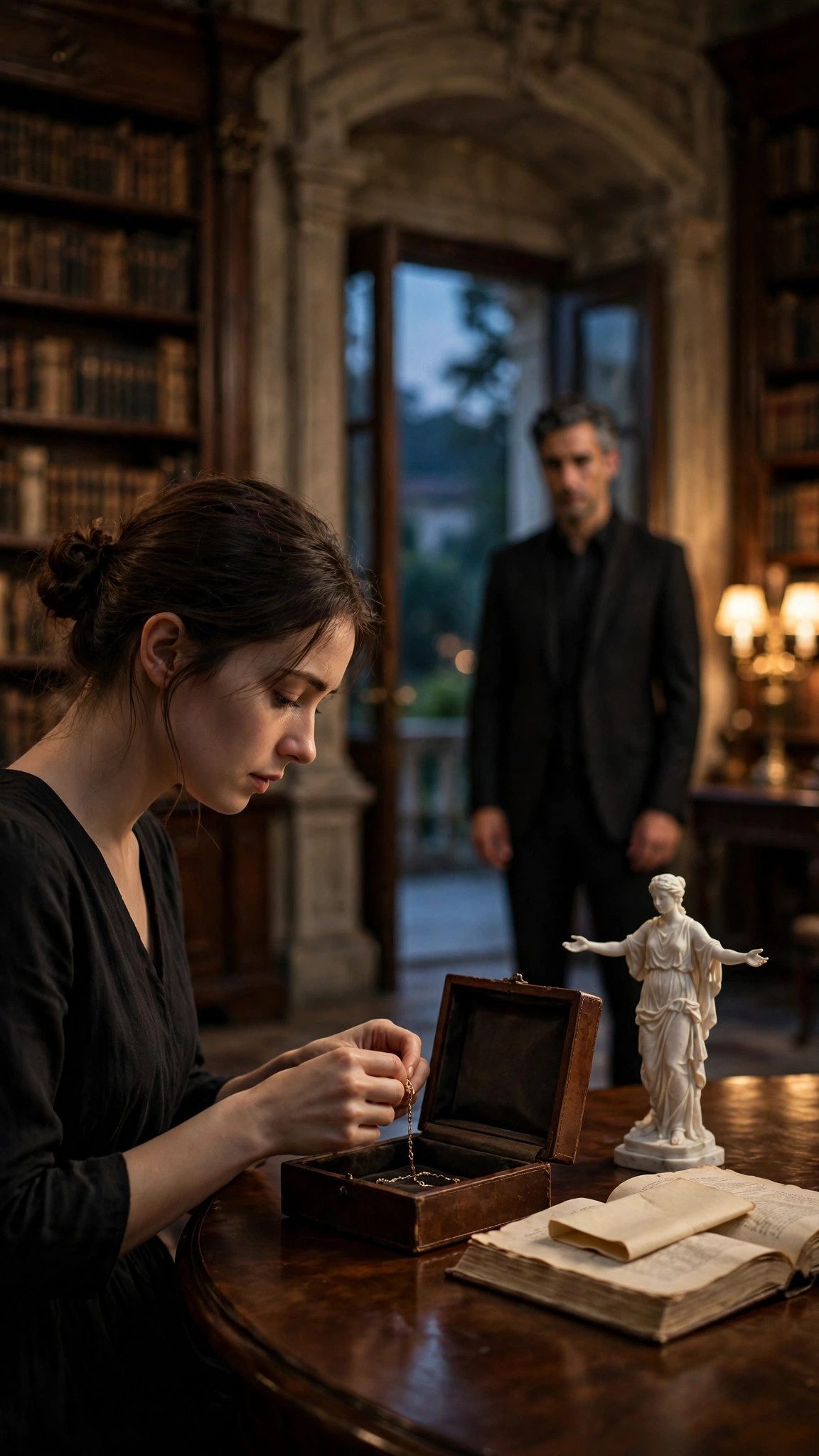
In the morning, Giulia laid the table, and she placed the two small bracelets on it, one for him and one for her, and she waited for Raphael to come.
He came at nine o'clock, as he had come every morning since he had found her, and he knocked softly, and she opened the door, and she led him to the table, and she sat down across from him, and she looked at him, and she said the words she had practiced all night.
"I will come home," she said, "if you will come home with me. Not to the villa as it was. To a new life. To a house where the name on the door is Victor, and where no one is afraid, and where the only gifts are the ones we give each other freely, with open hands."
Raphael looked at the two bracelets on the table. He looked at them for a long time, the way a man looks at something he has been searching for without knowing its name.
"Then that is the house we will build," he said. "And I will build it with you, not for you. That is the difference. I am learning that now. Everything I build from now on, I build with you."
He picked up one of the bracelets, and he held it out to her, and she held out the other one to him, and they put them on each other's wrists, there at the small table in the room above the bookshop, with the snow falling outside and the light coming through the window. And it was the simplest ceremony in the world, and it was the most important one either of them had ever been part of, because for the first time in his life, Raphael Carbone had received a gift from a woman who owed him nothing, and for the first time in her life, Giulia Ferraro had given a gift to a man who frightened no one.
They went back to the villa together in the spring, when the lemon trees were in flower and the garden was waking up. But they did not go back to the villa as it was. They went back to build something new.
Raphael called his men together, all of them, in the great hall where the family had met for fifty years, and he stood in front of them, and he told them the truth. He told them that the family was going to change. He told them that from now on, no one would be threatened in the family's name. He told them that debts would be collected with patience, not with fear. He told them that the men who had frightened Antonio the baker were no longer welcome in his house, and that any man who frightened an innocent person would answer for it, in the open, in the light.
Some of the men left. They left because they did not know any other way to live, and because a family without fear was a family they did not recognize. Raphael let them go. He did not threaten them. He did not punish them. He wished them well, and he paid them what they were owed, and he watched them walk out of the hall, and he felt lighter with every step they took, the way a man feels lighter when he sets down a weight he has carried for twenty years.
The men who stayed were the men who had always wanted a different life and had never dared to say so. Charles stayed, and he stood beside Raphael, and he said, "It will be harder this way, Boss. But it will be better. I have waited thirty years for someone to say what you just said."
The family changed. The shipping company, Carbone Holdings, became a real company, with real books and real contracts and real employees who were paid on time and treated with respect. The restaurants and the clubs that had once paid for protection began to pay for partnership instead, and they flourished, because a business that is not afraid grows faster than a business that is. The docks, which had once been a place of whispers and threats, became a place of honest work, and the men who worked there began to bring their sons to see what their fathers did, and to be proud of it.
And the villa changed too. The iron gates, which had been closed for fifty years, were opened. The garden, which no one in the neighborhood had ever seen from the inside, was opened to the town on Sundays, and children came to pick lemons, and old women came to sit by the fountain, which ran again for the first time in years. Rosa wept when she saw it, and she said, "Signora Elena would have loved this. She always said a garden is wasted if no one sees it."
The annual ball came again that autumn, and it was different from every ball that had come before it. There were still chandeliers, and there was still music, and there was still champagne. But the ball was no longer a night for showing the city how powerful the family was. It was a charity gala, for the children's hospital, and the guests were not only the city's important people, but also the bakers and the teachers and the shopkeepers, the people who had once been afraid to say the family's name. Antonio the baker came, and he brought bread, and he laughed, and he did not jump when the door opened. Marta came, and she danced, and she did not hold anyone's arm for fear. The restaurant man came, with his wife and his two children, and he shook Raphael's hand, and he said, "Thank you," and he meant it.
And Giulia stood at the top of the stairs that night, in a dress of deep green, the silver bracelet on her wrist, and she watched the room, and she saw what she had wanted to see for so long: no one lowered their voice when Raphael walked in. No one stopped laughing. No one made themselves smaller. They stood taller. They smiled. They came forward to greet him, not because they were afraid not to, but because they wanted to.
Raphael came up the stairs to her, and he took her hand, and he led her down into the ballroom, and the orchestra played, and they danced. And as they danced, he leaned close to her, and he said, very quietly, so that only she could hear it, "I used to think that respect was something you took. Now I know it is something you are given. And you gave it to me first, when you were the only person in this house who was not afraid of me."
"I was never not afraid," Giulia said, smiling up at him. "I was afraid too. I was afraid of losing you. That is why I left. And that is why I came back."
They were married in the spring, in the garden of the villa, under the lemon trees, with the fountain running and the roses in bloom. It was a small wedding, not a grand one, because Giulia had asked for it to be small, and because Raphael had learned that the best things in life are the small ones, freely given. Rosa cried. Marta cried. Charles stood as best man, and he cried too, though he would deny it for the rest of his life. Old Tomas drove them to the chapel in the car he had polished for three days, and he cried all the way there.
Giulia wore a simple white dress, and on her wrist she wore two bracelets: the thin silver band from the town market, and beside it, the small gold bracelet with the tiny flower charm, the one Elena had left her, the one she had returned in the leather box, the one Raphael had brought back to her on the morning of the wedding, with a note that said only, "This one was always given in love. It was never a chain."
Raphael wore a black suit, and on his wrist he wore the other silver bracelet, and when the priest asked him if he took this woman to be his wife, he said, "I do," and his voice did not shake, because for the first time in his life, he was not afraid of the answer.
After the wedding, they danced in the garden, under the lights Rosa had hung in the lemon trees, and the guests danced with them, and the music played, and the night was warm, and the villa, which had been quiet for so many years, was full of laughter.
Late that night, when the last guest had gone and the lights had been dimmed, Raphael and Giulia stood together in the library, in front of the table where the leather box had once sat, and where the book of poems had once held a letter. The table was empty now, except for a single photograph: Elena, laughing, her dark hair blowing in the wind, the way she had looked in the photograph in the hallway all those years ago.
"Do you think she would be proud?" Raphael asked.
Giulia took his hand, and she laid it against her cheek, and she said, "She always knew you were Victor. She just needed you to remember it. And you did. That is the bravest thing you have ever done."
He held her then, in the quiet library, with the photograph on the table and the garden outside the window, and he thought about the boy who had picked dandelions, and about the man who had learned to knock softly on a door, and about the woman who had returned every gift he had ever given her, and who had come back to him with two small silver bracelets and an open hand.
He had spent twenty years teaching people to fear him. It had taken one woman, one letter, and one winter to teach him the price of fear, and the value of the only thing fear could never buy.
Trust. Freely given. Freely returned. And kept, at last, in the light.
One year later, on a bright morning in May, Giulia stood in the garden of the villa with a basket of dandelions in her hands, and Raphael stood beside her with a small spade, and together they planted a patch of dandelions at the foot of Elena's roses, in the sunniest corner of the garden, where the light fell longest in the evening.
"A garden needs dandelions," Giulia said, pressing the earth down gently around the roots. "Your mother told me so. She said they were the most beautiful flowers in the world because they were the only ones nobody guarded."
Raphael smiled, and he wiped the earth from his hands, and he looked at the garden, at the roses and the lemon trees and the fountain running in the sun, and at the children playing on the lawn, the children of the town who came on Sundays now, and he thought about how far he had come from the man who had stood in doorways with his hands still at his sides.
The first charity gala had raised enough money to build a new wing at the children's hospital, and the second had raised more, and the ballroom that had once been a place of fear was now a place where the whole town gathered, bakers and teachers and shopkeepers and students, to eat and dance and give. Antonio the baker had become famous in the town, and his bread was served at every table, and he had named his newest loaf after Giulia, though he still did not know that she was the woman the boss had once loved from a distance.
Rosa had grown old gracefully, and she still ruled the kitchen, and she still made her almond biscuits on Sundays, and she still told anyone who would listen that she had known, from the very first day, that the girl with the spine would change everything.
And Charles, who had served the family for thirty years, had finally retired to a small house by the sea, where he wrote his memoirs and fished in the mornings, and where he told his grandchildren that the bravest thing he had ever seen was not a man with a gun, but a man who walked into a room full of his enemies, alone and unarmed, and spoke about the light.
That evening, as the sun set over the harbor, Raphael and Giulia walked together through the garden, past the roses and the lemon trees, to the patch of dandelions they had planted that morning. The flowers were small and yellow and brave, standing up straight in the earth, and Giulia bent down and picked one, and she held it out to him, and he took it, and he tucked it behind her ear, the way a boy tucks a flower behind his mother's ear, and she laughed, and he laughed, and the garden laughed with them, in the way gardens laugh when they are loved.
"Victor," she said softly, using the name only she used, the name his mother had used, the name that meant the boy and the man were finally the same person. "Thank you for learning how to knock."
"Thank you for leaving the door open," he said. "Just a little. Just enough for the light to come through."
And they stood there together, in the garden, in the evening light, with the dandelions at their feet and the roses above them, and the villa behind them with its doors wide open, and the whole town spread out below them, unafraid, and the future stretching out in front of them, bright and ordinary and entirely theirs. The gold bracelet glinted on Giulia's wrist beside the thin silver band, two gifts at last in agreement with each other: one given in love by a mother who had seen her clearly, and one given in freedom by a woman who had chosen for herself. And neither of them was a chain. Neither of them would ever be a chain again.
The End.
THE END