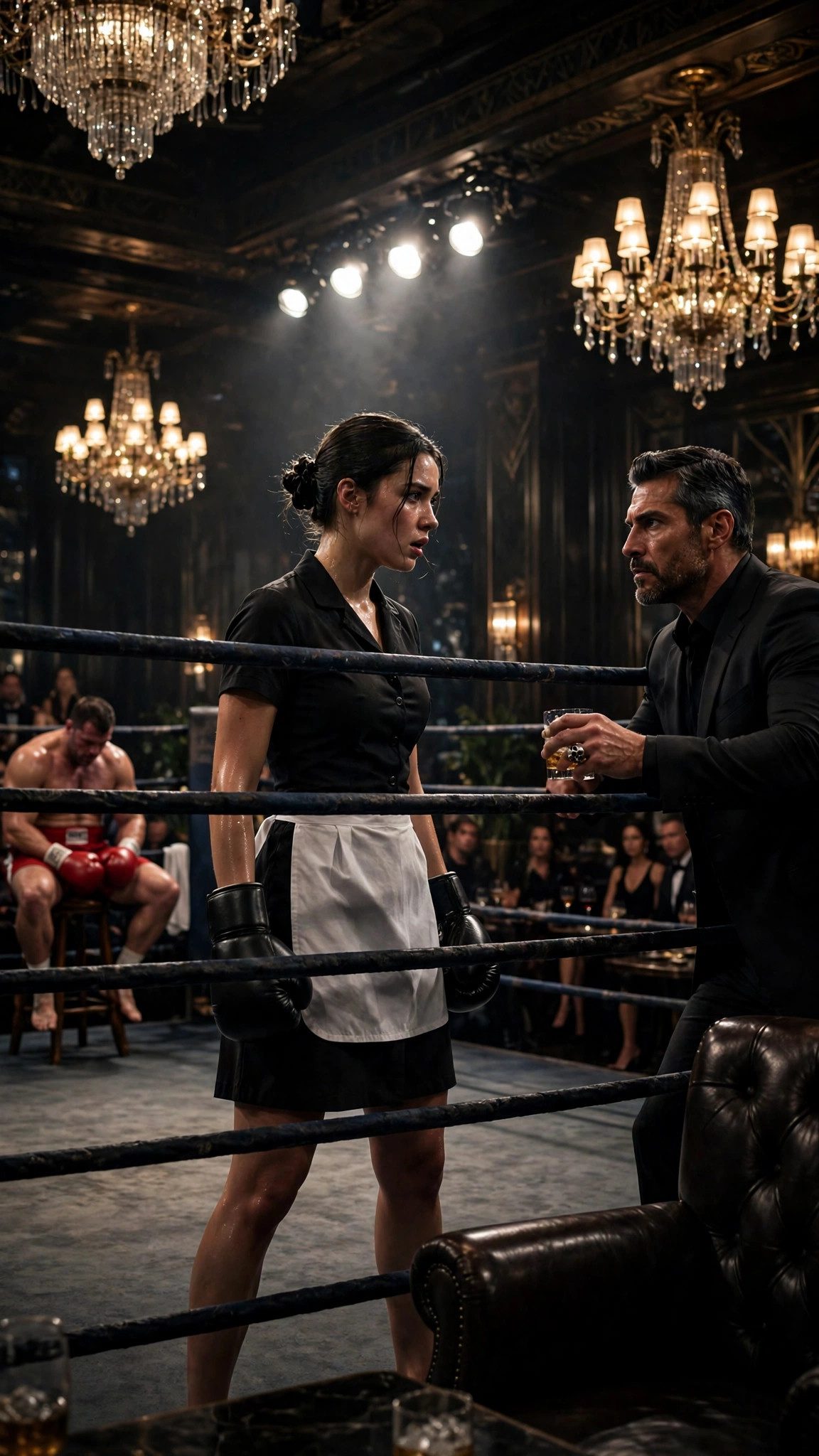
Six weeks before I dropped Tony Marino in thirty seconds flat, I got off a bus from Cleveland on a cold Tuesday morning in October with a duffel bag, my father's old boxing notebook, and a promise I had made to my mother on her deathbed.
My mother, Anna Callahan, died in a hospice room in Cleveland five months before that Tuesday, and she died the way she had lived, quietly and without complaint, holding my hand and telling me not to cry. She had been sick for a long time. The cancer had taken her slowly, the way it takes some people, a little bit at a time, until one morning there was not enough of her left to keep going. I nursed her through the last year myself. I quit my job at the diner in Cleveland, I moved into her little apartment, and I sat beside her bed and read to her and held her hand, and I watched her fade the way you watch a candle burn down to nothing.
On her last night, when the nurse had gone home and the room was dark except for the little lamp beside the bed, my mother opened her eyes and looked at me, and she said, "Sadie, your father did not die in an accident."
I had been twenty-eight years old for three months, and I had believed for twenty years that my father had died in a car accident on the West Side of Chicago, on a rainy night in October, when I was eight years old. That was what my mother had told me. That was what the police report had said. That was what everyone had always said. A car accident. A rainy night. A terrible, ordinary tragedy.
"He was murdered," my mother whispered, and her voice was so weak I had to lean close to hear her. "In his own gym. He refused to throw a fight for the Russo family, and they killed him for it. I never told you because I was afraid they would kill you too. But I am dying now, Sadie, and I cannot carry it to my grave. Promise me you will find out the truth. Promise me."
I promised. I held her hand and I promised, and she closed her eyes, and she died an hour later, and I sat there in the dark with her hand in mine until the morning came.
Three weeks after the funeral, I sold everything I owned that was worth selling. I packed a duffel bag with my clothes, my father's old boxing notebook, and the little photograph of him standing in front of Callahan's Gym with his arm around my shoulders when I was seven years old. I got on a bus to Chicago. I had not been back to Chicago since I was eight years old, since the night my father died and my mother packed us into a car in the middle of the night and drove us to Cleveland without stopping, without looking back, without ever telling me why we were running.
Chicago was bigger than I remembered, and colder, and louder. I rented a room above a laundromat on the West Side, two blocks from where my father's gym used to stand, and on my first morning I walked to the corner of Ashland and 18th Street, and I stood across the road and looked at Callahan's Gym.
The building was still there. The sign was gone, but the brick was the same brick, and the windows were boarded up, and the door was chained shut, and there was a faded poster on the wall for a fight that had happened twenty years ago, a fight my father had trained a boy for, a fight that boy had won. I stood there for a long time, looking at that building, and I thought about the mornings I had spent inside it, wrapping my father's hands, skipping rope in the corner, learning to throw a jab before I learned to ride a bicycle. I thought about the smell of leather and sweat and liniment, and about my father's voice saying, "Again, Sadie. Again. Until your hands know it better than your head does."
I went back to that building every day for a week. I watched who came and went. I asked the old men at the corner store if they remembered James Callahan. Most of them did. Most of them remembered him fondly, and most of them went quiet when I asked how he died, and most of them changed the subject. One of them, an old man named Sal who had run the corner store for forty years, looked at me for a long time and said, "You have his eyes, girl. Your father was a good man. A stubborn man. He would not throw a fight for the Russos, and the Russos do not forgive stubborn men."
"Who killed him?" I asked.
Sal looked up and down the street, and he lowered his voice, and he said, "Ask at the Velvet Ring. Dominic Russo owns it. He was there that night. He was twenty-two years old, and he was the one his father sent. That is all I know, and that is all I am going to say."
The Velvet Ring was the most luxurious fight lounge in Chicago. It sat on the river in the West Loop, all black marble and brass and chandeliers, and rich men went there to watch fights and drink whiskey and bet more money in one night than I had ever seen in my life. I went there on a Thursday afternoon and I asked for a job, and the manager, a thin man named Ray Deluca with slicked-back hair and a smile that never reached his eyes, looked me up and down and said, "We need a waitress. Black dress, white apron, no talking back to the guests. You start tonight."
I started that night. I carried trays of wine and whiskey to tables full of men in tailored suits, and I kept my head down, and I listened. I listened to the way they talked about Dominic Russo, the way their voices dropped when his name came up, the way they glanced toward the leather chair at the top of the room where he sat every night, silent, expressionless, one hand holding a glass of whiskey, the other hand resting on the skull ring on his right hand. I listened to the way they talked about the old days, about Salvatore Russo, Dominic's father, about the West Side families, about the fights that were fixed and the fighters who disappeared. And I listened for my father's name.
Nobody said it. Not once in six weeks did anyone in the Velvet Ring say the name James Callahan out loud. It was as if the name had been erased from the room, as if saying it would bring something back that everyone had agreed to forget. But I watched Dominic Russo, and I noticed something nobody else seemed to notice. He watched me. Not the way a man watches a waitress. The way a man watches a ghost. He watched me from his chair at the top of the room, and his eyes followed me when I carried trays across the floor, and sometimes, when I caught him looking, he looked away too quickly, like a man who had been caught doing something he was ashamed of.
I did not know then that he recognized me. I did not know then that he had known my father, that my father had taught him to box when he was sixteen years old, that my father had been the only man who ever treated young Dominic Russo like a son instead of like a weapon. I did not know then that Dominic had been in my father's gym on the night my father died, that he had been sent there by his own father with a gun in his hand and an order to kill the man who would not throw a fight. I did not know that Dominic had put the gun down and walked out, and that he had gone back an hour later, too late, and found my father dead on the floor of his own gym, and found me asleep in the back room, eight years old, curled up under my father's coat.
I did not know any of that. All I knew was that I had come to Chicago to find a killer, and the killer's boss was sitting in a leather chair at the top of the room, watching me carry wine, and I was going to make him tell me the truth.
My father's notebook helped me. It was a small leather book, the pages yellowed and soft with age, and my father had written in it in his careful, blocky handwriting, the names of every fighter he had ever trained, the dates of every fight, the amounts of every purse, and, on the last pages, the names of the men who had come to him in the last month of his life. Men who had asked him to throw a fight. Men who had threatened him. Men who had offered him money, and then more money, and then a gun in the dark. The last entry in the notebook was dated October 14th, twenty years ago, the day before he died. It said, in my father's handwriting, "Salvatore sent his boy tonight. The boy put the gun down. The boy is not like his father. If anything happens to me, tell Sadie her father loved her, and tell her the boy tried."
I read that entry a hundred times in my little room above the laundromat. The boy tried. The boy was Dominic Russo, twenty-two years old, sent by his father to kill my father, and he put the gun down. I did not know what to do with that information. I did not know whether it made Dominic Russo a murderer or a witness or something in between. I only knew that the notebook also had another name on the last page, a name written in a different ink, in a shakier hand, as if my father had written it in a hurry, as if he had known he was running out of time. The name was Vincent Castellano. And underneath it, in my father's handwriting, were the words, "He is the one who will come. Not the boy. Him."
My first week at the Velvet Ring taught me how the lounge worked, and it taught me how to survive in it. The rules were simple, and Ray Deluca had laid them out on my first night, standing in his office with his hands folded on his desk, looking at me over his glasses. Black dress, white apron, hair up. No talking back to the guests. No asking questions. No lingering at the tables. Carry the tray, pour the drink, smile, move on. The men in that room paid for the wine, and they paid for the silence, and they paid for the feeling that the world outside the doors did not exist.
Gabby took me under her wing on my second night. Gabby was twenty-six, with red hair and freckles and a laugh that could fill a room, and she had worked at the Velvet Ring for four years, and she knew everything about everyone who came through the doors. She taught me which tables to avoid, which men tipped well and which men tipped with their hands, which nights were busy and which nights were quiet, and how to carry a tray of eight whiskey glasses across a crowded floor without spilling a drop.
"Watch out for the boss," Gabby told me on my third night, while we were polishing glasses behind the bar. "Mr. Russo. He sits in that chair every night, and he watches everything, and he never talks to anyone, and if he ever talks to you, you listen, and you answer short, and you do not ask him anything back. He is not a bad man, Sadie. I have worked here four years, and I have never seen him hurt anyone who did not deserve it. But he is not a man you want to be curious about."
I was already curious about him. I could not help it. Every night, I carried trays past his table, and every night, I felt his eyes on me, and every night, I told myself it was nothing, that he watched everyone that way, that a man like Dominic Russo watched everything in his lounge because that was how he stayed alive. But on my fifth night, he spoke to me.
I was carrying a tray of whiskey to his table, and my hand was shaking, just a little, because I was nervous, and he looked up at me, and he said, "Your hands are shaking."
"Sorry, sir," I said. "It is my first week."
"Do not apologize," he said, and his voice was low and rough, like a man who did not use it very often. "A shaking hand pours a crooked drink. Breathe first. Then pour."
I breathed. I poured. I did not spill a drop. And when I looked up, he was watching me, and there was something in his eyes that I could not read, something that looked like recognition, and something that looked like pain, and I turned away before he could see that I had noticed.
That night, in my little room above the laundromat, I sat on the edge of my bed with my father's notebook open on my lap, and I read the last page again, the page that said, "Salvatore sent his boy tonight. The boy put the gun down. The boy is not like his father." And I thought about Dominic Russo, sitting in his leather chair, watching me carry trays, and I wondered if he was the boy. I wondered if he was the boy who had put the gun down twenty years ago. And I wondered, if he was, whether he remembered the little girl he had carried out of the gym that night, the eight-year-old girl who had been asleep under her father's coat.
I did not know who Vincent Castellano was. Not yet. But I was going to find out. And in the meantime, I was going to keep carrying trays at the Velvet Ring, and I was going to keep watching Dominic Russo, and I was going to wait for my moment. My moment came on a Friday night, six weeks after I arrived in Chicago, when Tony Marino, the undefeated champion of the lounge, called out to me across the room and told me to step into the ring with him, and I set my tray down, and I took off my apron, and I climbed through the ropes, and I showed the whole room what my father had taught me twenty years ago.