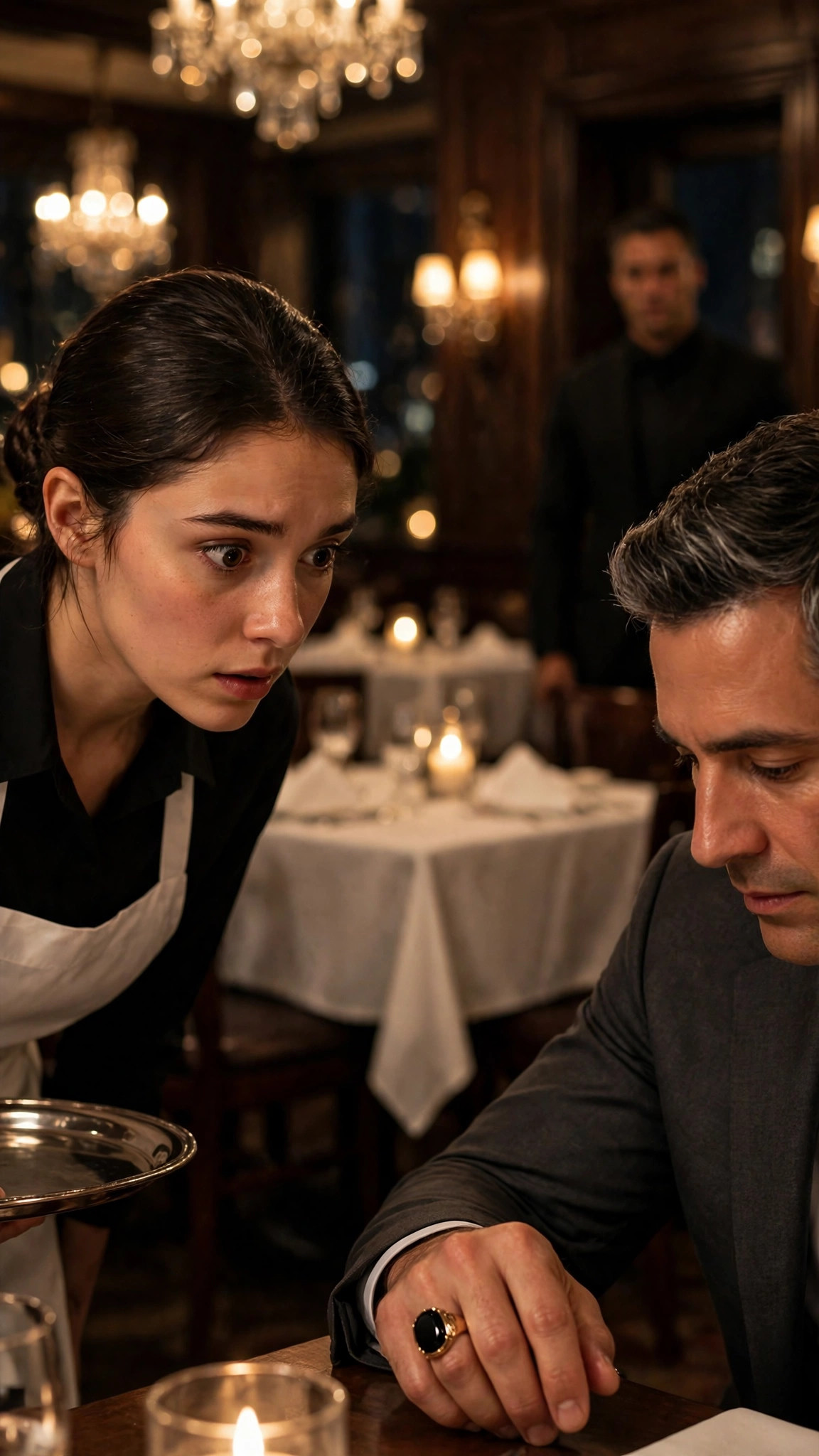
The scarred man stared at Nathaniel Caldwell for a long moment, and Viviana, watching from the doorway of the supply room with her hand gripping the frame so hard her knuckles had gone white, saw something move across his face.
It was not fear. Men like that did not feel fear in the ordinary way. It was confusion — the confusion of a man who had rehearsed a scene a hundred times in his head, and had just discovered that the other actor did not know his lines.
The plan had been simple. Walk in. Find the man in the charcoal suit. Make him stand up. Make him beg, or run, or reach for a weapon he did not have. Then do what they had been paid to do, in front of witnesses, so that everyone in New England would know by morning that Nathaniel Caldwell was dead and Vincent Castellano was the new power in the room.
But the man in the charcoal suit had not stood up. He had not begged. He had not run. He had sat down at the worst table in the restaurant, folded his hands on the white tablecloth, and invited the leader of the hit team to sit with him.
"Sit down, amateur," Nathaniel had said.
And in those three words, the entire plan had come apart.
"Who are you calling an amateur?" the scarred man said. His voice was rough, the voice of a man who smoked too much and slept too little. His hand was still inside his jacket. Viviana could see the shape of it there, the hard outline of something that was not a wallet.
"I'm calling you an amateur," Nathaniel said, "because a professional would have checked the exits before he walked into a room full of witnesses. A professional would have known that the man by the door" — he nodded, very slightly, toward Asher, who stood motionless beside the supply room — "has been watching you since you crossed the threshold. And a professional would never, ever bring four friends to kill one man in a restaurant where the kitchen has a back door, a service elevator, and a fire alarm."
The youngest of the five men — barely more than a boy, with acne on his chin and fear in his eyes — glanced toward the kitchen.
"Don't," Nathaniel said quietly. "Don't look at the exits now. It's too late for that. Sit down, and let's talk about who sent you."
The scarred man's jaw worked. He looked at his men. He looked at the guests, frozen at their tables, their champagne glasses forgotten in their hands. He looked at Asher, who had not moved, who had not spoken, who stood with his arms at his sides and his black onyx ring catching the light — and Viviana saw the scarred man's eyes drop to that ring, and saw him understand, a second too late, what it meant.
There were two rings in the room. Two men who wore them. And five men who did not.
"You think this is a negotiation," the scarred man said.
"I think this is a conversation," Nathaniel said. "And I think you are going to tell me who sent you, because the alternative is that my friend by the door closes it, and then there are only two ways out of this room, and neither of them is the way you came in."
It was at that moment that Viviana Marchetti did the bravest thing she had ever done in her life.
She did not run. She did not hide. She did not scream.
She stepped out of the supply room doorway, walked — on legs that shook so hard she was certain everyone could see them shaking — to the wall beside the kitchen, and pulled the fire alarm.
The sound tore through the restaurant like a siren. The string quartet stopped. The guests gasped. The five men spun toward the sound, their hands flying to their jackets, and in that single second of confusion, Asher moved.
He moved the way a door moves when it is kicked off its hinges — fast, and final, and without any wasted motion. He crossed the ten feet between the supply room and the nearest gunman in two strides, and his fist — scarred knuckles, fifteen years of practice — caught the man under the jaw and put him on the floor before the man had time to clear his coat.
The dining room erupted.
Guests shoved their chairs back and ran for the exits, screaming, their napkins fluttering to the floor like wounded birds. A woman in a red dress fell, and a man in a tuxedo dragged her to her feet and half-carried her toward the door. A waiter dropped a tray of glasses, and the sound of shattering crystal joined the scream of the fire alarm, and the chandeliers swayed gently overhead, throwing wild light across the ceiling.
Viviana did not run with them. She ran the other way — into the kitchen, where the cooks stood frozen at their stations, their knives in their hands, their faces white.
"Out the back!" she shouted, her voice cracking. "Everyone out the back door, now! The service elevator! Go! Go!"
She grabbed the youngest cook, a boy of seventeen named Paolo who had started two weeks ago and still burned himself on the oven door, and shoved him toward the back exit. She grabbed Madame Colette, who stood in the middle of the kitchen with a ladle in her hand and a look on her face that Viviana had never seen before — not fear, but fury, the fury of a woman watching her restaurant, her life's work, being torn apart in front of her.
"Madame," Viviana said, "please. The back door. Take them out the back door."
Madame Colette looked at her for one long second. Then she nodded, once, sharply, and began herding the kitchen staff toward the service exit with the same discipline she used to run a dinner service — calm, precise, leaving no one behind.
Viviana turned back toward the dining room.
Through the kitchen doors, she could see the fight.
Asher had a second gunman down, his arm twisted behind his back, his face pressed to the marble floor. The scarred man — the leader, Dominic Voss, though Viviana did not know his name yet — had his gun out now, and he was pointing it at Nathaniel Caldwell, who was still sitting at the table beside the overflowing trash can, his hands still folded on the white tablecloth, his expression unchanged.
"Stand up," Voss said, his voice shaking with rage. "Stand up, you arrogant bastard. Stand up and look at me when I kill you."
Nathaniel looked at him. Really looked at him, the way a man looks at something he is about to throw away.
"You were paid to kill me in front of witnesses," Nathaniel said, "because Castellano wanted a message. But you brought five men to kill one, and you let a waitress pull the fire alarm, and you let my enforcer take two of your men before you even drew your weapon. Do you know what that makes you, Dominic?"
Voss froze. "How do you know my name?"
"I know all of your names," Nathaniel said. "I know who hired you. I know what he paid you. And I know that the man who sold me to you is standing outside right now, in a car across the street, waiting to hear whether you did the job — and if you do not do it, he will tell Castellano that you failed, and Castellano will do to you what you were supposed to do to me."
Voss's hand trembled. The gun wavered.
"Put it down," Nathaniel said, very quietly. "Put it down, and I will give you something Castellano never will. I will give you a way out."
For a moment — one long, held-breath moment — Viviana thought he might do it. She saw the doubt cross Voss's face, saw his finger loosen on the trigger, saw the youngest gunman, the boy with the acne, lower his own weapon and take a half-step backward.
Then the front door of the restaurant burst open, and the room filled with light and shouting, and the police came in with their weapons drawn, and the FBI came in behind them, and the night changed shape again.
Later, Viviana would learn that Asher had called them — not the police, but the FBI, and not during the fight, but an hour before it, from the supply room phone, the moment he saw the five men cross the threshold. Later, she would learn that Agent Daniel Reyes had been waiting two blocks away with a team, watching the restaurant, because Nathaniel Caldwell had told him that morning that something was going to happen at Lumière tonight, and that he wanted it to happen where the law could see it.
But in that moment, all Viviana knew was that the screaming had stopped, the fire alarm had stopped, and the dining room of Lumière — the finest restaurant in Boston, with its chandeliers and its crystal and its white tablecloths — looked like a battlefield, and the man with the black onyx ring was still sitting at the worst table in the house, calm as still water, watching the police take the five men away in handcuffs.
And Asher Kane, his knuckles bleeding, his shirt torn at the shoulder, walked across the broken glass and the scattered napkins to where Viviana stood in the kitchen doorway, and looked at her for a long moment, and said the words she would remember for the rest of her life.
"You pulled the alarm," he said.
"I pulled the alarm," she said.
"You saved lives tonight," he said. "Maybe mine. Maybe his. Maybe your own."
Viviana looked past him, at Nathaniel Caldwell, who was now standing at last, straightening his jacket, brushing a speck of plaster from his sleeve as if he had just come from a meeting and not a war.
"He knew," she said. "He knew they were coming. He came anyway."
Asher nodded. "That is what the ring means," he said. "A promise is not a word. A promise is a weight. You carry it every day, or it crushes you."
Viviana looked down at her own hands — a waitress's hands, red from hot water and long shifts, with no ring on any finger — and she understood, for the first time in her life, that she had just picked up a weight of her own.
And she had no intention of putting it down.
The hours that followed were the strangest of Viviana's life, and she would remember them in fragments, the way you remember a dream — not in order, but in flashes of light and sound.
The police, first, with their notebooks and their careful questions. A young officer with kind eyes asked her what she had seen, and she told him — the five men, the guns, the fire alarm, Asher — and he wrote it all down without surprise, as if waitresses pulled fire alarms during armed standoffs every day. He asked her if she was hurt. She said no, and then she looked down and saw that her hands were shaking, and she realized that she had not stopped shaking since she pulled the alarm, and that she probably would not stop for a long time.
Madame Colette came out of the kitchen with her apron still on and her hair coming loose from its knot, and she walked straight to the middle of the ruined dining room, past the overturned chairs and the broken glass, and she stood there with her hands on her hips and surveyed the damage the way a general surveys a battlefield. "The chandeliers are intact," she announced, to no one in particular. "The floors can be cleaned. The tables can be reset. We will reopen on Monday." A police sergeant told her the restaurant would be closed for at least a week, pending the investigation. Madame Colette looked at him the way she looked at a waiter who had dropped a tray, and said, "We will reopen on Monday," and somehow, in the days that followed, they did.
Paolo, the seventeen-year-old cook, sat on the back steps with his head in his hands, crying quietly, and Viviana sat beside him and put her arm around his shoulders, and told him that he had done everything right, that he had gotten out, that he was safe. He asked her if the men would come back. She told him no, and she hoped it was true.
Asher's hand was bandaged by a paramedic in the back of an ambulance, his knuckles split open, his shirt torn at the shoulder. He sat on the edge of the ambulance bed with his feet on the ground, refusing to go to the hospital, refusing painkillers, staring at the restaurant as if he were memorizing the damage. When Viviana brought him a glass of water, he took it without a word, and drank it, and handed it back, and said, "You did well tonight."
"I was terrified," she said.
"Everyone was terrified," he said. "The difference is what you do when you are terrified. You pulled the alarm. That is what matters."
Nathaniel Caldwell gave his statement to the FBI, not the police, in a quiet corner of the dining room, standing by the window with Agent Daniel Reyes. Viviana watched them from across the room — two men, one in a tailored suit and one in a government-issue jacket, talking in low voices, their faces unreadable. She did not hear what they said. She did not need to. She could see, in the set of Nathaniel's shoulders and the stillness of his hands, that he was already planning, already three moves ahead, the way a chess player plans while the other man's pieces are still on the board.
When it was over — when the last police car had gone, and the last guest had been interviewed, and the last piece of broken glass had been swept into a dustpan — Viviana stood alone in the dining room of Lumière, in the dark, with the chandeliers off and the tables bare, and she looked at the table beside the overflowing trash can, the worst table in the house, where a man had sat calmly and waited for five armed men to decide his fate.
The table had been cleared. The trash can had been emptied. A new tablecloth had already been laid, white and crisp, as if nothing had ever happened there.
But something had happened there. And Viviana Marchetti, standing in the dark with her apron still on and her hands still shaking, understood that her life had changed in a way she could not yet measure, and that the man with the black onyx ring was the reason.
And she had no intention of putting it down.