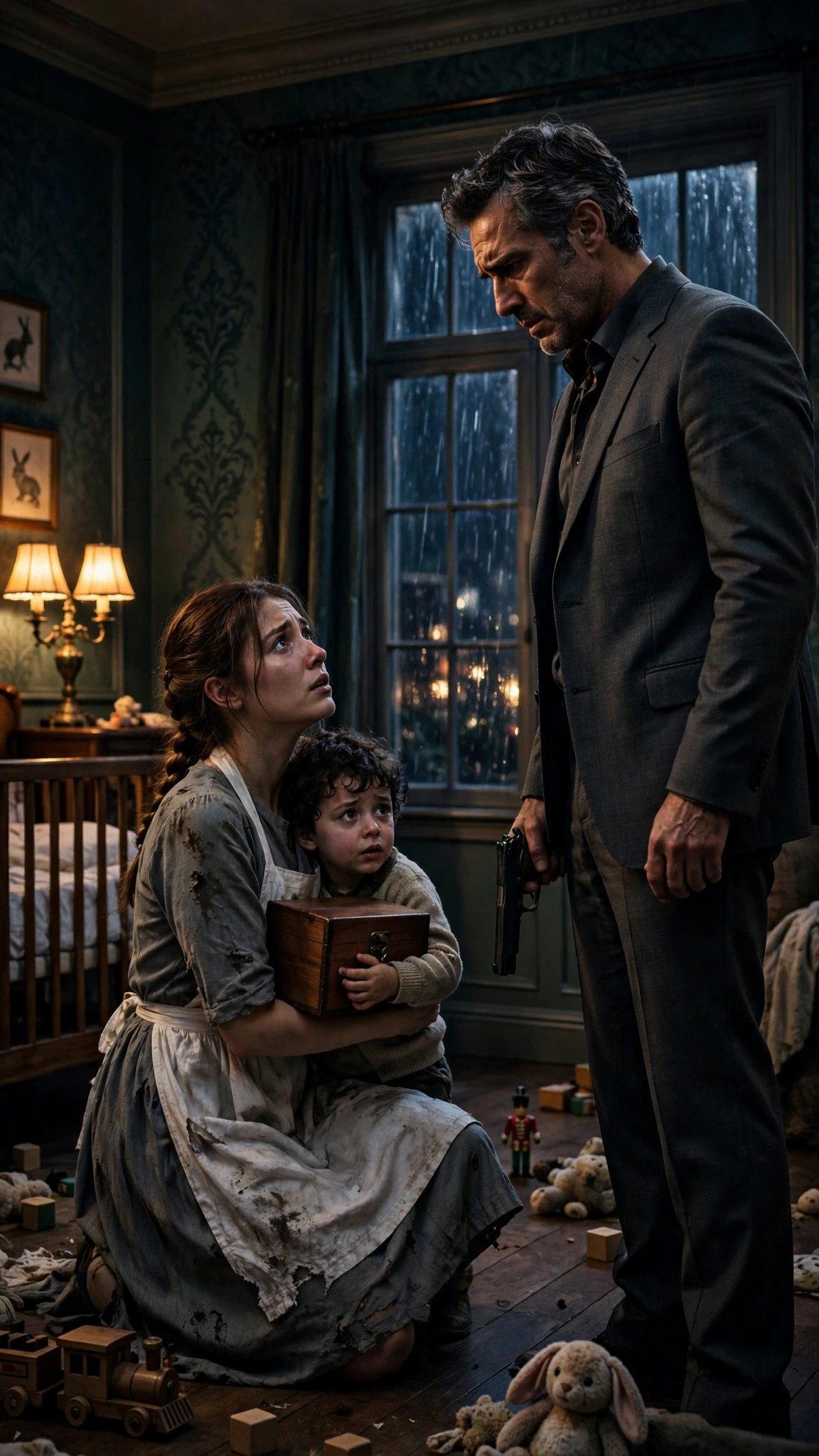
They brought Tony Falco to Adrian's office three days after the hospital. Not to the basement. Not to a warehouse. To the office. Adrian wanted it done in the light, in the room where Tony had sat a hundred times and called him boss, in the room with the oak box on the desk and the photograph of Isabella on the wall. He wanted Tony to see what he had thrown away. He wanted Tony to understand, before the FBI took him, exactly what he had done, and to whom.
Reyes was there, with two agents by the door. Livy was there, sitting in the corner in her black dress, her hands folded in her lap, her face like stone. Hannah was not there. Adrian had told her to stay with Leo in the nursery, and she had obeyed, because she was still a maid in that house, and because she did not want to see what was about to happen. But Leo was there. Adrian had brought him in, and Leo sat on his father's lap, holding his oak box, watching Tony with wide, dark eyes. Adrian had thought about it for a long time, and he had decided: his son deserved to see this. Not the violence. There would be no violence. But the truth. His son deserved to see the truth, and to see his father face it, and to see that the law was stronger than a gun.
Tony came in in handcuffs, with an agent on either side of him. He looked smaller than Adrian remembered. He had always been a big man, built like a wall, with a voice like gravel and a laugh that filled a room. Now he looked like a man who had shrunk, like a balloon with the air let out. His suit was wrinkled. His face was gray. His eyes moved around the room, looking for something — an exit, a friend, a way out — and finding nothing.
"Sit down, Tony," Adrian said. His voice was slow, and calm, and almost gentle, the way it always was when he was most dangerous. "We need to talk."
Tony sat. The agents stayed by the door. Reyes stood beside the desk with his arms crossed. Livy did not move. Leo did not move. The room was so quiet that Adrian could hear the clock on the wall, ticking, one second at a time.
"You told me she was harmless," Adrian said. He was not looking at Tony. He was looking at his son, at Leo's small hands holding the oak box. "A year ago, when I asked you about Hannah Collins, you told me she was harmless. Just a girl from Ohio. Do not worry about her. Do you remember saying that?"
Tony nodded. He did not speak.
"And then you went to my mother," Adrian said, and now he looked at Livy, and Livy's face did not change, but her hands tightened in her lap. "You went to my mother, and you told her the opposite. You told her Hannah was dangerous. You told her Hannah was here for the house, for the name, for the boy. You told her to watch the girl. You told her to make me doubt her. And my mother believed you, because you had been in this family for twenty years, and because you had never lied to her before. Is that right, Tony? Is that what you did?"
Tony swallowed. "Boss—"
"Is that what you did?" Adrian said, and his voice did not rise, but the room got colder. "Answer me. My son is listening. My mother is listening. The FBI is listening. Answer me."
Tony looked at the floor. "Yes," he said, very quietly. "Yes, boss. I did that."
"Why?" Adrian said. "Twenty years, Tony. Twenty years I trusted you. My father trusted you. You stood beside me when they carried my father out of a restaurant in a body bag. You stood beside me at my wedding. You held my son when he was a baby. Why?"
Tony was quiet for a long time. Then he lifted his head, and his eyes were wet, and he said, "Because I was afraid, boss. Because the Castellanos came to me a year ago, and they said, 'Tony, the Rossi family is weak. The boss is soft. He has a son, and a maid, and a mother who runs his house. He is not his father. Help us, and we will make you a boss. Refuse us, and we will kill you.' And I believed them. I believed them because I had watched you, boss, and I had seen you change. After Isabella died, you changed. You went quiet. You went soft. You let a maid raise your son. You let your mother run your house. And I thought — I thought the family was finished. I thought I had to save myself."
"You saved yourself," Adrian said, "by tying my four-year-old son to a tree in the dark. By killing my guards. By beating a sixty-one-year-old woman to death on my hallway floor. By pointing a gun at the woman who saved my son. That is how you saved yourself, Tony."
Tony's face crumpled. "I did not want Rosa to die," he said. "I told them not to touch her. I told them—"
"You told them," Adrian said. "You told them, and they did it anyway, because that is what happens when you sell your family to men like Vincent Castellano. They do not listen to you. They own you. And now you are owned, Tony. You are owned by the Castellanos, and you are owned by the FBI, and you are owned by me. And I am going to tell you what is going to happen to you, because you deserve to hear it from me, and not from a judge."
He leaned forward, and his voice dropped, and Leo, sitting on his lap, felt his father's chest move as he spoke, and he listened, very carefully, the way he listened when Hannah read to him.
"You are going to prison, Tony. For the rest of your life. Agent Reyes has your phone records. He has your bank records. He has the metal box from the pool house. He has the two men in the basement, who have already told him everything. He has Hannah Collins, who will tell a jury everything she saw and heard, in that quiet, steady voice of hers, and a jury will believe her, because she has no reason to lie. And he has me. I will testify. I will stand in a courtroom, in front of a judge, and I will tell them what you did to my son. And when it is over, you will go to prison, and you will die there, and you will never see the outside again. That is what is going to happen to you."
Tony did not speak. He sat in his chair, in his handcuffs, and he looked at Adrian, and then he looked at Leo, and his face changed, and for the first time since Adrian had known him, Tony Falco looked afraid. Not of Adrian. Not of the FBI. Of the small boy on Adrian's lap, holding an oak box, looking at him with his mother's brown eyes.
"Leo," Tony said, very quietly. "I am sorry. I am sorry for the woods. I am sorry for the tree. I was wrong. I was wrong about everything."
Leo looked at him for a long time. Then he said, in a small, clear voice, "My mama said that sorry is only a word if you do not change. Did you change, Uncle Tony?"
Tony closed his eyes. "No," he said. "No, Leo. I did not change. I am sorry."
Leo nodded, very slowly, like a small judge delivering a verdict. "Then sorry is only a word," he said. And he turned away, and he buried his face in his father's chest, and he did not look at Tony again.
Reyes stepped forward. "Take him," he said to the agents. They took Tony by the arms, and they led him out of the office, and as he went through the door, he looked back, one last time, at Adrian, and he said, "Boss. Take care of the boy. Take care of him better than I did."
And then he was gone. And the room was quiet. And Adrian sat in his office with his son on his lap, and his mother in the corner, and an FBI agent by the desk, and he felt something he had not felt in two years. He felt clean. Not happy. Not at peace. But clean, the way a house feels clean after you have thrown out something rotten that was hiding in the walls.
Livy stood up. She walked across the room, slowly, like an old woman — and Adrian realized, for the first time, that his mother was an old woman, that she had been old for a long time, and that he had never really seen it before, because she had always been so strong, so certain, so sure of everything. She stopped in front of him, and she looked down at Leo, and then she looked at Adrian, and she said, "I was wrong."
It was the first time Adrian had ever heard his mother say those three words. In thirty-eight years, he had never heard Livy Rossi say she was wrong. Not once.
"I was wrong about Hannah," Livy said. "Tony came to me, and he told me she was dangerous, and I believed him, because I wanted to believe him. Because it was easier to blame a girl from Ohio than to admit that the danger was already inside our house, wearing a familiar face. I told you to doubt her. I told you to watch her. I told you she would take something from us. And the only thing she took, Adrian, was my grandson out of the dark. She took him out of the woods. She took him out of a room with a gun in it. She took him, and she held him, and she did not let go. And I owe her an apology. And I owe you an apology. And I owe Leo an apology."
She knelt down then, slowly, painfully, in front of Leo, and she took his small hands in hers, and she said, "Leo. I am sorry. I was wrong about Hannah. She is not a stranger. She is family. She has been family since the day she sat on the floor of your nursery and read to you about a fox. Will you forgive me?"
Leo looked at his grandmother for a long time. Then he nodded, and he threw his arms around her neck, and Livy Rossi, who had not cried in forty years, cried. She cried quietly, into her grandson's hair, while Adrian watched, and Reyes watched, and the clock on the wall ticked, one second at a time, and the house, for the first time in a very long time, felt like a home.
After Reyes left, after Livy went to her wing to rest, after Leo fell asleep in the nursery with his gray blanket and his oak box, Adrian went to find Hannah. She was in the kitchen, washing dishes, because that was what she did when she did not know what else to do — she worked. Her arm was still bandaged. Her dress was still torn. She had not changed it. She had not slept. She had not eaten. She was standing at the sink, washing a plate that was already clean, and when Adrian came in, she did not turn around.
"Miss Collins," Adrian said. "Hannah."
She turned. Her face was pale. Her eyes were red. She looked at him, and she waited, and Adrian saw, in her face, the same thing he had seen in his son's face in the bedroom that night: fear. Not fear of a gun. Fear of him. Fear of what he was going to say.
"Hannah," Adrian said, and his voice was slow, and calm, and almost gentle, but this time it was not the calm of a man about to kill someone. It was the calm of a man who had finally learned how to tell the truth. "You told me she was harmless. That is what Tony said about you, a year ago. He told me you were harmless. And he was right, in a way he never understood. You are harmless, Hannah. You are the most harmless person I have ever met. You have never hurt anyone. You have never lied to anyone. You have never taken anything that was not yours. And the only thing dangerous about you — the only thing dangerous about you in this whole house — was that you made my son laugh. You made him trust again. You made him live again. And that frightened men like Tony, because men like Tony do not understand love, and they fear what they do not understand."
He stopped. He took a breath. And then he said the words he had been practicing in his head for three days, since the night he lowered his gun, and he said them badly, and honestly, and all at once.
"I was wrong about you. My mother was wrong about you. This whole house was wrong about you. And I am sorry. I am sorry I pointed a gun at you. I am sorry I believed Tony over you. I am sorry I let my mother tell me to doubt you. I am sorry for all of it. And I know that sorry is only a word if you do not change. So I am going to change. I am going to change this family. I am going to change this house. And I am going to start by asking you something I should have asked you a year ago, the night you saw the blood on my sleeve."
Hannah looked at him. She did not speak. She waited.
"Will you stay?" Adrian said. "Not as a maid. Not as a girl from Ohio who reads books. As family. As Leo's family. As my family. Will you stay?"
Hannah stood at the sink, with a clean plate in her hands, and she looked at Adrian Rossi, the most feared man in New York, standing in her kitchen, asking her to stay, and she thought about her mother, in the hospital in Ohio, who had taught her that a woman's hands were for holding children and healing the sick. And she thought about Leo, asleep in the nursery with his gray blanket and his oak box. And she thought about Rosa, lying on the hallway floor, saying, "She did it for you." And she said, in a voice that shook, and then steadied, "Yes. I will stay."