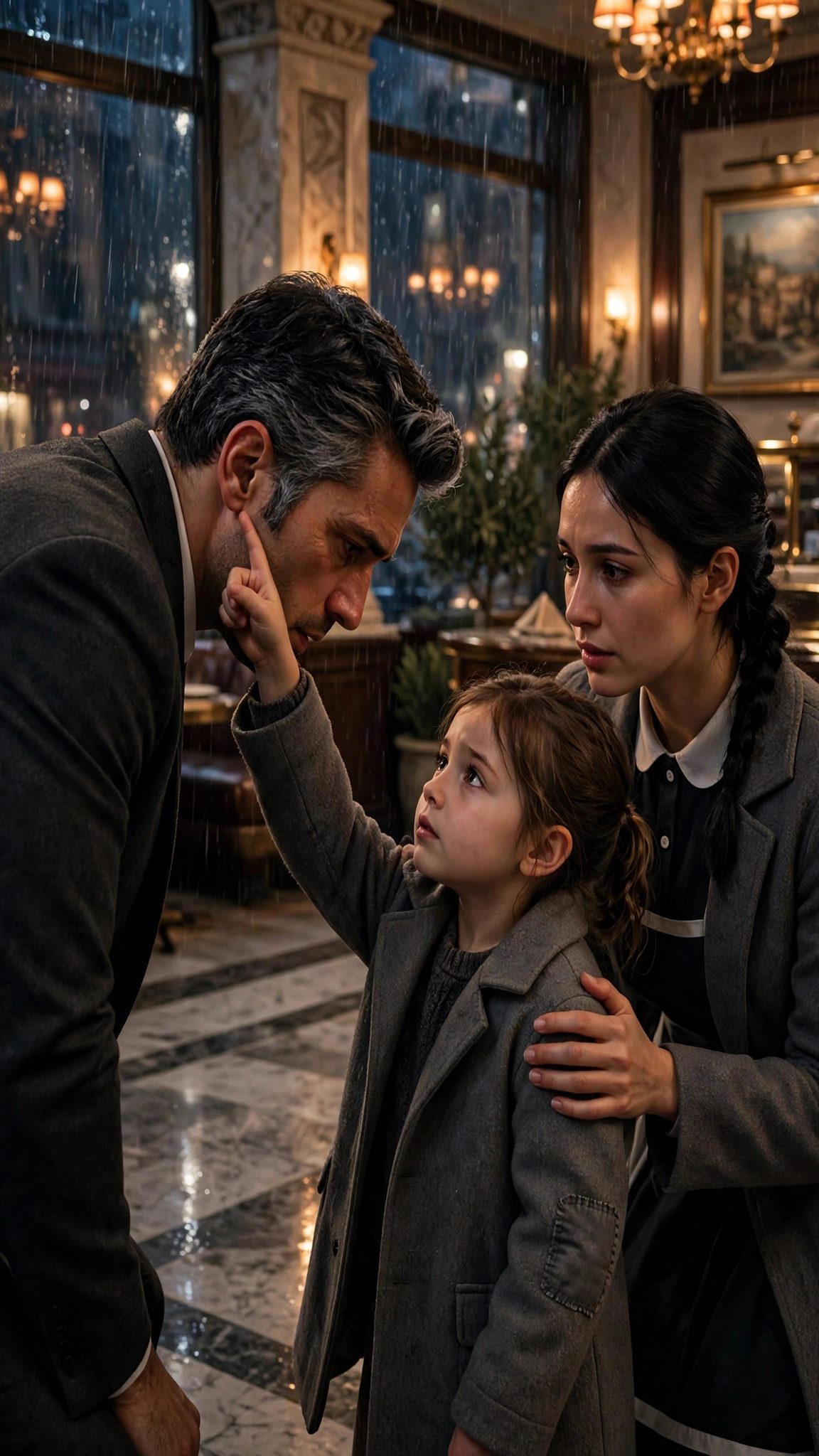
After the lobby, after the couch, after the little girl's finger pointing at the back of his neck, Dante Moretti did the thing he had been trained to do since he was eleven years old.
He did nothing. Outwardly.
He thanked Sophie Miller. He told her to keep Anna close and to come to work as usual, and to tell no one what had happened — not the other maids, not the cooks, not anyone. He walked her to the door of the bistro himself, which he had never done for anyone, and he watched her walk out into the rain with her daughter's hand in hers, and then he went back inside, and he sat at his table, and he ordered dinner, and he ate it slowly, the way a man eats when he is thinking about something else entirely.
Inside, his mind was on fire.
A listening device. Behind his ear. For months.
He thought about everything he had said in the last four months. The dock contracts. The Geneva account. The meeting with the port authority on Thursday. The names of men he trusted, spoken aloud in rooms he believed were safe. He thought about the deals that had fallen through for no reason, the shipments that had been intercepted, the men who had known things they should not have known. He had blamed bad luck. He had blamed the weather, the market, the times. He had never blamed a tiny black dot behind his ear.
Now he knew. And knowing changed everything, because knowing meant the enemy was not out there, beyond the walls. The enemy was in here, inside the house, standing behind his chair, holding the clippers.
Enzo. His barber of fifteen years.
Dante had known Enzo Falcone since he was twenty-three years old. Enzo had cut his father's hair before he cut Dante's. He had a shop on the corner of Fifth and Mercer that smelled of bay rum and hot towels, and he had a wife named Carla who made biscotti, and a son in the army, and hands so steady they never shook, not even when he was shaving a king's throat with a straight razor.
A man with hands that steady does not plant a listening device by accident. A man with hands that steady does it on purpose, for money, or for fear, or for someone who has something on him.
Dante did not confront Enzo. That was the first rule of hunting a traitor: you do not tell the traitor you know. You watch him. You feed him. You let him carry your words to his master, and you choose the words very carefully.
The next morning, Dante called Marcus Hale into his study.
Marcus came in the way he always came in — heavy boots, broad shoulders, scar through his eyebrow, eyes flat and dark. He stood in front of the desk with his hands behind his back, the way a soldier stands, and he waited.
"Sit down, Marcus," Dante said.
Marcus sat. He did not ask why. Marcus never asked why. That was one of the things Dante had always liked about him.
"I want to talk about Thursday," Dante said. His voice was quiet, the way it always was, but today the quiet had a purpose. Today, the quiet was a net, and he was casting it carefully. "The port authority meeting. I want to change the time. Move it to Friday, ten in the morning. And I want to move the shipment — the one from Genoa — to Pier Nine instead of Pier Four. Tell no one except the men who need to know."
Marcus nodded. "Pier Nine. Friday, ten. I'll handle it."
"Good," Dante said. "And Marcus — the Geneva account. I want the numbers moved. Not the money, just the numbers. Tell the bank to hold the transfer until I say so. And tell no one."
Marcus nodded again. "I'll handle it."
Dante watched him go. He watched the heavy boots cross the office floor, and the broad shoulders pass through the doorway, and the door close softly behind him. And then he sat alone in his study, and he waited.
He waited for the trap to spring. Because if Marcus was the traitor, then by Friday morning, Castellano would know about Pier Nine and Friday at ten and the Geneva account. And if Castellano knew, then Dante would know who had told him.
But waiting is the hardest part of hunting. Waiting means sitting still while the men you suspect walk around your house, eat your food, guard your door. Waiting means smiling at a man you believe is betraying you, and letting him pour your coffee, and saying thank you.
Dante was good at waiting. He had waited ten years in silence. He could wait three more days.
On the second day, he went to Enzo's shop.
He did not announce himself. He simply walked in, the way he had walked in a hundred times before, and he sat in the chair, and he let Enzo drape the cloth over his shoulders and pick up the clippers.
"Morning, boss," Enzo said. His hands were steady. They were always steady. "Just a trim today?"
"Just a trim," Dante said.
Enzo worked in silence for a while, the way he always did, the clippers buzzing softly at the back of Dante's neck. And Dante sat very still, and he felt the cold metal against his skin, and he thought about the thumb, three months ago, pressing something small and warm against the spot behind his ear.
"Enzo," Dante said, very quietly. "How is Carla?"
Enzo's hands stopped. Just for a second. Just a fraction of a second. But Dante felt it, the way a man feels a missed heartbeat.
"Carla is fine, boss," Enzo said. His voice was steady too. But his hands had stopped, and hands that never stopped had stopped. "She made biscotti yesterday. I brought you some. In the bag, by the door."
"Thank you," Dante said. "And your son? Still in the army?"
"Yes, boss. Still in the army. He writes every week."
Dante nodded. He did not say anything else. He let Enzo finish the trim, and he paid him, and he took the biscotti, and he walked out of the shop into the October afternoon, and he thought about what he had felt.
Fear. Enzo's hands had stopped because Enzo was afraid. And a man who is afraid is a man who has something to hide.
But fear is not proof. Fear is only fear. Dante needed proof, and proof was under a bathroom tile in a two-room flat above a laundry, in a black box that a maid in a gray coat had hidden with a kitchen knife.
That evening, Dante sent for Sophie Miller.
She came to the mansion at nine o'clock, with Anna asleep in the car outside — Paolo watching over her, because Dante had asked Paolo to, and Paolo was the only man alive who had ever heard Dante laugh, and Dante trusted him the way you trust a man who has kept your secrets for forty years.
Sophie stood in his study in her gray coat, with her hands folded in front of her, and she looked small in the big room, the way a bird looks small in a cathedral. But her eyes were steady. And when Dante asked her to tell him everything, she did.
She told him about the bag in the bathroom cabinet. She told him about the receiver, and the tapes, and the notebook. She told him about Marcus asking about the cabinet, and the way his eyes had moved over her hands and her apron and her cart. She told him about Anna seeing the barber's thumb, and about the four months of dates on the tapes, and about the line in the notebook that said "Only three men present."
Dante listened without interrupting. He listened the way he had listened for ten years — in silence, with his hands flat on his desk, his eyes on her face. And when she finished, he was quiet for a long time.
Then he said, "Show me the box."
They drove to her flat in the rain, Paolo at the wheel, Anna asleep in the back seat with her head on Sophie's lap. Sophie pried up the loose tile with the kitchen knife, her hands shaking now, because this was the moment — the moment when she handed the most feared man in the state the proof that his own men had betrayed him, and found out whether he would thank her or kill her for it.
Dante took the black box in his hands. He opened it. He looked at the receiver, and the tapes, and the notebook. He read the dates. He read the times. He read the line about the Geneva account, and the line about the three men present, and his face did not change. Not once. He had spent ten years learning not to let his face change.
But his hands changed. His hands, flat on the box, curled slowly into fists.
"Thank you," he said. His voice was so quiet Sophie had to lean in to hear it. "You have done me a service I can never repay. And you have put yourself and your daughter in danger to do it. I will not forget that."
Sophie looked at him, and she saw something in his eyes she had not seen in eight years. Not the silent king. Not the feared man. The man from the kitchen, at midnight, with two glasses of whiskey and an empty chair across from him.
"Mr. Moretti," she said, and her voice shook, because this was the other secret, the one she had carried longer than the box, heavier than the tapes, heavier than anything. "There is something else. Something I have not told you. Something I have carried for seven years."
Dante looked at her. He waited. He was good at waiting.
"Anna," Sophie said. "Anna is —"
And then the phone rang.
It was Marcus, calling from the mansion, his voice gravel in a bucket, calm as always.
"Boss," he said. "We have a problem. Castellano's men just hit Pier Four. They knew about the shipment. They knew the time. They knew everything."
Pier Four. The old pier. The pier Dante had told Marcus he was changing to Pier Nine.
Dante closed his eyes. Just for a second. Just long enough to feel the net close around the truth.
Marcus had told Castellano about Pier Four — the lie Dante had fed him, the old plan, the one Dante had pretended to change. And Castellano had moved on it. Which meant Marcus was the traitor. And it meant Castellano's men were already moving. And it meant the trap had worked.
But it also meant something else. It meant that the men who had been listening to Dante Moretti for months now knew that someone had found them. And they would come for the people who found them.
Dante opened his eyes. He looked at Sophie. He looked at Anna, asleep in the back seat with her head on her mother's lap. And he understood, in one cold flash, that the war had already started, and that the first battle would be fought over a maid in a gray coat and her seven-year-old daughter.
"Stay with me," he said to Sophie. "Both of you. Tonight. I will keep you safe. I swear it on my mother's name."
And Sophie Miller, who had been invisible for eight years, looked at the most feared man in the state, and she believed him.
Before he called Marcus into the study, Dante had set a second trap — a smaller one, for the barber.
He had gone to Enzo's shop the day before the Marcus meeting, and he had sat in the chair, and while Enzo worked, Dante had spoken — casually, the way a man speaks when he thinks no one is listening — about a shipment of cash coming into the city on Wednesday, hidden in a bread truck, through the old bakery on Mercer Street.
It was a lie. There was no bread truck. There was no cash. There was only a Wednesday, and a bakery, and a story told to a man with steady hands and a thumb that pressed too hard behind an ear.
On Wednesday morning, Dante's men watched the bakery on Mercer Street. And at nine o'clock, two of Castellano's men arrived, in a black car with no plates, and they parked across the street, and they waited, and they watched the door of a bakery where no bread truck was ever going to come.
Dante watched them from the car across the street, with Paolo beside him, and he felt something cold settle in his chest.
Enzo had carried the lie. Enzo had carried it the same day Dante told it. Which meant Enzo was not just the man who had planted the device. Enzo was an active line, still open, still carrying Dante's words to Castellano in real time.
"Boss," Paolo said, very quietly, from the driver's seat. He was sixty-one years old, with white hair and hands that had held a steering wheel for forty years, and he was the only man alive who had ever heard Dante laugh. "Boss, I have known Enzo for twenty years. I have eaten his wife's biscotti. I do not understand this."
"I don't either," Dante said. "But understanding comes later. First, we stop the bleeding."
Paolo was quiet for a moment. Then he said, "Your father used to say that a man is only as safe as the people who stand behind him. He said it the day he hired me. He said, 'Paolo, I don't need a driver who is fast. I need a driver who is loyal. Fast I can buy. Loyal I cannot.'"
Dante looked at his driver. "And what do you think, Paolo? Am I safe?"
Paolo looked back at him, and his old eyes were steady. "You are safe with me, boss. You have always been safe with me. But you asked the wrong question. The question is not whether you are safe. The question is whether you are alone. And I think, boss, that you have been alone for a very long time."
Dante did not answer. He looked out at the bakery, and the black car, and the two men waiting for a bread truck that would never come, and he thought about his father's rule. Never trust a stranger. Never let your guard down. Never show weakness.
His father had been wrong about one thing. The danger had not come from a stranger. It had come from the men he trusted most. From the barber who had cut his hair for fifteen years. From the head of security who had carried his father's coffin.
Trust was not the problem. Trust was the weapon. And the men he trusted had been holding it against his throat for months, while he sat in silence, believing the silence was armor.
That night, Dante sat alone in his study, and he did something he had not done in ten years. He opened the drawer of his desk, and he took out the velvet box, and he opened it, and he looked at his mother's gold necklace with its small locket, shining in the lamplight.
Rosa Moretti had worn that necklace every day of her life. She had laughed in the kitchen, and the whole house had laughed with her. She had pressed her hand against the window when it rained, watching the drops run down like tears. She had told Dante, when he was small, that a necklace was not jewelry. A necklace was a promise. You gave it to the person you would protect with your life.
Dante had not given it to anyone. Not to Isabella — she had her own necklace, her own promise, and it was buried with her. Not to anyone else. It had sat in the drawer for ten years, waiting.
He closed the box. He put it back in the drawer. He sat in the dark study, and he listened to the clock ticking in the hallway, and he thought about a maid in a gray coat, and a little girl with old eyes, and a black box under a bathroom tile.
They had seen what his own men had done. They had risked everything to tell him. And they had done it for nothing — for no money, for no protection, for no promise. They had done it because it was right.
Dante Moretti had spent ten years believing that silence was strength. But silence had nearly killed him. And the people who had saved him were the two people his empire had never once bothered to see.
He would remember that. He would remember it when the time came to choose between the law and revenge. He would remember it when the time came to decide what kind of man he was going to be.
Because the whisper behind his neck had taught him something his father never had: that the strongest thing a man can do is not to stay silent. It is to listen — to the smallest voice in the room, the one everyone else has been ignoring.