The knock came again — three slow knocks, patient, certain — and then the door handle turned, slowly, testing the lock.
I pressed my hand over Leo's mouth, gently, and shook my head. He nodded, his eyes wide, and buried his face against my shoulder. I could feel his heart hammering against my chest, fast as a bird's, and I thought: this is what I ran from. This is the thing I was afraid of. Men at the door in the dark, coming for my child.
And then, from the street below, came the sound of car doors slamming, and footsteps — many footsteps, fast and heavy — and a voice shouting, "Federal agents! Step away from the door!"
The handle stopped turning. There was a scuffle on the stairs, and shouting, and the sound of someone being pushed against a wall, and then silence. A long silence. And then a knock on the door — a different knock, quick and light — and a voice said, "Mrs. Vieri? Mrs. Hart? It's the FBI. You're safe now. You can open the door."
I didn't move. I couldn't move. My legs wouldn't work.
"Sofia," said another voice — a voice I knew, a voice that made my whole body go weak with relief. "Sofia, it's me. It's Matthew. Open the door. Please."
I stood up on shaking legs, still holding Leo, and I unlocked the door, and there he was — Matthew, in a charcoal suit, his hair wet from the rain, his face white, with two FBI agents behind him and Marco Bellini, his driver, standing on the stairs with his arms crossed. And behind them, on the landing, handcuffed and furious, were the two men who had knocked on my door.
Matthew stepped inside and closed the door behind him, and he looked at me, and he looked at Leo, and his whole body seemed to fold in on itself with relief. "You're all right," he said. "You're both all right."
"How did you—" I started.
"I called the FBI on the way here," he said. "Agent Reyes. I've been working with him for two years. The family, the business — I've been building a case. Against Castellano. Against all of them. I just needed the last piece, and tonight, they gave it to me. They came here, to my son's home. That's attempted kidnapping. That's federal."
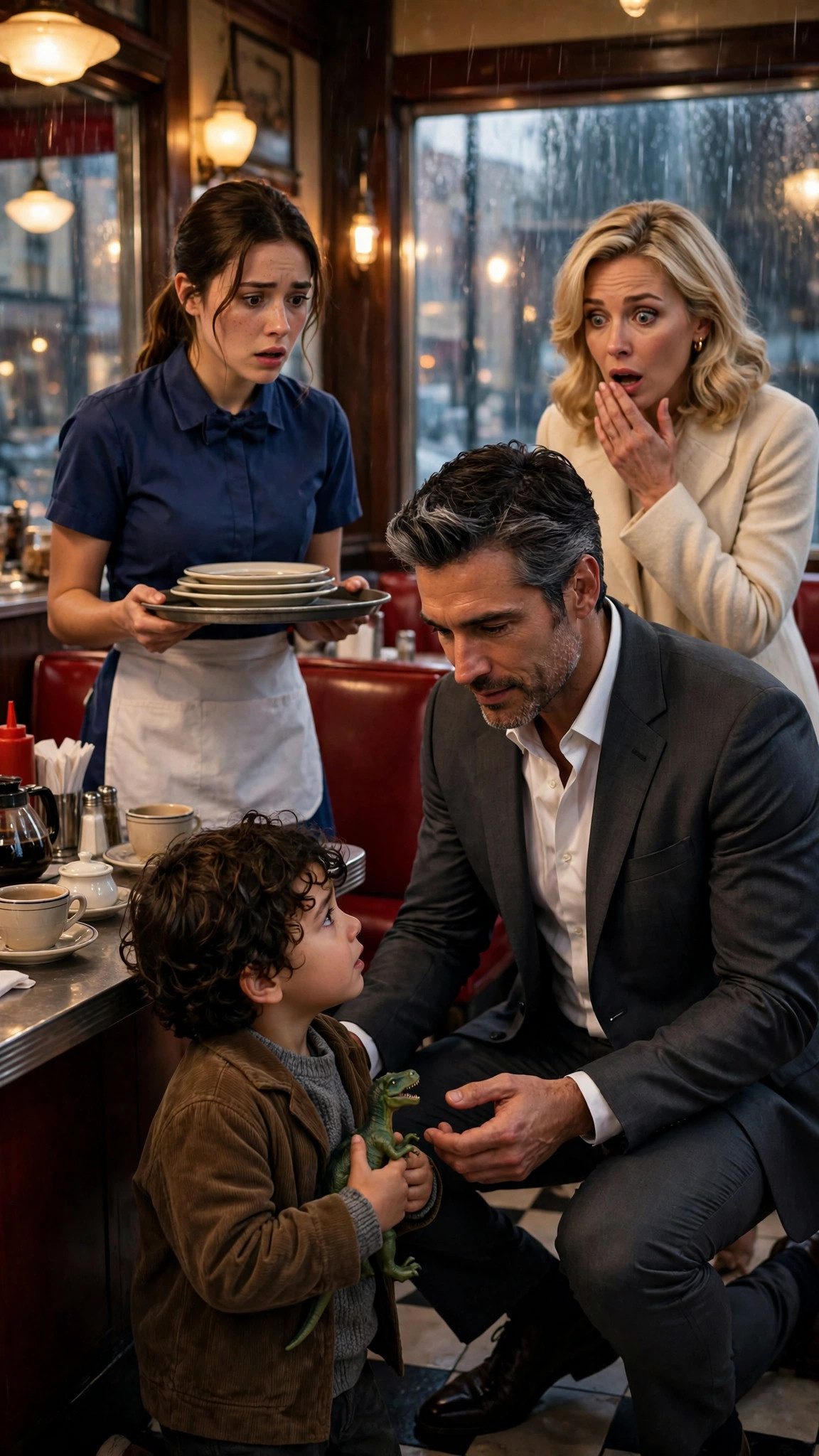
He knelt down then, in front of Leo, and he put his hands on Leo's shoulders, and he looked into my son's face with an expression so gentle it broke my heart. "Leo," he said. "I'm your father. I know that's a big thing to hear. And I know I wasn't there. I wasn't there because I didn't know. But I know now. And I'm here. And I am never going away again. Do you understand?"
Leo looked at him for a long moment, and then he held out Rex, his green dinosaur, and said, "This is Rex. He protects me. But you can protect me too, if you want."
Matthew took the dinosaur very carefully, as if it were made of glass. "I would like that very much," he said.
That night, after Leo finally fell asleep — in my bed, between me and the wall, with Rex tucked under his chin — Matthew and I sat at the kitchen table, and he told me everything.
He told me about the letter. The second letter, the one in my handwriting, the one that said I never loved him. He told me that Tony Russo had brought it to him, a year after I left, and that he had believed it, because the handwriting was mine, and because he could not imagine any other explanation.
"Tony copied your hand from old birthday cards," Matthew said, his voice flat and cold. "He kept them. He practiced for weeks. Castellano needed me alone. A man with a family is a man with something to lose. A man alone is a man who can be broken."
I stared at him. "You believed I never loved you?"
"I believed the letter," he said. "I believed it for six years. And every day, I asked myself what I had done wrong, and I never found an answer, because there was no answer. You loved me. You left because you were afraid. Not because you didn't love me."
"I left because I was pregnant," I whispered, "and because a bullet went through our kitchen window, and because I knew that if I stayed, our child would grow up behind a gate with guards at the door, and I couldn't do that to him. I couldn't do that to you, either. You were disappearing, Matthew. Day by day, you were disappearing into that life, and I couldn't watch it happen to our son, too."
"I know," he said. "And you were right to be afraid. But the life has changed, Sofia. I've changed it. For two years, I've been working with the FBI. I've been moving the business into legitimate shipping, legitimate trucking, legitimate everything. I've been cutting ties with the old ways, piece by piece. Tony didn't know. Castellano didn't know. They thought I was still the man they could control."
"Why didn't you tell me?" I asked. "Why didn't you come and find me?"
"Because I believed the letter," he said simply. "Because I believed you didn't want me. And because a man who believes that doesn't go looking. He just… stops."
We sat in silence for a while, at the small kitchen table, with the rain falling outside and our son asleep in the next room, and I thought about six years of running and six years of hiding, and about a letter I had never written, and about a man who had believed it because he had no reason not to.
"There's one more thing," Matthew said quietly. "Vivian."
I stiffened. "The woman from the diner."
"My fiancée," he said. "The council's choice. I was going to marry her. I had agreed to it, because I thought there was nothing left for me. But there is something left for me. There's you. There's Leo. And I won't marry her. I've already told her. She took it… better than I expected. She said she always knew I was married to a ghost."
"I'm not a ghost," I said.
"No," Matthew said. "You're not. You're here. You're real. And you're the mother of my son. And if you'll let me, I'd like to spend the rest of my life proving that the man you ran from is not the man I am anymore."
At dawn, the FBI moved on Castellano. I learned the details later, from Reyes, over coffee at my kitchen table — the way you learn about a storm after it has already passed. They hit the docks at five in the morning, and the warehouses at five-fifteen, and Castellano's house at five-thirty, and by seven o'clock it was over. Forty years of an empire, ended before breakfast.
Tony was arrested at his office, in front of his secretary, in front of men who had feared him for twenty years. He did not fight. He did not run. He put his hands on his desk, very calmly, and said, "I want a lawyer. And I want to talk about a deal." Reyes told me later that men like Tony always talk, in the end. They talk because they have spent their whole lives making sure other people take the fall, and when the fall finally comes for them, they have nothing left to hold on to.
Matthew called his mother that morning, from our kitchen, while Leo ate cereal at the table. I heard his voice from the next room — low, steady, tired. "Mother," he said. "It's over. Castellano's finished. Tony's finished. And Sofia — Mother, Sofia is alive. She has a son. My son. He's five years old, and he has my eyes."
There was a long silence on the other end of the line. And then Elena said something that made Matthew close his eyes and put his hand over his face, the way a man does when he is trying not to cry. "Bring them home, Matthew," she said. "Bring my daughter and my grandson home."
The next morning, Agent Daniel Reyes came to the apartment. He was a tall man in his forties, with tired eyes and a kind voice, and he sat at our kitchen table and drank Rosie's coffee — I had made a pot, out of habit, because that was what I did when people came to my home — and he laid out the case.
"Tony Russo has been on our radar for three years," Reyes said. "Phone records, bank transfers, meetings with Castellano's people. But we never had enough to move on him. Tonight, we do. His men came to your door, Mrs. Vieri. That's attempted kidnapping of a minor. That's federal time. And when we picked up his phone, we found the calls to Castellano. Forty-seven calls in the last month."
"And Castellano?" Matthew asked.
"We're moving on him at dawn," Reyes said. "The docks, the warehouses, the accounts. Tony's going to testify — we've already offered him a deal. Eight years, in exchange for everything he knows. He took it. He took it fast."
"Eight years," Matthew repeated. "For six years of lies."
"Eight years is what we can give him," Reyes said. "Castellano gets life. That's the one that matters."
I looked at Matthew. His face was very still, but I could see the war happening behind his eyes — the old Matthew, the one who would have handled this himself, the one who would have made Tony disappear and settled the score the way his father would have settled it, and the new Matthew, the one who had spent two years building a case, the one who had called the FBI instead of calling his men.
"Let the law have them," I said quietly. "Please, Matthew. Let the law have them. Leo doesn't need a father who settles scores in the dark. He needs a father who comes home for dinner."
Matthew looked at me for a long moment. Then he looked at Reyes, and he nodded. "Let the law have them," he said.
Reyes stood up. "Then it's done," he said. "Mr. Vieri, Mrs. Vieri — thank you. You did the right thing. Both of you."
After he left, Matthew and I sat at the table for a long time, not speaking, just listening to the sound of Leo breathing in the next room, and the rain on the window, and the quiet of a house that was, for the first time in six years, safe.
"There's one more thing I need to tell you," Matthew said finally. "Your note. The one you left on the kitchen table. I kept it. I carried it in my wallet for six years, next to your photograph. I read it a hundred times. And every time, I thought the same thing: she loved me. She said she loved me. And then she left anyway. I never understood it."
"I left because I loved you," I said. "I left because loving you meant losing myself, and I was afraid that if I lost myself, there would be nothing left to give our son. But I was wrong. Running didn't save me. It just made me smaller. It made my whole world small enough to hide in. And Leo deserved better than a small world. He deserved a father. He deserved a home."
Matthew reached across the table and took my hand. His hand was warm, and steady, and it was the same hand that had caught my oranges in the rain six years ago, outside a flower shop on Madison Avenue.
"Then come home," he said. "Both of you. Come home."
And for the first time in six years, I didn't say no. I didn't run. I didn't hide.
I said yes.
The next day, I went to the diner to tell Rosie. She was behind the counter, wiping down the coffee machine, and she looked up when I came in, and she knew before I said a word. She always knew.
"So," she said. "The man in the charcoal suit. He's the one you've been hiding from."
"He's Leo's father," I said. "His name is Matthew. And I'm going home with him. We're going home."
Rosie put down her cloth. She came around the counter, and she took my face in her hands, the way a mother would, and she looked at me for a long moment with those sharp old eyes that missed nothing. "I knew," she said. "Five years ago, the first week you worked here, I knew. A woman doesn't flinch every time the door opens unless she's afraid of who might walk through it."
"I'm not afraid anymore," I said.
"I know," Rosie said. "I can see it. You're standing up straighter, Sofia. You haven't stood up straight in five years."
She hugged me then, hard, and she whispered in my ear, "You come back and visit, you hear me? And you bring that boy. And you bring that man. I want to meet the man who finally came to his senses."
Leo said goodbye to his classroom the next morning. He stood in front of his teacher and his friends, in his blue backpack, and he said, very solemnly, "I'm going to live with my daddy now. He has a big house and a garden. And Rex is coming too." His teacher hugged him, and his friends gave him drawings, and one of them — a little girl named Maya — gave him a rock she had painted like a ladybug, and Leo carried it home in his pocket like treasure.
That night, we packed the apartment. It did not take long. Six years of a life fit into three boxes and a duffel bag, and that was the strangest thing of all — how small a life could be, when you built it to be small on purpose. I stood in the empty apartment for a long time, looking at the bare walls and the marks on the floor where Leo's bed had been, and I thought about the woman who had arrived here six years ago, pregnant and afraid, with three hundred dollars and a bus ticket stub.
She had done her best. She had kept her son safe. And now it was time for her to go home.