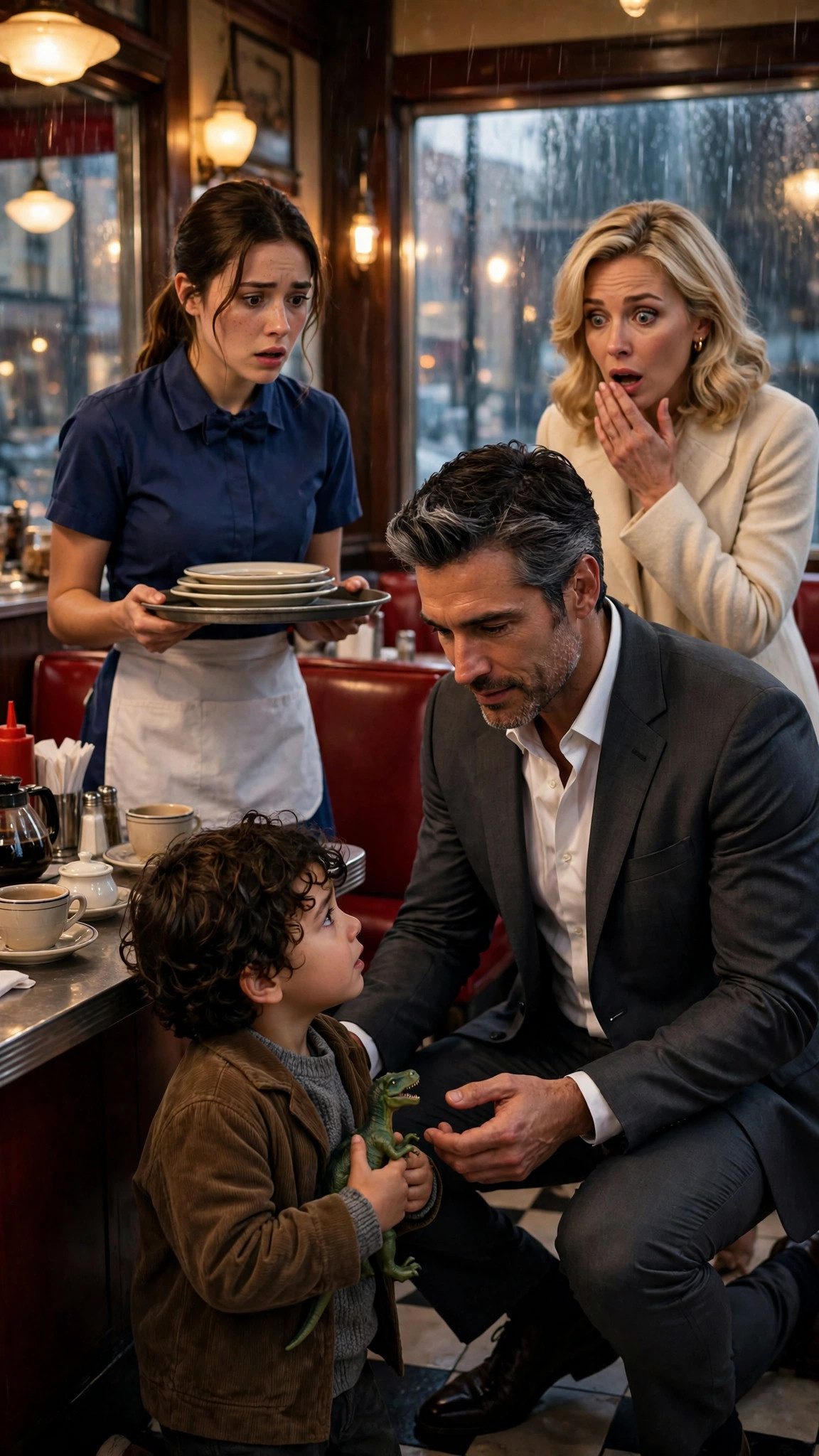
I did not call the number for three days.
I told myself I was waiting because I needed time to think. The truth was, I was waiting because I was afraid — afraid of what would happen if I called, and afraid of what would happen if I didn't. Afraid that Matthew would take Leo from me. Afraid that he wouldn't want him at all. Afraid that the life I had built in Millbrook would disappear, and afraid that it wouldn't, and that I would spend the rest of my life wondering what would have happened if I had been braver.
On the third night, Leo climbed into my bed after a bad dream — a dream about a storm, he said, and a house with no doors — and he curled up against me with Rex tucked under his chin, and he said, in a sleepy voice, "Mommy, is the man from the diner going to come back?"
"I don't know, baby," I said.
"I hope he does," Leo said. "He has eyes like mine. And he was nice. He got down on his knee like a prince."
"He's not a prince, Leo."
"He knelt, Mommy. Only princes kneel."
I held him a little tighter. "Go to sleep, baby."
But I didn't sleep. I lay awake listening to the rain on the window, and I thought about the card sitting on the counter at the diner, with a phone number written in black ink, and I thought about the boy in my arms, and the man who had knelt to him, and the six years I had spent running from a truth that had finally caught up with me.
In the morning, I called the number.
Matthew answered on the first ring. "Sofia," he said, as if he had been sitting by the phone for three days waiting for it to ring. Maybe he had. "Thank you for calling."
"I want a test," I said. My voice was steadier than I felt. "A DNA test. Before anything else. Before you talk to Leo again, before you come near him again. I want proof, and I want it done properly, by a doctor, with papers. And I want it to be my doctor, not yours."
"Done," Matthew said immediately. "Whatever you want. I'll pay for it. I'll do whatever you want."
"I don't want your money," I said. "I want the truth. That's all I've ever wanted."
The test was done the next day, in a small clinic on the edge of town, by a doctor named Dr. Patel who had kind eyes and did not ask why a waitress and a man in a charcoal suit needed a paternity test. Leo was brave about it — braver than I was. He held out his arm for the blood draw without flinching, and then he asked Dr. Patel if the needle was going to turn him into a superhero. Dr. Patel said it might, and Leo nodded gravely, as if that settled it.
Matthew stood in the corner of the room the whole time, very still, very quiet, watching Leo with an expression I could not read. He did not pace. He did not check his phone. He did not speak to anyone. He simply stood there, with his hands clasped in front of him, watching my son the way a man watches a sunrise he thought he would never see — afraid to blink, afraid it might disappear.
While we waited for the nurse, Leo asked Dr. Patel a dozen questions — how the machine worked, whether the blood went into a little bottle, whether the bottle had his name on it — and Dr. Patel answered every one of them patiently, the way good doctors do with brave children. Leo nodded at each answer, very seriously, and then he looked up at Matthew and said, "Mister, are you scared of needles too?"
Matthew crouched down so that his face was level with Leo's. "A little," he admitted. "But brave people get scared too. That's what makes them brave."
Leo considered this with great seriousness. "Then you're brave," he decided. "And I'm brave. And Mommy is the bravest, because she does everything."
Matthew looked up at me then, and for a moment, the room went very quiet, and I saw something in his eyes that I had not seen in six years — not the stillness, not the control, but the man underneath it, the man who had caught my oranges in the rain and danced with me in his mother's kitchen. And I thought, for the first time since the diner door opened, that maybe — just maybe — this could work. Maybe we could be a family. Maybe the six years had not broken us beyond repair.
When it was over, he knelt down in front of Leo and said, "Thank you for being so brave."
Leo looked at him solemnly. "Are you going to be my daddy?" he asked.
Matthew's face did something then — something I had never seen it do, not even on our wedding day. It broke open, just for a second, and underneath the stillness I saw a man who was terrified. "I hope so," he said quietly. "More than anything in the world, I hope so."
The four days of waiting were the longest of my life. Longer than the bus ride to Millbrook. Longer than the nights Leo had a fever. Longer than the whole first year, when I did not know if I would make rent or if Rosie would keep me on.
Leo asked questions I could not answer. "Mommy, is the man from the diner going to be my daddy?" "Mommy, if he is my daddy, does that mean I have to move to his house?" "Mommy, does he have a dinosaur too?" I answered each one as honestly as I could, and every answer felt like stepping onto ice I could not see through.
I worked my shifts with shaking hands. I dropped a plate on the second day, and Rosie came over and put her hand on my shoulder and said, "Sofia. Whatever it is, you tell me when you're ready. Not before." I nodded, and I did not tell her, not yet, because saying it out loud would make it real, and I was not ready for it to be real.
Matthew waited in a hotel on the edge of town — the only hotel in Millbrook, a low building with a flickering sign and a clerk who asked no questions. He told me later that he barely slept for those four days. He sat by the window of his room and watched the rain, and he thought about the letter in his desk drawer, and the photograph in his wallet, and the boy with the grey eyes, and he did the arithmetic over and over, the way a man counts the same money twice because he cannot believe how much there is.
On the third night, Leo climbed into my bed again, and he said, "Mommy, if the man is my daddy, will he stay? Or will he go away like the other daddies in my books?" And I held him, and I said, "I don't know, baby. But I promise you this: no matter what happens, you will always have me. Always." And Leo nodded, and he fell asleep with his head on my shoulder, and I lay awake for a long time, listening to him breathe, and wondering if I had been wrong about everything — about running, about hiding, about what it meant to protect my son.
The results came back in four days. Four days that felt like four years. I went to pick them up alone, early in the morning, before my shift, because I needed to know first. I needed to read the words with my own eyes before anyone else could say them to me.
Dr. Patel handed me the envelope. I opened it in the parking lot, standing beside my car, with my hands shaking so hard I could barely hold the paper.
Probability of paternity: 99.99%.
I stood there for a long time, staring at those numbers, and I felt something inside me let go — something I had been holding tight for six years, something that had kept me running and hiding and afraid. It let go, all at once, and I started to cry, right there in the parking lot, in front of anyone who might have been watching.
Leo was his. Matthew was his father. The eyes had not lied. The arithmetic had not lied. My son had a father, and his father had been looking for him for six years without knowing he existed.
I called Matthew from the parking lot. "It's yours," I said. "Ninety-nine point nine nine percent. He's yours."
There was a long silence on the other end of the line. And then Matthew said, in a voice so quiet I almost couldn't hear it, "Thank you. Thank you for telling me. Thank you for keeping him safe all these years."
"I didn't keep him safe from you," I said. "I kept him safe from your world. There's a difference."
"I know," Matthew said. "And I'm going to prove it to you. I'm going to prove that the world has changed. That I've changed."
That was the moment everything went wrong.
Because while Matthew and I were talking on the phone, while I was standing in a clinic parking lot crying over a piece of paper, Tony Russo was sitting in an office in New York, reading a report from one of his men, and learning that Matthew Vieri had found his wife and son in a small town called Millbrook.
Tony had been feeding information to Vincent Castellano for six years. He had been the one who told Castellano's men where to find the Vieri house that dawn morning, the one who had made sure the bullet went through the kitchen window. He had been the one who forged the second letter, copying Sofia's handwriting from old birthday cards, because Castellano needed Matthew isolated, grieving, and weak. A man with a family is a man with something to lose. A man alone is a man who can be broken.
And now Matthew had a family again. A wife. A son. A reason to be strong.
Castellano could not allow that.
The call came that night, while Leo and I were eating dinner in our small apartment. My phone rang, and it was Rosie, and her voice was shaking. "Sofia," she said. "There are men at the diner. Two of them. They came in asking about you. About Leo. They said they were friends of your husband's. Sofia, they didn't look like friends."
I dropped the phone. I grabbed Leo. I ran to the window and looked down at the street, and there it was — a black car with tinted windows, parked across from our building, its engine running, its headlights off.
They had found us. They had found my son.
I ran to Leo's room and pulled him out of bed, still in his pajamas, and I carried him to the living room, and I locked the windows, and I turned off every light in the apartment, and I sat on the floor with my back against the couch and my son in my arms, and I listened. The street below was quiet. Too quiet. The black car was still there, its engine running, its headlights off, waiting in the dark like a held breath.
Leo whispered, "Mommy, why are the lights off?"
"Because we're playing a game," I whispered back. "A hiding game. And we have to be very, very quiet."
"Is it a fun game?" he asked.
"The funnest game," I said, and my voice shook, and he must have heard it shake, because he put his small arms around my neck and held on tight, and he whispered, "Don't worry, Mommy. Rex will protect us. Rex is the bravest dinosaur in the whole world."
I closed my eyes. I held my son. And I thought about the man who was driving through the night toward us, through the rain, with the FBI on the phone and twenty minutes between us and whatever was waiting outside. Twenty minutes. I had waited six years. I could wait twenty minutes. I had to wait twenty minutes.
I called Matthew. My hands were shaking so hard I could barely hold the phone. "They're here," I whispered. "At the diner. Asking about Leo. Matthew, they're going to take him."
"Stay inside," Matthew said, and his voice had gone very calm, very cold, the voice of a man who had just become dangerous. "Lock the door. Don't open it for anyone. I'm on my way. I'm already on my way."
"How long?" I whispered.
"Twenty minutes," he said. "Sofia, listen to me. I need you to listen. Whatever happens, don't open that door. Do you understand?"
"Yes," I whispered.
"And Sofia — I'm sorry. I'm sorry for everything. For the letter. For the six years. For all of it. But I swear to you, on my life, on my mother's life, no one is going to touch our son. Not while I'm breathing."
He hung up. I locked the door. I turned off the lights. I sat on the floor of our small apartment with Leo in my arms, and I held him, and I listened to the footsteps on the stairs below, and I prayed — to God, to my mother, to anyone who might be listening — that twenty minutes would be fast enough.
Leo looked up at me with those grey eyes, his father's eyes, and whispered, "Mommy, are the bad men here?"
"No, baby," I whispered, lying to him for the last time. "No bad men. Just go to sleep. Mommy's got you."
But the footsteps kept coming. Closer. Closer. And then there was a knock on the door — three slow knocks, patient, certain — and a voice said, "Mrs. Vieri. Open the door. We just want to talk."
I held Leo tighter. I did not answer. I did not move. And I thought about the man who was driving through the night toward us, the man I had run from six years ago, the man who had knelt in a diner in front of strangers and taken my son's hand.
And for the first time in six years, I was not afraid of him.
I was afraid of what would happen if he didn't get here in time.