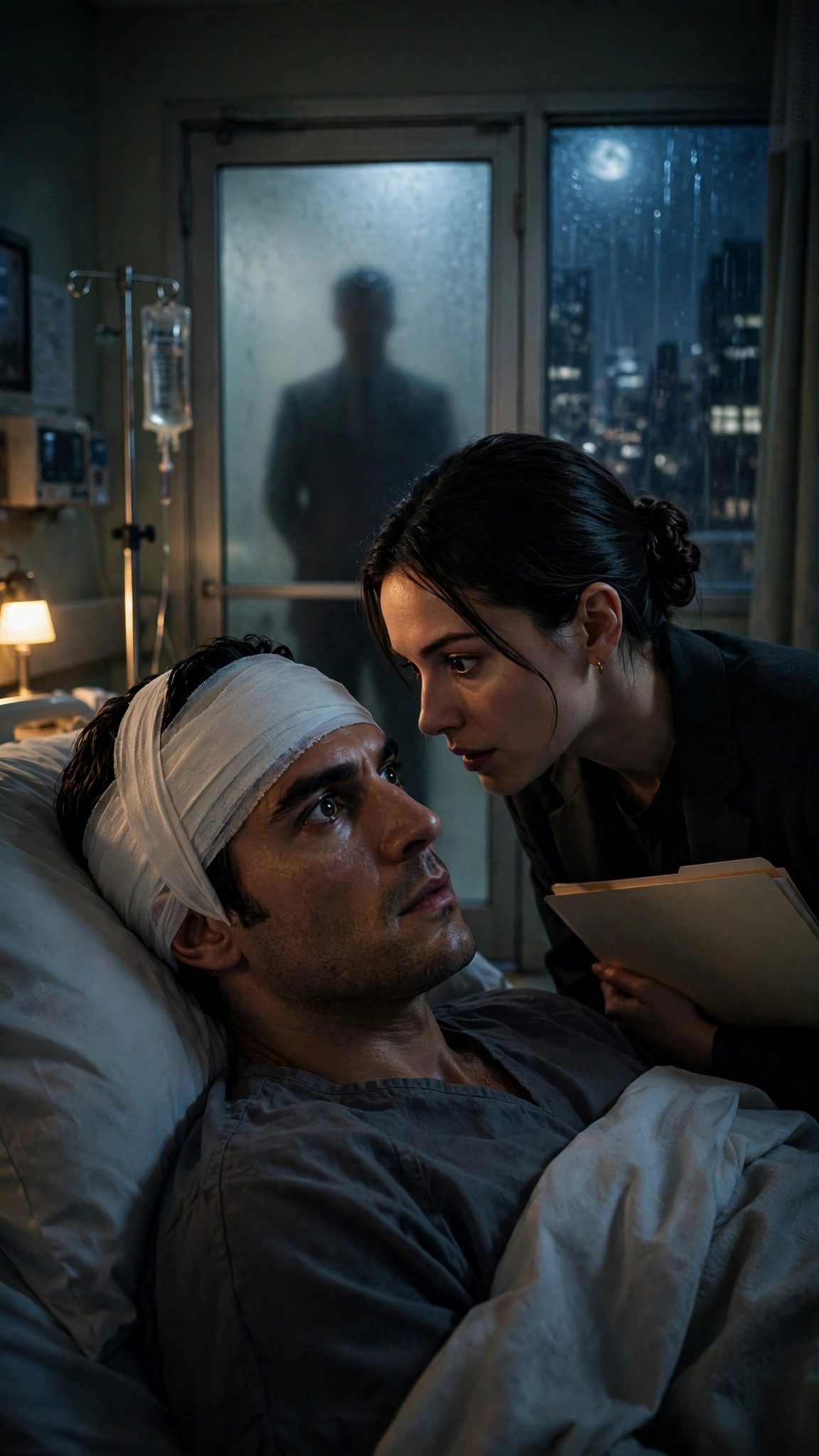
The second attempt came that night, and it came the way the first one had come: quietly, without announcement, wearing an ordinary coat and knocking on an ordinary door.
I was awake. I had not slept well since the shooting, and that night I did not sleep at all. I lay in the hospital bed with my eyes closed, listening to the sounds of the ward settling down for the night — the nurses' soft shoes, the carts rolling past, the faraway sound of an elevator — and I thought about Thursday, and Pier Nine, and the man with the briefcase who did not exist, and the woman who had told me she loved me, and the three men who had driven through the rain looking for things that were never there.
And I thought about the restaurant. I thought about it the way I had thought about it every night since the shooting, frame by frame, because a man who has been shot does not stop replaying the moment. The private room at Santoro's. The white cloth. The candles burning low. Sal's voice, talking about the shipping schedules, about the captains who were unhappy, about the men who thought the docks should stay the way they were. Marco near the door. The lights going out, all at once, not a flicker, the whole room going black the way a room goes black when someone throws a switch on purpose. The gunfire, flat and ugly in the dark. The glass exploding. Frankie shouting my name. The taste of copper in my mouth. The floor coming up to meet me, hard and cold, and Leo's voice cursing in Italian, and the smell of blood and wine, mixed together, the way they mix when a dinner becomes a crime scene.
I had replayed it a hundred times, and every time I replayed it, I came to the same conclusion: the shooter had known exactly where I would be sitting. He had fired in the dark, and he had still come within an inch of killing me. That was not luck. That was information. Someone had told him where the private room was, and where I sat, and when the lights would go out. Someone had drawn him a map of my death, and he had followed it almost all the way to the end.
The ward was quiet now. The nurses had finished their rounds. The carts had stopped rolling. Somewhere down the hall, a machine beeped, steady and patient, counting someone else's heartbeats. I listened to my own monitor, and to the rain that had started again outside the window, thin and cold against the glass, and I thought about the boy who would come tonight — because I knew someone would come tonight, I had known it since Emily told me about Sal's call, and I had told Marco to watch the door, and Marco had told Frankie, and Frankie had told the men in the hallway, and we were all waiting, in our own ways, for the second bullet to arrive.
At 2:14 in the morning, the door opened.
I did not open my eyes. I kept them closed, and I kept my breathing slow and even, the way a sleeping man breathes, and I listened.
Soft shoes. Not a nurse's shoes. Heavier. A man's shoes, moving carefully, the way a man moves when he does not want to be heard. The smell of disinfectant, and underneath it, something else — leather, and oil, and the cold metal smell of a gun that has been cleaned recently and oiled carefully.
A hand touched the IV line. A voice, low and calm, said, "Mr. Moretti?"
I did not answer. I kept my eyes closed, and I kept breathing, and I waited, because I had learned, a long time ago, that the most dangerous thing a man can do in a dark room is to let the other man know he is awake.
The hand moved from the IV line to the pillow. It lifted the edge of the pillow, just slightly, and I understood, in a single cold second, what was happening. He was going to smother me. Quietly. Without a shot. Without a sound. A man with a fractured skull, found dead in his hospital bed in the morning, and the doctors would call it a complication, and the police would call it a tragedy, and Castellano would call it finished.
I opened my eyes.
The man standing over my bed was not a nurse. He was not a doctor. He was a young man, maybe twenty-five, with a shaved head and a face I did not recognize, wearing a white orderly's uniform that did not fit him properly, the sleeves too short, the collar too tight, the way a uniform fits when it has been stolen from someone else.
He froze when he saw my eyes open. For one second, we looked at each other, and in that second I saw everything I needed to see: the fear in his face, the gun in his waistband, the way his hands were shaking, the way he had not expected me to be awake, because the men who sent him had told him I was a man with no memory, a man who would not fight back, a man who was already as good as dead.
"Don't," I said, very quietly, and my voice was my own voice, not the confused voice, not the pretending voice, but the voice of Vincent Moretti, the man who ran the family, the man who had survived nine years of men trying to kill him. "Don't do this. You do not want to do this."
He hesitated. His hands were still on the pillow, and I could see him deciding, the way a young man decides when he is in over his head and he knows it, and he is trying to find a way out that does not end with him in prison or in the ground.
Then the door opened again, and Marco was there.
Marco Benedetti, my right hand for eight years, standing in the doorway in his shirtsleeves, with his gun in his hand and his face like stone, and behind him, Frankie, and behind Frankie, two of my men, and behind them, Emily, standing in the hallway in her dark coat, holding the folder against her chest, watching everything with those eyes that missed nothing.
"Step away from the bed," Marco said, and his voice was very calm, the way a man's voice is calm when he has already decided what he is going to do. "Step away, and put your hands where I can see them, and do not reach for the gun, because if you reach for the gun, I will shoot you where you stand, and I will not miss."
The young man stepped away from the bed. His hands went up. They were shaking, badly, and I could see the tears in his eyes, and I understood, in that moment, that he was not a killer. He was a boy, sent by men who did not care whether he lived or died, to do a job he did not want to do, for money he would never live to spend.
"Who sent you?" Marco asked.
The boy did not answer. He looked at the floor, and his shoulders shook, and he said, in a voice so quiet I could barely hear it, "I don't know his name. A man in a black coat. He gave me five thousand dollars. He said the boss wouldn't wake up. He said it would be easy. He said no one would know."
He was crying now, openly, the way a young man cries when he has done something terrible and he knows it, and he cannot take it back, and he is waiting for someone to punish him.
"My mother is sick," he said, through the tears. "She needs medicine. It costs more than I make in a month. The man said five thousand dollars, cash, no questions. He said all I had to do was hold a pillow for one minute. He said the boss was already dying. He said I would not be killing anyone. He said I would be finishing something that was already finished."
Marco looked at me, and I looked at the boy, and I saw what he was: not a killer, not a soldier, not a man of the family. A kid from the Bronx with a sick mother and an empty wallet, who had been bought for five thousand dollars by a man in a black coat, the way you buy a tool you intend to throw away when you are done with it.
"What's your name?" I asked him, quietly, in my own voice, the way I would ask a man his name when I wanted to remember it.
"Danny," he said. "Danny Cole."
"Danny," I said, "listen to me. You are going to go with these men, and you are going to tell the police everything you just told me. The man in the black coat. The five thousand dollars. Your mother. All of it. And if you tell the truth, the law will help you. Agent Reyes will help you. Your mother will get her medicine. Do you understand?"
He nodded, wiping his face with the back of his hand, and I saw the relief flood through him, the way relief floods through a man who has been expecting a bullet and has been given a second chance instead.
"Castellano," Frankie said, from the doorway. "It has to be Castellano. The same man who paid for the shooting. The same man who is paying Sal."
Marco looked at me, and I looked at him, and in that look there was a whole conversation, the same conversation we had been having since the day I woke up: I know you are loyal. I know you are not the traitor. I know you would die for me, and I know you almost did, standing in that doorway with a gun in your hand.
"Take him to the police," I said, and my voice was steady, and it was my own voice, and I did not bother to pretend anymore, not in front of these people, not in front of Marco and Frankie and Emily, who all knew the truth already. "Take him to Agent Reyes. Tell him everything. Tell him about the five thousand dollars. Tell him about the man in the black coat. Tell him about Sal. And then come back here, because tomorrow is Thursday, and we have a meeting on Pier Nine."
Marco nodded, and he took the boy by the arm, gently, the way a man takes a prisoner who is more frightened than dangerous, and Frankie went with him, and the two men went with them, and Emily came into the room, and she sat down in the chair, and she looked at me, and she did not say anything for a long time.
Then she said, "You were awake."
"Yes," I said. "I was awake. I have been awake every night since the shooting. I have not slept. I have been listening. And tonight, I heard him coming, and I was ready."
She nodded, slowly, and she opened the folder, and she showed me the last page, and on it, in her small precise handwriting, was a note she had written that afternoon.
"Sal DeLuca called Tommy Falco at 4:30 p.m. He told him to go to the hospital tonight. He told him the boss would not wake up. He told him to make it look natural. I have the call. I have the time. I have everything."
She closed the folder and looked at me, and her eyes were steady, and her voice was calm, and she said the thing that mattered most.
"Tomorrow," she said. "Pier Nine. It is no longer just a trap, Vincent. It is a rescue. Sal tried to kill you twice, and he failed twice, and tomorrow, he is going to walk into a room full of law enforcement officers, and he is going to tell them everything, because he will have no other choice. And Castellano, who paid for all of it, is going to fall with him. And when it is over, you are going to walk out of this hospital, and you are going to tell the family the truth, and you are going to be the boss again."
I lay back against the pillows, and I closed my eyes, and for the first time since the shooting, I felt tired. Not the tiredness of a wounded man. The tiredness of a man who has been pretending for a long time, and who is finally, finally, almost done pretending.
"Emily," I said, without opening my eyes. "Stay."
"I am staying," she said. "I am not going anywhere. I told you that. And I meant it."
And she stayed, in the chair by the bed, with the folder on her lap, watching the door, while the hospital slept around us, and the city slept outside the window, and the man who had tried to kill me was on his way to the police, and the man who had paid him was sleeping in his own bed, believing that by tomorrow night, I would be dead.
A nurse came in an hour later, on her rounds, and she checked my bandage, and she checked the monitor, and she looked at Emily asleep in the chair, and she smiled, and she whispered, "She has not left your side all night. Not once. She is a good woman, Mr. Moretti. Hold on to her." And I nodded, because I already knew, and because I was already holding on, with everything I had.
He was wrong. Tomorrow night, he would be the one in handcuffs. And I would be the one walking out of the hospital, alive, with my memory intact, and a woman beside me who knew everything, and three loyal men behind me, and the law on my side.
The second bullet had missed, too. And this time, I was not going to pretend it had hit me.