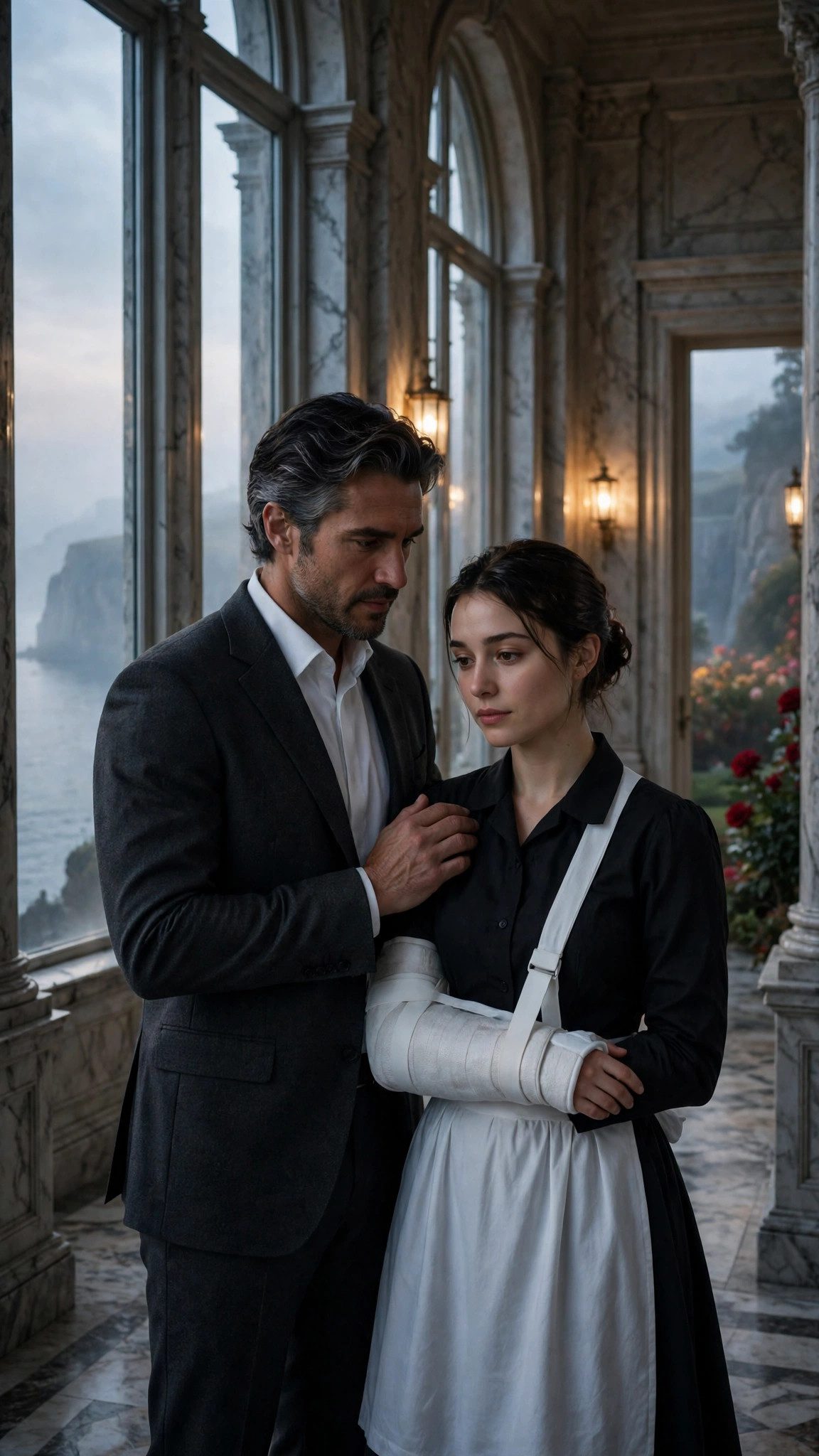
My mother, Grace Bennett, cleaned houses for twenty years, and she taught me everything I know about being invisible.
"People who pay for cleaning do not want to see the person who cleans," she told me when I was nine years old, and she was showing me how to fold a fitted sheet so that it lay flat in the linen closet. "They want to come home and find the house clean, as if the house cleaned itself. You are part of the house, Kate. You are like the pipes, or the wiring. You do your work, and you do not disturb them."
She said it without bitterness. That was the thing about my mother. She had no bitterness in her, even though she had spent her life on her knees in other people's kitchens, scrubbing other people's floors, folding other people's sheets. She tended broken people and hidden people for a living, and she did it with a kind of quiet dignity that I have never seen in anyone else, before or since.
My mother died when I was nineteen. It was her heart, the doctor said, worn out from twenty years of hard work and worry. She left me the two-bedroom apartment, and a box of her things, and a piece of advice that I have carried with me ever since: "Learn the house, Kate. A house will tell you everything you need to know about the people who live in it, if you know how to listen."
I married at twenty-two. His name was Tommy, and he worked on the docks, and he was kind in the way that young men are kind when they are in love and the world has not yet disappointed them. We were married for two years, and then a container fell from a crane on Pier Four, and Tommy was underneath it, and I was a widow at twenty-four.
After Tommy died, I cleaned houses, the way my mother had. I cleaned offices at night, and apartments in the morning, and I saved every dollar I could, and my uncle Ray, my mother's younger brother, a retired longshoreman with hands like rope, set aside a dollar bill for me every week, folded it small, and put it in a wooden box. "For emergencies," he said. "Everyone needs a box for emergencies."
By the time I was twenty-six, there were twenty-one folded dollar bills in that box, and I carried it with me every single day, in the bottom of my bag, because it was the only thing in the world that was truly mine, and because knowing it was there made me feel less alone.
The job at the Blackwell estate came through an agency. The pay was less than a thousand a week, but it was steady, and it came with a room in the staff wing, and Mrs. Calloway, the head housekeeper, told me on my first day that the work was hard but the house was quiet, and that if I did my job and kept my head down, I would be fine.
"The house is large," she said, showing me the corridors. "There are forty rooms. You will clean the ground floor, the library, the study, and the guest wing. You will not go into Mr. Blackwell's private rooms unless I tell you to. You will not speak to Mr. Blackwell unless he speaks to you first. You will not speak to his brother, Mr. Daniel, at all, unless he speaks to you, and if he does, you answer briefly and you leave."
She said all of this in the brisk, practical tone of a woman who had been running this house for thirty years, and I nodded and memorized every word, because I had spent my whole life memorizing the rules of other people's houses.
The estate was the most beautiful place I had ever seen. It stood on a cliff above the bay, a sprawling mansion of pale stone with tall windows and a garden full of roses, and from the terrace you could see the water stretching out to the horizon, and the boats moving slowly across it like toys. Inside, the floors were marble, and the ceilings were high, and the library had more books in it than I had ever seen in one place in my life.
But it was a cold house. Not cold in temperature — the heating worked perfectly, and the fires were always lit — but cold in the way that a house is cold when the people in it do not trust each other. The staff moved quietly through the corridors, and they did not talk more than they had to, and when one of the Blackwell men came down a hallway, everyone found a reason to be somewhere else.
In my first week, I learned the names of the staff, and I learned that none of the Blackwell men knew mine. To the cook, I was "the new girl." To the driver, I was "the maid." To Mrs. Calloway, I was "Kate," but only when no one else was listening. To everyone else in the house, I was invisible, and I had been trained since I was seven years old to be invisible, so I did not mind.
Or I told myself I did not mind.
The first time I saw Damon Blackwell, he was standing in a hallway talking to a man whose expensive suit had been ruined by gunpowder. The man's jacket was torn at the shoulder, and there was a dark stain on his sleeve, and he was talking fast, in a low voice, about a shipment and a warehouse and a man who had not paid. Damon listened without speaking, and his face gave nothing away, and when the man had finished, Damon said three words — "Fix it. Quietly." — and the man went away, and Damon stood there for a moment, looking at the wall, and then he turned and saw me.
I was holding a bucket and a mop, and I was frozen in the hallway, and I thought he would be angry that I had heard. But he only looked at me for a second, and then he looked away, as if I were part of the furniture, and he walked past me without a word.
That was how it was supposed to be. That was how my mother had taught me it would be. You are part of the house, Kate. You do your work, and you do not disturb them.
But that night, in my small room in the staff wing, I took the wooden box out of my bag, and I counted the twenty-one folded dollar bills, and I thought about my mother, and about Tommy, and about the fact that I was twenty-six years old and no one in the most beautiful house I had ever seen knew my name.
I did not know then that the house was about to learn it.
In my second week, I began to notice things. A house will tell you everything you need to know about the people who live in it, if you know how to listen, and I knew how to listen.
I noticed that the men who came to the house at night did not come through the front door. They came through the service entrance, after midnight, and they went to the boathouse, and they carried heavy chipboard boxes across the marble floor, and they left before dawn. I noticed that Mrs. Calloway left tea and sandwiches in the library at midnight, even though no one was supposed to be in the library at midnight. I noticed that Daniel Blackwell, Damon's younger brother, came to the house almost every day, and that the staff went quiet when he arrived, and that he looked at the maids the way a man looks at things he owns.
And I noticed Damon himself. I noticed that he ate alone, every night, in the dining room, at a table set for one, and that he read the newspaper while he ate, and that he never seemed to enjoy the food. I noticed that he walked the garden in the early morning, before anyone else was awake, and that he stopped at the rose beds, and that he touched the roses the way a man touches something that belongs to someone he has lost.
One afternoon, Mrs. Calloway brought me tea in the kitchen, and she sat down across from me, which she had never done before, and she looked at me for a long moment.
"You are a good worker, Kate," she said. "You are quiet, and you are careful, and you do not gossip. That is rare in this house."
"Thank you, Mrs. Calloway," I said.
"Be careful," she said, and her voice dropped lower. "This house is not what it seems. There are men here who do not belong to Mr. Damon, even though they wear his name. If you see something you should not see, you look away. Do you understand me?"
"I understand," I said. But I did not understand, not really. Not yet.
That same week, I was cleaning the library, and I found a photograph on the desk, half hidden under a stack of papers. It showed a woman with dark hair and a bright smile, standing in the garden among the roses, her arm around a younger Damon Blackwell, who was laughing. On the back, in faded ink, someone had written: "Marla, summer."
I put the photograph back where I had found it, and I did not mention it to anyone. But I thought about it for a long time afterward, because it was the first time I had seen Damon Blackwell smile, even in a photograph, and because the woman in the picture had looked at the camera the way a person looks at the camera when they believe they will be happy forever.
Later, I learned that Marla had been Damon's wife, and that she had died five years earlier, killed by a car bomb that had been meant for him. I learned that he had planted the roses in the garden for her, and that he walked among them every morning because it was the closest he could come to talking to her.
And I learned something else, too. I learned that the house had once known a woman's name, and that it had forgotten it when she died, and that ever since then, it had been a house full of people whose names nobody bothered to learn.
I did not know then that I would be the next name it learned. I only knew that I was the new girl, and that I carried a wooden box with twenty-one dollars in it, and that I was very good at being invisible.
On my third day at the estate, I met the only other maid close to my own age, a girl named Ana, who was nineteen and came from a village two hours up the coast, and who talked too much because she was nervous, and who told me, in a rush, on our lunch break in the staff kitchen, everything she had learned in her six months at the house.
"Do not go into the library after dark," Ana said, stirring sugar into her tea with great concentration. "Do not ask Mr. Daniel any questions. Do not wear perfume, because Mr. Victor hates perfume, and he will send you home. And do not, whatever you do, let them see you cry. If they see you cry, they will know you are afraid, and if they know you are afraid, they will use it."
"Use it how?" I asked.
Ana shrugged, and she looked down at her tea, and she said, "I do not know. I have never let them see me cry. That is my rule. I cry in the shower, where the water covers the sound."
I liked Ana. She was the first person in the house who had spoken to me as if I were a person and not a piece of furniture, and for a little while, on my lunch breaks, I did not feel quite so alone. But two weeks later, Ana was gone. Mrs. Calloway told us she had gone home to her village to take care of her mother, but I had seen Ana the day before she left, and she had not mentioned a sick mother, and her eyes had been red, and she had been carrying her bag as if she were running away.
I never saw her again. I never learned what happened to her. And I understood, then, what Ana had meant about crying in the shower, and about the house using your fear, and I made the same rule for myself: I would not cry where anyone could see me. I would not give the house anything it could use.
In the evenings, after my work was done, I sat in my small room and I took the wooden box out of my bag, and I opened it, and I counted the twenty-one folded dollar bills, one by one, and I thought about my uncle Ray, who had folded each one of them with his big, rough hands, and I thought about my mother, who had taught me to be invisible, and I wondered if she had ever been afraid, and if she had ever cried in the shower, and if she had ever wished that someone in one of those houses had asked her name.
Sometimes I wrote letters to Tommy in a notebook I kept under my mattress. I told him about the house, and the bay, and the roses, and the strange, cold feeling of the corridors, and I told him that I missed him, and that I was trying to be brave, and that I hoped he was proud of me. I never sent the letters, because there was nowhere to send them, but writing them made me feel less alone, and on the nights when the house was quiet and the wind came off the bay and rattled the windows, the letters were the only thing that kept me from feeling as if I had disappeared entirely.
It was a skill that was about to fail me, because in a house full of men who made people disappear, being invisible was the most dangerous thing a person could be.