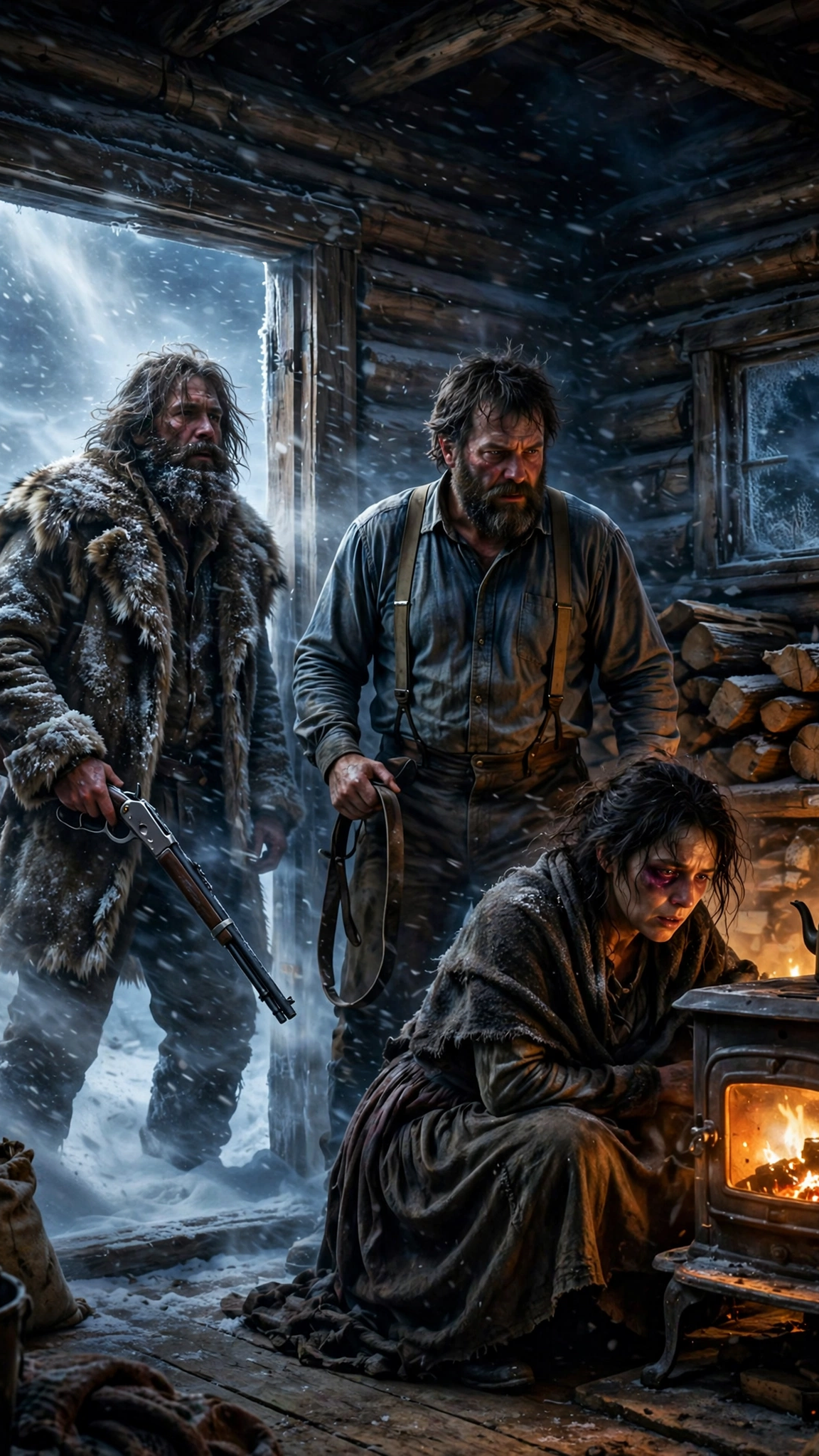
The storm broke at dawn, the way Harlon had said it would.
Hazel woke to a silence she did not recognize. The wind had stopped screaming. The walls had stopped groaning. The cabin was quiet, and through the frost-covered windows came a pale, cold light, and she sat up in her blanket by the stove, and she looked at the door, and she saw a thin line of white light around its edges, and she understood that the blizzard was over.
For now. Harlon had said they would have a day, maybe two, before the next one came. A day was enough. A day had to be enough.
She stood up. She folded the blanket. She went to the stove, and she put the coffee on, and she looked at Baron, still tied against the wall where Harlon had left him, asleep with his head tilted back and his mouth open, and she felt nothing at all when she looked at him. Not anger. Not fear. Not pity. Nothing. Three years, and this was what was left: nothing. And the nothing felt like freedom.
Harlon was already up. He had been up for an hour, she could tell — the fire was built up, the woodbox was full, the snow had been cleared from the doorway, and his pack was sitting by the door, lashed and ready. He was a man who did things before other people woke up, and who did not make a show of it.
"We leave at first light," he said. "That's now. The snow will be deep, but the crust will hold if we stay on the high ground. Six miles to the Odegards. We'll be there by noon if we don't stop."
Hazel nodded. She went to her mother's trunk at the foot of the bed. She opened it, and she took out the things that mattered: her mother's Bible, and the daguerreotype of her parents, and the silver hair combs, and the worn book of poems. She left the dresses — they were too heavy, and she was done carrying things that did not matter. She took the knife, too, the kitchen knife with the bone handle, and she tucked it into her shawl, not because she thought she would need it, but because it was hers, and because her father had used it to cut apples, and because some things you keep.
She took the salve from under the floorboard. She took the tin cup that had been her mother's. She put it all in a small sack, and she tied the sack shut, and she set it by the door, next to Harlon's pack, and she stood there for a moment, looking at the cabin, and she thought about the three years, and about the girl who had arrived here in a wagon, and about the woman who was leaving, and she felt the anger in her belly, hot and clean, and she felt the fear gone, and she felt ready.
Baron woke. He opened his eyes, and he saw Hazel standing by the door with her sack, and he saw Harlon standing by the stove with his pack, and he understood, all at once, what was happening, and his face went white, and then red, and he began to struggle against the ropes.
"Hazel," he said. "Hazel, wait. Wait. Please. Don't go. I'm sorry. I'm sorry for all of it. The beans. The wrist. All of it. I'm sorry. I'll change. I'll stop drinking. I'll be a good husband. Please. Don't leave me here."
Hazel looked at him. She had heard him say he was sorry before. She had heard it after the first blow, and after the second, and after the third, and after the wrist, and after every time, and every time it had been a lie, and every time she had believed it, because she had wanted to believe it.
She did not believe it now.
"You've said that before, Baron," she said, quietly. "You've said it a hundred times. And every time, you did it again. I don't believe you anymore. I don't think I ever really did. I think I just wanted to."
Baron's face changed. The begging went out of it, and something else came in, something cold and hard, and he said, "You'll die out there. The snow is four feet deep. The fort is forty miles. You'll die, and it'll be your own fault, and nobody will care."
"Maybe," Hazel said. "But I'll die free."
She turned away from him. She went to the door, and she put on her shawl, and she put on her boots, and she picked up her sack, and Harlon opened the door, and the cold air came in, sharp and clean, and the snow outside was white and blinding in the morning sun, and the world was wide and open, and Hazel stepped out of the cabin and into the snow, and she did not look back.
Behind her, Harlon stopped. He went back to Baron, and he untied the ropes — not all of them, just enough that Baron could work himself free in a few minutes — and he took the shells out of his coat pocket, and he set them on the table, next to the empty shotgun, and he looked at Baron, and he said, "Your shells. Your gun. Your house. All yours. A man who needs a gun to keep a woman is no man at all."
Baron stared at him. His hands were free now, and he rubbed his wrists, and his face was red, and his mouth was working, and he said, "I'll come after you. I'll come after both of you. She's my wife."
Harlon looked at him. His gray eyes were steady. His voice was calm. He said, "You come after us, Baron, and I'll put a hole through you. I told you that once. I meant it then. I mean it now."
He turned. He went out the door. He shut it behind him, and the cabin was quiet, and Baron sat on the floor with the ropes around his ankles and the shells on the table and the shotgun empty in his hands, and he listened to the footsteps going away through the snow, and he did not follow them.
Outside, Hazel stood in the snow, and the sun was bright, and the air was cold and clean, and Harlon came out of the cabin, and he took up his pack, and he looked at her, and he said, "The Odegards are six miles that way. We walk slow, and we stay on the high ground, and we don't stop until we get there. You ready?"
Hazel looked back at the cabin, one last time. She looked at the warped timber walls, and the frost-covered windows, and the woodbox by the door, and the smoke coming out of the chimney, and she thought about the three years, and about the girl who had arrived here, and about the woman who was leaving, and she said, "I'm ready."
They walked. The snow was deep, and the crust held, the way Harlon had said it would, and they walked slow and steady, and Harlon broke the trail, and Hazel followed in his footsteps, and the sun climbed higher, and the snow glittered, and the world was white and wide and open, and Hazel walked, and with every step, the cabin got smaller behind her, and the fear got smaller with it, and by the time they had gone a mile, she could barely see the cabin at all, and by the time they had gone two miles, it was gone, swallowed up by the snow and the distance, and she did not look back again.
At noon, they reached the Odegards.
Mrs. Odegard came to the door, and she saw Hazel, and she saw Harlon, and she saw the sack in Hazel's hand, and she understood, all at once, what had happened, and she did not ask any questions. She took Hazel inside, and she sat her down by the stove, and she gave her hot coffee, and she gave her bread, and she looked at her swollen eye, and she said, very quietly, "You did right, girl. You did right."
Hazel cried then. She had not cried in three years. She had refused to cry. But now, sitting by Mrs. Odegard's stove with hot coffee in her hands and bread on a plate in front of her, she cried, and Mrs. Odegard held her, and Harlon stood by the door with his hat in his hands, and the Odegard children peeked around the corner, and the cabin was warm, and the storm was over, and Hazel cried, and it felt like the first honest thing she had done in three years.
When she was done crying, she wiped her eyes, and she looked at Harlon, and she said, "Thank you."
Harlon nodded. He put his hat back on. He said, "We should keep moving. The fort is forty miles, and the weather won't hold forever. The Odegards will give you a bed for the night, if you want it. Or you can come with me. Your choice. No obligation. No price."
Hazel looked at Mrs. Odegard. She looked at the warm cabin, and the hot coffee, and the bread, and the children peeking around the corner. She looked at Harlon, standing by the door with his hat in his hands and his Winchester on his back.
She stood up. She picked up her sack. She said, "I'll come with you."
Mrs. Odegard nodded. She pressed a loaf of bread into Hazel's hands, and a small tin of salve, and she said, "You come back and see me sometime, girl. You hear? You come back and see me."
Hazel nodded. She went out the door, into the snow, with Harlon, and they walked on toward the fort, and the sun was bright, and the air was cold and clean, and the world was white and wide and open, and Hazel walked, and with every step, she felt a little lighter, and a little freer, and a little more like the girl she had been, before the wagon, before the wedding, before the cabin, before the three years.
Behind them, the Odegard cabin grew small, and the snow glittered, and the road stretched out ahead of them, forty miles to the fort, and Hazel walked, and Harlon walked beside her, and the storm was over, and the morning was bright, and everything was about to change.
—
The road to the fort took five days.
They walked in the mornings, when the snow was crusted hard and the sun was bright, and they camped at night by the fire, and Harlon taught Hazel how to build a fire in the snow, and how to read the weather in the clouds, and how to tell which way was north by the stars. He taught her the way a man teaches a person he respects — patiently, without condescension, as if she were capable of learning anything, which was a new thing for Hazel, who had spent three years being told she was capable of nothing.
At night, by the fire, they talked. Harlon told her about the trapping lines, about the beaver and the marten and the fox, about the winters in the high country, about the cabin he had built with his wife, and about the pine tree where he had buried her. Hazel told him about her father, and about the settlement, and about the book of poems her mother had given her, and about the girl she had been, before the wagon, before the wedding, before the cabin.
On the third night, it snowed again — not a blizzard, just a soft, steady snow that fell through the pines and covered the world in white. Harlon built a lean-to out of branches and a canvas tarp, and they sat under it by the fire, and Hazel read to him from her mother's book of poems, by the firelight, and her voice was shaky at first, because she had not read aloud in three years, but then it grew stronger, and Harlon listened, and he did not interrupt, and when she was finished, he said, "Your mother had good taste."
Hazel laughed. She had not laughed in three years. She had forgotten what it sounded like. It sounded strange, and rusty, and wonderful, and Harlon smiled — a real smile, the first she had seen from him — and the fire crackled, and the snow fell, and the world was quiet, and Hazel thought about the cabin, and about Baron, and about the belt on its nail, and she felt the anger in her belly, hot and clean, and she felt the fear gone, and she felt something else, something she had not felt in a very long time.
She felt hopeful.
On the fifth day, they reached the fort.
It was bigger than Hazel remembered — a sprawling collection of log buildings and corrals and wagons, with smoke coming out of a dozen chimneys and people moving in every direction, and the sound of hammers and voices and horses, and Hazel stood at the edge of it, and she felt overwhelmed, and Harlon put a hand on her shoulder, and he said, "It's a lot, I know. You'll get used to it."
He took her to the trader's store, and he sold his pelts — a season's worth of beaver and marten and fox, enough money to last a year — and he bought supplies: flour and coffee and salt and sugar and ammunition, and a new coat for Hazel, a good wool coat with a fur collar, and a pair of boots that fit her feet, and a hat, and gloves, and Hazel stood in the store in her new coat and her new boots, and she looked at herself in the trader's mirror, and she barely recognized the woman looking back at her.
Her eye was healing. The swelling was going down. Her hair was still tangled, but Mrs. Odegard had given her a comb, and she had combed it that morning, and it fell to her shoulders in dark waves, and her face was still pale and weathered, but there was something in her eyes that had not been there before — a light, a steadiness, a look that said: I am still here. I survived. I am still here.
Harlon watched her look at herself in the mirror, and he did not say anything, and then he said, "My cabin is two days north of here, in the high country. It's small, but it's warm, and the stove is good, and the roof doesn't leak. There's work to do — trapping, and tending the garden in the summer, and cutting wood in the fall. It's a hard life, but it's an honest one. You're welcome to come with me, if you want. No obligation. No price. Just a place to live, and work to do, and a fire to sit by."
Hazel looked at him. She looked at the store, and at the fort, and at the people moving in every direction, and at the mountains in the distance, white and high and clean, and she thought about the cabin, and about Baron, and about the three years, and about the girl she had been, and about the woman she had become, and she said, "Yes. I'll come with you."
Harlon nodded. He paid the trader. He loaded the supplies onto the mule. He helped Hazel up onto the wagon seat, and he climbed up beside her, and they drove out of the fort, north, toward the mountains, and the sun was bright, and the air was cold and clean, and the world was white and wide and open, and Hazel sat beside him, in her new coat and her new boots, with her mother's Bible in her sack and her father's knife in her shawl, and she looked at the mountains, and she thought about the future, and for the first time in three years, the future did not frighten her.
It excited her. And that, she thought, was the most hopeful thing of all.