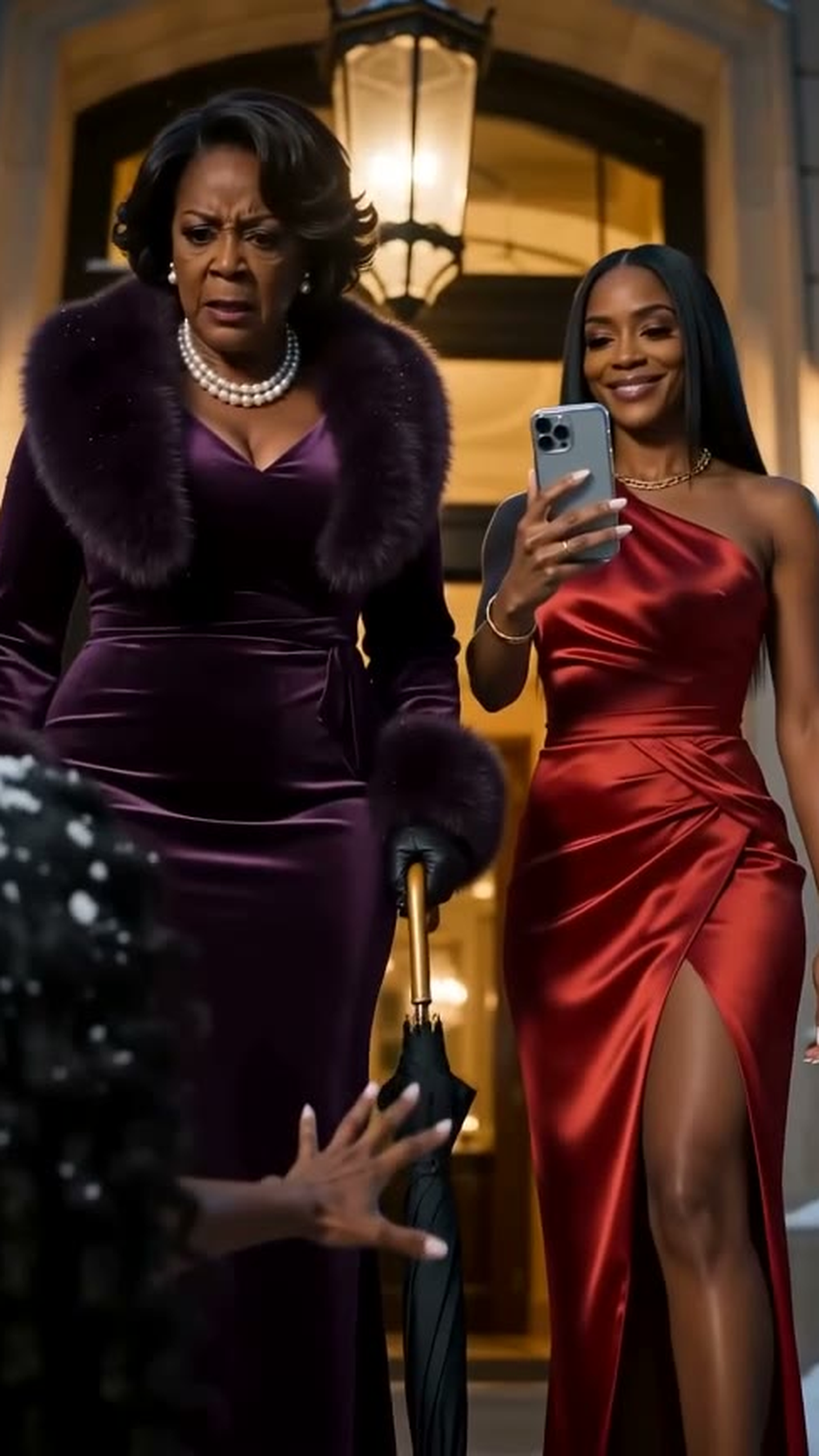
The competency hearing was held in a wood-paneled courtroom on the fourth floor of the county courthouse, and the Ashford family arrived to it the way they arrived everywhere: early, immaculate, and united.
Vivian sat at the petitioner's table in a black suit with her pearls, her face arranged into the exhausted sorrow of a mother asking the state to save her child from herself. Emma, in demure navy — someone had dressed her down for court, Tessa noted, and it almost worked — kept her eyes lowered and her phone nowhere in sight. Richard sat behind them in the gallery's first row, a man attending his own haunting. Their legal team occupied two tables: three partners from the city's oldest firm, men who had closed deals and buried stories for the Ashfords for decades, led by a silver-haired litigator named Prescott Hale, who had the manner of a man who had never lost an argument he couldn't buy.
The family's case was a cathedral of concern. Their physician testified — smoothly, sadly — to Tessa's "escalating instability," her paranoia, her "fixations" on imaginary financial wrongdoing. A foundation executive described finding her weeping in her office. Emma, called as a witness, cried on cue, real tears, beautifully lit by the courtroom's high windows: "She attacked my mother in the street. She was screaming. We tried to help her, we tried to get her into the car to take her somewhere safe, and she ran. We searched all night. I have the video, I was filming because I was scared, I didn't know what else to do—"
It was, Tessa thought, sitting beside Bridget at the respondent's table with her bandaged hands folded, a genuinely magnificent performance. In another life her sister could have had a career that wasn't built on other people's pain. Prescott Hale rose for his closing flourish, voice pitched to the judge's conscience: "Your Honor, this is a sick young woman being exploited by an attorney who stands to gain—"
"Your Honor." Bridget Colton stood. She did not raise her voice. She had the particular calm of a person holding four aces and no further need of theatre. "The petitioners have presented a video. We'd like to present the rest of it."
The courtroom screen lit.
Bridget played Emma's video first — the family's exhibit, the thirty seconds the city's charity circle had whispered over: Tessa wild on the pavement, reaching, incoherent, a madwoman in a silver dress. She let it run to its end. She let the silence sit.
"That video," Bridget said, "was recorded by the witness, Emma Ashford, on her phone. It is a clip. It begins twenty seconds after the events it purports to describe, and it ends before the alley. The full record of that night was preserved by the Ashford Sterling Hotel's own security system, and provided to law enforcement by my client's evidence — evidence the petitioners dumped her in a freezing alley to suppress. Your Honor, with the court's permission — the unedited camera."
What the courtroom watched then, in silence so complete that the radiator's ticking sounded like a clock in an empty house, was the whole of it: the side door, the ice, the umbrella striking the stone beside a reaching hand, the grip, the fall, the father's turned back, the SUV, the dragging feet. And Emma — smiling, stepping backward, keeping her sister in frame like a director.
When it ended, Vivian Ashford's face had the stillness of a portrait whose subject has died.
"The state," said Detective Cole Voss, called next, in the flat voice of a man reading weather, "has opened a criminal investigation into the petitioners, encompassing conspiracy, assault, unlawful imprisonment, attempted involuntary commitment by fraud, and financial crimes against the Ashford Foundation totaling at minimum six point four million dollars, currently under review by the attorney general and the Federal Bureau of Investigation. The psychiatric evaluation request submitted by the petitioners is, in the state's assessment, an overt act in that conspiracy, intended to render the victim incompetent to testify." He looked at the judge. "The state opposes this petition in the strongest terms. The only danger Miss Ashford presents, Your Honor, is to the people who filed it."
Before the video, though, Bridget had done something quieter, and in its way crueler: she had cross-examined Emma.
It was the family's own strategy that put Emma on the stand — their narrative needed the frightened sister, the witness with the phone — and Bridget rose to meet her with a gentleness that the courtroom, at first, mistook for weakness. She established the phone. She established the filming. She established, with Emma's eager agreement, that Emma had recorded because she was frightened of what her sister might do.
"Miss Ashford, in your statement to police, you said your sister, quote, 'attacked your mother in the street and ran screaming into the night.' Do I have that right?"
"Yes," Emma said, and dabbed her eyes. "It was terrifying."
"And you filmed because you were frightened."
"Yes."
"Miss Ashford, how long have you had the video on your phone set to record in slow motion?"
The courtroom's silence changed quality. Emma blinked. "I— what?"
"The metadata, Miss Ashford. Your phone records its settings. At 11:47 p.m., four minutes before the events outside the hotel, you opened your camera application and selected slow-motion capture. You adjusted the exposure. You'd practiced the framing — there's a deleted test clip, same angle, timestamped 11:49." Bridget's voice never rose; it descended, almost to kindness. "People who are frightened press record, Miss Ashford. They don't art-direct. When did you decide to film your sister's breakdown — before or after your mother told you there would be one?"
Emma looked at her mother's table. Vivian did not look back. It was a small thing — a quarter-second of a daughter searching a mother's face for rescue and finding a stranger doing arithmetic — but it was the moment the cathedral fell, before any video played, because everyone in the room had children or had been one, and everyone understood what they had just seen: the second daughter learning, in public, the lesson the first daughter had learned on the ice. That in that family, love was not a fact. It was a budget. And the budget could be cut.
Emma did not answer the question. Her counsel objected; the judge sustained; it did not matter in the slightest. Bridget said, "No further questions," and sat down, and the foundation executive in the third row was seen, by three reporters, to quietly leave the courtroom and place a phone call, and the empire — which had survived markets, scandals, and one fire — did not survive the afternoon.
The judge denied the petition in eleven minutes. She denied it with prejudice, in language that made Prescott Hale study his hands, and she referred the family's physician for perjury review before anyone had finished standing up.
On the courthouse steps, in the raw wind, a reporter put a microphone in front of Tessa — she walked slowly, on Bridget's arm, her ribs taped, her face still carrying the faint yellow geography of old bruises — and asked the question the whole city was asking: What do you want to happen to your mother?
It was the sound bite the evening news was starving for, and Tessa knew it, and knew as well that her answer would be played at the trial, and clipped, and captioned, and fed into the machine that had already begun turning her into a character again — the avenging daughter now, in place of the mad one. She thought about the portrait. She thought about the woman in purple on the ice, and the same woman in grey being led to a car, and the distance between those two images, which her whole life had traveled.
"I want the foundation's money back," she said. "I want Dwayne Pell to sleep in his own house without checking the street. I want the students who got letters to get their scholarships. After that—" she shook her head, once, and the wind took her hair — "my mother is the state's problem now. She stopped being mine on the ice. That's the truest thing I know how to say."
Inside the car, with the door shut on the noise, Bridget exhaled for what sounded like the first time in three days. "That," she said, "is going to lead every broadcast in the state."
"I didn't say it for them."
"No," Bridget agreed, starting the engine. "That's why it works." She pulled into traffic, past the courthouse, past the first raw headlines scrolling on a news van's monitor. "You know there's a year of this ahead. Grand juries. Motions. Your sister's lawyers, your father's. The board. The money, getting it back one frozen account at a time. It will be slow and it will be ugly and there will be days you wish you'd let the petition go through and taken the quiet room and the sedation."
"I know," Tessa said. She watched the city go by, grey and bright. "Let them take the year. I have the rest of my life to be believed in." And she settled back against the seat, carefully, around the ribs, and closed her eyes — not sleeping, just resting inside the first hour in thirty years in which no one, anywhere, was editing her.
What happened outside the courtroom happened fast, because the press had been in the gallery and the video had been in open court. Vivian Ashford was arrested that evening at the house on Regent Street — not dramatically, not in purple, in a grey coat, saying nothing, with the dignity of a woman who has decided that silence is the last luxury she owns. The foundation's board, convening in emergency session, voted unanimously to suspend her, freeze the accounts, and cooperate fully; the empire, that great careful machine, did what machines do and turned, without sentiment, to protect itself. Emma was charged with obstruction, conspiracy, and evidence tampering — her smile, replayed on every channel in the city, had made her the face of it, and there was a grim symmetry in that which Tessa took no pleasure in. None. That was the worst of it, later: how little pleasure there was in any of it.
And Richard.
Her father came to Tessa's hospital room — she had been kept one more night for observation, the doctors watching the tremor in her hands — on the evening after the hearing, and he stood in the doorway in his charcoal coat with his hat in his hands, looking twenty years older than the man in the golden doorway, and he said the words he had not said on the pavement.
"I saw you," he said. "On the ice. I saw you reach for your sister. I saw your mother—" His voice broke, unbeautifully, a sound she had never heard him make. "And I turned around and went inside where it was warm. I have told the detectives everything, Tessa. All of it. The accounts too — what I knew of them, God forgive me, what I chose to suspect and not know. I will testify. It won't undo— I know it won't undo—"
"No," Tessa said gently. "It won't."
He nodded, accepting it like a sentence, which it was. "Your mother told me that night that you were ill," he said. "I wanted to believe her. Believing her was warm. You were lying on the ice, and believing her was warm." He put the hat down, slowly, as if it weighed a great deal, and left it there, and went out of the room and out of the family's story, into whatever remained of his.
Tessa lay in the white room that night with the window open a crack to the cold, clean air, and listened to the city, and thought about empires: how they are built, how they rot, how a woman can raise one like a cathedral and a child like a stranger in the same lifetime. The drive was in evidence now, its contents multiplying through agencies and servers, unkillable. Her mother had spent forty years building something that could not be questioned.
Tessa had ended it with one word, whispered from a hospital bed.
But an ending, she was beginning to understand, is just a beginning wearing black. The question — the last question, the one waiting on the other side of all this ruin — was what she intended to build on the ground her mother had salted.